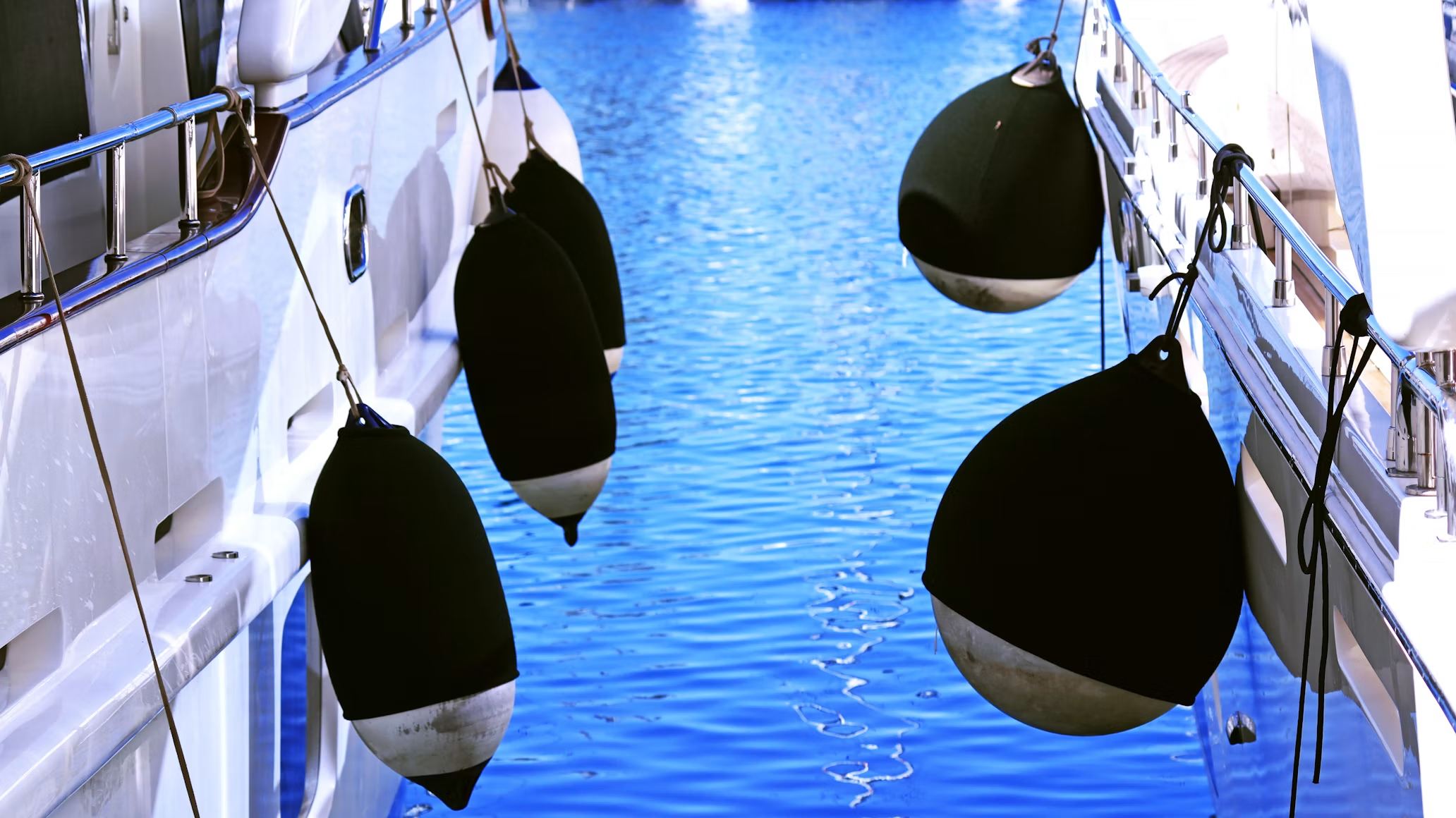
From above, a row of fenders can look continuous. Sight along the outside of a hull and the gaps become more apparent: the widest section is protected, but the shoulder of the bow could still meet another vessel first if the approach becomes oblique. Catamaran fender placement in the Panama Canal begins with that difference between looking prepared and protecting the surface that will actually touch. A fender works only where it remains between the yacht and the thing pressing towards it.
For Discovery, our 2025 Lagoon Eighty2, the canal belongs to the planned route of the Naora Global Expedition. We cannot responsibly fix the final arrangement of fenders before the transit position is assigned. What we can prepare is the equipment, the attachment points, the clear working space and the ability to change the arrangement without improvising under load. Sven, Naora’s founder and captain, will have to see the whole yacht. The people tending the sides will have to notice details that are difficult to see from the helm.
Catamaran Fender Placement Starts With The Assigned Position
The first decision is not how many fenders to hang. It is what Discovery will be held beside, and how her position will be controlled. A yacht kept in the centre of a chamber by lines has a different exposure from one secured alongside another vessel or a wall. A centre-chamber arrangement can also involve a raft of vessels, in which case the raft is held clear of the concrete while neighbouring hulls remain close together. Protection against a possible approach to a wall and protection at a continuous alongside contact are different jobs.
These are arrangements to understand, not choices we can assume will be offered to Discovery. Her particular requirements, including lines, line handlers, transit personnel and permitted configuration, must be confirmed for the vessel. Instructions written around a smaller cruising yacht cannot simply be enlarged by buying larger fenders. The geometry, mass and working loads have changed as well.
The original lock chambers have usable dimensions of approximately 305 metres in length and 33.5 metres in width. Those dimensions describe the chamber, not the space available to manoeuvre. Other vessels, their assigned positions and the lines crossing the water determine the room that matters. A long stretch of visible concrete can make the setting feel spacious while the useful clearance beside a hull is quite small.
Our preparation therefore has to cover both sides, even if one side is expected to do most of the work. That means keeping suitable fenders and their suspension lines accessible, rather than burying the spare equipment beneath everything already deployed. The final check comes against the actual neighbouring surface. An arrangement that made sense while waiting may need adjustment when the other vessel’s rubbing band, deck edge or bow shape comes into view.
Two Hulls And A Changing Point Of Contact
A catamaran does not have one continuous underwater body beneath its deck. Its two hulls occupy the outer edges of a broad platform, and a force applied near one edge can turn the whole yacht. The practical consequence is easy to miss when attention settles on the nearest fender. A movement that opens the gap at one bow can close it at the opposite quarter. Someone watching only the side under immediate pressure may not see the next contact developing.
The useful inspection is an outline of the whole boat, viewed against the likely neighbouring surface. We need to establish which part would touch first if Discovery moved sideways, which part would touch if she turned slightly, and what would become exposed if the adjacent vessel moved forward or aft. The widest part of the hull is important, but it is not the only part worth protecting. Bow shoulders, aft corners and any projection outside the hull’s smooth profile deserve separate attention.
That does not mean hanging equipment indiscriminately along every metre. A fender too far forward on a narrowing bow may swing into empty space while a less conspicuous section farther aft carries the contact. A fender near a stern must remain clear of propulsion and steering equipment. Protection that can fall into the water and become an obstruction has introduced a different risk.
Discovery’s twin engines offer useful control at low speed, but propulsion cannot substitute for a sound alongside arrangement. Once vessels are secured together, an engine movement affects more than our own position. It may change the load in a spring line or turn the neighbouring boat. Any such movement has to belong to the agreed manoeuvre. The quiet discipline is to recognise when the yacht is being controlled as part of a larger assembly rather than as an independent boat.
Catamaran Fender Placement At The Contact Height
Fender height is measured against the object that might strike the hull, not against a pleasing line along the deck. The useful part of an inflated fender is its body, where it has room to compress. If the neighbouring rubbing band bears near the tapered end or the attachment eye, the fender can be displaced rather than compressed. Hanging it lower does not automatically improve matters. A partly floating fender can lift or swing away from the contact it was intended to cover.
Alongside another vessel, the inspection has to include both boats. A strong rubbing band on one may align with a vulnerable fitting on the other. Different freeboards can place a deck edge above the area protected by a low fender. Both vessels can look well supplied with equipment and still present an unsuitable contact. If the geometry cannot be made safe, the issue needs to be raised before the boats are pressed together. Another fender is not an answer to every mismatch.
There is an important distinction between the water rising and the contact height changing. Two floating vessels generally rise together as a lock fills. Their relative freeboards do not change simply because the chamber water level changes. A wall is different: the yacht passes vertically along a fixed surface, encountering different patches, joints or projections. It is the relationship between the surfaces that determines whether a fender needs adjustment, not the sight of the water climbing the concrete.
Long cylindrical fenders can protect a useful vertical band. Larger round fenders can provide substantial separation at a particular contact. Neither shape is universally better. Selection depends on the surfaces, the expected movement and whether the fender will stay where it is needed. Even a generous fender can roll or be squeezed out when the two hull shapes form a wedge.
The suspension line also needs thought. It must hold the chosen height without slipping, allow adjustment from a safe position and avoid obstructing the lines controlling the yacht. Its attachment must be suitable for the pull of a fender that could become trapped, rather than casually transferring that load into a guardwire. We would make a height adjustment while there is clearance, or after the contact has been safely unloaded. A hand does not belong in the narrowing space between hull and neighbour.
Fender Compression And Closing Speed
A fender is an energy absorber with a limited amount of travel. It deforms as the gap closes, taking up energy before hard surfaces meet. Once it has been compressed beyond its useful working range, its presence offers much less reassurance than its appearance. The important observation is therefore not simply that a fender remains visible. It is whether it still has room to work.
For the same effective moving mass, doubling the relative closing speed means four times the kinetic energy must be absorbed. That relationship explains why controlling movement early matters more than trying to solve the final approach with extra equipment. It is the relative speed between the surfaces that counts. A yacht can appear almost stationary against the chamber while another vessel is moving towards her.
Nor can we assume that a row of identical fenders shares the load equally. Hull curvature may bring one into contact before the others. A neighbouring rubbing band may bear heavily on a single point. The first fender then compresses while several others remain largely idle. Watching the shape of the working fender tells us something that counting the total cannot.
There is a credible argument for generous fendering in a canal, and we share it. The limit is that more equipment can also conceal the hull, foul a line lead or make it harder to move a spare where it is actually needed. Inflation must follow the fender’s specification, not the assumption that harder means safer. Readiness lies in enough suitable protection, correctly positioned, with someone still able to see what it is doing.
Line Leads As The Water Rises And Falls
The canal carries vessels to a lake-level channel roughly 26 metres above the sea, although the actual level varies. That change occurs through successive lock operations, not one uninterrupted lift. For a line handler, the useful fact is that the shore attachment remains fixed while the boat changes height. The line’s angle and the distance between its endpoints change throughout the operation.
With the usual lead to an attachment above the yacht, rising water shortens that distance and creates slack unless the line is taken in. Descending water increases the distance and requires line to be paid out. The precise handling follows the assigned arrangement and the directions for the transit. A line left slack can allow movement followed by a sharp arrest. A line that cannot run when the yacht descends can impose severe vertical loads on the fitting and the boat.
The angle matters independently of the line’s apparent tightness. At 45 degrees above horizontal, about 71 percent of the tension acts horizontally. At 60 degrees, only half does. The rest acts vertically. Those figures do not provide a target tension for the crew. They explain why a steep line cannot be judged by the same visual impression as a nearly horizontal one, and why taking more strain can put substantial load into a cleat without producing an equivalent increase in sideways restraint.
The lead across the deck deserves the same attention. A line must reach a suitable strong point without bearing on a stanchion, catching a locker lid or sawing across an unsuitable edge. Chafe protection belongs where movement under load is expected, but wrapping a bad lead does not make it a good one. The load path has to make sense all the way from the external attachment to the yacht’s structure.
In a raft, the lines holding neighbouring boats together have a different function from the lines holding the raft in the chamber. Springs control fore-and-aft movement between the boats. Other connecting lines limit separation and help maintain alignment. Their arrangement must allow the fenders to remain between appropriate surfaces rather than pulling one vessel’s bow into another’s unprotected quarter.
This is also where fender lines and transit lines must be kept distinct. A working line led across a fender can drag it away from the contact point or trap its suspension. A fender hung from a fitting needed for line handling can obstruct the very action that would relieve the pressure. Before any load comes on, we need to see an unobstructed route for each line and sufficient clear deck for its tail to run.
Hands, Calls And The Space Around A Loaded Line
Inside a lock, engine noise reflected from concrete can make a short distance feel acoustically crowded. Water moves against the hull; someone looking down the side may be facing away from the helm. This is where an elaborate instruction becomes less useful than an agreed vocabulary. A report should identify the place and the condition: which side, bow or stern, a closing gap, a fender moving out, a line unable to run. The report needs acknowledgement, not an assumption that it was heard.
For Discovery, we will establish observation positions and handling responsibilities before entering the working sequence. The person responsible for a line must know who gives the instruction to alter it. The person watching a contact point must be able to report without leaving their own footing or reaching outside the guardrails. Sven needs information early enough to act on the developing geometry, rather than a shout after the gap has disappeared.
Wet rope can lie quietly on deck until a loose bight starts to narrow. That movement may be the first visible sign that the load is changing. Feet stay out of bights, hands stay clear of the cleat as the line comes under strain, and nobody stands in a position from which a running line could trap them. A loaded rope can recoil along a path altered by its lead or a failed fitting. There is no safe habit of standing close simply because nothing has moved yet.
Heat adds a less visible demand. Sun reflected from the deck, warm air against the wall and the repeated effort of handling wet line can erode attention without producing a dramatic moment. Drinking water and arranging relief during a suitable pause are part of maintaining the watch on the contact points. A tired person is more likely to stop looking beyond the fender directly in front of them.
Guests do not need to become spare line handlers because the setting is interesting. Their place during the working sequence should be clear, out of the leads and with room for the crew to move. Participation, if appropriate, must be agreed and briefed beforehand. Nobody should discover a responsibility at the moment a rope tightens.
The Check Before The Next Contact
When a lock operation ends, the equipment has not necessarily returned to the condition in which it began. A fender may have ridden up. A suspension line may have shifted. A shore line may have developed a damaged patch where it travelled through a fairlead. Before the next movement, the inspection needs to follow what has actually carried load, including sections that were hidden while the boats were together.
That check is also a chance to reconsider placement. A position that worked against one vessel or one surface is evidence about that contact, not proof that it will work everywhere else. If the assigned arrangement changes, the protection and line leads must be assessed again. After the transit, cleaning, drying and examining the gear will show more than a quick glance at equipment still wet and under tension.
The view from the helm cannot contain every small movement along two hulls. Somewhere below that view, a fender will be compressing, holding its place or beginning to escape it. That is where our attention has to remain. The useful detail is a little uncompressed space still left between the rubber and the hard surfaces on either side.