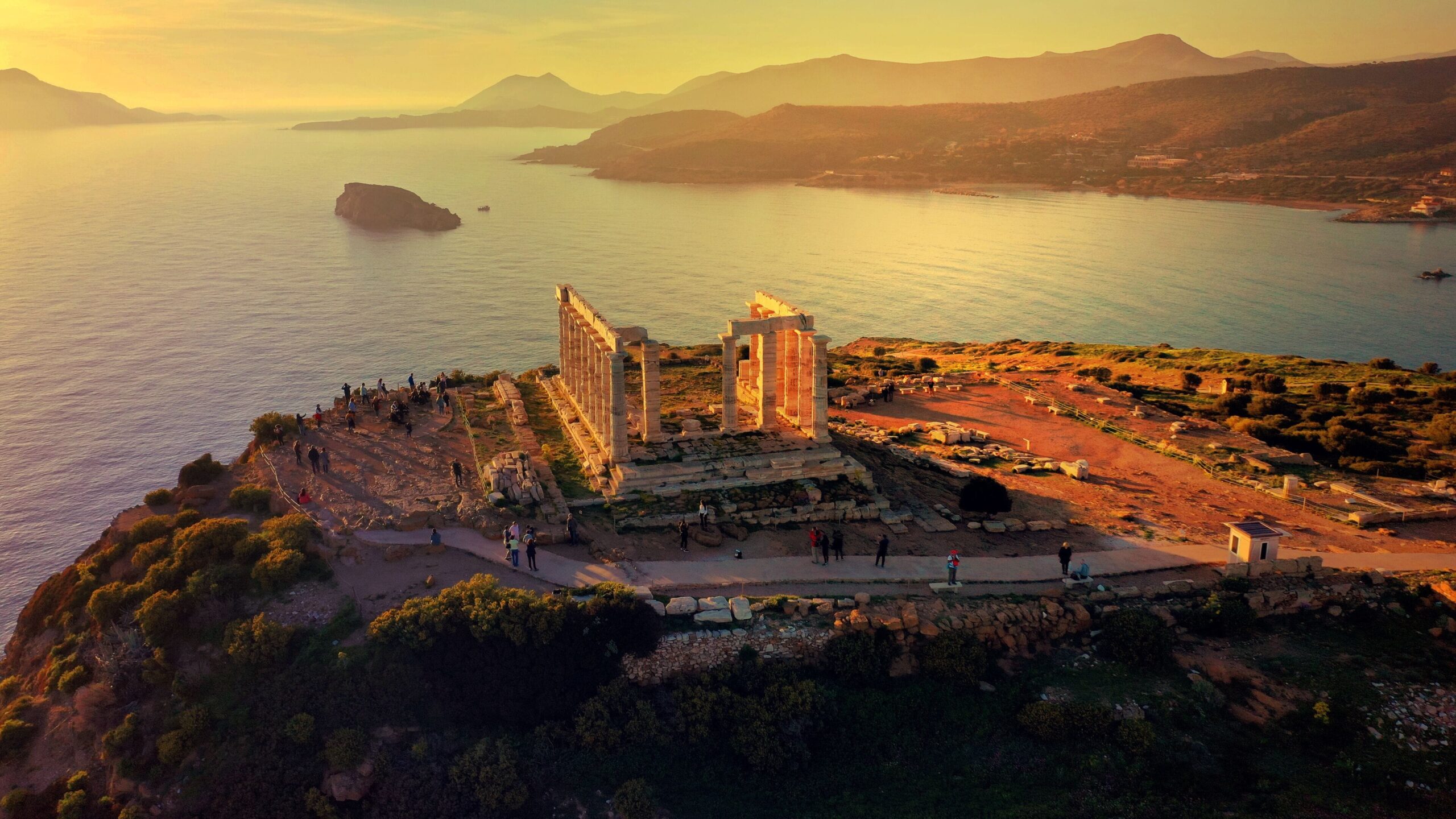
In low evening light, the gaps between the columns at Cape Sounion can be as striking as the marble itself. Sky appears between the uprights, and what first looked like a pale mark on the headland resolves into a building. From the water, you see its position before you see its detail. The temple stands where anyone rounding the southern end of Attica must understand the shape of the coast.
That is the part of Sounion we find most compelling. The sunset is beautiful, but arriving under sail gives the place another dimension. Before there can be an evening among the columns, there is a headland to round, a forecast to interpret and a decision about whether the bay below offers shelter for the time we intend to stay.
The practical work belongs to the experience. A sanctuary dedicated to Poseidon becomes more intelligible when the sea still has a say in your visit.
The Approach To Cape Sounion
Cape Sounion marks the southern tip of Attica and the eastern entrance to the Saronic Gulf. Athens and Piraeus lie beyond it to the northwest. The open Aegean lies to the east, with water extending south beyond the cape. It is a turning point in the coastline, rather than a harbour entrance: rounding it changes your exposure, but does not automatically put you in protected water.
The distinction matters aboard. A headland can hide the sea state on its other side, and a smooth-looking patch close to land may be only a small area of shelter within a much less comfortable approach. We want to understand what happens beyond the visible corner before committing to it, especially if the remaining daylight is becoming short.
The temple is a useful visual reference, not a substitute for navigation. Its height makes it conspicuous without telling us how far the underwater hazards extend. The chart, position, sounder and an attentive lookout each answer different questions. Agreement between them is reassuring; disagreement is something to resolve while there is still room.
This is also a working coast on the approach to a major port. The ancient skyline does not remove the need to watch commercial traffic or judge a developing crossing situation. We would rather have the sails and approach settled early than divide attention between a manoeuvre, another vessel and the first clear view of the columns. There is more pleasure in looking when the boat is already in good order.
A Sanctuary Above A Working Sea
The surviving marble Temple of Poseidon was built around 440 BC, during the great building period of classical Athens. It stands roughly 60 metres above the sea, high enough for the sanctuary to announce itself well before an approaching sailor could distinguish its architectural details. The height was part of its presence in a maritime landscape.
Athens depended on ships for trade, supplies and naval power. A sanctuary at this threshold therefore belonged to the city’s practical geography as well as its religious life. Poseidon was associated with the sea and with earthquakes, forces that could unsettle the apparent security of human arrangements. Here, that association needs little explanation.
The original outer colonnade had six columns across each end and thirteen along each side, making thirty-four columns once the shared corners are counted correctly. Knowing that arrangement gives the remaining structure a different clarity. Instead of looking at isolated survivors, you can begin to reconstruct the perimeter and imagine the enclosed temple within it.
Doric architecture rewards this kind of patient looking. The capitals are comparatively restrained, the columns fluted, the rhythm established by the relationship between solid stone and open space. Low light helps reveal the fluting because the grooves hold shadows while their edges remain bright. You do not need to identify every architectural term to see how carefully the building was proportioned.
The marble came from nearby quarries in Attica. That local material ties the sanctuary to the land beneath it, even though its most powerful relationship is with the water. The setting sun illuminates the ruin; it does not, by itself, explain why the sanctuary was built here.
Reading The Wind Before Choosing The Bay
In summer, the meltemi is central to sailing this part of the Aegean. These northerly winds are generally most persistent in July and August, although their strength and duration vary between weather patterns. A clear sky is entirely compatible with demanding sailing conditions. Sunshine tells us very little about whether an anchorage will remain comfortable.
Nor do we assume that a strong northerly will stop at sunset. Local heating can influence the day’s wind, but the larger pressure pattern can sustain it through the night. An evening ashore is planned against the forecast for the whole absence from the yacht, including the return, rather than against the pleasant interval in which someone first suggests going up to the temple.
Headlands complicate that forecast at boat level. Wind can accelerate around an exposed point, and land can produce gusts and disturbed flow on its sheltered side. Swell behaves differently again, sometimes bending around the cape into water that is protected from the direct wind. A quiet anemometer reading does not guarantee a quiet tender landing.
With southerly weather, the bay below Sounion becomes a different proposition. Wind and sea can enter the opening, and the shore that looked reassuring becomes the direction towards which the boat is being pressed. The decision may be to pass the cape without stopping. That is preferable to making a marginal anchorage work because sunset has acquired the weight of an appointment.
Tidal rise and fall here are generally modest compared with an Atlantic harbour, but modest tides do not mean motionless water. Wind-driven changes in level and local flow still deserve attention. We read the water we have, not the reputation of the sea we are in.
Holding Ground Beneath The Headland
The bay immediately west of the promontory is a possible anchorage for a temple visit in suitable conditions. It can offer shelter from northerly weather, while remaining exposed to southerly wind and swell. That description is a starting point, not an assurance. The usable part of the bay depends on the weather, other boats, permitted anchoring areas and the room needed by the yacht.
We look for clear sand rather than treating the seabed as uniform. Weed and seagrass can obscure the bottom, compromise an anchor’s set and suffer damage from both the anchor and its chain. A pale patch seen through the water is a candidate to investigate, not proof of good holding. The choice has to make sense on the chart, through the sounder and in what can actually be observed.
Depth matters through its relationship with the anchoring system. The relevant vertical distance runs from the seabed to the bow roller, not merely from the seabed to the waterline. The sounder’s reference point also needs to be understood. Those differences affect the amount of rode deployed and, in turn, the space through which the yacht may swing.
Discovery has a broad platform, but stability at rest does not cancel wind load. We allow for the yacht’s windage, the expected gusts and a possible change of direction. Swing room includes the hull beyond the rode, and neighbouring boats may move on different arcs.
After deployment, the anchor must be set and its holding checked under controlled load. We watch position against fixed references and allow time to establish that the boat is genuinely settled. An anchor alarm adds another layer of attention; it does not establish holding by itself.
This is where an apparently easy evening earns its ease. If the position is doubtful, we reset or leave before anyone is ashore. The view is never improved by having to worry about the boat beneath it.
Going Ashore At Cape Sounion
The shore transfer and the walk need to be considered separately. A short distance on a map does not establish a safe landing, and landing below the headland does not mean that the archaeological entrance lies directly above it. We establish where the tender may come ashore and use the proper approach to the site rather than assuming a shortcut up the slope.
We also confirm opening arrangements for the day. Closing time and last admission are different constraints, and seasonal hours can change. Planning to arrive just before sunset leaves little allowance for the landing, the ascent or a gate that has already stopped admitting visitors. The better evening begins with time in hand.
On a warm day, the climb carries some of the afternoon with it. Heat comes back from the ground, the glare makes you narrow your eyes, and the breeze that felt welcome at sea may not reach every part of the path. Drinking water and shoes with a dependable sole matter more than the apparent brevity of the walk. A light layer becomes useful when sweat cools in the wind at the top.
For a family, the pace should belong to the people walking, not to a photograph someone hopes to take. Leaving enough margin lets a child pause over a detail or an older traveller rest without turning either into a delay.
Meanwhile, the yacht still needs attention. A shore visit requires an agreed watch aboard, a means of communication and a clear return arrangement. If the return will be after dark, the tender’s lights and equipment are checked beforehand. We assess the landing for the conditions expected later, not just those present when everyone steps out. A beach that is easy in calm daylight may be awkward when a swell arrives.
What The Evening Light Reveals
At the top, the scale changes. From below, the temple dominates the cape. Close to it, the sea dominates the temple. Water occupies the spaces beyond the columns, and the building becomes a precise, finite arrangement against something much harder to measure.
As the sun lowers, the fluting becomes more legible and the shadows lengthen across the stone. The air can feel cooler before the ground has released its warmth. Wind is suddenly audible against an ear or a loose sleeve. These are small sensations, but they keep the place from becoming only an image.
The sunset’s position changes through the year, so there is no single permanent alignment between sun, columns and sea. The sky also determines how long the marble seems to hold its colour. A hazy evening and a clear one reveal different things. We leave room for that difference rather than expecting the cape to reproduce a familiar photograph.
Sounion is well known, and sunset draws people. Arriving by yacht does not make the archaeological site private. A quieter experience comes from allowing time, moving considerately and being willing to look away from the place where everyone has gathered. One column edge, with light on one side and shadow on the other, can hold attention without an unobstructed panorama.
The carved name traditionally attributed to Byron belongs to the site’s later history of visitors. Literary fame does not make leaving a mark a practice to repeat. We stay within the permitted areas and let looking be enough.
There is also value in beginning the descent before darkness makes every change in the ground harder to read. The evening need not be exhausted to have been fully enjoyed.
A Pause Within The World Route
For Naora, Sounion belongs within the wider Mediterranean experience of the Naora Global Expedition, a private sailing expedition around the world. Discovery, our 2025 Lagoon Eighty2 sailing catamaran, continues through a five-year route whose rhythm is shaped by seasons and weather. A possible evening below this temple is part of that continuity, not a performance detached from the sailing that makes it possible.
Members choose when they join, where along the worldwide route they step aboard and how long they stay. Someone may have a week in the Aegean; someone else may remain for a much longer stretch. Their time has different boundaries, while the yacht keeps sailing. Both need the same honest understanding that a desired stop remains subject to conditions.
Sven, Naora’s founder and captain, plans every weather window and sails every leg himself. Here, that responsibility reaches into an apparently modest decision: whether there is enough margin for people to leave the yacht, walk uphill and return without haste. The calculation includes their evening, not merely the boat’s position.
If conditions are right, we can give the place our attention. If they are not, the temple can still be seen from the water. It was visible to sailors long before visiting it became an evening excursion.
There is something generous about that distant view. Nothing needs to be entered or completed. Above the darkening headland, there is still a little light between the columns.