The thickness of the walls at Brimstone Hill is easiest to understand at a doorway. There is enough stone around the opening to make the transition from sunlight to shade feel like entering another climate. Outside, the pale ground returns the glare; inside, the eye needs a moment to adjust. Before the fortress becomes a date, a battle or a view across the Caribbean, it is a physical fact. Someone cut this stone, brought it into position and made it hold.
For Naora, St Kitts belongs to the Caribbean chapter of a much longer sailing expedition. Brimstone Hill is a reason to leave the water for a morning, but arriving by yacht gives the visit a useful perspective. We have already been thinking about shelter, exposure and the shape of the coast. On the hill, those same features reveal another purpose. The water we read for a safe arrival was once watched for approaching ships, reinforcements and an enemy fleet.
Coming Ashore At Basseterre
Basseterre is the starting point for the road journey north. The drive to the fortress is roughly thirty minutes, an estimate rather than a promise: traffic, the collection point and the final approach all affect it. For us, however, the first practical question comes before the car. It is whether the yacht can be left in good order and whether the transfer ashore will still be comfortable when everyone returns.
St Kitts can provide shelter from the prevailing northeasterly tradewinds without excluding swell. Wind is what is happening over the water nearby; swell may have been generated by weather far beyond the island. During the northern winter, distant systems can send northerly swell through the Leeward Islands. How much reaches a particular anchorage depends on its direction and the shape of the intervening coast. A patch of apparently quiet water under the land is not enough evidence on its own.
Sven, Naora’s founder and captain, plans every weather window and sails every leg. A shore visit belongs inside that planning. The forecast needs to cover the return transfer, not merely the departure from Discovery. Local harbour instructions, suitable depth, holding ground, swinging room and access ashore all matter. We would not choose an anchorage simply because it made the road journey shorter, nor assume that a landing comfortable in the morning would remain so later.
There is a useful distinction here for anyone arriving by water. The yacht’s motion and the landing’s motion are separate considerations. A stable platform aboard a large catamaran does not guarantee an easy step onto a quay or a dry beach landing. Looking at the whole transfer, including the people making it, is what allows the time ashore to feel unhurried.
Reading Brimstone Hill From The Coast
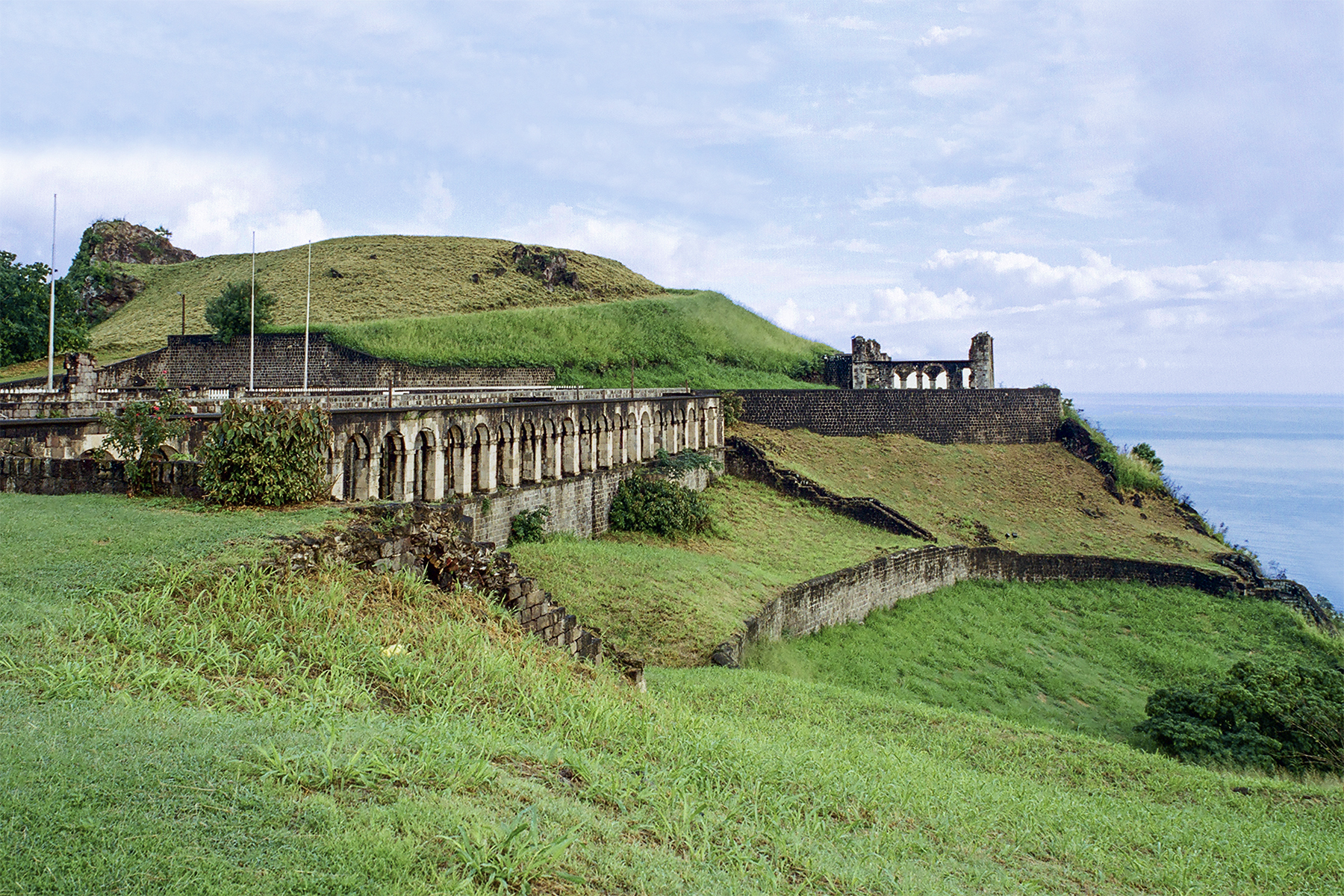
The fortress occupies a volcanic hill rising roughly 230 metres above sea level. That elevation means something immediately understandable to a sailor: a broader horizon and an earlier opportunity to distinguish a ship from the water behind it. It also means a steep approach for anyone trying to reach the defences from below. The hill supplied advantages before the engineers laid out a wall.
Height alone, however, does not explain the architecture. At a projecting bastion, look along the neighbouring wall rather than only out to sea. The projection allowed defenders to cover approaches that would otherwise lie awkwardly beneath or beside a straight defensive face. The outline was designed around overlapping observation and fire. What can look ornamental in a photograph becomes purposeful when you follow the angles with your eye.
The upper citadel, the barracks, the magazines and the parade ground describe different parts of the same working place. A magazine kept gunpowder protected from moisture and accidental ignition. Barracks housed the people expected to maintain the position. Water storage mattered because height made every interruption to supply more consequential. The fortress had to sustain life as well as withstand attack. Its less dramatic spaces deserve as much attention as the cannon.
On a clear day, neighbouring islands help explain the wider setting. St Eustatius and Saba are among the landforms that may be visible, but haze and cloud decide how much of the horizon can be read. We would rather identify the coast that is actually there than promise a tally of islands. A faint outline can be more instructive than a perfect panorama: it shows how easily distance becomes uncertainty at sea, even from this height.
The People Who Built The Walls
Construction began in 1690 and continued in stages for roughly a century. That long development matters. Brimstone Hill was not completed in a single burst of confidence and then tested. It was altered, strengthened and extended as military needs changed. The famous siege occurred while that longer process of development was still unfolding.
British military engineers shaped the design, while enslaved Africans carried out much of the construction. Those facts belong together whenever the quality of the masonry is admired. Engineering drawings could specify a defensive position, but they could not quarry stone, dress a face, prepare mortar or set a heavy block accurately. The building required skilled hands as well as sustained physical labour, under a system in which the people doing that work were denied freedom.
Much of the dark volcanic building stone came from the hill itself. Local material reduced the need to bring all the stone from elsewhere, but it did not remove the work of extraction and handling. Look closely at the difference between a rough stone surface and an edge worked to fit an opening. The regularity is made, not found. Lime mortar joined the masonry, and every course depended on the preparation beneath it.
The wider purpose of the fortress cannot be separated from the island’s plantation economy. Sugar production depended on enslaved labour; imperial power defended the territory and the wealth produced through that system. Seen only as British and French military rivalry, the story loses the people whose coerced work made both the economy and much of its protection possible.
There is no need to invent an individual life to make that history human. The evidence is already substantial. A wall contains countless acts of judgement and effort, even when the names of those responsible are not readily available to the visitor. We can acknowledge the skill without treating the conditions under which it was used as a detail beneath the architecture.
What The Siege Of Brimstone Hill Reveals
French forces captured the fortress in 1782 after a siege lasting about a month. The contrast between the long construction and the relatively brief siege is striking, but it can become misleading if told as a joke at the engineers’ expense. A strong position can delay an attacker without being able to resist indefinitely. Its success depends on much more than the thickness of its walls.
The French campaign put pressure on the island from land and sea. A fortress might command a view of the water while still being unable to secure the support it needed across it. British naval activity offshore did not prevent the eventual surrender. The position on the hill and the contest beyond it were connected, but they were not the same battle.
When reading any fortified place, it helps to separate protection from endurance. Protection concerns what the works can resist. Endurance concerns ammunition, food, water, the condition of the defenders and the prospect of relief. These are the pressures that make a siege different from a simple exchange of cannon fire. A wall can remain standing while the position it encloses becomes untenable.
The peace settlement of 1783 returned St Kitts to British control. That reversal came through negotiation rather than another successful assault on the hill. The fortress therefore holds evidence of several kinds of power: the labour that built it, the force that captured it and the agreements that changed its possession again.
Later conservation also belongs to the account. What survives is neither an untouched battlefield nor a stage set. Restored buildings and maintained grounds make parts of the military complex legible again. Its World Heritage status recognises the importance of the place; the quieter work of caring for masonry, drainage and access allows that importance to remain physically accessible.
Giving The Hill Enough Time
Half a day is a reasonable planning allowance for the outing from Basseterre, including the road journey and time to stop rather than hurry through. It is not a fixed duration for everyone. The important distinction is between arriving at the site and having the energy to understand it. A rushed climb in the hottest part of the day can reduce a complicated place to a view and a photograph.
Where opening arrangements and the shore transfer allow, we would favour the cooler part of the day. We would also confirm current access arrangements before leaving Discovery. Vehicle access does not make every part of a hilltop fortress equally easy to reach. Gradients, steps and uneven historic surfaces deserve an honest conversation with anyone for whom walking is difficult. It is better to plan a satisfying shorter visit than discover a limitation halfway up an exposed section.
In sunshine, the parade ground is an exercise in reflected heat. A breeze at an open corner may feel generous, then disappear as soon as a wall interrupts it. The body notices that change before the mind does: warmth at the back of the neck, a damp shirt, the sudden pleasure of shade. Water, a hat and shoes that grip stone do more for the morning than another item on the itinerary. Wind can make heat feel less insistent without removing the need to drink.
With children, the architecture offers enough to engage attention without turning the visit into a lesson delivered at every doorway. Follow the route by which supplies would have entered. Notice where defenders could see and where they could not. Find the spaces intended for living rather than fighting. Questions emerge naturally from the ground, while close supervision remains necessary around steep edges and uneven steps.
We would leave room for a pause. Sitting in shade after looking at the barracks can make their purpose easier to grasp than immediately moving to the next viewpoint. A fortress was inhabited through heat, fatigue, maintenance and waiting. Battle occupied only part of its life.
The Monkeys And The Coast Below
The green monkeys found on St Kitts are often called vervets locally. Their ancestors were brought from West Africa during the colonial period; they are introduced animals, not evidence of an ancient native monkey population on the island. Their presence adds another layer to a landscape changed by the movement of people, plants and animals across the Atlantic.
An encounter is possible, not something to promise. If monkeys are nearby, keep food put away and give them space. Feeding changes the relationship between an animal and the next person it approaches, encouraging behaviour that may become troublesome or unsafe. Watching them without drawing them closer also gives a better chance of seeing ordinary movement and interaction rather than a performance around a snack.
They are engaging animals, but their place in island life is more complicated than a photograph suggests. Monkeys can damage crops. The same animal that delights a visitor may create work and loss for someone growing food. Keeping both realities in view is a small but worthwhile form of respect for the people who live here.
The black sand coast below the hill can provide a quieter interval on the return. A beach stop and a swim are separate decisions. Dark sand can become very hot in direct sun, and attractive water says little about shore break or the ease of getting back out. We would read the conditions at the water’s edge before deciding. Sometimes the better ending is simply a walk beside the sea.
Taking The Island Back Aboard
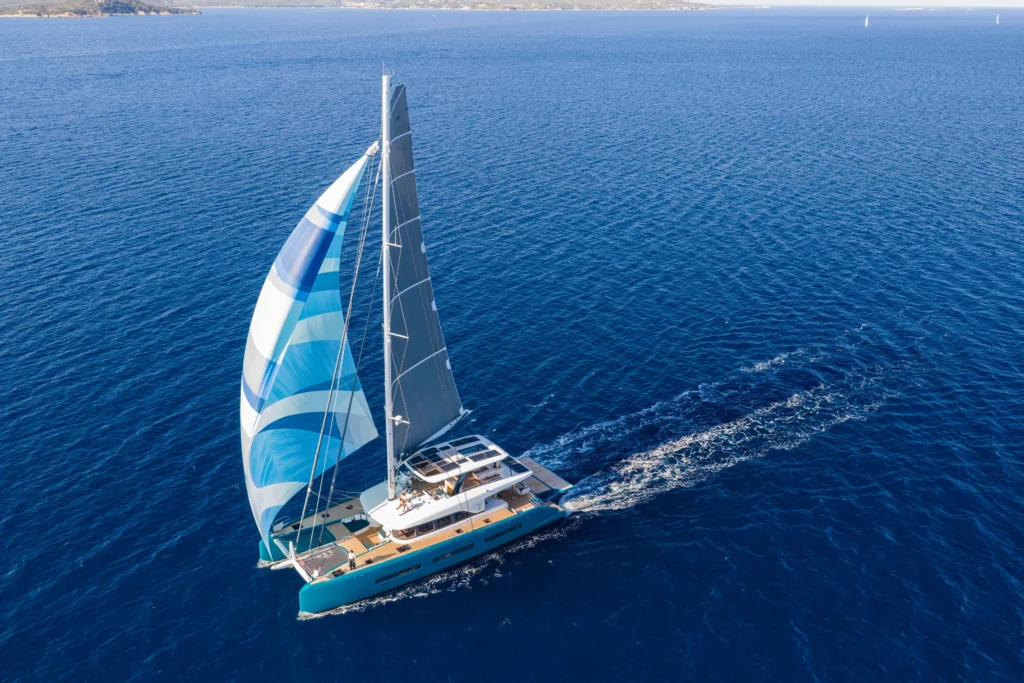
Discovery, the Lagoon Eighty2 sailing the Naora Global Expedition, gives us continuity between places without requiring every day to resemble the previous one. Members choose when they join, where along the worldwide route they step aboard and how long they stay. That freedom is meaningful partly because a day ashore need not be treated as an obligation to see everything within reach.
At St Kitts, Brimstone Hill can be enough. There is no need to fill the return journey with additional stops merely because the road allows them. Taking time at the fortress, leaving space for shade and attending to the people walking beside us can produce a fuller understanding than a longer list of places visited. The decision is practical as much as philosophical: attention diminishes when people are tired, thirsty or watching the clock.
Coming back aboard also restores the scale that the hill briefly changes. From above, the coast seems readable at once. At water level, it becomes particular again: the landing, the movement beside the tender, the direction of the wind. Neither perspective is complete. Together they make the island harder to reduce to scenery.
That is what we would want to carry away from Brimstone Hill. The view deserves its reputation, but the closer attention belongs to the stone and the people whose work remains in it. Long after the eye has gone back to the sea, there is still the weight of the wall.