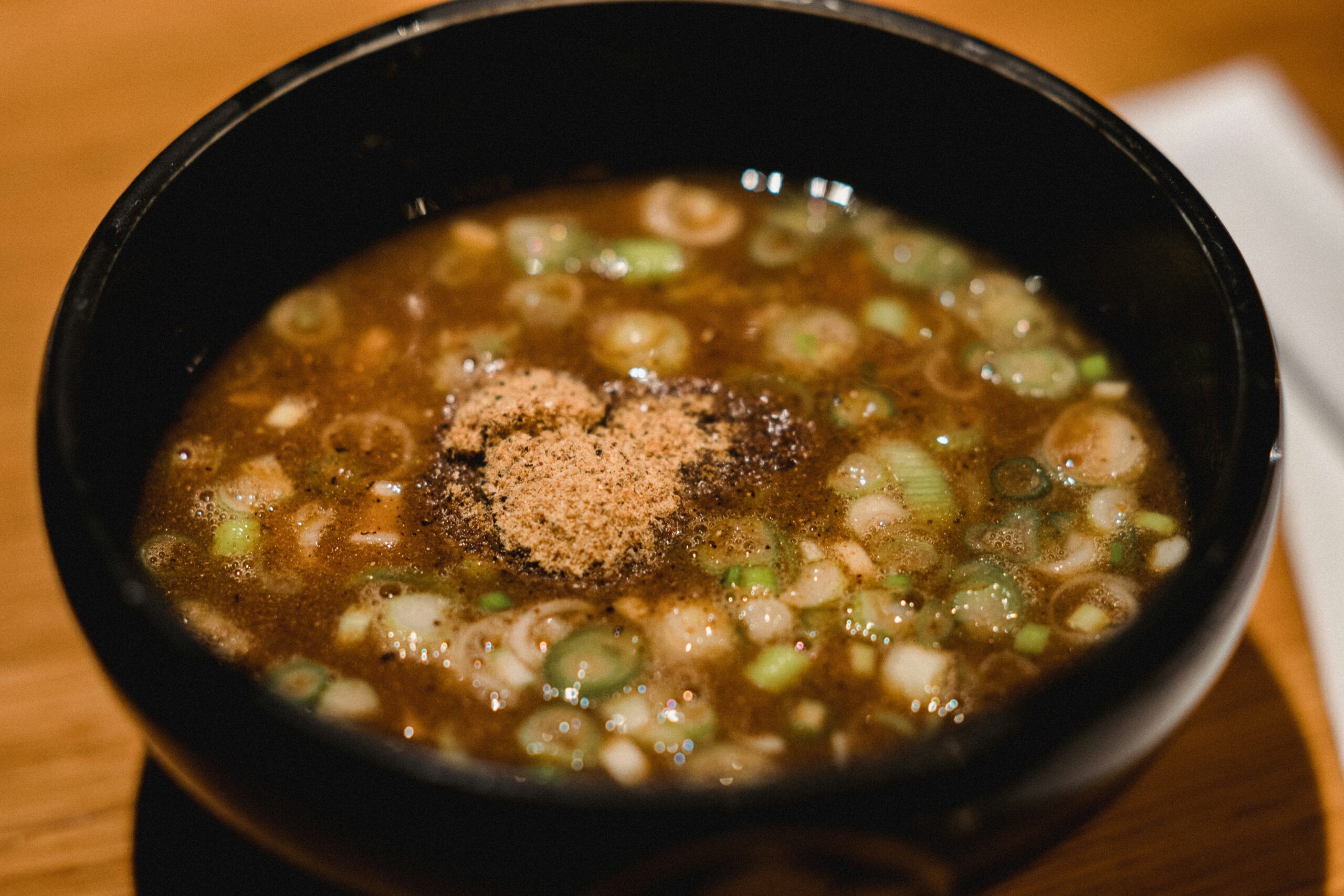
Black bean soup smells ready before it is ready. Smoke from the ham hock rises with the thyme, but a bean pressed against the inside of the pot can still leave a pale, chalky centre. That small resistance matters more than the fragrance. Before leaving Barbados, I would rather allow the pot a little longer than ask anyone to mistake a good smell for a good supper.
The meal I have in mind is simple: black beans, smoked ham, spring onion, thyme and Scotch bonnet, with an aged cachaça from Brazil considered alongside it. It is a supper worth planning for Discovery because much of the work can be finished before people gather. On the evening before a passage, the cook should also have an evening. The people eating should be able to linger without keeping someone else at work until the last conversation ends.
The Place In The Pot
I would describe this as our black bean soup cooked in Barbados, rather than present it as a definitive Bajan dish. Black beans and smoked pork belong to several culinary traditions, and a familiar combination does not acquire an island pedigree simply because we prepare it there. Barbados has its own food language, including cou-cou made with cornmeal and okra, flying fish, and saltfish in fish cakes. Those distinctions deserve to survive our arrival.
The connection to the island can be more modest and more useful. Thyme gives the broth a persistent herbal note. Spring onion contributes sweetness from its pale lower stems and freshness from its greens. Scotch bonnet has a fruitiness that can disappear behind excessive heat. These are ingredients worth understanding separately, rather than treating Caribbean seasoning as a single, forceful flavour.
For a substantial bowl with bread, a working allowance is roughly 75 to 100 grams of dried beans per adult. That is a starting point, not a rule about appetite. The beans absorb water, the broth adds volume, and the pork makes the meal richer. A smaller first serving is sensible before returning to motion, particularly for someone who knows their stomach takes time to settle at sea.
Nor does an ocean crossing create identical needs around a table. One person may want something substantial; another may want a little broth and an early night. A meal becomes hospitable when it allows those differences without comment.
Making Black Bean Soup With Patience
The beans need attention before they need seasoning. Sort them, rinse them, and give them enough water to expand without emerging above the surface. An overnight soak of about 8 to 12 hours is a useful preparation, but in a tropical galley that soak belongs in the refrigerator. Warm water left standing through a warm night is not improved by calling the method traditional. Soaking helps the beans hydrate more evenly and usually shortens the cooking that follows.
The ham hock has its own timetable. I would start it separately, simmering it until the meat loosens from the bone, then use its cooking liquor selectively. This gives control over both salt and texture. A heavily cured hock can produce a broth that is already strongly seasoned before any salt reaches the spoon. Keeping that liquor separate allows us to add flavour without committing the whole pot to whatever concentration the pork happens to supply.
In the soup pot, soften the pale spring onion stems gently, without browning them hard, then add the thyme, drained beans and fresh water. Bring the beans to a proper boil before reducing the heat to a steady simmer. After soaking, roughly 1 to 2 hours is a reasonable cooking allowance, although older beans can demand longer. The useful test is tenderness all the way through. A timetable cannot tell us that.
There is no need to fear salt as the automatic cause of tough beans. Age, the composition of the water and acidic ingredients can have more influence on how readily they soften. Lime belongs near the end, once the beans are tender. Meanwhile, the hock can be stripped of bone, tough rind and excess fat, with the meat returned in pieces small enough to fit comfortably on a spoon. Nobody should have to dismantle their supper.
For thickness, crush a ladleful of beans against the side of the pot and stir them back through. Their starch gives the broth body while leaving most of the beans intact. Stop before it becomes a purée. Soup thickens as it stands, so the texture in the saucepan should be a little looser than the texture wanted in the bowl.
A whole Scotch bonnet can lend fragrance, but it is not a guarantee of mildness. Heat varies between peppers, and a split skin can change the pot quickly. For a mixed table, I prefer a restrained base with additional chilli offered separately. Finish with the spring onion greens and enough lime to make the flavours distinct. Acidity should clarify the smoke and beans, not conceal them.
Keeping Black Bean Soup For The Passage
There is a practical attraction to cooking a little beyond supper: a meal for the first unsettled hours after departure. But leftovers are useful only if the galley has the capacity to handle them properly. A large pot of dense soup holds heat in its centre long after its surface seems comfortable to touch. Leaving it on the stove overnight is not a method of preserving it.
The portion intended for another meal should be set aside cleanly before service, divided into shallow containers and cooled rapidly. An ice bath can help remove heat without asking the refrigerator to cool a large, hot mass. Refrigerate promptly at 4°C or below, with enough space for cold air to circulate. That number matters because the refrigerator is protecting tomorrow’s food, not merely making drinks pleasant.
When the soup is used again, reheat it thoroughly to 74°C throughout, stirring and checking the temperature rather than judging by steam alone. A thick soup can heat unevenly. Reheat the amount required, rather than repeatedly warming and cooling the whole reserve. Labelling the container with its contents and preparation date removes a surprisingly common source of uncertainty from a busy galley.
The other preparation is physical. A saucepan that was harmless in sheltered water needs securing when the yacht moves. Bowls should be filled conservatively, and the person carrying them needs a clear route and a hand available for support. Getting food ready before departure reduces work later, but it does not remove the need to serve it with respect for hot liquid and a moving floor.
What Sugar Left In Barbados
The bottle beside this supper opens another part of the island’s story. During the 1640s, sugar cultivation expanded rapidly in Barbados, transforming land use, ownership and labour. The developing plantation economy depended on the forced labour of enslaved Africans. The wealth associated with cane cannot be separated from the violence through which it was produced.
That history is larger than rum, and it deserves more than a picturesque reference to old plantations. It shaped who controlled land, whose work generated wealth and whose lives were treated as expendable. Emancipation did not simply erase the inequalities that had accumulated. A visitor can appreciate the skill in a spirit while refusing to turn the system behind its early prosperity into decoration.
Brazil’s cane history carries related burdens, but the two places should not be folded into one interchangeable sugar culture. Their languages, colonial histories, communities and drinking traditions are distinct. Bringing cachaça to a table in Barbados can make those differences interesting. It should not make them disappear.
The living island also asks for attention. Buying locally is valuable, but an ingredient sold at a local stall is not necessarily grown locally. Dried beans may have travelled a long way; herbs may have travelled very little. Asking where something came from is more useful than assuming that every purchase near the harbour expresses the same relationship to the land. For Naora, sourcing with care starts with that ordinary distinction, and with paying attention to the answer.
Cachaça Is Not Another Name For Rum
Cachaça is a Brazilian spirit distilled from fermented fresh sugarcane juice. Much Caribbean rum begins with molasses, the concentrated material remaining after sugar production, although cane juice rums also exist. The raw material is therefore an important distinction, but not a complete definition. Cachaça has its own Brazilian identity and production requirements. Calling the bottle cachaça rum loses something we should be interested in keeping.
An aged cachaça from Minas Gerais brings a different expression of cane to the evening. Ageing can change colour, aroma and texture, but the result depends on the wood, the vessel and the time spent in it. Without knowing the bottle, I would not promise vanilla, spice or any other tasting note. It is better to smell what is actually in the glass than search obediently for flavours someone else has supplied.
Cachaça’s legal bottling strength is 38 to 48 per cent alcohol by volume. Even the lower end is a full-strength spirit, which is a reason to taste attentively rather than pour generously. Water belongs on the table. So does the uncomplicated possibility of having none.
On a departure evening, responsibility decides more than ceremony. The people responsible for overnight watchkeeping, navigation or handling the yacht need to remain fit for those duties. For them, the sensible glass contains no alcohol. There is also little value in a nightcap that helps someone feel sleepy while making their sleep less restorative. Opening a bottle should never become an obligation created by the fact that it has crossed an ocean.
The cachaça can wait. Its place in the story does not depend on everybody drinking it.
The Work Before Departure
Barbados lies east of the main Caribbean island arc, which helps explain its significance as an Atlantic landfall. It does not mean that every crossing ends there, or that every crew arrives after the same number of days. Passage duration, accumulated fatigue and the condition of the yacht all affect what happens next. Time ashore is valuable, but a few nights in a harbour do not automatically certify that everyone is rested.
During the northern winter and into spring, the easterly trade winds are generally more established. That broad seasonal pattern is useful context, not a departure forecast. The western side of Barbados may offer shelter from the prevailing wind while still receiving swell generated far away. Northerly swell can affect waters that look reassuring on a wind chart. Direction and period matter alongside height, because the spacing and approach of the waves influence how they reach a coast.
This is why a quiet evening at the table cannot be the final evidence that the next morning will be straightforward. Sven, Naora’s founder and captain, plans every weather window and sails every leg himself. The departure decision has to include the latest conditions, the yacht’s readiness and the state of the people aboard. Formalities must also be complete. Dinner is easier to enjoy when the remaining work is understood, rather than optimistically assumed to be finished.
Discovery, the Lagoon Eighty2 sailing the Naora Global Expedition, belongs to a continuous world route. Panama lies farther west across the Caribbean, within that larger progression, but the longer horizon should not become pressure on a particular morning. Waiting can protect sleep, equipment and the quality of the passage. It is an ordinary part of sailing well.
Members choose when and where along the worldwide route they join, and how long they stay. A last supper in Barbados may therefore sit near the beginning of someone’s time aboard and near the end of someone else’s. The yacht continues around the world, but the people at the table do not all inhabit the same calendar. There is warmth in allowing that difference, rather than insisting that everyone experience the evening as the same farewell.
A Table With Room For Tomorrow
There is a particular comfort in holding a warm bowl while moving air cools the salt on your forearms. The first spoonful carries smoke; the next makes the thyme clearer. Lime lifts the heavier flavours, and the spring onion greens still have a little resistance between the teeth. Even in warm weather, a hot supper can feel right. Its comfort comes partly from being able to stop making decisions for a while.
That is what I would want from this evening in Barbados. Enough attention in the galley that nobody needs to discuss the galley. Enough preparation elsewhere that tomorrow does not keep interrupting. Someone can stay for another spoonful; someone else can leave the table early without the meal being declared over.
The next place will have its own provisions, weather and questions. For now, the bowl is still warm.