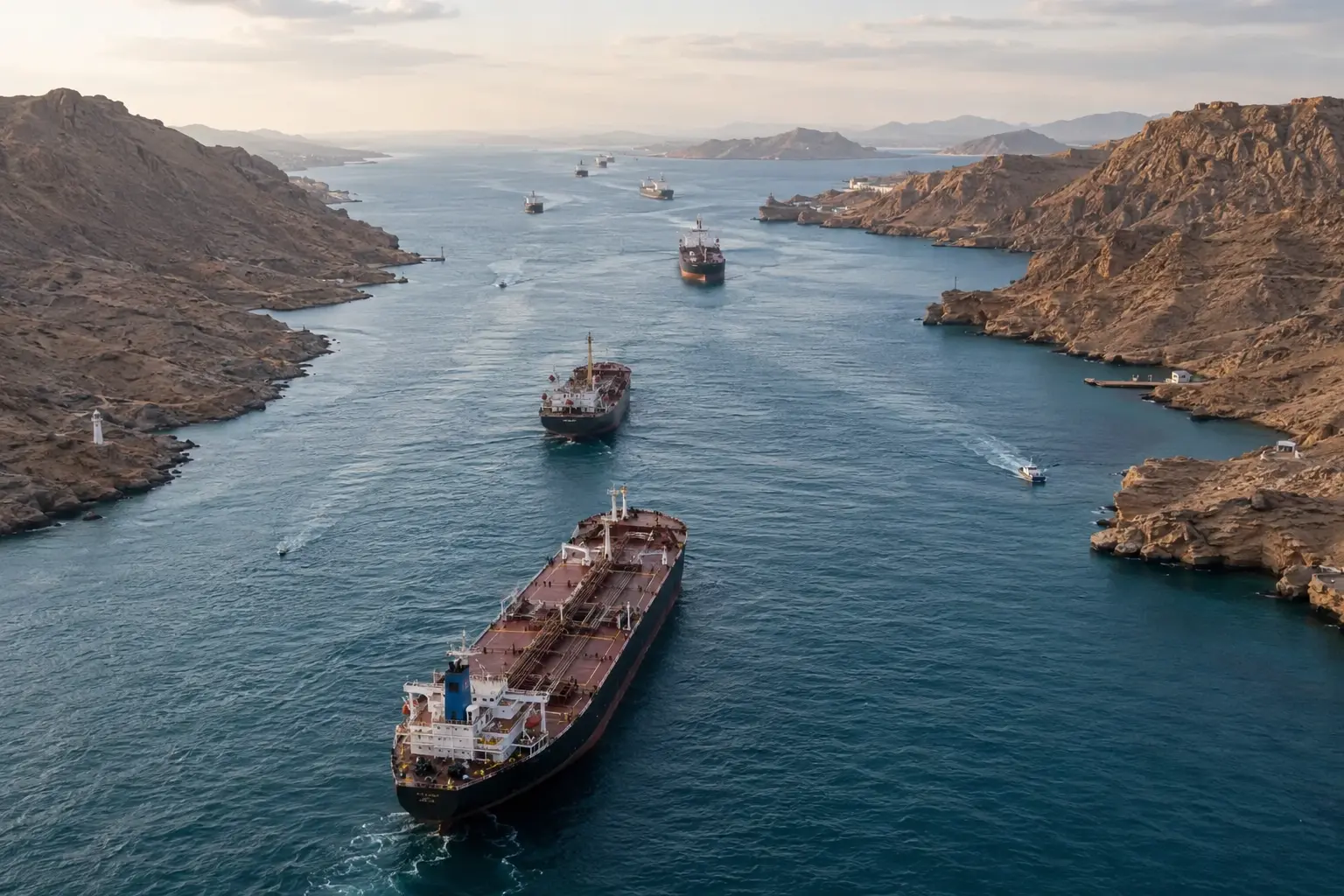
On the chart of the Bab-El-Mandeb Strait, Perim sits close to the Yemeni shore, not in the middle of the gap. It is a small correction to the picture many people carry of this place: two continents facing one another, an island between them, an opening into another sea. To a sailor, the displacement matters. It creates two unequal passages, with different depths and different demands, and concentrates the main shipping route on the African side of the island.
For the Naora Global Expedition, planned for 2027 to 2031, the Red Sea belongs to a much longer movement around the world. That makes this threshold worth understanding properly. It does not make a transit inevitable. A line drawn through a strait expresses an intention; weather, traffic and security determine whether that intention can responsibly become a passage.
The Geography Of The Bab-El-Mandeb Strait
The overall narrowing between Africa and the Arabian coast is roughly 16 Nm across. That is close enough to suggest an intimate meeting of continents when seen on a small-scale map, yet much too broad to understand as a single channel. Perim divides it into a narrow eastern passage beside Yemen and a much wider western passage towards Djibouti.
The eastern passage is roughly 1.5 Nm wide, with depths around 30 metres. The western passage is roughly 14 Nm wide and reaches depths of about 300 metres. These are rounded geographic dimensions, not navigational clearances. A yacht cannot treat the whole blue space on a map as available water. Shoals, charted dangers, traffic arrangements and any restrictions in force belong to the usable geography just as surely as the coastline does.
The contrast in depth also explains why a strait cannot be understood from its surface alone. The deeper western passage accommodates much of the exchange between the Red Sea and the Gulf of Aden, while the island and surrounding seabed help shape the movement of that water. Two stretches of sea separated by a short distance can behave differently.
For a southbound yacht leaving the Red Sea, Africa lies broadly to starboard and Yemen to port. It is worth getting that simple picture right before becoming absorbed in the instruments. Good pilotage keeps the larger orientation alive while attending to smaller things: the next alteration, the traffic lane, the position of the island, the water into which the boat is being carried.
The Wind Changes Along The Red Sea
The Red Sea does not offer a dependable following northerly from one end to the other throughout the year. That assumption is particularly unhelpful near its southern entrance. During the northern winter, winds in the southern Red Sea commonly blow from the south or southeast, even while northerlies persist farther north. A southbound yacht can leave favourable sailing behind and find the wind coming towards her before reaching the strait.
In northern summer, northwesterly winds are more characteristic through the southern Red Sea. Beyond the entrance, the Gulf of Aden responds to the seasonal monsoon system. These waters are connected, but they do not behave as one uninterrupted wind corridor. The surrounding land redirects the flow, and the constriction can accelerate it.
For us, the useful forecast is therefore not a single arrow over the whole region. It is the sequence of conditions the yacht would meet along her track, at the times she would reach them. A favourable departure can lead into an unfavourable arrival. An apparently modest wind over open water can become more demanding where land channels it, particularly if it meets an opposing current.
This changes practical decisions before departure. Sail should be reduced while there is room and attention to do it well, rather than during a close traffic encounter. The propulsion plan must allow for conditions that make sailing alone unsuitable. An arrival time deserves a range rather than a confident minute, because progress through the southern Red Sea can change materially as the wind changes.
The seasonal pattern helps us ask better questions. It cannot answer them for a particular day. That distinction is part of the craft: climate suggests what is likely; the immediate weather decides what is possible.
Reading The Water At The Bab-El-Mandeb Strait
The Red Sea loses substantial water through evaporation and receives little freshwater in return. The water left behind becomes saltier and denser. Exchange through the strait helps balance that loss: in the winter pattern, relatively fresher water generally enters near the surface while denser Red Sea water flows outward beneath it.
Summer can bring a more complicated arrangement, including cooler inflowing water below the surface and an outward-moving surface layer. A yacht occupies only the uppermost part of this system. The direction of deeper exchange is interesting oceanography, but it is not a prediction of the current acting on the hull.
Tidal streams, wind and the shape of the seabed are superimposed on that seasonal exchange. The practical question is where the surface water will carry the yacht during the intended transit. Tide height alone does not answer it, and high or low water should not be assumed to coincide with slack current. Relevant tidal information needs to be read alongside the weather and checked against what the boat is actually doing.
Speed through the water and speed over the ground tell different stories. Their difference can reveal an opposing stream; the difference between heading and track can reveal sideways set. Those comparisons matter more than the reassuring appearance of a course line that remains neatly centred on a display.
When wind opposes current, the sea can become shorter and steeper without the wind increasing. On a catamaran, that change may arrive in the body before it becomes a conscious observation: a sharper lift, a brief pause, then the blunt sound of water against the bridgedeck. A hand stays around the cup. Walking across the saloon takes more attention.
The response may be to reduce speed or alter the angle to the waves, provided traffic and available water allow it. The aim is to preserve control and reduce repeated impacts, not to defend an earlier estimate of arrival.
Sharing The Passage With Commercial Ships
The importance of Bab-El-Mandeb does not require a daily cargo statistic to become apparent. It connects the Red Sea with the Gulf of Aden and, beyond it, the Indian Ocean. Ships serving widely separated ports are brought into the same restricted piece of water. Their destinations may have little in common; their immediate navigational problem does.
For a yacht, the first discipline is to understand the traffic separation scheme before approaching it. A sailing vessel must not impede the safe passage of a power-driven vessel following a traffic lane. Being under sail does not confer a general entitlement to make a large ship alter course.
If a crossing is necessary and permitted, the collision regulations call for a heading as nearly as practicable at right angles to the traffic flow. Heading is the important word. Current may carry the yacht sideways, making her track over the seabed look different. Trying to force the plotted track into a perfect right angle can obscure the purpose of the rule: a recognisable crossing, with as little time as practicable spent in the lane.
AIS helps identify ships and understand their movement, but a predicted closest point of approach assumes that the vessels continue as expected. A course alteration can change that prediction immediately. Some craft may not transmit useful AIS information at all. The screen belongs beside radar and a proper visual lookout, not in place of them.
In darkness, a ship may first appear as a small arrangement of lights with no visible hull beneath it. Warm air moves through the cockpit, machinery hums underfoot, and the eye wants to remain with the brightest object. The watchkeeper has to resist that pull, look into the unlit water, and rebuild the whole picture.
There is little room here for prolonged uncertainty about another vessel’s intentions. Early assessment preserves choices. A late decision consumes them, particularly when a yacht has limited room to turn and a ship cannot readily leave the water assigned to her.
The Decision Before Departure
Weather and pilotage are only part of the assessment. Attacks on shipping in the Red Sea and Gulf of Aden since late 2023 have made security an essential, separate condition of any passage decision. A calm forecast cannot compensate for an unacceptable threat. Commercial ships continuing to use a route do not establish that it is suitable for a private yacht.
Any decision about a future transit must be made from the situation at that time. Current threat information, applicable restrictions, reporting requirements, the vessel’s circumstances and insurance cover all need examination. None should be treated as a formality. Insurance cover does not itself establish safety, and a naval presence does not amount to a promised escort or protection.
There are risks that better watchkeeping and a sound engine room cannot remove. We would not describe those risks as manageable simply because acknowledging them complicates the route. Waiting, changing the plan or deciding against a transit must remain genuine options before anyone becomes attached to a departure.
Sven, Naora’s founder and captain, plans every weather window and sails every leg himself. Here, that responsibility begins well before casting off. It includes refusing to let a guest’s flight, a hoped-for landfall or the elegance of a world route become an argument for proceeding.
If the wider assessment supports a passage, the ordinary preparations still matter: current charts and notices, steering and propulsion checks, working communications, sufficient fuel margin, rested watchkeepers and a clear understanding of who does what if conditions deteriorate. Essential information should not exist only in the captain’s head.
This preparation costs time and sometimes requires disappointing someone. That is a real cost, but it belongs ashore, before departure, where the consequences can still be absorbed without exposing people unnecessarily. A serious passage plan includes the conditions under which it will not be used.
Keeping Life Aboard Discovery Settled
Discovery, the Lagoon Eighty2 sailing the Naora world route, is both a working yacht and a place where people live. In confined, busy water, those two purposes need careful separation. The cockpit may require sustained concentration while someone below is reading, resting or helping a child settle. The quiet is possible because the work is organised around it.
The useful preparations are often domestic. A meal that can be served without prolonged cooking reduces heat and activity in the galley during the busiest part of a transit. Loose objects are secured before motion makes them a nuisance. Drinks are placed where they will stay put. A tired person is encouraged to rest before fatigue becomes something to endure.
Guests need an understandable briefing, not a transfer of responsibility. They should know which areas need to remain clear, how to move safely, and when to leave the watchkeepers uninterrupted. Children can be interested in the ships and the chart without being drawn into the demands of navigation. Curiosity is welcome; responsibility remains with the crew.
Within Naora’s private circle, members choose when they join, where along the world route they step aboard and how long they stay. The yacht’s larger voyage continues around those individual chapters. That freedom works only when we distinguish the experience someone hopes for from a movement the sea must permit.
A person can choose the time they want to give to the Red Sea. We still owe them an honest account of what conditions may change. It is kinder to explain uncertainty while there is room to accommodate it than to disguise it until a departure becomes difficult.
The Human Scale Of The Gateway
Bab-El-Mandeb is usually translated as the Gate of Tears. The name carries the weight of difficult navigation, although its precise origin should not be reduced to one confidently repeated shipwreck story. It belongs to a place where water has connected communities and separated them, where passage has long depended on knowledge that could not be replaced by determination.
Arabian, Indian and East African trading networks used the seasonal winds to connect these coasts with the wider Indian Ocean. The useful inheritance is not the idea that we sail in exactly the same conditions as an ancient dhow. It is the understanding that departure and return belong to a seasonal system, and that accepting its limits is a form of competence.
The modern strait is not unchanged water beneath different vessels. Traffic has changed. Shores have changed. Conflict has altered what a responsible visitor can contemplate. The people living beside the passage should never become background to our account of crossing it.
Its geography is still arresting: Africa and Asia close together, the Red Sea opening into the Gulf of Aden, the chart gathering distant routes into a narrow space. Aboard a yacht, however, responsibility remains at a smaller scale. It rests with the person keeping watch, the people sleeping beyond the cockpit, and the next decision that belongs to the captain.