White water breaking on a reef collapses almost as soon as it appears. A ribbon of foam leaving the pass can do something different: hold its line towards open water, meeting swell that is travelling the other way. When we look at atoll pass currents, that distinction matters. The breaking water marks an event. The moving foam gives us a clue to the flow, and the flow may bear little resemblance to the pause someone has inferred from the tide table.
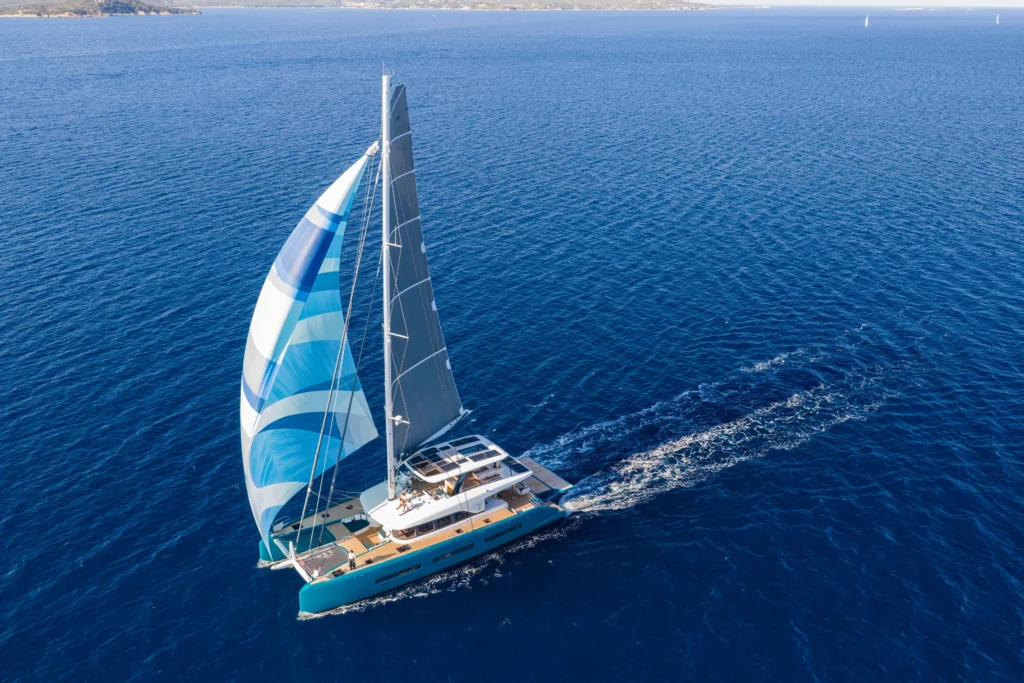
For the French Polynesian atolls on the Naora Global Expedition, we are planning the approach as part of the ocean passage, not as the easy bit left over at its end. Discovery, our Lagoon Eighty2, needs an entry window that works for the yacht, the people handling her and the water actually moving through the reef.
The important preparation is to preserve a choice. We want to reach the vicinity of a pass able to enter if conditions support it, but equally able to remain outside without turning a delay into another problem.
What Tide Predictions Tell Us About Atoll Pass Currents
A tide table gives predicted water levels at a stated location and the times of their highs and lows. It does not, by itself, give the moment when a stream through a nearby opening will stop. High water is a turning point in water level. Slack water is a pause in current. The two can be related, but treating them as interchangeable is the first mistake to remove from an approach plan.
Even without swell, a lagoon and the ocean outside need not rise and fall together. The lagoon exchanges water through restricted openings and across shallow reef areas, so its response can lag behind the sea outside. The current through a pass depends on the difference in level between the two sides, together with the shape and resistance of the waterways connecting them. The ocean can reach high water while that difference still exists. There is no universal correction of a certain number of minutes after high water that works across Polynesian atolls.
We still need the prediction. We check the reference location, the date, the time convention and any established relationship between the predicted tide and the intended pass. A pass-specific current prediction is more directly useful than a water-level table, but unless it includes wave forcing it cannot account for the extra water being driven over the reef by the present swell. Precision on a screen does not expand what the calculation contains.
How Ocean Swell Raises A Lagoon
A reef rim is not a watertight wall with a single doorway. Where waves break over its exposed shallows, they can drive water across the reef flat towards the lagoon. Breaking waves transfer momentum to the water and help establish a rise in mean water level over the reef, a process called wave setup. The resulting flow depends on reef shape, depth and friction, but the practical consequence is straightforward: water can be entering the lagoon across a broad stretch of reef while leaving through a much narrower pass.
That difference in scale is worth holding in mind. The entrance we are studying from the helm may be only one outlet for water arriving somewhere else, perhaps well beyond our view. A sheltered approach does not mean a sheltered reef rim. Nor does a smooth lagoon surface mean the lagoon is at the same level as the ocean. The elevation driving the outflow can be difficult to recognise by eye.
For scale, a hypothetical rise of 10 cm across one square kilometre of lagoon adds 100,000 cubic metres of water. This is an illustration, not a measurement from a particular atoll. It explains why a visually modest change in level can involve a substantial volume, and why drainage cannot be understood simply by watching whether the next wave breaks at the entrance. The lagoon is storing water as well as exchanging it.
If the ocean tide starts rising, that rise may reduce the difference in level without eliminating it. The outgoing stream can weaken yet continue in the same direction, rather than stop and reverse at the expected time. If water keeps arriving across the reef quickly enough, the weakest current of the cycle may still be outward. There may be no slack during that cycle at all. When the swell eases, the response is not necessarily immediate either. Stored water still has to leave, and the time required depends on the lagoon and its outlets.
Why Atoll Pass Currents Change With The Swell
Wave height is only part of the approach forecast. An 8-second swell and a 16-second swell of the same height are not equivalent. In deep water, the longer-period swell transports more wave energy per unit time. What reaches the lagoon then depends on how those waves meet and break over the reef. We cannot turn a forecast period into a predicted current speed, but we should not read a modest swell height and stop there. Period, direction and persistence all belong in the decision.
Direction determines which parts of the rim receive that energy. A swell may be breaking heavily on an exposed face while the pass itself sits in relatively quiet water. Wind at the yacht can be light because the swell was generated by distant weather. Conversely, local wind can roughen the entrance and push lagoon water towards particular outlets without a conspicuous increase in the offshore swell. The breeze on our faces and the water arriving over the reef are related observations, not substitutes for one another.
Reef-flat depth also changes with the tide, affecting how waves break and how readily water crosses. The width and depth of the passes influence how easily that water can escape. Several openings may share the discharge, and wind can redistribute water within the lagoon. This is why a useful explanation of one atoll is not automatically a usable timing rule for the next. The mechanism travels with us. The local relationship has to be learned again.
There is a counterpoint here. Not every pass is dominated by swell-driven outflow, and tide-based timing can be very useful when reef inflow is small and the local tidal pattern is well understood. We are not replacing a tide table with an instinct for water. We are deciding how much weight to give each piece of information under the conditions in front of us. A familiar tidal pattern becomes less persuasive when the reef has been receiving an unfamiliar amount of swell.
Reading The Water Before Yacht Entry
The observation begins from a position with adequate sea room, chosen using the chart, the weather and the yacht’s actual drift. We do not have to approach the narrowest part to discover that an outgoing jet is meeting incoming waves. Its effects may extend beyond the reef opening. Nor do we assume that clear water outside the entrance provides a harmless place to linger. The set towards the reef matters while we are looking elsewhere.
Foam moving steadily seaward is useful evidence, but it is not a current meter. Wind moves surface material too. We look for agreement between several signs: the movement of streaks past fixed references, an organised jet, eddies along its edges and waves whose crests remain nearly fixed in position rather than travelling through. An outward current opposing incoming swell can shorten and steepen the waves. Breaking water across the intended track is a reason to reject that approach, not an invitation to test the engines.
At the helm, low sun can turn the surface into a sheet of reflected light. The reef edge that looked distinct a few minutes earlier becomes difficult to separate from a cloud shadow, and shading the eyes only partly restores the view. That is a pilotage problem, not merely an uncomfortable brightness. We need usable light for the channel and the water beyond it. Polarised glasses can reduce glare, but neither glasses nor a promising patch of blue replace the chart, position checks and a proper lookout.
Observation also needs time. A quieter interval between swell groups is not proof that the current has reached slack. We want to understand what the larger sets do to the entrance, not choose the calmest instant and assume it represents the whole approach. Where reliable instruments allow it, comparing speed through the water with speed over ground helps us understand the flow at our position. It does not measure the current farther inside the constriction.
Local knowledge makes these observations much more valuable when we ask specific questions. Is the pass flowing out now, and is that flow easing? What is happening at the bend or the narrowest section? Are the larger sets breaking across the usual track? How recently was that assessment made? Someone who watches the opening every day may recognise a pattern that a visitor misses. We still need to distinguish a route suitable for a small local boat from one suitable for Discovery, with her different dimensions and handling requirements.
Keeping Control Through The Pass
There is a temptation to reduce an adverse current to an engine calculation. If the yacht can move through the water faster than the stream is moving out, she can make progress in. That calculation is necessary, but insufficient. It says nothing about breaking waves, lateral set, steering loads or the room available if the flow is stronger than expected. Engine power does not remove those questions. A successful entry needs reserve, not merely a positive number on the speed display.
Take a deliberately simplified example, not a performance estimate for Discovery: a yacht making 6 knots through the water against a directly opposing 4-knot stream advances at 2 knots over the ground. Across an illustrative 0.5 Nm stretch, that means 15 minutes rather than the 5 minutes required at the same through-water speed in still water. The boat spends longer in the constriction and longer exposed to whatever sea state occupies it. A small increase in opposing flow can consume much of the remaining progress.
Low speed over ground does not automatically mean poor steerage. The rudders respond to water moving past them, not to the number produced by satellite positioning. But the flow is rarely uniform across a reef opening. Crossing the edge of a jet can alter the set quickly, and eddies can demand a different correction from the one that held the yacht on track moments earlier. Watching ground track, heading and the water together is more useful than defending one steady compass course.
A current running inward is not automatically the better answer. In the same simplified example, a 4-knot following stream added to 6 knots through the water produces 10 knots over the ground, reducing the time available to interpret a bend or correct a developing error. A modest countercurrent in flat, well-understood water may offer more manageable progress than a strong flood. We do not insist on zero current as a ritual. We insist on conditions that leave control and an adequate margin.
For a powered entry, sail handling belongs in open water. Before committing, we want both engines available, steering checked, the deck secured and the pilotage roles understood. The brief includes the route beyond the entrance and the point before which an approach can still be abandoned safely. A narrow pass may offer no room for a turn once the yacht is committed. That judgement sits with Sven, Naora’s founder and captain, who plans every weather window and sails every leg himself. The decision is made while there is still room to choose.
Waiting Outside An Atoll Safely
Waiting is often described as though it costs nothing. Outside an atoll it can cost fuel, daylight and the rested part of a crew’s watch. There may be no suitable anchoring depth beyond the reef, and the seabed may fall away too steeply to offer a practical holding place. An apparent lee can become a poor place to remain if the wind shifts or the yacht is being set towards danger. Waiting has to be planned as an operation, not accepted as an empty space between other operations.
The useful work starts offshore. We can adjust passage speed, where conditions permit, to avoid reaching the entrance with only a narrow strip of daylight left. We preserve fuel for manoeuvring and for remaining under way if necessary. We consider where we can safely keep sea room, what weather would make that position untenable and what alternative remains if the pass does not become suitable. An anticipated slack that fails to appear is much easier to absorb before the yacht has been allowed to run out of options.
Useful daylight means more than enough light to cross the reef. There must also be time to navigate the lagoon and assess the intended anchorage. A favourable current window and favourable visibility may not overlap. If the weakest flow arrives in poor light, the answer is not to pretend one advantage cancels the other. Likewise, a forecast improvement does not justify holding close outside a reef if the waiting position itself is deteriorating. Sometimes the right decision is to keep clear and revise the arrival altogether.
People aboard should know what the delay means without having to interpret every engine adjustment. We can explain that swell is still feeding the lagoon, that the observed outflow is stronger than our approach allows, and that we will reassess rather than promise entry at the next mark on the clock. That is a more useful account than calling the tide wrong. It also leaves the crew free to maintain a proper lookout and rest in rotation instead of having everyone remain on deck in a state of permanent arrival.
From the cockpit, a safe stand-off can feel strangely unfinished. The same low reef stays in view. The hulls lift to another swell, the bright line of breaking water forms again, and the sheltered water beyond it appears close enough to have already arrived. Yet there is no need to resolve that view immediately. For a while, the lagoon is simply somewhere we can see.