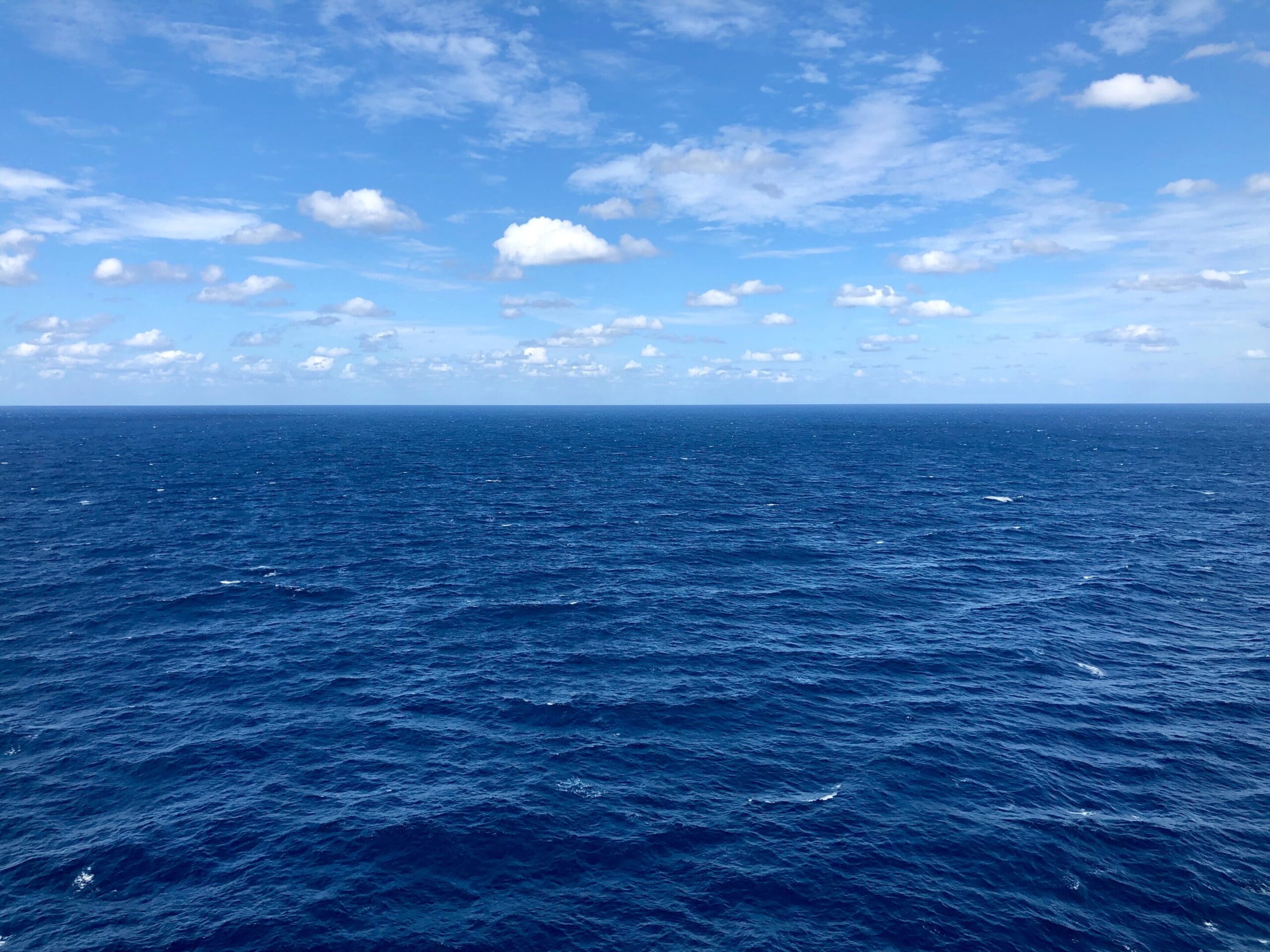
There is a moment on a companionway step when the next tread seems to rise towards the sole of your foot. The distance between the steps has not changed. The motion beneath them has. Atlantic wave forecasts become useful in precisely this small interval, where a number on a screen becomes something the body must accommodate.
A forecast showing a lower sea does not necessarily describe an easier passage. Closely spaced waves can keep interrupting movement, while a higher, longer swell may allow a more legible rhythm. Then another swell arrives across the first, and the rhythm becomes harder to anticipate. Height matters throughout. It simply cannot explain the experience alone.
For the Atlantic crossings within the Naora Global Expedition, we read these distinctions with Discovery in mind: a 2025 Lagoon Eighty2 sailing catamaran, carrying people who need to move, eat and sleep while the ocean continues beneath them. The useful forecast is the one that helps us understand what the yacht will meet, rather than merely how large the sea might look.
What Atlantic Wave Forecasts Mean By Wave Height
The headline wave height usually means significant wave height, a statistical description close to the average height of the highest third of waves in a sea state. Height is measured from trough to crest. It is not the distance a crest stands above an otherwise flat ocean, and it is not a limit that individual waves have agreed to respect.
This matters because the surface is uneven even when the underlying conditions are steady. Smaller waves pass, then a group of larger ones. Individual waves approaching twice the significant height are possible over a long exposure. That relationship is a reason to allow margin, not a formula for predicting the largest wave of a crossing.
Nor does the definition mean that a large wave will arrive at a regular count. There is no dependable sequence to wait through before carrying something across the saloon. A statistical description belongs to a population of waves; the person moving through the yacht has to deal with the next movement.
We also need to know which height the display is showing. A combined sea includes locally generated wind waves and swell arriving from elsewhere. A swell layer may show only one part of that sea. Comparing the total height on one screen with the primary swell height on another can create an apparent disagreement that is really a difference in what has been selected.
The first useful habit is therefore modest: read the label before interpreting the colour. A reassuring shade on a chart has little value until we know what it represents. Even correctly understood, significant height says nothing by itself about the spacing of the waves, their direction or the way separate systems overlap.
How Wave Period Changes The Shape Of The Sea
Wave period describes time between crests at a fixed position, but a real ocean contains a range of periods rather than one repeated interval. A forecast may give a mean period or a peak period. The peak identifies the period associated with the most energetic part of the wave spectrum. The mean describes a broader average. They are not interchangeable readings.
Consider two illustrative forecasts, both showing a significant height of 2 m. One is dominated by waves with a period of 6 seconds; the other by swell at 12 seconds. These are examples, not predicted conditions for a Naora departure. In deep water, the longer period corresponds to much greater spacing between crests. Doubling the period makes the wavelength roughly four times as long.
That changes the shape the yacht has to travel across. At comparable height, the shorter waves are generally steeper. They can bring more frequent changes of support beneath the hulls and sharper interruptions to movement. The longer swell may produce a broader rise and fall, giving the body more time to respond. The comparison concerns slope and timing, not a claim that the longer swell contains less energy.
It would still be wrong to turn this into a rule that a longer period always means greater comfort. A yacht has its own responses to wave forcing, influenced by hull form, loading, speed and the angle of encounter. Some combinations encourage a more pronounced movement than the height alone suggests. A long swell across the beam can remain tiring even when its surface looks beautifully smooth.
Long swell also deserves particular attention near land. As it enters sufficiently shallow water, its speed and shape change; refraction and shoaling can concentrate or steepen it. A period that described an accommodating offshore rhythm may become important for an entirely different reason near an approach or harbour entrance. Deep water and coastal water do not offer the same answer.
Wave Direction And Catamaran Motion
The forecast period belongs to a location on the ocean. Discovery is moving through that location. The interval between the waves we actually encounter therefore depends on our course and speed as well as the period in the forecast. Sailing towards the waves brings the crests more frequently. Travelling with them generally lengthens the interval as they overtake us.
An idealised example makes the difference tangible. In deep water without current, an 8-second wave system encountered by a yacht moving at 8 knots would arrive roughly every 6 seconds directly into the waves, or every 12 seconds travelling directly with them. Real seas are irregular, and these are not measured figures for Discovery. They show why the same forecast can become a different physical experience after a change of heading.
Direction needs its own careful reading. Marine wave directions are commonly expressed as the direction the waves come from. A northerly swell travels south. Arrows on different displays may instead indicate travel direction, so their meaning has to be checked rather than inferred from appearance. Reversing that interpretation would reverse the expected encounter.
On a catamaran, waves approaching the bows tend to emphasise pitching and vertical motion. Waves arriving across the yacht can lift the hulls differently and introduce roll. A quartering sea may combine pitch, roll and yaw, producing a diagonal movement that is harder to anticipate than a straightforward rise and fall.
Discovery’s width provides substantial resistance to heel, but resistance to heel is not freedom from acceleration. The body feels the rate at which movement changes, not merely the angle of the deck. In some conditions, water can meet the underside of the structure between the hulls with a sharp impact. Heading, speed, loading and wave shape all influence that encounter. A spacious yacht still requires a captain to choose how she meets the sea.
When Wind Waves And Swell Arrive Together
Local wind and the waves beneath it need not share a recent history. Wind waves grow under the weather nearby. Swell has travelled away from its generating area and can arrive from a storm far beyond the horizon. A pleasant wind over the deck does not establish that the ocean has become equally settled.
In the North Atlantic during the boreal winter, northeast trade winds at lower latitudes can coexist with swell generated by depressions much farther north. The wind may support the intended passage while the remote swell crosses the locally generated sea. This is a seasonal relationship, not a forecast for a particular departure. It explains why following the tradewinds does not mean following a single orderly wave system.
When systems overlap, their significant heights are not simply added. For independent components, their energies combine. An illustrative 2 m swell and a 1.5 m wind sea give a combined significant height of about 2.5 m, rather than 3.5 m. The combined figure still cannot describe how the crests of those systems will meet at a particular moment.
Some crests reinforce one another; elsewhere the surface movements partly cancel. A broad underlying swell may continue while a shorter sea cuts across it, changing the slope beneath one hull before the other. The resulting movement can feel out of proportion to the modest change in total height.
This is where a secondary swell deserves attention even when it does not dominate the forecast. Lying in a berth, a person may accommodate the slow rise and fall but wake when a smaller sideways movement rolls a shoulder against the bedding. The interruption has a direction as well as a size. A crossing sea is not automatically unacceptable, and a weak secondary component may make little difference. Its significance depends on what it adds to the motion already present.
Reading Atlantic Wave Forecasts Along The Route
A useful reading begins with the combined height, then separates the wind sea and the available swell components. For each component, period and direction belong beside height. We want to understand whether the sea is becoming more organised or more complicated, whether the local wind is building new waves, and whether an approaching swell will change the encounter after departure.
The distinction between peak and mean period becomes especially important in mixed conditions. A small change in the relative energy of two systems can make the displayed peak period switch from one to the other. The number may jump while both systems remain in the water. Reading that jump as an abrupt transformation of the entire sea would give it a meaning it does not have.
Time needs the same attention as the wave layers. The conditions at the departure point this afternoon are not the conditions the yacht will meet farther along the route tomorrow. We read the forecast against an estimated progression through the water, allowing for changes in speed and course. A comfortable-looking corridor is useful only if it remains relevant when Discovery reaches it.
Current can alter the picture further. Where waves meet an opposing current, they can shorten and steepen, making a local area less comfortable than the broad offshore pattern suggests. Near land, depth and coastal shape also matter. A regional forecast cannot be expected to resolve every entrance, shoal or current boundary with equal precision.
Successive forecast updates help reveal whether the larger pattern is holding together. Agreement between models is useful, but it does not remove uncertainty, particularly where they share assumptions or inputs. Once underway, the visible sea and the yacht’s response remain essential checks. If the forecast suggests an easy motion and the motion is not easy, the people aboard are not required to be wrong.
Choosing A Departure Window For Sleep And Safety
Sven is Naora’s founder and captain. For an Atlantic crossing, the decision involves more than finding the lowest wave-height figure near the departure coast. It requires a workable relationship between wind, sea state and the direction we need to sail, together with enough margin to respond when the pattern develops differently.
Waiting can allow a short, steep wind sea to subside. It can also mean that a new swell arrives before the yacht has cleared the area, or that the useful wind shifts away. There is no virtue in waiting simply because waiting sounds cautious. The judgement concerns which departure offers the more manageable sequence of conditions, not which day looks calmest from shore.
The beginning of a passage deserves particular care because people are adjusting to motion while the crew establishes the offshore rhythm. An unnecessarily tiring opening can carry a cost into later watches. Sleep lost to repeated sharp movement is not fully described by saying that conditions remain within the yacht’s capability.
That distinction matters. Conditions can be manageable for the vessel yet demanding for the people living aboard her. Meals become more awkward, small tasks require bracing, and rest becomes fragmented. Comfort is part of passage management because fatigue changes how people move, notice and decide. It is not an ornamental consideration added after the serious work.
No departure forecast can certify an entire ocean crossing. Detailed confidence diminishes with distance into the future, so the plan must remain open to revision. We look for room to alter course or pace without immediately exchanging one difficulty for another. A faster track that depends on every forecast detail being correct may offer less useful margin than a slightly longer one.
Nor is there a universal period or height at which departure becomes sensible. A number without direction, duration, trend and context is an incomplete decision. The responsibility is to understand the combination, including the experience and condition of the people aboard, rather than find a convenient threshold that appears to decide for us.
Adjusting Course And Life On Board
Once at sea, course and speed become ways of changing the encounter. Easing speed in a head sea may reduce the severity of impacts. Altering the angle to the waves may soften the motion, but it can add distance, change the sailing angle or expose the yacht more directly to another swell. Any adjustment has to be considered against the whole pattern, not merely the wave that has just passed.
Slower is not automatically kinder in every direction. In a following sea, reducing speed can shorten the interval between overtaking crests. A change may also bring the yacht into a less comfortable response to the waves. The practical approach is to make a considered adjustment, allow enough time to feel its effect across several wave groups, and assess both movement and control.
Sail configuration belongs within that decision. Carrying sail simply to preserve a target speed can make the yacht harder to manage when the sea becomes confused. Reducing sail before handling becomes unnecessarily difficult gives the crew more room to work. On a catamaran, a lack of dramatic heel should never substitute for attention to sail loads and changing conditions.
Below and on deck, the preparation is quieter. Loose objects need securing before movement sharpens. A route through the yacht should leave a hand available for support rather than require both hands to carry something. Tasks involving hot water or awkward loads can wait for a more suitable moment. These are small accommodations, but repeatedly having to rescue an unsecured object is effort that should never have been required.
A watch handover should carry the character of the sea as well as the wind reading and course. Occasional impacts, a new swell angle or a change in how the yacht settles after a crest can matter to the next watch. A forecast update cannot replace that continuity of attention.
A person asleep below is free to know none of this. Water continues past the hull, and the watch continues above.