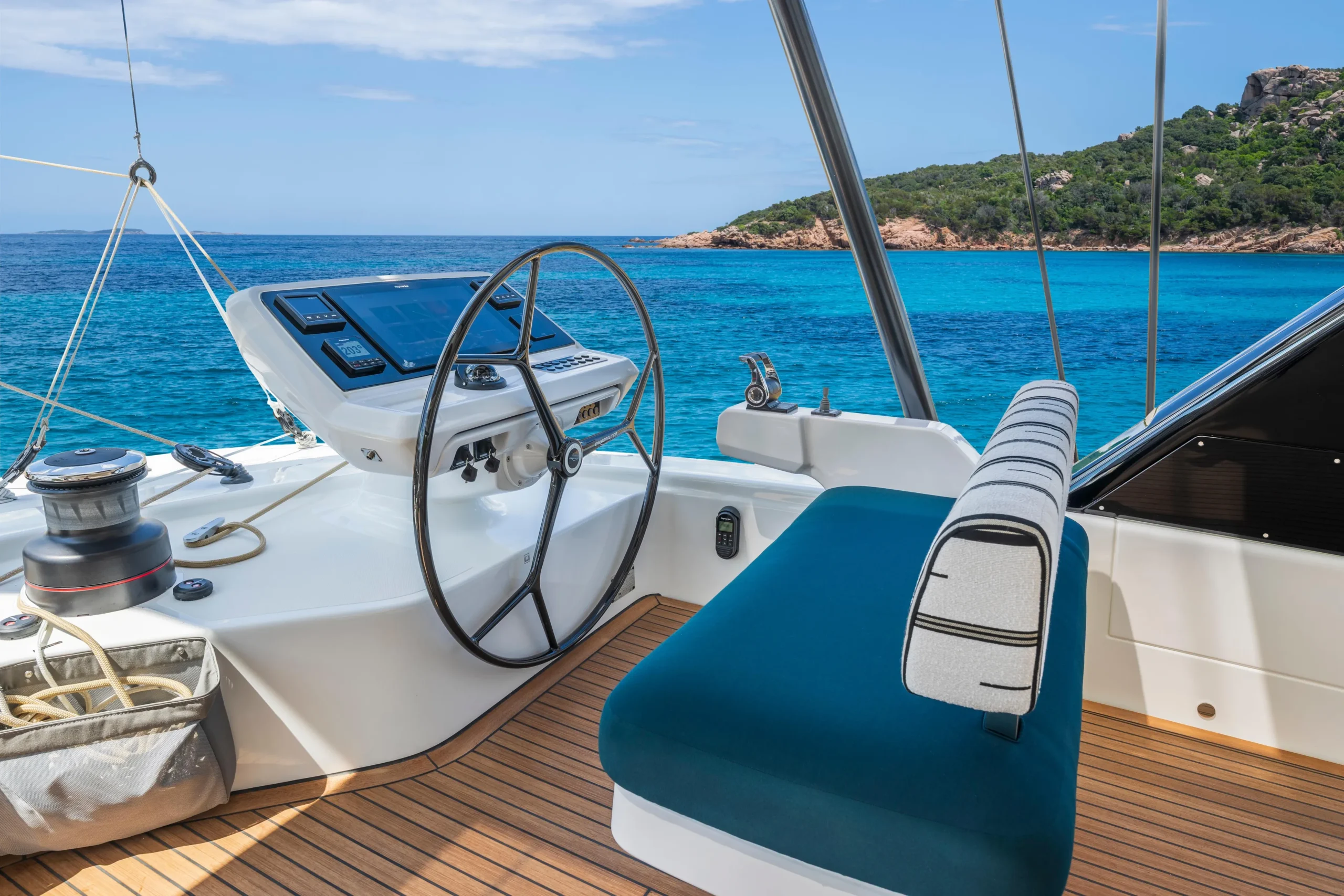
A neat heading display is not proof of a well-balanced yacht. If the steering has to make the same correction after every gust, I want to understand the sails before asking the autopilot to work harder. In Atlantic catamaran sailing, the important distinction is between steering that responds to the sea and steering that repeatedly compensates for a sail plan I should change.
I am planning Discovery’s Atlantic passages within the Naora Global Expedition, our private sailing expedition around the world from 2027 to 2031. Discovery is a 2025 Lagoon Eighty2 sailing catamaran, and I am Naora’s founder and captain. For those passages, I want the steering understood as part of the yacht’s balance, rather than an appliance expected to correct whatever happens above deck.
How Sail Balance Changes Steering Load
The sails produce forward drive, but their combined force can also turn the yacht. Its effect depends on where that force acts relative to the resistance of the hulls and underwater surfaces. Sail area matters, but so do trim, twist, apparent wind angle and the changing pressure across each sail. Two sail combinations with similar total area can ask quite different things of the rudders.
On a reach, a mainsail contributing too much turning force aft can increase the tendency to head towards the wind, commonly called weather helm. The rudders must oppose that tendency. A gust may then produce a larger correction because the imbalance increases with the load. That does not make every gust response evidence of poor trim. I am looking for a persistent relationship, rather than diagnosing the yacht from one movement.
A constant rudder offset and frequent rudder movement are different observations. The first can indicate a steady turning tendency being opposed. The second describes activity, which may come from waves, fluctuating sail forces or the way the pilot is responding. A yacht can have one without much of the other. This distinction matters because movement, hydrodynamic load and electrical consumption are related, but they are not interchangeable measurements.
Nor is a perfectly centred rudder my target in every condition. A modest, stable angle can be entirely reasonable. Chasing a zero indication could leave the yacht less settled, and the indication itself needs to be correctly calibrated. I want useful drive with manageable steering demand, not a flattering number.
Speed through the water changes the interpretation too. In comparable flow, doubling the speed gives roughly four times the rudder force at the same effective angle. Waves and disturbed inflow complicate that simple relationship, but its implication is useful: a small rudder angle at higher speed is not necessarily lightly loaded. Angle alone cannot tell me how hard the steering is working.
Normal Corrections In Atlantic Catamaran Sailing
During the northern winter, the northeast trades across the subtropical North Atlantic can bring roughly 15 to 25 knots of true wind. That is a seasonal pattern, not a forecast for a departure. Squalls, lighter intervals and swell arriving from distant weather can all disturb the apparently simple proposition of sailing west with the wind behind us.
A following or quartering sea repeatedly changes the yacht’s motion and the water flowing past its rudders. A wave can lift the stern and encourage a yaw, the bows swinging away from the intended heading. A competent helmsman would make corrections. The autopilot must make them too. Regular activity in those conditions is not, by itself, evidence of waste or poor balance.
At night, the edge of a sail may be difficult to read against a clouded sky, but the stern lifting beneath your feet is immediate information. I would compare that movement with the heading change and the steering response. A correction that accompanies each passing crest has a different explanation from a repeated pull towards the wind whenever the mainsail loads.
The apparent wind adds another moving part. In a simplified run directly downwind, 20 knots of true wind and 8 knots of boat speed leave 12 knots of apparent wind, ignoring current and wave-driven acceleration. The air felt on deck can therefore seem moderate while the wider conditions deserve attention. As speed and heading change on a wave, the apparent wind changes too, altering both sail force and balance.
I would expect some variation, not demand an unnaturally straight trace. What interests me is a change in pattern: more sustained rudder bias, larger heading excursions, or a drive becoming busier without a corresponding change in the sea. Those observations give me somewhere sensible to begin.
Finding The Cause Before Changing Autopilot Settings
Before touching the controls, I want to know what the pilot has actually been asked to maintain. A compass heading, a wind angle and a navigational track are different objectives. I would check the selected mode and its inputs, rather than assume the yacht is responding to the number most prominent on the display.
Course over the ground is not the same as heading. Current can carry the yacht sideways while its bow remains steady, and leeway creates another difference between where it points and where it travels. Comparing those readings without understanding them can make normal behaviour look like a steering fault. Equally, a faulty heading input can make the pilot correct a turn the yacht has not made.
Where rudder-angle information is available, I would compare its indication with the yacht’s behaviour and the known calibration. Drive activity and electrical readings add evidence, but no single display settles the question. A persistent offset might reflect sail balance, sensor alignment or something mechanical. New difficulty turning in one direction deserves investigation, not an assumption that the mainsail needs easing.
In suitable conditions, a controlled period of hand steering can help separate the yacht’s behaviour from the pilot’s response. That means a competent person at the helm, a proper transfer of control and the lookout maintained. It does not mean releasing the wheel to see what happens. Some steering arrangements isolate much of the rudder load from the wheel, so a light feel is not proof of a light load.
I would notice whether the same corrective input is repeatedly needed, how the yacht responds to it and whether the response changes with a gust or wave. If heading control is deteriorating, diagnosis cannot become a leisurely exercise. The immediate requirement is reliable steering and a manageable sail plan. Adjusting response settings comes after that, within the installed system’s operating limits.
Changing Sail Balance Before Adding Autopilot Effort
If the yacht is carrying too much sail for the conditions, I would reduce it rather than conduct a long trim experiment. The permitted sail combinations and the developing weather govern that decision. A relatively level catamaran can still be heavily loaded, and the autopilot keeping the bow pointed in the right direction does not make an excessive sail plan acceptable.
Within an appropriate sail plan, I would make a deliberate adjustment and observe its effect. If the main is contributing disproportionate turning force, changing its working angle or allowing appropriate twist may reduce that contribution. The upper part of the sail can then carry less load without treating the entire sail as either fully powered or completely released. The adjustment still has to preserve control and avoid damaging flogging.
The headsail belongs in the same decision. Reducing it automatically because the steering seems busy may move the balance in the wrong direction. Adding more forward sail to counter an overloaded main can also be the wrong answer: it may improve the turning balance while increasing total rig load. Balance and safe sail area have to be right together.
A partly blanketed headsail introduces a different problem. When it collapses and fills again, the cloth can announce the change with a hard report, followed by a pulse through the rig and a swing of the bows. Asking the pilot to react faster may hide some of the heading movement, but it does nothing to make that repeated loading desirable. Sail configuration or course may need to change.
There is a useful counterpoint here. Less sail does not always mean less steering effort. Reducing too far can leave insufficient speed for effective rudder response in a following sea, or make the sails less stable. I am looking for controlled, sustainable drive, not the smallest possible sail area. The answer depends on the yacht, the wind and the waves acting together.
After an adjustment, I would allow enough comparable wave encounters to judge it, provided control remains comfortable. I would look for a change in persistent rudder bias, correction size and speed through the water, rather than celebrate one quiet interval. If the improvement requires the pilot to tolerate unsafe heading swings, it is not an improvement. Proper response settings remain necessary even with well-balanced sails.
What Autopilot Effort Costs In Electricity
The electrical cost depends on the installed steering arrangement. A loaded rudder held at a steady angle may require little additional electrical power in one system, while another arrangement has different holding or standby demands. Moving the rudders repeatedly introduces further consumption, but the relationship between force, movement and current is not a universal conversion. I would not assign Discovery a consumption figure from its model name.
For passage planning, the useful quantity is energy accumulated over time. A brief current peak tells me something different from the average demand through a watch. Where the monitoring permits it, I want steering demand separated from the rest of the yacht’s electrical use. Otherwise, a refrigeration cycle or another onboard load can make a trim change appear more effective, or less effective, than it was.
Consider an illustrative extra demand averaging 100 watts over 24 hours. That amounts to 2.4 kilowatt-hours in a day. It is not a measured figure for Discovery, but it explains why a modest continuous difference matters offshore: energy used unnecessarily has to be replaced. The practical cost may include charging time and reduced flexibility about when other electrical work is done.
It would be misleading to translate that example directly into generator running time. Charging losses, the charging system, battery condition and simultaneous loads all affect the result. Nor can an amp-hour figure be interpreted properly without knowing the system voltage. For comparisons, energy measured over a representative interval is more useful than an isolated current reading.
I would also record the conditions around a comparison. Lower consumption after reducing sail proves little if the sea has flattened at the same time. A defensible judgement needs similar speed, wind angle and sea state, or an honest acknowledgement that they changed. The purpose is to understand demand, not to produce an attractive saving. Steering remains a safety function, and I will not weaken useful control to improve an energy figure.
Steering Wear And Watch Handover
Repeated movement under load has consequences beyond the batteries. Depending on the drive arrangement, motors, pumps, joints, seals and bearings experience different combinations of heat, pressure and cycling. Unnecessary reversals can add work to components that must continue operating far from shore. That does not mean every audible correction is harmful. The equipment is there to steer, including in an active sea.
I am more concerned by a change from established behaviour than by an arbitrary count of movements. Increasing current for comparable work, a new noise, unexpected play, fluid leakage where applicable, or a discrepancy between commanded and actual response deserves attention. Sail trim cannot repair a restriction or a worn connection. Turning up the pilot’s response can sometimes conceal a developing problem while adding further effort.
Physical inspection has to respect the machinery. Moving steering gear and loaded connections are not places for exploratory hands. Checks requiring isolation belong within the appropriate shutdown procedure, with control of the yacht maintained. Before an ocean departure, I want the crew familiar with the actual arrangements for manual control, drive disengagement where applicable and emergency steering, rather than relying on a generic understanding of autopilots.
The watch handover should preserve the explanation of the yacht’s behaviour. A note that the pilot is working harder becomes useful when it includes the wind angle, sea state, sail configuration and any adjustment already made. Otherwise, the next person can inherit an unexplained setting and begin changing it again. Consistency between watches protects both judgement and rest.
In a quiet cabin, a mechanical sound can become more noticeable than it was beside a conversation on deck. A change in its rhythm may be worth reporting, but cabin silence is not a condition report. I want the watch to notice steering behaviour before it becomes something a resting person feels obliged to investigate.
Choosing A Course For Atlantic Catamaran Sailing
Sometimes the most effective adjustment is to the course. Sailing deeper may look attractive on the chart while bringing unstable sails, an awkward wave angle or too little margin from an accidental gybe. A different angle can give steadier drive and more predictable steering. It can also add distance. That trade needs to be assessed against actual progress and the wider weather picture, not dismissed because the line is less direct.
Where wind steering is available, maintaining an apparent wind angle can help preserve the relationship between the sails and the airflow. But a wind shift can then alter the yacht’s geographical course. Compass steering preserves a heading while allowing the wind angle to change, which may demand a sail adjustment instead. Neither mode removes the need to watch the sea, traffic, squalls and the margin from an unintended gybe.
I would not choose a course solely because it produces the lowest steering demand. Navigation and safety come first, followed by a workable balance of progress, motion and load. There will be conditions in which the pilot has to work steadily despite sensible sails and a sensible route. The responsible choice then is to recognise legitimate demand, monitor it and preserve the equipment’s operating margin.
That is the distinction I want carried into Discovery’s Atlantic watches. Some mechanical effort belongs to the passage. Some is a request for a better decision. The person asleep below should not need to know which sound is which.