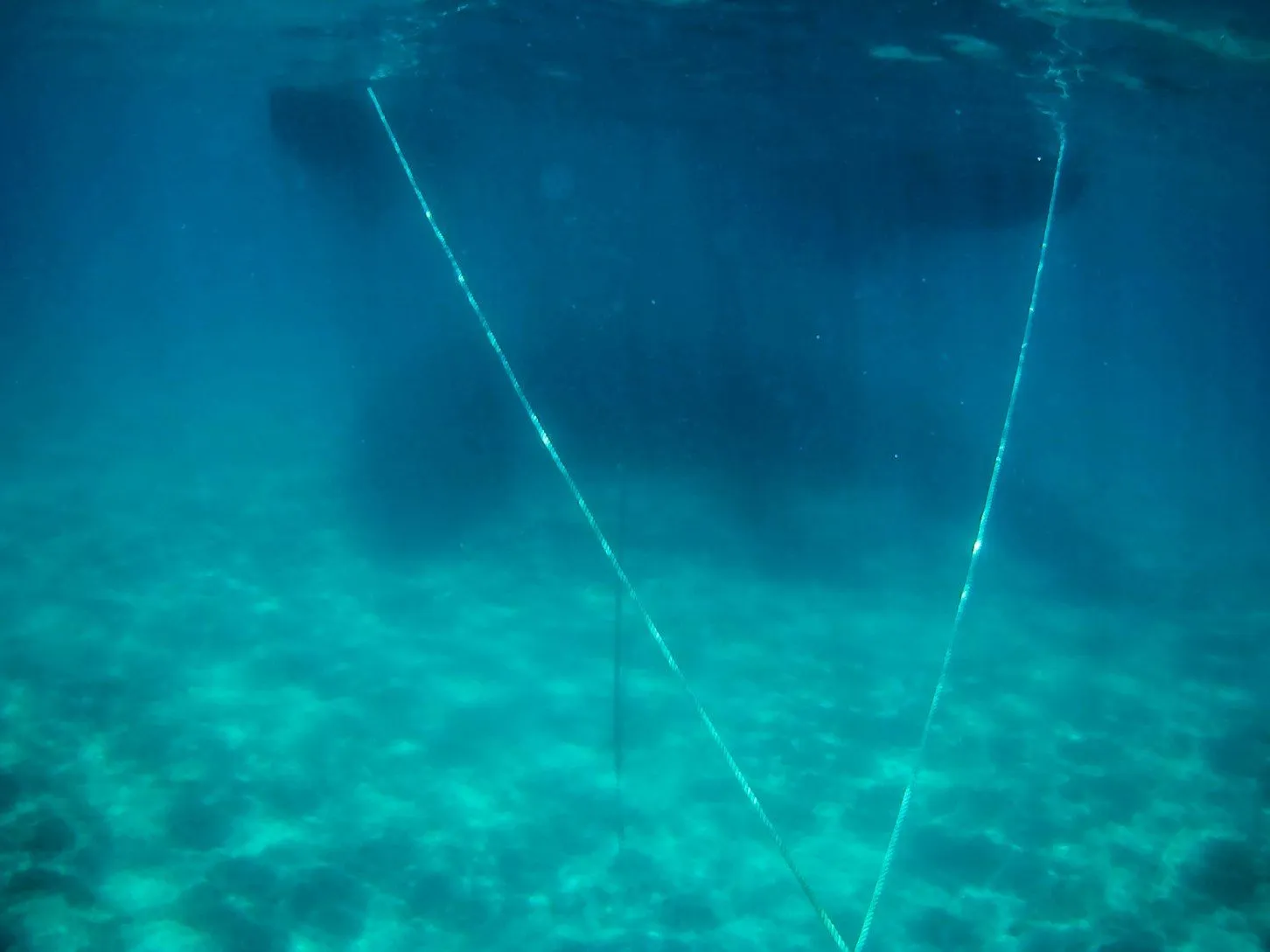
The revealing moment comes just after the bow begins to swing back. A bridle leg that looked almost loose straightens again, and the rope moves against the mouth of its protective sleeve. That small movement is where an examination of anchor bridle chafe begins, even when the water around the yacht looks settled enough to invite a swim. The anchor may be holding perfectly. The rope is still working.
For the Caribbean chapter ahead of Discovery, our 2025 Lagoon Eighty2, this distinction matters more than the appearance of the bay. Shelter is not a single condition. We can have shelter from breaking seas without shelter from wind, and shelter from wind without being free of the swell that finds its way around a headland. A comfortable anchorage can keep an anchoring system busy throughout the night.
We want the inspection to answer a particular question: what is moving against what, under which part of the load? Looking at a sleeve and finding it intact answers something much narrower. It tells us about the sleeve.
Why A Sheltered Caribbean Bay Still Loads The Bridle
In exposed Caribbean waters, easterly trade winds around 15 to 25 knots are common during winter, with lulls, stronger spells and squalls outside that range. The range describes a familiar weather pattern, not the conditions promised inside a particular bay. A hillside can interrupt the wind while a gap beside it concentrates the flow, giving an anchored yacht alternating periods of apparent rest and a firm pull astern.
Wind load also grows faster than wind speed. With the same exposed area and orientation, a rise from 20 to 30 knots produces roughly two and a quarter times the aerodynamic force. That is a simplified comparison, not a calculation of Discovery’s bridle tension, because heading, motion and the anchoring arrangement all intervene. Its useful meaning is that a modest-looking increase on the wind display deserves more attention than the difference between the numbers suggests.
Then there is the water. Swell generated elsewhere can bend into a bay that has very little locally generated chop. Current may hold the hulls across the wind rather than neatly into it. Passing wakes add occasional movement. A catamaran can surge backwards and forwards, yaw from side to side, and pitch while the shore appears almost stationary.
Low light is useful here. Watch the changing curve of each bridle leg, rather than only the bright water beyond it. One side may straighten while the other eases, then reverse as the bows come through the wind. An anchor alarm can remain silent throughout, correctly reporting that the yacht has not left its permitted area. It cannot tell us that the same short length of rope is rubbing with every swing.
How Lead Angles Change Anchor Bridle Chafe
The bridle carries the anchor load towards strong points on both sides of the yacht, but two legs do not automatically mean that each carries half the pull. Their angles matter. So does the direction from which the load arrives. A still photograph of a symmetrical bridle is a poor description of the forces in one that is moving.
Consider a simplified arrangement with equal legs, a centred pull and both legs in the same horizontal plane. At an included angle of 60 degrees where the legs meet, each carries about 58 per cent of the total pull. Open that angle to 120 degrees and each leg carries a tension equal to the whole pull. The sideways components oppose one another, leaving only part of each leg’s tension to resist the yacht’s movement astern.
Those figures explain why a very wide bridle deserves scrutiny. They do not provide a sizing calculation for Discovery. Real leads descend towards the chain, attachment heights differ, and yaw can put substantially more load on one leg. The deck fittings and their supporting structure must be suitable for the actual direction of pull, not merely strong in some general sense.
At each contact point, the question becomes more local. Does the rope follow a fair curve over a generous bearing surface, or turn sharply around an edge? Does the contact remain on the protected section throughout the swing? A surface that feels smooth with the rope slack may still concentrate pressure when the lead changes. A sleeve cannot turn an unsuitable fitting into a suitable one.
Length offers a trade off rather than a universal answer. Longer legs can narrow the included angle and, with an appropriate elastic rope, provide more stretch. They can also introduce contact with the hulls or chain, or put a connection where pitching creates another problem. Shorter legs may improve clearance while making the geometry wider and the system less forgiving. We need to see the complete movement before deciding that an adjustment has improved anything.
What Repeated Loads Do To An Anchor Bridle
The damaging feature of a trade wind anchorage is often repetition rather than a single exceptional pull. If a movement repeats every ten seconds, it happens 360 times in an hour. That is an illustrative rhythm, not a measured period aboard Discovery, but it gives scale to something the eye dismisses as a small twitch. Overnight, the rope can make thousands of movements against the same contact surface.
Rope does not have to slide visibly through a fitting for wear to develop. It stretches and contracts. Its fibres bend, compress and move against one another. Where a sleeve remains against a bearing surface, the rope may move inside it. Grit caught between them adds an abrasive material to an already active interface.
An elastic snubbing arrangement helps by allowing the yacht to decelerate over more distance instead of coming up abruptly against a nearly rigid restraint. Nylon is commonly used for this purpose, but material names alone do not describe a complete system. Construction, working length, wet behaviour, terminations and the permitted loads all matter. A very strong, low-stretch rope is not automatically a substitute for an elastic one.
Chain contributes through its weight and changing curve, particularly at lower loads. As the pull increases and more chain lifts, there is less of that geometric reserve available. We cannot assume that the weight of chain will always soften the next surge. Nor is an arrangement that repeatedly goes slack and then snaps tight satisfactory merely because the rope has stretch. That movement is a reason to reconsider the whole setup, including the anchorage itself.
Where Protective Sleeves Conceal Wear
A sleeve does useful work by keeping the rope away from a damaging surface and providing material that can wear instead. The difficulty is that it also covers the place we most need to examine. A sound outer surface can conceal damaged rope, while a worn sleeve may have done its job without significant injury to the fibres beneath it.
The ends deserve particular attention. A sleeve can migrate until the working contact lies beyond its protection. A stiff sleeve can create a new bending point at its mouth. A securing arrangement can keep the sleeve in place while leaving the rope to work inside it. Adding another layer may increase protection against an external edge, but it can also make the area harder to inspect and less able to follow the rope’s movement.
Once the line is safely unloaded, sight and touch belong together. We want the whole circumference exposed, including the underside that faced the fitting. Local loss of diameter, cut strands, concentrated fuzzing, flattening or an unusually hard patch need investigation. Glossy or fused fibres can indicate heat damage. None of these signs tells us a dependable percentage of remaining strength, and a clean exterior cannot certify the condition of the interior.
The tactile comparison is often more revealing than an isolated look. A wet sleeve can feel cool and smooth in the hand; the rope beneath it may feel different from the adjacent, unaffected length. A short section that resists bending deserves attention even if its colour looks ordinary. We compare like with like, allowing for how wet and tightly constructed the rope is, rather than treating every change in feel as the same defect.
There is an important counterpoint to excessive caution by appearance alone. Light, evenly distributed surface fuzz is not equivalent to a deep local wound, and discarding every rope that looks used is not sound maintenance. The judgement depends on its construction and retirement criteria. Where damage cannot be assessed confidently, the answer is replacement, not a more reassuring cover.
Inspecting Anchor Bridle Chafe With The Load Off
The inspection begins before anyone touches the rope. We watch several complete movements from a safe position, identifying where the load transfers and where contact occurs. We keep hands away from loaded lines and fittings, and bodies clear of bights and the possible recoil path. A bridle that looks quiet between gusts is still part of a loaded anchoring system.
Moving a sleeve or opening a termination requires the load to be removed in a controlled way. That means having a suitable alternative load path, through equipment and strong points intended for the task, before disturbing the bridle. Depending on the arrangement, this may involve a properly rated chain stopper or a separate holding arrangement. The windlass alone is not something to assume can take the anchoring load.
Nor do we assume that the remaining bridle leg can safely carry everything while its partner is examined. Its rating, lead and fittings must support that decision. Sven, Naora’s founder and the captain who sails every leg, is responsible for the anchoring decision; the inspection has to be coordinated with whoever is controlling the load transfer. A passing lull does not replace that coordination.
With the relevant section genuinely slack, the protection can be moved far enough to inspect all the rope it covered. The examination continues through eyes, splices, bearing points and the chain connection. Grit and salt deposits need to be removed in a way suitable for the material, because dirt can both conceal damage and contribute to it. If a protective arrangement prevents meaningful inspection, that limitation belongs in the maintenance decision.
Returning the load is part of the check. We watch the rope settle, confirm that the intended contact remains protected, and observe the next swings. The setup that looked correct in the hand has to prove itself in its working shape.
When To Adjust, Replace Or Move
The cause matters as much as the damaged patch. If a sleeve has migrated, securing it appropriately may solve the immediate problem, provided the rope beneath remains serviceable. If a sharp lead is concentrating pressure, a thicker sleeve merely delays the same mechanism. If yaw repeatedly pulls a leg across an unsuitable edge, the lead itself needs changing within the limits of the yacht’s anchoring arrangement.
Moving a worn section away from the fitting can be useful only after deciding that the rope is still fit for service. It does not restore damaged fibres. A replacement also needs to be suitable in construction, length, strength and terminations; the strongest spare on board may have the wrong stretch characteristics for the job. This is why a spare bridle is something to specify before departure rather than improvise after finding damage.
More rope is not always the answer elsewhere in the system either. Additional anchor scope may improve the geometry at the seabed, but requires adequate swinging room and does not cure a bad bridle lead at the bow. Nearby yachts, the depth change with tide and the possibility of a wind shift remain part of the decision. A repair made at deck level cannot compensate for an unsuitable berth.
Sometimes the useful adjustment is geographical. A different position may reduce swell or put the yacht out of a gust corridor. Sometimes the sensible choice is another anchorage. Leaving a pleasant bay costs time and may alter an afternoon ashore, but staying while repeatedly dressing the same abrasion point is not necessarily the more considered decision.
The next inspection follows the conditions, not only the clock. A stronger forecast, a change in swell direction or a newly restless swing changes the value of the previous check. Recording the location and character of wear makes that check more useful later, when it becomes possible to distinguish a recurring lead problem from an isolated damaged sleeve.
The Quiet After The Inspection
There is a particular mistake in treating maintenance as the interruption to life at anchor. Some of it interrupts, certainly. A load transfer needs attention, and a sleeve that will not move may take longer than expected. But leaving uncertainty beneath a cover does not preserve the afternoon. It leaves a portion of the mind at the bow, listening for a noise and reconsidering something that could have been examined properly.
Across the Naora Global Expedition, Discovery will move between regions where the water has different colours and the shore asks different things of us. The continuity is practical. The condition found at one anchorage accompanies the yacht to the next. A note about a contact point, an appropriate replacement and a corrected lead are part of what makes a long route possible without asking each arrival to begin from nothing.
By evening, a small change in sound can be easier to notice than it was among the movements of the day. A repeated creak deserves a look; its absence is not proof of anything. Once the checks are complete, attention can return to ordinary things, the water against the hull, a conversation continuing behind us, the light going from the shore.
The sleeve is back in place. What lies beneath it is no longer a guess.