Spread a chart of the Mediterranean across a table and follow the coast east from Palma. Valletta comes next, then Alexandria. Beyond Egypt, the route turns into the Red Sea and continues towards AMAALA in Saudi Arabia. At this scale, a finger can cover the passage in seconds. Enlarge it, and the spaces between those names begin to fill: headlands, shipping lanes, exposed approaches, places to wait.
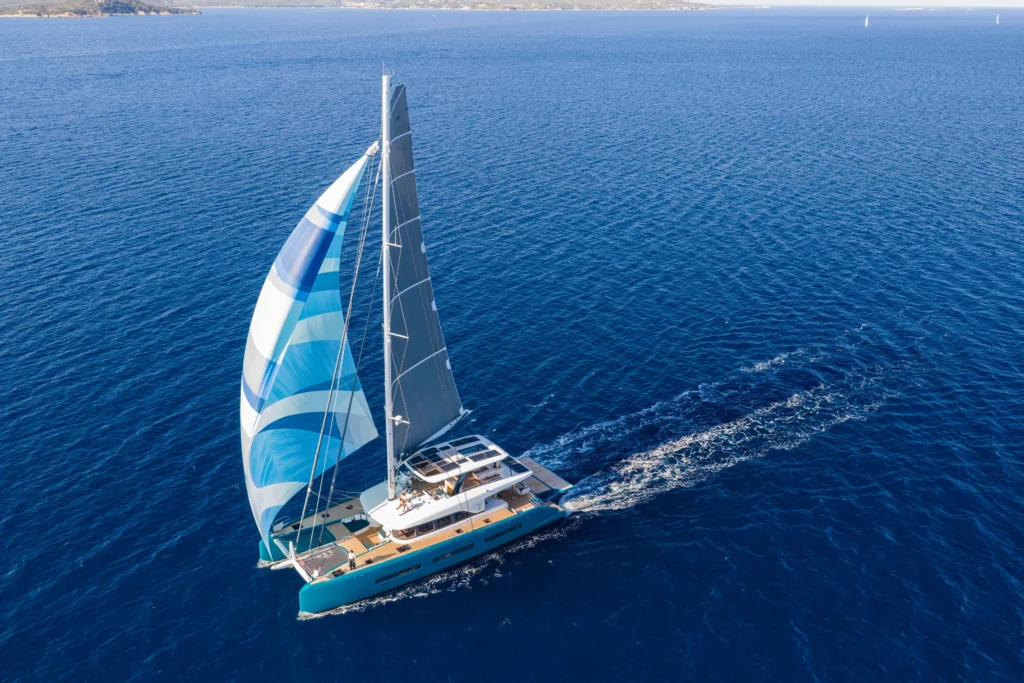
That difference between the broad line and the detail is where Sven’s work begins. He plans every weather window and sails every leg aboard Discovery, 2026 Lagoon EIGHTY 2 sailing catamaran. The prelude runs from January to April, before NAORA begins in the Red Sea. It is a passage east, but it is also a succession of decisions about when to move, how to arrive, and what to leave open.
The person responsible for the space between
Antony is the co-founder behind NAORA and its idea of a world at sea you enter and leave on your own terms. Sven is the captain responsible for navigating Discovery through the conditions that make that world possible. The distinction matters. A vision can describe the freedom of a day afloat; a captain has to account for the wind that afternoon and the sea outside the harbour entrance.
On this prelude, Sven’s responsibility is continuous. He does not simply set a route for someone else to sail. He plans the weather windows and then sails the legs those decisions create. There is a direct connection between the forecast considered ashore and the motion felt later through the boat.
That is the most useful place to begin a portrait of him: with the work. Before asking what kind of captain someone is, look at what they must notice, and what they must be prepared to change.
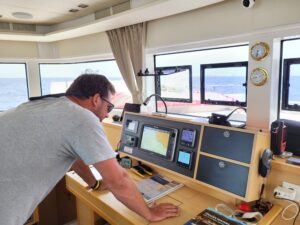
A weather window has an exit as well as an entrance
A departure forecast can be reassuring and still describe a poor passage. The wind may be comfortable outside Palma while the next system is already shaping the conditions farther east. A weather window is therefore not just a favourable hour to leave. It needs to make sense along the route and, crucially, at the other end.
One useful planning technique is to work backwards from arrival. What conditions would make the approach manageable? How much daylight would be helpful? If progress is slower than expected, does the arrival remain sensible, or does it slip into a less forgiving period? Those questions help define the departure rather than merely follow it.
For Sven, planning every window means holding that whole sequence together. A date in the itinerary cannot answer those questions. Neither can a single wind arrow on a screen.
Distance in Nm gives the passage its length. It does not, by itself, tell you how long the crew will be exposed to difficult motion, or how much reserve they will have when the harbour finally comes into view.
Reading the sea behind the wind
Wind speed is an incomplete description of what a boat will meet. The sea has a memory. Swell can remain after the wind that produced it has eased, while a newer wind builds a different wave pattern over the top. Two forecasts with similar wind strengths can produce very different days aboard.
Wave period is one of the less obvious details worth understanding. It describes the time between successive wave crests. A shorter period generally means less time between encounters; direction and steepness then help determine how those encounters feel. On a large catamaran, a short, steep sea on an awkward heading can make a moderate forecast surprisingly tiring.
This is why route planning cannot be reduced to finding the fastest line. A change of heading may improve motion but add distance. Slowing down may reduce impacts while moving the arrival later. Each adjustment affects something else.
Sven has to plan for those relationships, not just the individual numbers. Comfort and seamanship often meet in the same decision: less punishing motion can also mean a crew better able to rest and work.
Palma to Valletta: winter sets the terms
The first leg begins in Palma de Mallorca and heads towards Valletta. Starting the prelude in January means treating the western Mediterranean as a winter sea, not borrowing its summer reputation. Strong weather can develop across the basin, and shelter at the departure berth says little about conditions beyond it.
There is a sensory trap here. Inside a harbour, the water may barely move. Coffee stays level in a cup. Beyond the breakwater, the same day can have an entirely different character. A captain has to make the decision using that second picture, even while standing comfortably inside the first.
Malta brings another planning distinction into focus: reaching an island is not the same as completing an arrival. The approach, traffic, harbour arrangements and conditions near the entrance all belong in the passage plan.
For Sven, Valletta is both the destination of one leg and the starting point of another. An arrival needs to leave room for rest, checks and a fresh assessment, rather than becoming an automatic departure east.
Valletta to Alexandria: keep the alternatives alive
East of Malta, the next destination is Alexandria. Here, as on any offshore leg, an alternative must be more than a name on a chart. It needs to remain reachable in the conditions that might make it necessary.
A harbour behind the boat may become an uncomfortable upwind return. A closer refuge may have an approach exposed to the very weather being avoided. The useful question is not simply where shelter exists, but when a change of plan would still give access to it.
A practical technique is to identify decision points before departure: stretches of the route where continuing would narrow the options. Reassessing before those points is more useful than waiting until the boat is already committed.
This is part of the substance behind Sven’s weather planning. There is the intended route, and there is the changing set of choices around it. Good preparation preserves those choices for as long as reasonably possible. It also makes turning back or waiting an ordinary navigational decision, rather than a drama.
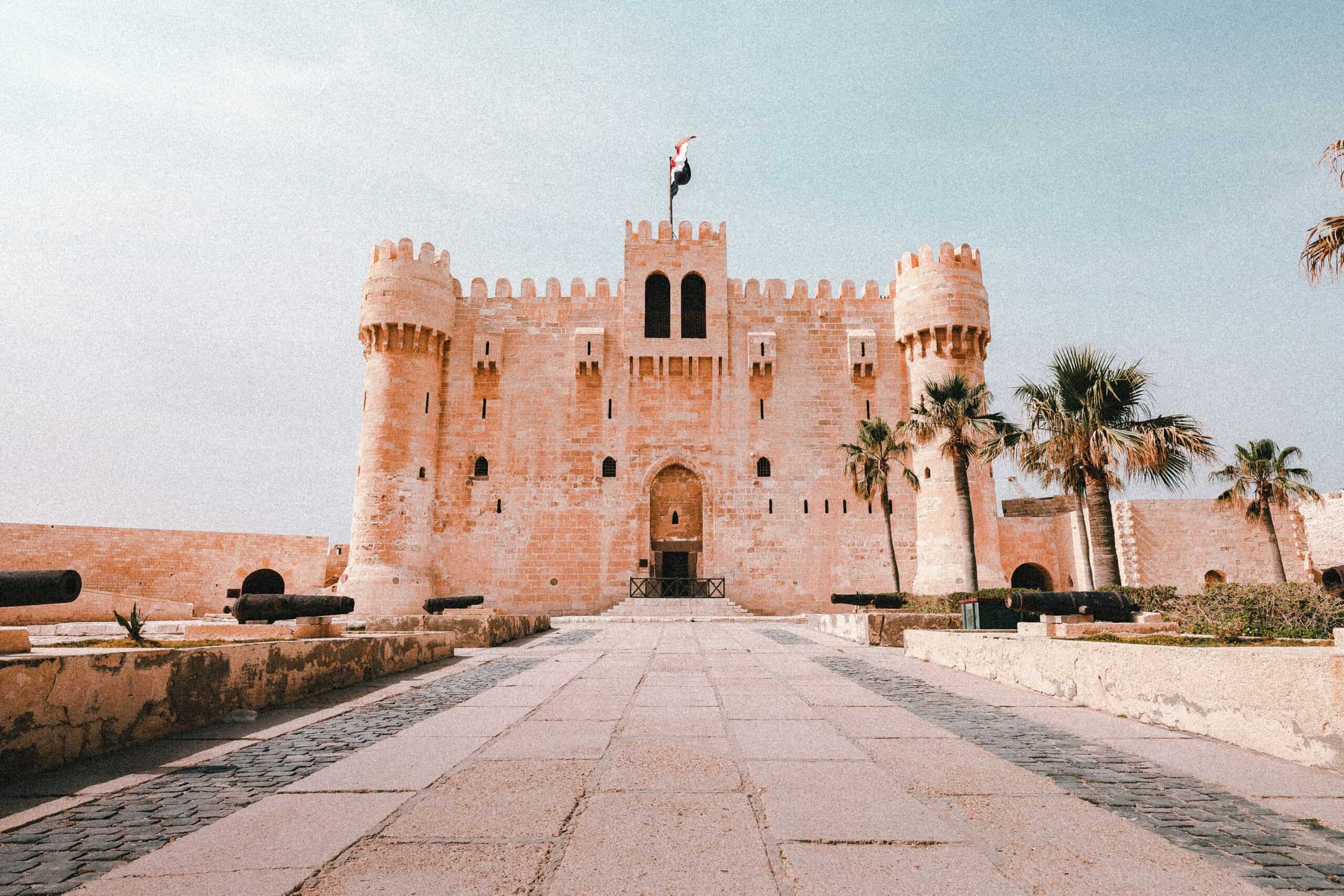
Alexandria is not the Red Sea
On a small map, Egypt can look like a single threshold. In practice, Alexandria lies on the Mediterranean coast, west of the Suez Canal’s northern entrance at Port Said. Reaching Alexandria does not mean the yacht has reached the canal, let alone the Red Sea.
The onward passage therefore contains distinct tasks: coastal navigation, coordination for the canal transit, and preparation for the waters beyond Suez. Administrative readiness and weather readiness are different things. Having arrangements in place does not oblige a captain to accept an unsuitable sea state.
For Sven, this transition also means changing the planning frame. Offshore sailing gives way to a regulated waterway with its own procedures, then opens into the Gulf of Suez. The physical distance between those environments can be modest compared with the difference in attention each requires.
The route continues east and south, but the work does not follow one unchanging rhythm.
Into the Red Sea, towards AMAALA
The Red Sea is long and narrow, bordered by land that influences the wind. Conditions are not uniform along it. The Gulf of Suez deserves its own assessment, and farther on, reefs and coastal approaches demand attention quite different from that of open-water sailing.
Clear water can be deceptive. A change from deep blue to pale turquoise may be beautiful from the deck, but colour alone cannot establish a safe route. Charted information, navigational instruments, visibility and a proper lookout need to support one another. Glare or a low sun can make visual interpretation harder precisely when detail matters.
The final leg towards AMAALA is consequently not a ceremonial finish. It is still a passage for Sven to plan and sail, with an arrival to prepare. By April, the prelude’s calendar has advanced considerably from its January beginning in Palma. The obligation to assess the next stretch on its own terms remains unchanged.
What the title comes down to
Who is Sven? On the passage from Palma to AMAALA, he is the person who connects the route on the chart with the conditions outside. He plans every weather window, sails every leg, and carries the decisions from one into the other.
Much of that work is quiet. It happens before departure, while the boat is still, and again when a forecast needs testing against the sea itself. Sometimes the sound that follows is an engine starting and lines coming aboard. Sometimes the lines stay where they are.