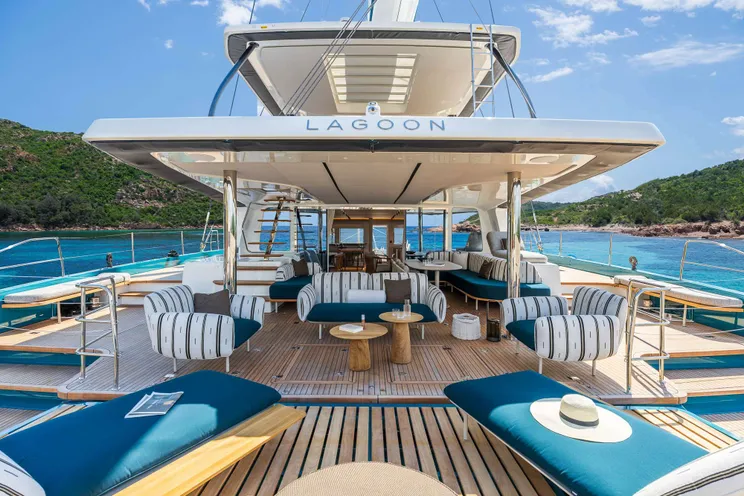
For much of the last two decades, luxury yachting equated size with status. Bigger hulls, taller superstructures, more decks, more crew, more gold leaf on the railings. That era is not over, but it is increasingly sharing the stage with a different sensibility, one that values restraint over spectacle and substance over display. We call it quiet luxury, and it has become one of the defining ideas behind how we built Naora.
Quiet luxury at sea does not mean a lack of quality. It means quality that does not need to announce itself. Our members travel aboard the Lagoon Eighty2, a vessel chosen for seaworthiness and comfort rather than for the number of jet skis it can carry or the size of its onboard cinema. The experience is refined precisely because it is uncluttered.
This distinction matters more than it might initially seem. A vessel designed to impress from the dock often makes design compromises that work against comfort once underway: excess weight from elaborate fittings, complex systems that demand constant crew attention, and interior layouts built for photographs rather than for the rhythms of daily life aboard. A catamaran built around genuine livability, by contrast, tends to sail more comfortably, anchor more stably, and require less constant maintenance fuss from the people meant to be enjoying it.
From Flashy to Refined
The shift away from ostentation has been building across luxury categories for years. Quiet luxury first took hold in fashion, where logo-heavy pieces gave way to unmarked cashmere and tailoring that whispers rather than shouts. Hospitality followed soon after, with design-led boutique properties drawing attention away from logo-stamped five star chains. Yachting, an industry historically built on visible scale, has been slower to embrace the same restraint, but the appetite is clearly shifting among a new generation of charter guests and owners.
Part of this shift is generational. Many of today’s most active luxury travelers built their wealth through technology, media, or asset-light ventures rather than inherited fortune. Their instincts run toward efficiency and authenticity rather than display, and a sailing experience that prizes calm anchorages over crowded marinas tends to suit that instinct far better than a superyacht parade through a packed harbor.
There is also a practical dimension. The largest, most visible yachts attract attention not only from photographers but from harbor authorities, port fees, and increasingly from local communities pushing back against oversized vessels crowding small coastal towns. A more modestly scaled vessel moves through the world with far less friction, able to reach smaller harbors, shallower anchorages, and more remote stretches of coastline that a 60 meter superyacht could never approach in the first place.
What Quiet Luxury Looks Like Onboard
Several principles guide how we have designed the onboard experience around this idea:
- Small groups of 10 to 12 guests rather than crowded charter parties
- Anchorages chosen for calm and privacy rather than visibility
- Onboard chef and crew service that feels personal rather than performative
- Destinations selected for character rather than for their presence on a tourist map
- A focus on conversation, rest, and genuine connection over staged experiences
None of these choices are accidental. Each reflects a deliberate decision to prioritize how an experience feels over how it photographs, even though, in practice, the resulting moments tend to photograph rather beautifully on their own.
The Difference Between Exclusive and Loud
It is worth separating two ideas that often get conflated: exclusivity and visibility. A mega yacht docked prominently in Saint Tropez is highly visible but not necessarily exclusive, since anyone walking the marina can see it and photograph it. A small vessel anchored quietly off an island with no public mooring, accessible only to a curated group of members, is exclusive in a far more meaningful sense, even though almost nobody else will ever know it was there. We have built Naora firmly on the second definition.
True scarcity, after all, is not about how large or how visible something is. It is about how difficult it is to access regardless of how much money someone is willing to spend. A walk-up charter can be booked by almost anyone with sufficient funds and a free week. A place aboard the Eighty2 requires membership, a fit with the existing group, and a willingness to travel on the rhythm of an ongoing journey rather than a fixed departure date chosen purely for convenience.
Loud Luxury Versus Quiet Luxury at Sea
| Element | Loud Luxury Yachting | Quiet Luxury at Sea |
|---|---|---|
| Vessel size | As large as possible | Sized for comfort, not spectacle |
| Anchorage choice | Visible, popular harbors | Calm, often remote bays |
| Group size | Large parties, frequent guests | 10 to 12 curated members |
| Signal of status | Visible scale | Access others cannot simply buy |
| Primary focus | Being seen | Genuine rest and connection |
Why This Resonates With Our Members
Many of our members come from professional worlds where visibility is already a constant. Founders are photographed at conferences, creatives are tagged across social platforms, and public figures rarely have a private moment that stays private. What they tell us they crave at sea is the opposite of that exposure: anonymity, calm, and a group small enough that no one needs to perform for anyone else aboard.
That is also why our membership structure caps group size deliberately rather than maximizing it. A larger group would generate more revenue per leg, but it would also dilute the very quality our members join for. Quiet luxury, in this sense, is not a marketing aesthetic for us. It is a structural decision built into the size of the vessel, the size of the group, and the choice of where the Eighty2 drops anchor each evening.
We have noticed this preference show up in small details as much as large ones. Members rarely ask about onboard entertainment systems or elaborate water toy inventories during initial conversations. They ask about the size of the group joining their leg, the privacy of the cabins, and whether the itinerary includes time at anchor away from other vessels. These are quiet questions, and they tend to come from people who have already experienced the louder alternative and decided it was not, in fact, what they were looking for.
A Quieter Way Forward
As the broader luxury industry continues its shift away from display and toward depth, we expect sailing to follow the same trajectory that fashion and hospitality have already traveled. The vessels that matter most in the years ahead may well be the ones nobody notices from the dock, simply because they are already somewhere quieter, further out, where the only audience that matters is the small group of people actually aboard.
We built our circumnavigation around that belief from the outset, and we continue to shape every leg of the route, from the eastern Mediterranean onward, with the same quiet principle in mind, choosing each anchorage as carefully as we chose the vessel itself.
If a quieter, smaller, more deliberate version of luxury at sea sounds closer to what is missing from current travel, we would welcome a conversation about the route and the tiers available.