Owning a yacht has long been treated as the ultimate marker of arrival, a symbol that years of work had finally paid off. Yet a growing number of entrepreneurs and creatives who could easily afford a vessel of their own are choosing a different path. They are joining sailing memberships instead, and the reasoning behind that shift says a great deal about how luxury itself is being redefined.
We built Naora around exactly this insight. Rather than asking members to buy, crew, insure, and maintain a vessel, we offer access to a fully serviced five year circumnavigation aboard the Lagoon Eighty2, currently underway across more than 183 destinations. Our members step aboard for the experience and leave the logistics, the maintenance schedules, and the depreciation curve entirely to us.
The pattern is not unique to yachting. Across luxury categories, from private aviation to fine wine, access models have steadily gained ground on outright ownership over the past decade. Fractional jet programs, private members clubs, and curated collecting networks have all demonstrated that wealthy individuals are increasingly comfortable paying for guaranteed access rather than for the asset itself, provided the experience on offer is genuinely superior to anything they could arrange independently.
The Hidden Cost of Ownership
Industry estimates have long placed annual running costs for a superyacht at around 10 percent of the original purchase price, covering crew salaries, berthing, insurance, fuel, and refits. A vessel bought for 20 million euros can therefore demand 2 million euros a year simply to remain seaworthy, regardless of how many weeks it is actually used. For most owners, that figure translates into a handful of personal weeks aboard each year and a much larger number of weeks paying for a boat that sits idle at a dock.
There is also the matter of attention. Owning a yacht means owning a small business, with crew contracts, maintenance vendors, and flag state paperwork all requiring oversight. For entrepreneurs who already run demanding ventures on land, adding a second operation at sea rarely sounds appealing once the novelty fades.
Resale presents its own complications. Yachts depreciate faster than almost any other luxury asset class, often losing a significant share of their value within the first few years regardless of how well they have been maintained. An owner who buys at the top of the market and needs to sell during a downturn can find themselves losing far more on the transaction than the running costs alone would suggest. None of this is a secret within yachting circles, yet it remains one of the least discussed aspects of ownership when a purchase is first being considered.
What Membership Solves
A membership model removes nearly all of that friction while preserving, and in many cases expanding, the experience itself. Consider what changes when access replaces ownership:
- No capital outlay for a vessel, crew payroll, or refit budget
- No depreciation risk tied to resale value or market conditions
- Access to a far larger geographic range than a single privately owned yacht would typically cover
- A built-in community of similarly minded members rather than a solitary vessel
- The ability to join or pause participation as life and business demands shift
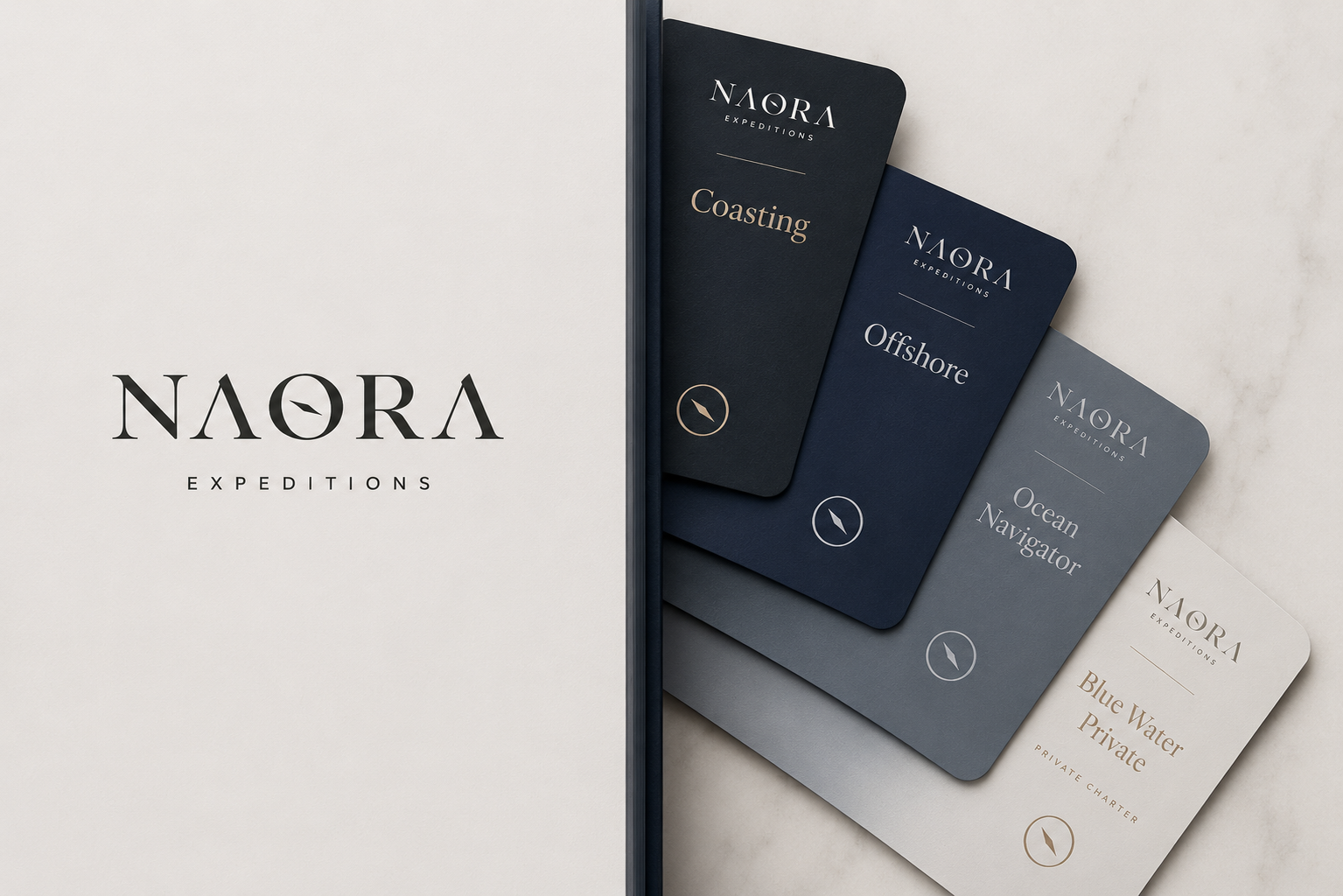
This last point matters more than it might first appear. Ownership locks a person into a single vessel regardless of mood, season, or evolving taste. Membership, by contrast, lets our members dial their involvement up or down across the Coastal, Offshore, Navigator, and Bluewater Private tiers as their available time changes year to year.
A Note on Status
For a previous generation, a privately flagged yacht parked in Monaco harbor was the clearest available signal of success. Among younger high net worth circles, that signal has started to lose its shine. Owning a large, mostly idle asset increasingly reads as inefficient rather than impressive. Being part of a small, curated voyage that others cannot simply buy a ticket to join reads as something closer to true exclusivity.
This is partly generational and partly cultural. Many of today’s most active entrepreneurs built their fortunes through asset-light businesses, software, brands, or services rather than capital-heavy industry. They are naturally inclined toward models that mirror the efficiency they apply to their own ventures, and an idle multi-million euro vessel sitting unused for fifty weeks a year sits uneasily with that instinct.
Ownership, Charter, and Membership Compared
| Factor | Yacht Ownership | Weekly Charter | Naora Membership |
|---|---|---|---|
| Upfront cost | Multi-million euro purchase | None | Entry fee from €3,000 to €5,000 |
| Ongoing cost | Roughly 10% of value yearly | Per-week charter fee | Tiered annual membership |
| Maintenance burden | Owner responsibility | None | None |
| Geographic range | Limited to one vessel’s schedule | Single region per trip | 183+ destinations over 5 years |
| Community | None built in | None built in | Curated group of 10 to 12 guests |
Who Tends to Make the Switch
We see two distinct groups gravitating toward membership over ownership. The first is entrepreneurs early in their wealth journey who recognize that a yacht purchase would tie up capital better deployed elsewhere, while still wanting genuine access to the sailing lifestyle. The second, somewhat unexpectedly, is former yacht owners themselves. Many have already lived the ownership experience, calculated the true cost per day actually spent aboard, and concluded that membership delivers more days at sea for a fraction of the commitment.
Both groups arrive at Naora for a similar reason: they want the depth of a long term relationship with the sea without inheriting the operational weight that has traditionally come bundled with it, season after season, refit after refit. Our entry fees, ranging from €3,000 to €5,000 depending on tier, sit a world apart from a yacht purchase price, yet open the door to a far longer and more varied journey than most private vessels ever attempt.
There is a third, smaller group worth mentioning: families who once chartered the same region every summer and grew curious about what lay beyond it. A membership built around a multi-year global route answers that curiosity directly. Rather than returning to a familiar stretch of coastline each year because the planning effort to find something new feels daunting, our members simply join the next leg of a journey that is already mapped, crewed, and underway, with an entirely different region waiting each time they choose to return.
A Different Way to Define Arrival
The old definition of arrival was a vessel with a name on the hull and a flag at the stern. The newer definition, at least among the members we speak with, is access without anchor: the freedom to step aboard a serious vessel on a serious five year journey, then step back into life on land without a second job waiting at the marina. That is the trade we believe more explorers will continue to make in the years ahead, and the one we built Naora to support for as long as the journey continues.
If the idea of trading a depreciating asset for an expanding journey resonates, we would welcome the chance to walk through how each membership tier works in practice, including current availability on upcoming legs of the route.