The Bodrum loops occupy a small part of our route plan, yet they can hold the whole of someone’s time aboard. That is a useful place to begin with the Naora World Sailing Programme. A person can join in Turkey, spend their time among its anchorages, and go home without having crossed an ocean. Their experience belongs to the same continuous voyage as someone who later joins for a long Pacific passage.
We have built Naora around that difference between the life of the yacht and the lives of the people aboard. Discovery keeps moving around the world. Guests choose the chapters that fit their lives, without having to make the whole expedition their own. Making that freedom practical requires considerably more structure than the view from the aft deck suggests.
The Scale Of The Naora World Sailing Programme
The Naora Global Expedition is a private sailing expedition around the world, planned across five years, from 2027 to 2031. The route covers roughly 49,000 Nm. That distance describes the scale of the undertaking, rather than an odometer reading we can promise in advance. Weather routing, approaches to anchorages and decisions about shelter all affect the distance actually sailed.
There are 166 planned legs and more than 187 destinations. A leg is a section of the voyage, not necessarily a single crossing between two harbours. It may include several stops, and its character matters more to someone joining than its position in the sequence. A coastal loop and an ocean passage ask different things of the people aboard.
The ten regional chapters are the Mediterranean, Atlantic, Caribbean, Panama, French Polynesia, Pacific, Asia, Indian Ocean, Africa and the Red Sea. Within them are the Bodrum loops, the Dodecanese and Cyclades, the Corinth Canal transit, Atlantic crossings, the Panama Canal transit, Polynesian atolls, Asian archipelagos, Indian Ocean island groups and East African coasts.
The eastbound prelude is the opening chapter before the expedition begins in the Red Sea. Planned for January to April, it leads from Palma de Mallorca to Valletta, then Alexandria, into the Red Sea and onward to AMAALA in Saudi Arabia. It is important to distinguish that approach from the much larger undertaking that follows. Naora is the whole world route, with its changing seasons, maintenance demands and daily life.
How The Naora World Sailing Programme Fits A Life
Guests can join through Naora’s private circle or arrange the private hire of Discovery for a carefully designed voyage. In both cases, the starting point is the same: when someone can travel, where along the route they would like to join, and how long they want to stay. One week can be a complete experience. A longer stay allows the rhythm to change more gradually.
That freedom needs an honest boundary. Joining an expedition does not mean boarding at any point on a chart or leaving an ocean passage halfway through. Embarkation and disembarkation have to work with safe access, entry formalities, transport ashore and the route’s weather logic. A beautiful anchorage may be a poor place to organise an international journey home.
We therefore need to understand the part of a person’s calendar that cannot move. Someone who must be back for a particular commitment needs a different margin from someone whose return is flexible. Building breathing room around travel connections is often more useful than fitting one more destination into the plan.
It also helps to distinguish length of stay from intensity. A shorter visit with repeated exposed crossings can feel more demanding than a longer period of coastal sailing. The useful questions concern time underway, likely motion, access ashore and the possibility of waiting for conditions to improve.
The yacht does not reset when one group leaves. Provisions are replenished, maintenance continues and the next passage is prepared. That continuity is part of what guests join. Their days aboard have a beginning and an end; the working life around them carries on.
A Route Built Around Wind And Season
The route follows the tradewinds and parts of what sailors call the Coconut Milk Run. The name can make the sailing sound effortless. In practice, following favourable seasonal patterns is a way of reducing unnecessary resistance, not removing uncertainty. Wind direction is only part of a passage decision. Swell, current, squalls and the conditions at the destination matter too.
In the northern winter, the northeast trades can favour westbound Atlantic sailing. That broad pattern still has to be read alongside the tropical cyclone outlook and the developing weather across the intended passage. A seasonal window tells us when to look seriously. It does not tell us to leave on a particular morning.
Closer to Bodrum, the Dodecanese and the Cyclades, the summer meltemi brings a different set of judgements. Its northerly flow can strengthen between islands, and a coast that appears sheltered on a small chart may receive hard gusts spilling down from higher ground. Clear skies do not necessarily mean an easy crossing.
At anchor, protection from wind and protection from swell need separate consideration. A bay may offer one without the other. Holding ground matters as well: an anchor that can bury in suitable sand is a different proposition from one resting on rock or lying over seagrass that should not be disturbed.
Even the depth figure needs interpretation. When working out anchor scope, the relevant vertical distance runs from the bow roller to the seabed at the highest expected water level, not simply from the water surface. Swinging room must then accommodate the yacht and its neighbours if wind or current changes.
Canal passages introduce another kind of discipline. For the Corinth Canal and Panama Canal transits, dimensions, current operating requirements, paperwork and line-handling arrangements belong in the preparation. The appealing line on the map becomes a series of practical conditions that must be satisfied before proceeding.
Discovery And The Work Behind The Ease
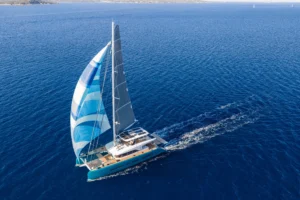
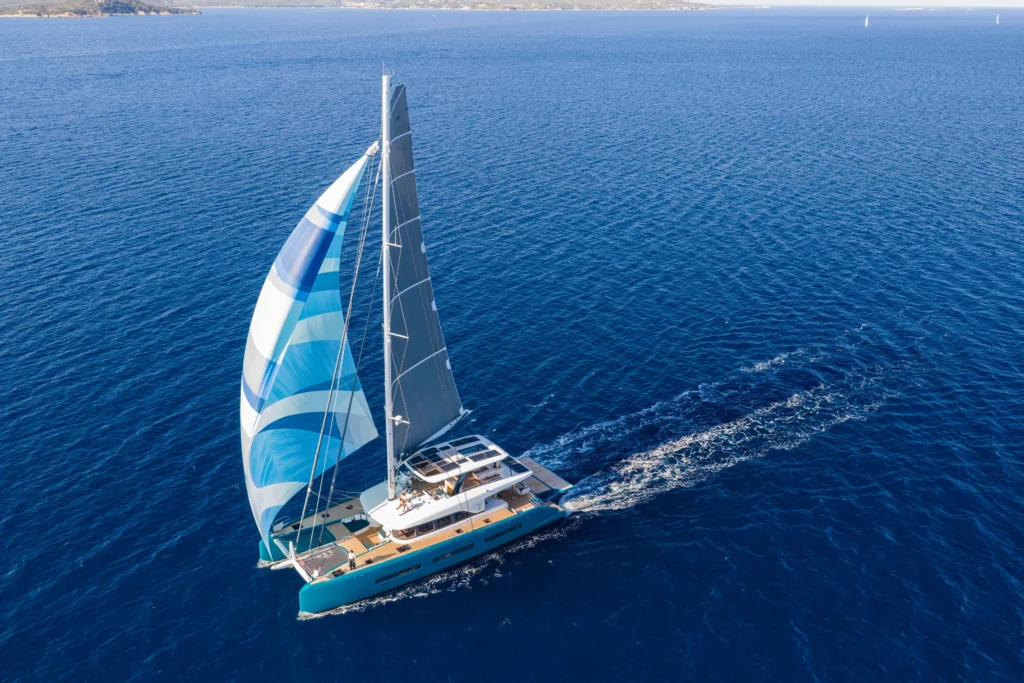
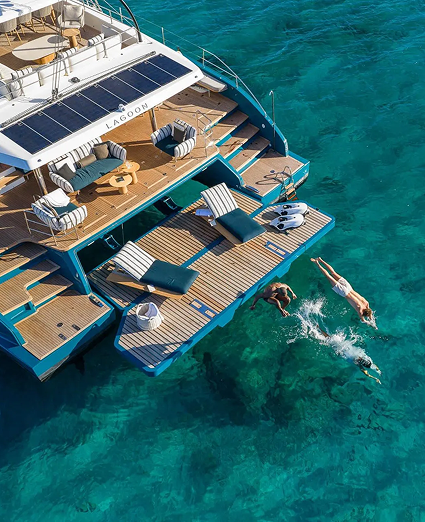
Discovery is a 2025 Lagoon Eighty2 sailing catamaran. Lagoon is an established, large-scale cruising catamaran builder, and that context matters. We are taking a yacht from a serious shipyard on a long voyage, while recognising that the name on the hull does not replace inspection, maintenance or sound decisions.
A catamaran’s broad platform gives people room to live alongside one another without sharing every moment. It also has its own behaviour at sea. Short, steep waves can produce uncomfortable motion and impacts beneath the bridgedeck. Altering course, reducing speed or choosing a different departure time may do more for comfort than any feature of the accommodation.
Sven is Naora’s founder and captain. He plans every weather window and sails every leg himself. Antony is the co-founder. Sven’s commitment places responsibility close to the decisions: the person considering a departure is also the person who will live with its consequences offshore.
That does not mean a captain should keep every watch. Long passages depend on a proper watchkeeping structure, clear handovers and protected rest. Fatigue can narrow attention before the tired person recognises it. Sleep therefore belongs in passage planning alongside fuel, navigation and weather.
Discovery has onboard water production and independent energy systems, which support time away from shore infrastructure. Independence still has limits. Water production needs power and functioning equipment. Pumps, filters and electrical systems need attention, and spare parts have to be considered before a fault makes them urgent.
This is the work behind an unhurried breakfast. Someone has considered what happens if a system stops, which small defect cannot wait and what needs checking before departure. The aim is not to make guests conscious of every task. It is to avoid asking them to live with problems that reasonable preparation could have prevented.
Choosing Coastal Time Or An Ocean Passage
A coastal chapter leaves more room for a day to change shape. Depending on conditions, there may be time ashore, a different anchorage or another morning in the same place. A Bodrum loop and a longer stay among the Greek islands can both offer that relationship between sailing and land, without being interchangeable experiences.
On an ocean passage, shore ceases to be a daily option. Meals, sleep and movement settle around the vessel’s progress. The distinction deserves more attention than the romance of an ocean name. Someone who enjoys swimming from an anchored yacht may discover that uninterrupted days underway ask something quite different of the body.
Before dawn offshore, the horizon can become difficult to separate from the sky. Cockpit lighting is kept low to preserve night vision. Wind finds the exposed skin at a collar, a loose object makes itself heard, and the movement beneath your feet requires a quiet adjustment of the knees. A warm drink has to be put somewhere secure before attention returns outside.
There can be great pleasure in that concentration, but it should not be sold as effortless. Motion may affect appetite and sleep, especially at first. Guests need a clear understanding of what participation involves, what support they need and which activities remain the responsibility of the crew.
For someone uncertain about offshore life, choosing a coastal chapter first is a sensible decision, not a lesser one. Experience aboard is a better guide to a future ocean passage than enthusiasm expressed from land.
Private Time With Family And Colleagues
Private hire allows Discovery to hold one family’s or one party’s rhythm within a real part of the expedition. Meals, time ashore and the balance between movement and staying put can be discussed around the people coming aboard. Weather, safe navigation and the demands of the continuing route remain the boundaries.
For families, useful preparation begins with ordinary details. How confidently does each person move on steps? Who needs help getting into a tender? Does someone tire in the heat or become unsettled when sleep changes? Those conversations are more valuable than assuming that everyone of the same age wants or can manage the same day.
Children can learn a great deal from watching weather, recognising a coastline or understanding why a rope must be kept clear. Participation has to suit the child and the task. Supervision, safe movement and the correct use of safety equipment are matters to settle explicitly, rather than leave to the reassuring appearance of a large yacht.
For founders, leadership teams and discreet company gatherings, shared time at sea can mark sustained contribution or an important milestone. It should not come with a promised business result. A meal may allow a conversation to develop; tiredness or motion may equally make silence the better choice. The setting deserves to remain a voyage rather than become a meeting room with a moving view.
Privacy is similarly practical. It concerns considerate behaviour, photographs, conversations within earshot and space for someone to withdraw without explanation. It never removes the normal requirements of ports, borders or authorities. Discretion should make daily life easier, not theatrical.
The Shape Of An Ordinary Day
On a settled morning at anchor, the first sounds may be water touching the hull and the small movements of breakfast being prepared. The air can still feel cool against skin warmed by sleep. A cup rests on the table, light works its way across the deck, and there is time to notice the shore before deciding what to do with the day.
That ease depends partly on the galley. Local provisioning requires judgement about ripeness, storage and the next opportunity to replenish. Soft tomatoes belong near the beginning of the plan; firmer produce can wait. Before a passage, preparing some food in calmer conditions reduces the amount of hot, awkward work required if the sea becomes uncomfortable. Good food aboard has to suit both the place and the motion.
Time in the water also follows conditions rather than a promise on an itinerary. Clear water can carry a strong current. Entry, exit, surface support and the abilities of the people entering matter more than how inviting the reef appears from deck. Freediving requires proper buddy supervision, not an assumption that another swimmer somewhere nearby is watching.
Some guests will need to work. The important distinction is between having communication equipment and being able to guarantee a connection at a particular hour. Neither uninterrupted connectivity nor a quiet call during every passage should be assumed. Work that can tolerate delay fits more comfortably than obligations that cannot.
Others will want less contact with home. There is room for both intentions, provided neither becomes an expectation that everyone aboard must share.
Entering Places With Care
Naora’s intention is to move carefully, source locally and stay as close to carbon neutral as possible. That is an aim requiring choices, not a claim that sailing has no footprint. Engines, refrigeration, water production, maintenance and travel to the yacht all carry consequences. Sailing when conditions allow is meaningful; pretending that it settles the whole question would not be.
Care is often less conspicuous than a policy statement. It means choosing anchoring ground without damaging seagrass or coral, understanding restrictions before entering the water and buying food with some knowledge of its season and origin. Spearfishing belongs only where it is lawful and appropriate, with decisions about species and size made before a fish is taken.
Ashore, arriving by yacht gives us no special claim on a place. Local dress, religious rhythms, permission to land and the courtesy of asking before photographing someone remain important. A harbour is somebody’s working day before it becomes part of our experience.
The continuity of the expedition gives these encounters time to accumulate without requiring every guest to remain aboard. Some will remember a passage; others, an unhurried morning ashore or the first night they slept without checking the time. None needs to collect the whole route for their part of it to matter.
I would rather we leave room for a place to become familiar than hurry to replace it with the next one. There is a particular pleasure in looking towards a shoreline and recognising it.