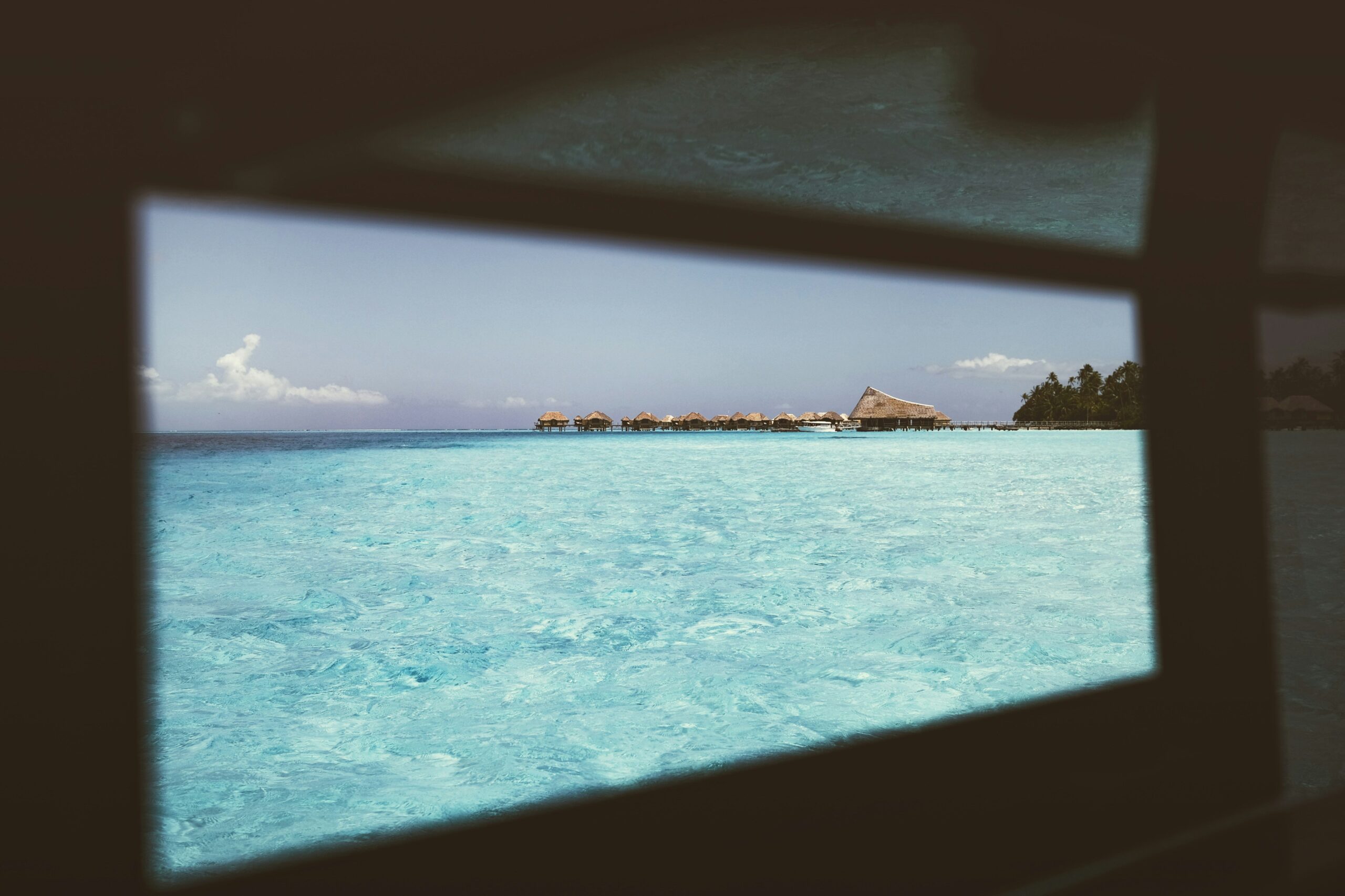
The water beneath an approaching squall can darken before the rain reaches the yacht. A patch of rougher surface advances towards the boat, giving the person on watch something to consider while the deck is still dry. On a Pacific Ocean crossing, reducing sail at this point can mean less work under load later, and a quieter night for everyone asleep below.
That is a useful place to begin thinking about the passage from the Galápagos to the Marquesas. The distance is substantial, but distance alone does not explain what the crossing asks. Much depends on decisions made before they become urgent: how much sail to carry, when to rest, what to cook, how much margin to leave around the expected arrival.
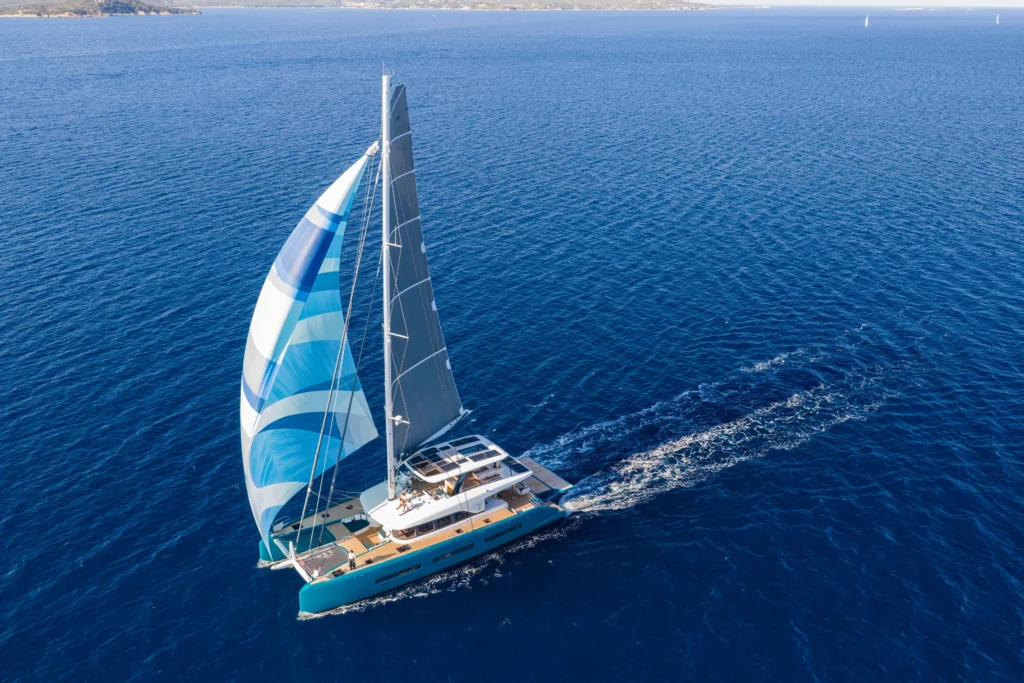
For Naora, this passage belongs to a continuous world route, sailed aboard Discovery, our Lagoon Eighty2 sailing catamaran. Preparing for it means taking the people aboard as seriously as the weather. A workable plan must account for someone who sleeps lightly, someone who feels unwell at first, and someone discovering how differently time passes beyond sight of land.
The Distance Behind A Pacific Ocean Crossing
The Galápagos to Marquesas passage is roughly 3,000 Nm. The actual distance sailed changes with the departure point, the chosen landfall and the course that makes sense in the conditions. A line drawn between islands is a starting calculation, not necessarily the track the yacht will leave behind.
At a sustained average of six to eight knots over the ground, that distance represents approximately sixteen to twenty-one days. This is arithmetic, not a performance forecast for Discovery. It assumes the average can be maintained, and it does not allow for extra distance. Current matters because speed through the water and progress towards the destination are not the same measurement.
Eighteen to twenty-two days is a plausible planning range for a sailing passage on this route, provided it is understood as a range that can be exceeded. Light winds may reduce progress. An uncomfortable sea may justify slowing down. Near the destination, arrival in useful daylight can matter more than preserving an impressive average. None of these decisions needs to indicate that anything has gone wrong.
The practical consequence belongs in the calendar before departure. A flight or an obligation immediately after the predicted landfall puts pressure in the wrong place. We would rather leave generous time ashore than allow an appointment made months earlier to become an argument for carrying more sail or approaching an unfamiliar coast tired.
Planning The Weather For A Pacific Ocean Crossing
March to May is a common departure period for this westbound passage, rather than a fixed Naora sailing date. The broad aim is to find an appropriate seasonal window into the southeast trade wind system, while considering the tropical weather outlook and the conditions awaiting the yacht farther into French Polynesia. Part of that period overlaps the end of the South Pacific cyclone season. A familiar departure month never replaces a current assessment.
The Intertropical Convergence Zone, usually shortened to ITCZ, needs a more careful explanation than it often receives. This shifting region of converging winds encourages rising air, cloud and heavy showers, with light or variable winds between active areas. The main Pacific belt generally lies north of the equator. A passage heading west and south from the Galápagos therefore does not automatically require a crossing of it. Equatorial calms and convective weather can still complicate departure, and a secondary convergence band can develop south of the equator.
We plan around the weather that is present, rather than around a compulsory encounter with something labelled the doldrums. Sven, Naora’s founder and captain, plans every weather window and sails every leg himself. Seasonal planning begins well before departure, but the detailed decision must draw on forecasts close enough to describe the developing situation. No departure forecast can reliably describe every day of a passage lasting several weeks.
Once offshore, routing remains active. Gridded wind forecasts help describe the broad flow; they cannot place every squall or resolve every local gust. Cloud development, pressure trends, the sea surface and the wind actually reaching the boat all belong in the assessment. There are choices of course and speed, although reaching shelter is generally not a realistic response in the middle of this crossing. The aim is to preserve room to respond before a forecast becomes an immediate problem.
Sail Area And The Shape Of The Sea
In established southeast trades, winds of around fifteen to twenty-five knots are a useful picture of conditions a yacht may encounter, not a promise of continuous wind within that range. There can be weaker intervals, stronger spells and squall gusts above the prevailing wind. Downwind sailing also changes the sensation on deck: because the yacht is moving partly with the wind, the apparent breeze can feel gentler than the true conditions suggest.
On a catamaran, a relatively level deck provides no assurance that sail loads are modest. Discovery does not need to heel dramatically for the rig to be working hard. Sail reduction must follow the yacht’s operating guidance and the actual conditions, with particular attention before darkness or a period of unsettled weather. Waiting for discomfort to announce the need is poor judgement.
A sea of two to three metres is similarly incomplete information. Widely spaced waves arriving from aft can produce a much easier motion than shorter waves of the same height meeting the yacht at an awkward angle. A remote swell may cross the locally generated sea. The result can be pitching, sudden acceleration or water striking beneath the bridgedeck. Two hulls change the motion; they do not remove it.
A small course adjustment can sometimes make movement through the boat easier, but it may add distance or alter sail loading. That trade off deserves attention. The useful measure of progress includes whether people can sleep, prepare food and move safely, not simply what the speed display shows at its most flattering moment.
Keeping Watch And Protecting Sleep
In darkness, the horizon can disappear while the boat continues moving beneath your feet. Water sounds close against the hull, then falls away. A fresh gust reaches the face before its effect is fully visible on the instruments. With the displays dimmed, small lights become easier to distinguish, and the eyes gradually recover the parts of the night that a bright screen would erase.
This is watchkeeping as physical attention, supported by instruments. A quiet traffic display does not establish that the sea is empty. Not every vessel transmits a usable signal, and objects without lights or transmitters remain possible. The person on watch needs to understand the sail plan, the developing weather and the circumstances that require another person to be called, rather than treating the watch as a period of solitary endurance.
A handover carries forward what has changed: an approaching shower, a doubtful contact, an unfamiliar sound, a reason for the current course. It also establishes what should prompt action next. Writing something in a log does not replace making sure the incoming watch understands it. Fatigue is particularly good at turning an assumption into something that feels like a fact.
The watch arrangement has to protect meaningful rest, including Sven’s. Being responsible for the passage does not make a captain immune to sleep loss. Guests should understand their own role before departure; any participation must be agreed and supervised rather than quietly becoming a substitute for a rested crew. Quiet around sleeping spaces, meals available without fuss and equipment secured against repeated rattling are small acts of consideration with practical consequences. Someone who has slept properly notices more.
The Galley And The Water Reserve
Food planning begins with the number of people aboard, a realistic passage allowance and a reserve beyond the expected arrival. It also begins with appetite. Someone adjusting to motion may manage a small bowl of something warm long before they want a full dinner. Having that option ready is more thoughtful than insisting that everyone settle into the same rhythm immediately.
Fresh food needs an order of use. Delicate leaves and ripe fruit belong earlier in the passage; sound cabbage, squash and carefully stored citrus can remain useful longer, though heat, bruising and ventilation affect how they keep. Dry staples and preserved ingredients should support meals people actually want to eat. A dependable dish of rice, lentils and vegetables is worth more offshore than an ambitious menu whose essential ingredient has spoiled.
The galley must also work when the sea becomes awkward. Preparing components during an easier spell reduces the cutting, lifting and handling of hot liquid needed later. A pot must be secured before the cook reaches for something else. Food safety deserves particular attention where refrigeration and electrical power are interconnected systems. Offshore, a freezer problem becomes a provisioning decision, not merely a maintenance entry.
Water production gives Discovery independence, but production capacity is not the same as a reserve. Pumps, filters, membranes and their power supply all have to function. The water plan needs to account separately for drinking, cooking and washing, and for what happens if production stops. Watching tank levels as well as output reveals whether consumption is quietly overtaking production. A machine that ran today has not produced tomorrow’s water yet.
Before departure, we also consider what will remain aboard at arrival. Packaging occupies space for the whole passage, and fresh provisions may be subject to biosecurity restrictions. Reducing unnecessary packaging, buying locally where practical and planning for lawful disposal ashore make more sense than discovering the waste problem after the supplies have been loaded.
Choosing A Passage You Can Stay For
Naora members choose when they join, where along the world route they step aboard and how long they stay. Discovery continues sailing as people step into and out of that larger voyage. An ocean passage gives this freedom an important boundary: the choice is made before departure. Between the Galápagos and the Marquesas, there is no routine opportunity to shorten the stay.
That deserves an honest conversation, particularly for a first substantial passage. Previous experience of sleeping and eating aboard a moving yacht is useful information. So are medical needs, medication supplies, dietary requirements and any history of severe seasickness. Appropriate advice about prevention belongs before sailing. Far offshore, communication with medical support may be possible much sooner than physical help can arrive.
Work needs the same realism. Satellite navigation and satellite internet are different services; knowing precisely where the yacht is says nothing about whether a video call will hold. Any connection can be interrupted by equipment, power or service limitations. Weather and safety communications take priority. Someone with an obligation that genuinely requires dependable daily access should settle that conflict ashore rather than rely on optimism at sea.
The reward for making these arrangements is often very ordinary. You can finish breakfast without mentally calculating a meeting in another time zone. You can return to a book after lunch, or sit with someone without needing the conversation to reach a point. This does not happen to everyone at once. Some people take time to stop looking for a new destination each morning.
Nor does choosing the crossing make someone a more serious member of Naora than choosing time among islands. The passage is a particular kind of stay: sustained motion, repeated horizons, shared space and limited ability to change the plan. Understanding that honestly makes room for pleasure without requiring anyone to perform enthusiasm for circumstances they would not have chosen.
Making Landfall In The Marquesas
The Marquesas are high volcanic islands, a very different landfall from the low coral atolls encountered elsewhere in French Polynesia. On an approach, cloud can hide the upper slopes while the lower coast gradually becomes distinct. After weeks of judging distance mostly through instruments and the sea around the boat, the eye has depth and texture to work with again.
This is also a point at which anticipation can compete with judgement. The crew may be tired, everyone knows land is close, and the temptation is to consider the passage effectively finished. We still need to check the approach, current weather, anchorage conditions and clearance requirements. If visibility or timing makes an entry doubtful, waiting remains a valid part of the passage.
Wind shelter and swell shelter are separate questions. A bay protected from the prevailing breeze may still admit swell from another direction. Steep island terrain can alter the wind close to shore. Before anchoring, the charted depth and seabed, the room to swing and the forecast all need consideration. A calm patch of water on arrival is an observation, not a forecast for the night.
There is no need to make the first day ashore carry all the expectations accumulated at sea. Arrival formalities, a settled anchorage, food and proper rest have their own importance. The islands are lived places, with their own routines, rather than a backdrop arranged for the end of our crossing.
For a while, it is enough to sit aboard and watch a hillside stay where it is.