Your departure and the yacht’s departure are two different entries in the plan. You may be taking a soft bag ashore while Discovery is being prepared for another passage, with provisions to stow and a weather window to consider. This is the useful starting point for understanding an offshore sailing membership: your time aboard can come to an end without the voyage itself ending.
That continuity changes the decision. Instead of assembling a separate sailing holiday each time, you have a relationship with an expedition already moving around the world. You choose where your life can meet it, how much time you can give it, and what kind of sailing you want that time to contain.
The attractive part is easy to describe. The more important work is explaining what this freedom means in practice, where it has limits, and why the right arrangement for one person may be wrong for another.
What An Offshore Sailing Membership Gives You
Membership is an access arrangement, not a universal set of entitlements. The word alone does not tell you how many days are included, how individual passages are reserved, or what happens when plans change. Those things belong in the agreement. Its defining quality is the continuing relationship with a sailing programme, rather than the purchase of an isolated voyage.
At Naora, that programme is the Naora Global Expedition, a private sailing expedition around the world. It is planned across five years, from 2027 to 2031. That is the expedition’s horizon, not a period anyone needs to clear from their own calendar. Members join through the private circle where the route meets their interests and responsibilities, for one week or many, then step ashore while the yacht continues.
The planned distance is roughly 49,000 Nm, divided into 166 legs. The division matters more to a prospective member than the impressive length of the line on the chart: it makes a worldwide undertaking something a person can join in manageable sections. More than 187 destinations sit within that framework, so a leg should be understood as a stretch of life aboard, not simply a transfer between two ports.
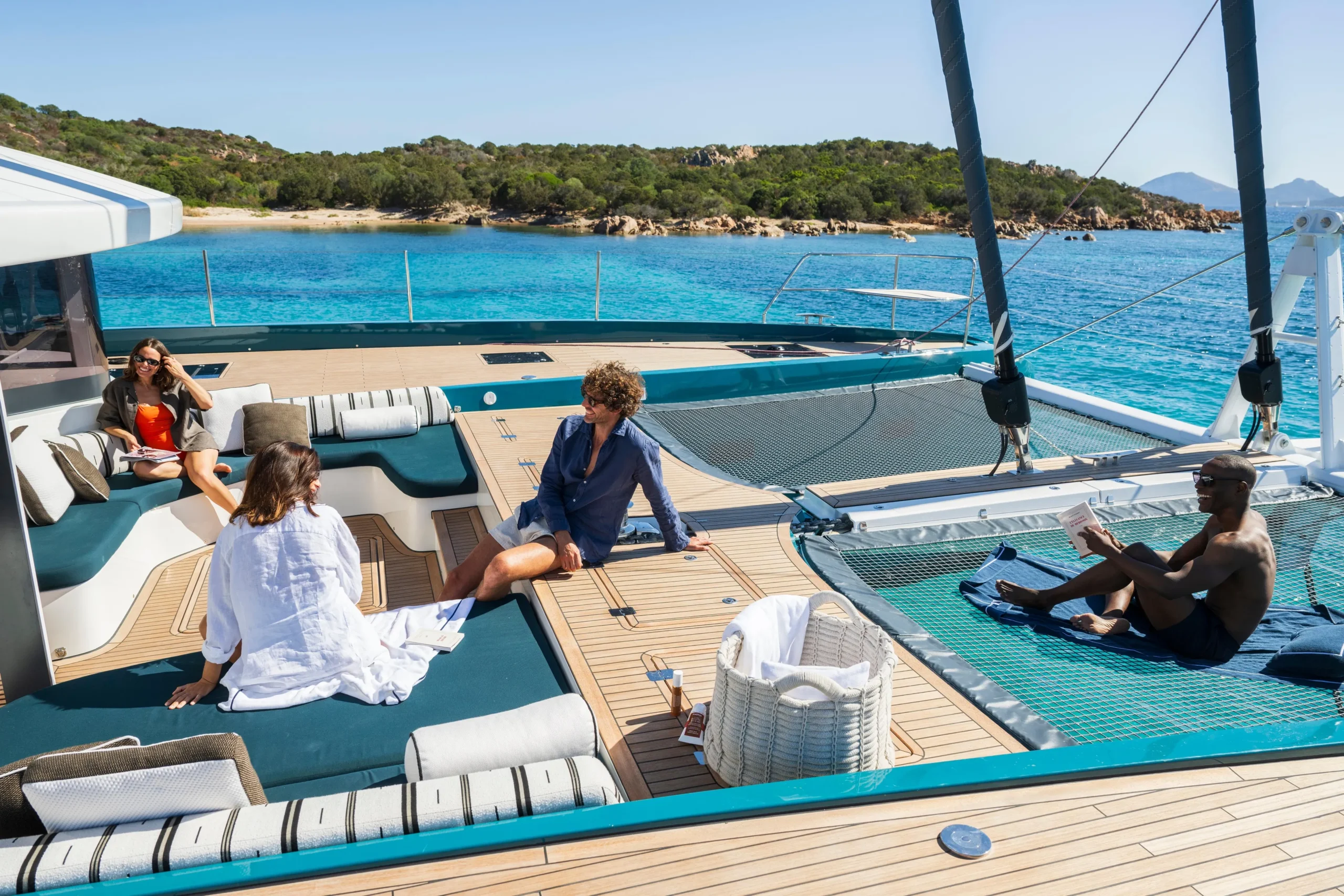
The yacht carrying this continuity is Discovery, a 2025 Lagoon Eighty2 sailing catamaran. Having the same yacht throughout gives the expedition a consistent physical setting even as the water, food, language and shore change around it. There is no need to pretend that every return will reproduce an earlier experience. A Bodrum loop and an Atlantic crossing ask different things of the boat and the people aboard. The continuity lies in the undertaking, not in making every week feel alike.
Offshore Sailing Membership And Private Hire
A conventional yacht charter usually begins with a party of people, a region and a defined period. The voyage is then planned around that booking, within the limits of weather, regulation and the yacht’s capability. That is a sensible arrangement for people whose first priority is being together with their own family or friends.
Membership begins elsewhere. The expedition exists independently of your participation. You select a place within its progress rather than asking the whole undertaking to revolve around your dates. In exchange, you can belong to something longer than your own stay, and return to it in another region without having to construct a new sailing project from the beginning.
Wanting your own group does not rule out Naora. Discovery can also be privately hired for a carefully designed voyage on a real part of the route. A family, a group of friends or a small leadership team may prefer that arrangement because meals, conversation and time ashore can follow the needs of people who already know one another. Private hire changes the social setting. It does not remove the captain’s responsibility for conditions or turn the world route into an unrestricted choice of destinations.
An expedition cruise offers a different structure again: a larger vessel, an organised programme and a shared itinerary designed for many passengers. That can suit someone who values a clearly arranged succession of activities and does not want much involvement in the decisions of daily life aboard. A private sailing yacht offers a smaller setting, but also closer proximity to other people and to the practical consequences of weather. Neither format deserves to be judged by pretending it does the other’s job.
Choosing The Shape Of Your Time Aboard
The first useful distinction is between days aboard and days under way. They are not interchangeable. Time on a coastal leg may include short passages, swimming, provisioning and unhurried periods ashore. An ocean passage gathers those days into sustained movement, with no harbour available simply because someone would prefer a different afternoon.
A loop beginning and ending in Bodrum has a different travel shape from a passage that finishes far from its departure port. Returning to the same port can simplify arrangements ashore, although it says nothing by itself about how easy the sailing will be. A point-to-point passage needs separate thought about arrival, departure and the margin between expected landfall and an obligation you cannot move.
Distance is only part of that assessment. A relatively short passage into steep seas can be more tiring than a longer passage with a favourable wind and a more regular swell. For any leg, the revealing details are the likely time under way, the possibility of sailing overnight, the direction of the prevailing weather and the places where shelter could be found. A destination photograph cannot answer those questions.
At night at sea, a bright phone screen can undo the eye’s adjustment to darkness. A mug needs a secure place before a hand reaches for a rail. Conversation becomes quieter because someone else may be sleeping, and the movement of the yacht registers through the soles of the feet. These are small changes, but they describe passage life more honestly than the word adventure.
Someone who wants frequent swims and meals ashore should choose with those priorities in mind rather than assume every leg contains them. Someone drawn to the sustained attention of an ocean crossing should understand that its value comes partly from the absence of alternatives. Neither preference needs improving. It needs a suitable place on the route.
Why A Weather Window Matters
Freedom of choice applies to when, where and for how long you join. Once aboard, decisions still have to respect the conditions. Sven, Naora’s founder and captain, plans every weather window and sails every leg himself. That puts the responsibility for a departure with the person who will take the yacht through its consequences.
A weather window is more than a forecast showing an agreeable wind speed. Wind direction matters because the same strength can offer a comfortable passage on one heading and difficult progress on another. Sea state matters because swell can remain after the wind that produced it has eased. The conditions at the destination matter too: reaching an exposed entrance at the wrong moment can undo the benefit of a reasonable passage.
In the Dodecanese and Cyclades, the summer meltemi commonly brings northerly winds that can persist and strengthen through the channels between islands. A harbour may feel sheltered while the water beyond its headland is considerably less comfortable. The practical response may be an earlier departure, a different anchorage or a decision to stay put. Waiting is sometimes the most competent use of a sailing day.
Discovery being a catamaran does not make these considerations disappear. A multihull’s relatively level sailing attitude should not be mistaken for an absence of load in the rig. Reducing sail in good time is a response to wind and sea conditions, not something postponed until the yacht feels dramatically overpowered. The working decisions that preserve an easy atmosphere are often made before a guest has reason to notice them.
This is why a sensible joining plan includes some breathing room around travel connections. The appropriate margin depends on the passage and the consequences of being late. An immovable commitment ashore should influence the choice of leg before departure, rather than become pressure on the captain near its end.
The Quiet Agreements Of Shared Life
The private circle matters because a yacht is a shared place, even when everyone has room to withdraw. Compatibility does not require matching professions, ages or biographies. It requires a reasonable understanding of how other people live, and enough consideration not to make one person’s preferences everyone else’s obligation.
If you come in from a morning swim, salt dries on your forearms while you sit over breakfast. Another person may still be asleep. There is room for both mornings only if the swimmer remembers how easily a voice or a dropped locker lid carries. Much of the warmth of life aboard rests on courtesies this small.
Privacy has similarly ordinary foundations. Asking before photographing another person, keeping a private conversation private and allowing silence at the table all matter more than declarations about discretion. Shared dinners need not become compulsory social performances. A person can enjoy the company and still want an afternoon alone with a book.
For a family, the practical discussion concerns mobility, confidence around water, dietary needs and the kind of passage each person can comfortably manage. Those considerations should be discussed before choosing the leg, not discovered when the lines are already off. Interest in sailing is welcome, but any participation has to fit the captain’s briefing and the demands of the moment. Enthusiasm is not a substitute for an understood task.
Work deserves the same honesty. A voyage may leave space for reading, writing and decisions that do not require an immediate reply. A commitment that depends on uninterrupted connectivity is different. Offshore communications should never be treated as an unconditional promise, and a call whose failure would have serious consequences belongs in the planning conversation.
Shared expectations also extend beyond the yacht. We aim to move with care and source locally, which means allowing the place to influence what comes aboard rather than insisting that every stop reproduce the same menu. Ashore, local customs and everyday life are not scenery for our visit. The expedition has to make room for them.
What The Membership Terms Must Explain
A comparison of membership tiers can look precise while leaving the most important questions unanswered. An annual allowance, if the arrangement includes one, says little until it is clear how that time is counted and used. Consecutive days may serve one person better than several separate stays. Access to an ongoing expedition should not be confused with an unrestricted right to any cabin on any date.
The current agreement should explain the period of membership, any time allowance, how leg reservations work, what is included aboard and what remains a separate arrangement. It should also make clear how accompanying family or friends are treated and how a member’s own change of plan differs from a change made for weather or operational reasons. These are the details that prevent the same word from carrying two different expectations.
Naora’s private member platform provides access to bookings and route availability after membership activation. A published route is therefore a planning framework, not a personal reservation. The distinction is worth keeping clear before flights, time away from work or family arrangements begin to depend on a particular passage.
There should be equal clarity about the social side. A continuing circle can make returning meaningful, but it is not a promise of instant friendship, professional connections or a calendar of unspecified benefits ashore. The sound basis for membership is the voyage itself and an accurate understanding of how you can take part.
Recognising A Good Fit
This model tends to make sense when sailing belongs in your life more than once, but owning and operating a yacht does not. You may want to return in different regions, spend longer aboard when circumstances allow, or join a passage whose purpose extends beyond delivering a holiday. The attraction is continuity without needing to be continuously present.
It is less suitable when the only satisfactory trip is one that starts and finishes at exact hours, follows a personally fixed sequence of stops and never asks for an adjustment. Private hire can address the wish to travel with your own people. It cannot promise immunity from weather, port procedure or the needs of the yacht. If certainty of timing is the overriding requirement, another kind of travel may serve it better.
The personal conversation before membership has a practical purpose: to bring these expectations into the open while there is still time to choose well. How much absence is genuinely possible, how much movement feels welcome, and how comfortably you share space are more revealing than an enthusiasm for a beautiful destination. A modest stretch of the route that fits your life is worth more than an ambitious plan you cannot inhabit.
The arrangements should be clear enough that, once aboard, a quiet breakfast can remain a quiet breakfast.