A rough patch in a rope can be easier to feel than to see. With the line unloaded, passing its cover slowly through the hand may reveal an abrasive interruption where the braid was smooth. An honest sailing circumnavigation cost calculation needs room for what happens next: examining the damage, finding its cause, deciding whether the line remains fit for its job, and having a suitable replacement before departure becomes urgent.
This is where the familiar monthly cruising budget becomes incomplete. Food and harbour accounts describe money spent during the voyage. They do not necessarily describe what it took to make the yacht ready, what keeps it ready, or what remains to be settled after the sailing ends.
For the Naora Global Expedition, roughly 49,000 Nm are planned across five years, from 2027 to 2031. That distance means repeated inspections and service intervals, not simply a longer line on a chart. The useful comparison is between different ways of carrying those responsibilities, rather than between two attractive totals.
What The Sailing Circumnavigation Cost Must Include
The first distinction is between money needed and money consumed. Buying a yacht requires capital, but the entire purchase amount is not automatically lost. The boat remains an asset, with an uncertain eventual value. A whole-voyage calculation begins with acquisition and preparation, adds operating and selling expenses, then subtracts the proceeds of a sale. If the owner keeps the yacht, its remaining value still belongs in the calculation, although that value is not cash available to pay an invoice.
Resale deserves particular restraint. Distance sailed, maintenance records, condition, equipment age and the market at the time all matter. A substantial refit may make the voyage possible without adding an equivalent amount to the selling price. Work done to suit one owner’s preferences may have little value to the next.
Cash flow needs a separate view. A yacht can retain considerable value while its owner lacks the money immediately needed for a repair. Funds for purchase, preparation and continuing operation must be available at the right moments. An emergency reserve belongs in that funding requirement, but it becomes an expense only when it is used.
Financing introduces another distinction. Interest is an additional expense; repaying borrowed principal is not a second purchase of the same boat. A hypothetical return on the owner’s capital is an assumption, not an invoice. It can help someone think through the decision, provided it is not presented as a certain loss.
These distinctions are less dramatic than a single circumnavigation total. They are also more useful. They prevent the same money being counted twice and stop a favourable resale assumption from quietly financing the entire dream.
The Yacht Before The First Offshore Mile
Preparation starts by separating defects from preferences. A suspect steering component and a different upholstery fabric may both appear on a refit estimate, but they do not have the same relationship to departure. The first concerns seaworthiness. The second concerns how someone wishes to live aboard. Combining them makes it difficult to understand what offshore readiness actually requires.
A survey is part of that understanding, not a guarantee that every future fault has been found. Access can be limited, machinery needs examination in operation, and evidence from maintenance records matters alongside what can be seen on the day. Sea trials should test the systems the voyage will depend upon, followed by enough local sailing to reveal installation mistakes and unfamiliar behaviour before distance makes either harder to resolve.
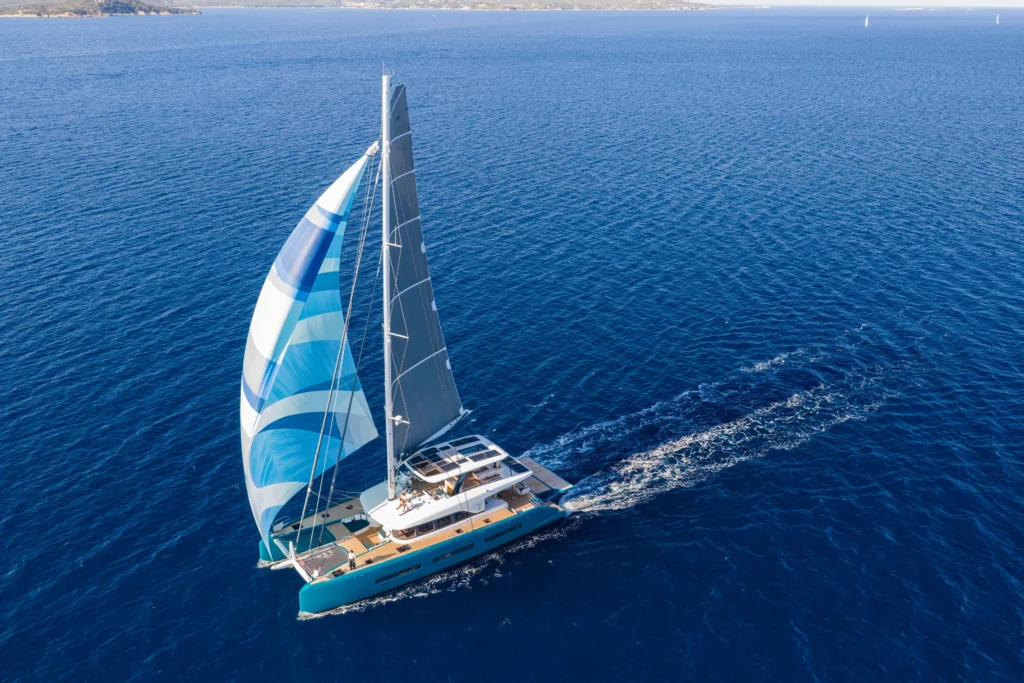
Discovery is a 2025 Lagoon Eighty2 sailing catamaran. A recent build does not remove service requirements, spare parts or the need to understand how systems interact. Nor is a yacht of this scale a sensible financial equivalent for a smaller, simpler vessel sailed by its owners. Space, installed equipment, professional operation and the desired standard of daily life all change the cost base.
For an owner preparing any boat, the practical question is what happens when an essential system stops working. Can it be isolated safely? Is there a workable alternative? Are the right parts aboard, and can someone identify and fit them? Carrying a spare without the tools, access or knowledge to use it is an incomplete form of preparation.
Some of the best preparation expenditure is almost invisible afterwards. A reachable valve, a legible wiring label and an accurate record of a modification may never appear in a photograph. They can make an awkward fault much easier to manage.
The Work That Continues Between Passages
Maintenance follows several clocks. Engines accumulate operating hours. Some equipment has calendar-based service requirements. Sails, ropes and fittings respond to load, movement, sunlight and salt. A quiet month at anchor does not stop every clock, and a long passage can advance several of them quickly.
The expedition’s planned 166 legs therefore cannot be treated as identical units of expenditure. A coastal leg and an Atlantic crossing ask different things of the boat and crew. Their departure checks, fuel planning, stores and recovery time differ. Dividing a voyage budget evenly between legs would conceal the periods when the demands are greatest.
A useful maintenance forecast follows the actual equipment aboard. It records what is fitted, its condition, the applicable service intervals and what each job requires. Some work needs consumable parts and time. Other work needs a specialist, a berth with suitable access or a haulout. Knowing this before arrival is part of choosing where maintenance belongs along the route.
Labour needs equal honesty. Owner maintenance may reduce cash expenditure, but the hours do not disappear. They can be deeply satisfying hours for someone who enjoys understanding a boat. They can also occupy the afternoon that another person imagined spending ashore with their family. Neither response is wrong.
Crew requirements depend on competence, fatigue and the passage, rather than on a blanket assumption that every owner needs additional paid help. Provisioning, watchkeeping and repairs still have to be managed when someone is tired or unwell. An owner budget should reflect the people who can reliably do the work, not the most optimistic version of their stamina.
At Naora, Sven is both founder and captain. He plans every weather window and sails every leg himself. That continuity matters because a boat’s condition is cumulative: a sound heard under load or a recurring adjustment belongs to an ongoing understanding of the vessel, not merely to one departure checklist.
The Geography Of A Repair
The same component failure can have very different consequences in different places. In an established service port, the part may be straightforward to obtain and the work easy to arrange. Around Polynesian atolls, the problem may include freight, entry formalities, onward transport and the time needed to reach appropriate assistance. The component has not become more complicated. Its surroundings have.
More than 187 destinations are planned along the Naora route. That breadth is a reason to understand support between destinations, not to assume it exists at each one. A beautiful anchorage and a useful maintenance stop serve different purposes. Sometimes the sensible choice is to spend time in the latter before proceeding to the former.
Remote preparation is therefore selective. The aim is not to carry a duplicate yacht in lockers. It is to identify failures with serious consequences, understand what redundancy already exists, and carry items whose absence would create a disproportionate problem. Correct part identification matters, including any differences between apparently similar installations. Finding that a carefully transported replacement does not fit is an avoidable kind of delay.
Administrative expenditure also follows geography. Canal transits, including Panama, involve procedures and arrangements distinct from an ordinary coastal arrival. Insurance needs to be examined against the actual intended route, dates, operating arrangements and policy conditions. A policy label alone does not establish that a particular passage is covered.
For someone building an ownership budget, this suggests a practical method: work through the route geographically, attaching service needs, formalities and insurance checks to the places where they arise. A broad annual allowance can then sit above real decisions rather than substitute for them. Local circumstances will still change. The point is to know which changes would alter the plan.
Keeping Time And Money In Reserve
Waiting for weather can mean listening to rain tick against the coachroof while the same headland stays in the window all afternoon. Wet clothing hangs where it can dry. The boat is ready, people are ready, and departure still does not make sense. This is an ordinary possibility in sailing, but it becomes financially uncomfortable if the budget assumes movement every day.
In the Cyclades, sustained summer northerlies can make a short passage more demanding than its distance suggests. Direction, exposure and sea state matter alongside wind strength. The decision may be to leave earlier, choose another suitable stop or remain where the boat is secure. None of those decisions should depend on an urgent need to escape another day’s expenses.
Time reserve and financial reserve support the same judgement. An allowance for waiting gives the captain room to use a better window. It can also absorb the less romantic delay of a technician arriving later than expected or work revealing another fault once access has been opened.
A useful contingency begins with consequences. Consider what a failure could require: parts, labour, transport, accommodation ashore if the boat cannot be occupied, and changes to onward travel. Some of those expenses can occur together. A flat allowance chosen because it makes the spreadsheet look complete tells the owner very little about their ability to cope.
Delay also affects guests joining or leaving. Travel plans need sensible margins around sea passages, particularly where there are few alternatives. The cost of reaching the yacht and returning home belongs in a comparison of participation just as it belongs in an owner’s planning. The sea does not become more predictable because a flight has already been arranged.
Comparing Sailing Circumnavigation Cost Fairly
Ownership and joining a continuing expedition are different arrangements. Ownership brings control over the vessel, subject to weather, law and practical limits. It also brings responsibility between the memorable passages: storage, insurance, servicing, accounts and decisions about what happens next. Someone who wants those things should not be told that they are an unnecessary burden. They may be a central part of the pleasure.
Naora’s private circle offers another relationship with the world route. Guests choose when they join, where they step aboard and how long they stay, one week or many, with joining and leaving points shaped by the route and operating conditions. Discovery continues sailing around the world when they return to life ashore. Participation does not require owning a yacht throughout the intervals between visits.
The comparison still needs a defined scope. What does participation cover? Which travel arrangements and personal expenses remain separate? How are changes handled? These belong in the written terms of the actual arrangement. An article cannot honestly replace them with a sweeping claim that everything is included or that nothing can become the guest’s concern.
Privately hiring Discovery for a family or another private party is a different comparison again. The relevant unit is the whole party and its voyage, rather than one person’s participation. It should be considered against the experience actually wanted, not made to look favourable by comparing unrelated boats, durations or operating standards.
Days aboard also need context. A week exploring the Bodrum loops and time on an Atlantic crossing are both part of sailing, but their rhythms differ. One allows more frequent transitions between boat and shore; the other asks people to settle into the continuity of passage. Dividing expenditure by days can clarify a calculation. It cannot establish which days someone will value most.
The Part Of The Voyage You Want To Own
Time away from professional life is often the largest assumed figure in a circumnavigation comparison and the least carefully examined. It is not honest to multiply someone’s present income by the years of a voyage and call the result inevitable. Some owners stop working. Others reduce their involvement, delegate, work intermittently or choose a deliberate break whose value cannot be measured as lost earnings alone.
Joining selected parts of a world route can make it easier to fit sailing around commitments ashore. It does not guarantee uninterrupted work aboard. Connectivity can fail, motion can make concentration difficult, and watchkeeping, where undertaken, changes sleep. A critical call should not rely on the most hopeful interpretation of conditions at sea.
The better calculation starts with what must genuinely change. Which responsibilities need another person? Which expenses at home continue? What income is likely to be affected, rather than merely associated with being present? Time spent administering the voyage also deserves recognition, even when assigning it an hourly rate would feel artificial.
We should be equally careful about what cannot be reduced to a cost. Learning a vessel thoroughly has value. So does returning to the same continuing expedition without having to maintain a boat during every month ashore. A family may want an ocean passage together without wanting their entire life to become the organisation of ocean passages.
There is no universal financial winner between those choices. There is a more truthful account of what each asks. The purpose of doing that work is to leave fewer unresolved demands aboard, so that an evening can be spent sitting together before supper, with the boat ready for the night.