The wind can fall away before the motion does. In the cockpit, a page lies still while the boat keeps rising to swell arriving from beyond the headland. When we think about a luxury sailing experience in 2027, we start with that distinction: a beautiful view and a comfortable place to spend the night are not necessarily the same thing. Knowing the difference, and acting on it before anyone loses sleep, belongs near the centre of the experience.
It is also difficult to represent in a comparison table. Cabin dimensions can be compared. So can destinations and days aboard. The judgement behind a departure, the room left in a plan for weather, and the relationship between your time aboard and the yacht’s wider voyage require a longer conversation. That is where the difference between Naora and other forms of sailing travel becomes useful, rather than merely a claim to occupy a category of our own.
What A Luxury Sailing Experience Can Promise
A well-run private charter can give a family precisely what it wants: its own company, an agreed sailing area and a crew concentrating on that particular stay. A sailing school organises its days around learning, with repetition and supervised practice that a general voyage may not provide. A dive liveaboard can make sustained time underwater the organising principle of the trip. An expedition cruise offers a different scale of logistics and shared exploration. None needs to be diminished to explain Naora.
Nor are these categories uniform. Some expedition ships carry relatively small groups. Some charter captains have known their sailing grounds for decades. Some dive operations have exceptional local knowledge. It would be misleading to give each format a single passenger count, crew standard or level of care and then declare a winner.
The more revealing comparison concerns what the voyage is built around. A school needs suitable learning conditions. A dive operation needs workable sites and recovery arrangements. A ship’s programme must accommodate the movement of the whole ship. A conventional charter usually has a defined beginning and end around which the sailing must be organised. These are practical structures, not shortcomings.
Naora is built around a continuous private sailing expedition. The people aboard join a voyage that already has a direction, a season and responsibilities extending beyond their stay. That gives their time a different context. It also asks something of them: an understanding that the most attentive response to their wishes may occasionally be to explain why a crossing, an anchorage or a departure should change. Good service at sea includes the ability to say no clearly and early.
A Route That Continues Without You
The Naora Global Expedition is planned over five years, from 2027 to 2031, covering roughly 49,000 Nm across 166 legs and more than 187 destinations. The distance matters because this is genuine ocean travel, with the provisioning, maintenance and seasonal planning that entails. The legs make that enormous undertaking understandable at a human scale. They do not represent identical portions of sailing, and a destination count says little about how a particular day will feel.
The Bodrum loops, the Dodecanese and the Cyclades offer a different relationship with shore from an Atlantic crossing. The Corinth Canal and Panama Canal transits introduce controlled waterways and formal procedures into a voyage otherwise shaped largely by weather. Polynesian atolls require another kind of attention, particularly around passes, current and the light needed to read shallow water. Asian archipelagos, Indian Ocean island groups and East African coasts bring their own seasons and ways of arriving respectfully.
The route follows the tradewinds and parts of what sailors call the Coconut Milk Run. That phrase describes a broad sailing tradition, not a promise of effortless weather. Favourable prevailing winds help make long westward passages practical, but squalls, changing sea states and local effects still require active decisions. Mediterranean sailing and the Red Sea chapters cannot simply borrow an ocean passage plan and expect it to work.
Guests choose when they join, where along the worldwide route they step aboard and how long they stay. A week can belong to a much longer voyage without requiring anyone to give their life over to it. Joining and leaving still need workable ports, lawful entry and realistic travel connections. The freedom lies in choosing a suitable part of the route, rather than requiring the yacht to abandon its seasonal logic. When you step ashore, the expedition continues.
The Decisions Behind A Comfortable Night
Sven is Naora’s founder and captain. He plans every weather window and sails every leg himself. That places responsibility for the route and the decisions made on the water with the same person. It does not remove the need for rested watchkeepers, clear handovers or another careful look at a forecast. Familiarity is valuable only while it remains attentive.
A useful forecast reading begins with more than wind strength. Direction determines exposure. Wave period helps explain whether the movement is likely to be short and abrupt or longer and more rolling, although depth, direction and local geography can alter that picture. A fresh wind over an older swell can produce an awkward sea that neither forecast element describes adequately on its own. The question is how those conditions meet the yacht’s intended course.
In the Aegean, the summer meltemi commonly brings northerly winds that can persist beyond the convenient boundaries of a holiday. Channels and headlands can accelerate the flow. A bay that appears protected on a small-scale chart may receive strong gusts from the land, while another may keep the wind out but admit swell. The right decision may be a shorter passage, a different anchorage or a day spent where the boat already lies well.
Anchoring adds a second layer of judgement. We need room to swing, an appropriate depth and a bottom in which the anchor can hold without damaging sensitive habitat. A clear patch of sand is not automatically suitable if it is too small for the boat’s movement. Seagrass is neither an acceptable target for convenience nor reliable holding ground. The surrounding boats matter too, particularly if they lie to different amounts of chain or move differently as the wind turns.
Even the simple business of deciding how much chain to pay out begins with the right measurement. The relevant vertical distance runs from the bow roller to the seabed, not merely from the waterline down, and allowance must be made for a rise in water level. More chain can improve the geometry of the pull, but it also requires more swinging room. Ease aboard comes from resolving these competing needs before the evening settles, not from assuming that a large yacht makes them disappear.
A Yacht Built For Life Between Shores
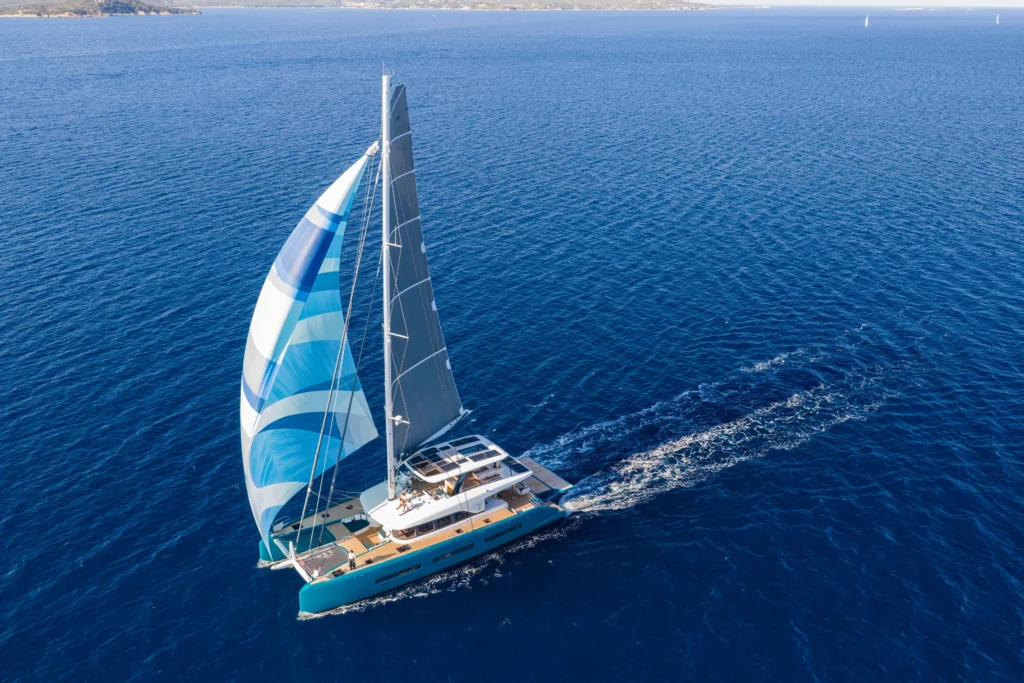
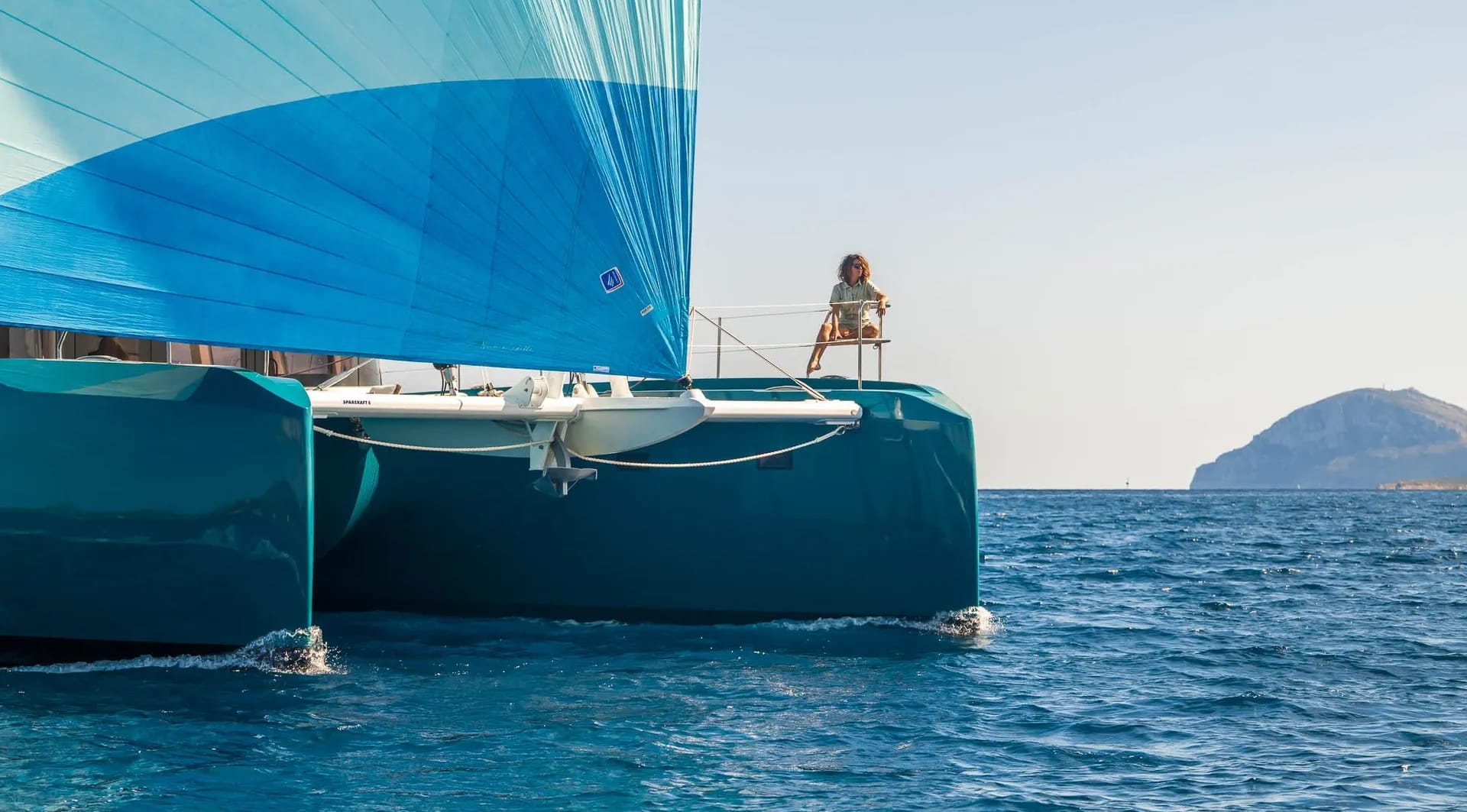
Discovery is a 2025 Lagoon Eighty2 sailing catamaran. Lagoon is an established cruising catamaran builder, and the yacht gives Naora the space for shared life and withdrawal to coexist. That matters over time. Being able to read apart from a conversation, or go below while others remain at the table, helps a small group live comfortably without requiring everyone to keep the same hours.
A catamaran’s relatively level sailing platform does not mean an absence of motion. Pitching, yawing and, in some conditions, waves meeting the structure between the hulls can affect comfort. Nor should limited heel be mistaken for permission to carry more sail. A catamaran may not communicate increasing sail load through heel as a monohull does. Reefing decisions belong with the yacht’s operating guidance, wind conditions, sea state and the loads being carried, rather than with how relaxed the cockpit looks.
Onboard water production and independent energy systems support time away from shore infrastructure. They do not abolish dependence. Water production requires power and maintained equipment. Batteries store energy that must be replenished. Refrigeration, cooking and climate control all have demands. The useful meaning of self-reliance is knowing those demands, monitoring the systems and carrying appropriate spares, not pretending that a remote anchorage has no limits.
Some of the most important work is undramatic: securing a cupboard before departure, noticing a change in pump behaviour, keeping cold storage in order and making maintenance time part of the route. Guests should not need to supervise it. They should be able to notice its consequences in a cabin that remains comfortable, a meal prepared without disorder and a crew that is dealing with routine work before it becomes urgent.
When The Shore Falls Away
Offshore, the distinction between travel formats becomes bodily. A coastal stay can contain frequent opportunities to go ashore and reconsider the next day. An ocean passage commits everyone to a period in which the yacht is the whole inhabited setting. That can be deeply satisfying. It can also involve interrupted sleep, reduced appetite and the slow work of finding your balance. These possibilities belong in an honest conversation before a leg is chosen.
On a night passage, the cockpit can feel cool after the warmth below. A cup warms the palms while the water passes close enough to hear but not always to see. A bright phone screen can leave a pale rectangle in your vision when you look back into the dark. Ordinary actions become more deliberate: placing the cup where it will stay, keeping a hand available for support, closing a door without waking someone. The sea enters daily life through these small adjustments.
Behind that quiet, a watch system has to preserve attention as well as cover the hours. A useful handover includes nearby traffic, changes in weather, sail configuration, the yacht’s position and any equipment concern. Being awake is not the same as being fit to keep watch. Rest is operational, and a guest’s interest in navigation does not remove the captain’s and crew’s responsibilities. Participation can be meaningful without turning a holiday into an unspoken staffing arrangement.
The same realism applies to work ashore. Connectivity may support some tasks, but an ocean passage is a poor place to attach an immovable commitment that depends on a reliable connection. An onward flight also needs breathing room after an estimated arrival. Forecasts and passage estimates help us plan; they cannot make the sea keep an appointment. For someone with fixed obligations, a coastal leg may offer the more generous experience precisely because it demands less compromise.
Choosing A Luxury Sailing Experience By Its Rhythm
Before comparing amenities, it is worth describing the day you actually want. Time mostly at anchor, with meals ashore and short sails between places, is different from the accumulating distance of a passage. Wanting one does not make a person less adventurous than someone who wants the other. It simply changes which part of the Naora route is likely to suit them, and how much uncertainty they should be comfortable accepting.
The people travelling together matter just as much. A family with different sleep patterns and levels of confidence in the water needs room for unequal participation. One person may be content to remain aboard while another spends time ashore. Private hire of Discovery allows a family, a group of friends or a discreet company gathering to shape that shared rhythm within the realities of the route. It does not make weather negotiable. It makes preferences easier to understand and work with.
Joining through Naora’s private circle brings another possibility: sharing part of the worldwide voyage with others who have chosen this way of travelling. The quality of that company cannot be reduced to a selection label. It depends on everyday consideration, including how people use shared space, respect rest and allow others to be quiet. Privacy aboard should feel ordinary. It does not need a performance of separation from the rest of the world.
Water activities also deserve a more useful comparison than a tick beside the word diving. A particular outing depends on conditions, individual experience, equipment readiness and a credible recovery plan. A clear-looking surface does not reveal everything about current below it. Snorkelling, freediving and scuba diving are different activities with different safety requirements. The valuable promise is not that every activity will happen every day, but that a decision to proceed will have a sound reason, and a decision to stop will be respected.
The Value Of Leaving Room
A worldwide route creates opportunity, but opportunity can become another form of pressure if every possible stop has to be collected. The canal transit, the offshore passage and the quiet time near shore each need their own allowances. Official clearances and canal procedures cannot be treated as incidental details. Maintenance cannot always wait for a less interesting place. A serious plan leaves room for the work that allows the rest of the voyage to remain unhurried.
Leaving room also changes how we enter a place. Sourcing locally requires attention to what is actually available and appropriate, rather than asking every market to reproduce the same menu. Going ashore involves local customs, working hours and religious rhythms that do not exist for visiting yachts. A coast becomes more intelligible when there is time to notice what people are doing, rather than only what a visitor can do there.
Naora’s aim is to move with care and stay as close to carbon neutral as possible. That is an operating intention, not a claim that sailing has no footprint. Engines, onboard energy use, maintenance, provisions and travel to and from the yacht all carry consequences. Using the wind well and avoiding unnecessary movement are practical decisions. They deserve to be described plainly, without turning a sail into an environmental guarantee.
This is where we would place the emphasis when considering the best sailing experience for a particular person: in the fit between the life they want aboard and the voyage the yacht can responsibly make. There is no need to force every pleasure into one stay. A yacht can be bound for the other side of the world without asking everyone aboard to hurry.