After a Sunday drive, there is a small pleasure in switching off the engine and hearing the garage become quiet again. The Ferrari is home. The afternoon remains available. An Atlantic crossing asks for a different arrangement with the rest of your life: once the coast has fallen behind, the time belongs to the passage until the passage is finished.
Both can sit behind the same private question: what do I do with what I have built? The question need not contain dissatisfaction. Work may be meaningful, home happy, the car genuinely loved. Still, there can be a distance between having the means to choose and actually allowing a choice to rearrange the calendar.
We should be careful with the easy answer that objects are shallow and experiences profound. Anyone who has loved a machine knows better. The useful distinction is more practical. One pleasure can usually be fitted into the life already being lived. The other requires that life to make room.
What The Ferrari Gives You
The Ferrari is not merely an object in a garage. It is steering feel, the relationship between an engine and a right foot, the pleasure of learning a familiar road without needing to arrive anywhere important. Ownership can support years of attention, friendship and knowledge. There is nothing incomplete about that pleasure on its own terms.
Its particular freedom is that it can wait. If work overruns, the drive moves to another morning. If the weather turns unpleasant, the garage door stays closed. This is part of what makes a car compatible with a demanding life. Enjoyment remains available without requiring the surrounding responsibilities to be reorganised.
An ocean passage cannot offer the same accommodation. Weather may move the departure. A slower passage may move the arrival. An important conversation ashore cannot necessarily bring the yacht into port sooner. The distinction is not between a possession and a memory, but between something you can return to when convenient and something you must remain present for while it unfolds.
That makes the crossing a different response to achievement, rather than a superior one. It asks whether some of the freedom created through work can be expressed as protected time, including time whose exact shape you cannot determine in advance. Paying for a passage does not make that decision for you.
The Time An Atlantic Crossing Actually Takes
There is no honest universal duration for an Atlantic crossing. Departure and arrival points matter, as do season, routing, current, sea state and the sail plan that conditions allow. A number of days detached from those particulars is an attractive headline, not a passage plan.
For scale, an illustrative average of 7 knots over the ground produces 168 Nm in 24 hours. At 8 knots, that becomes 192 Nm. These are arithmetic examples, not projected speeds for Discovery. The difference shows why a modest change in average progress, sustained across successive days, can move an arrival estimate appreciably. A brief spell of fast sailing does not cancel a long period of lighter wind.
Speed over the ground is the useful measure here because it describes progress across the chart. Speed through the water describes the yacht moving through water that may itself be moving. Current can help or hinder, and a comfortable course through the waves may not be the shortest line to the destination. We plan around the passage the boat can reasonably make, not the distance divided by its most flattering speed.
The calendar therefore needs room on both sides of the sailing. Before departure, that room allows for preparation and a suitable weather window. Afterwards, it prevents a slower passage from immediately becoming a missed obligation. A tightly connected return flight can exert pressure long before anyone reaches the airport.
One useful preparation is to identify what must happen on a fixed date and move it away from the expected landfall. If that cannot be done, a shorter coastal chapter may be the better choice. There is no seamanship in selecting a passage whose uncertainty your life cannot presently absorb.
What We Read Before We Leave
For a westbound passage in the northern Atlantic tradewind belt, northern winter generally offers more established easterly winds than summer. That seasonal pattern explains much of the familiar sailing rhythm across the ocean. It does not promise uninterrupted following winds, nor does it remove the need to examine the actual weather developing around departure.
We look beyond wind arrows. Swell can arrive from a distant weather system, with a direction different from the locally generated waves. Wave height alone tells an incomplete story: the interval between waves and their angle to the yacht affect motion, steering and fatigue. A sea that looks modest as a single number can become wearing when the waves are short and awkwardly aligned.
The departure forecast is only the beginning. Its useful detail diminishes further into the future, so routing has to remain a continuing judgement rather than a decision completed ashore. New forecasts must be read alongside the conditions actually encountered. A proposed change of course deserves scrutiny for what it does to comfort, sail handling and the next weather system, not merely the estimated arrival time.
On a cruising catamaran, increasing load does not necessarily announce itself through the progressive heel familiar from a monohull. Sailing downwind can also make the apparent wind feel gentler than the true wind. That is why reefing belongs to a considered sail plan, informed by the yacht’s guidance and the approaching conditions, rather than waiting until the boat feels alarming. Reducing sail before a squall is usually a quieter job than doing it inside one.
Preparation extends below deck. Steering, rigging, communications, charging and safety equipment need attention before departure. Provisioning needs a reserve for delay. Water production does not remove the need for a drinking-water contingency. These are not signs that a difficult crossing is expected. They are how an ordinary equipment problem is kept from consuming every remaining option.
The Working Life Of An Atlantic Crossing
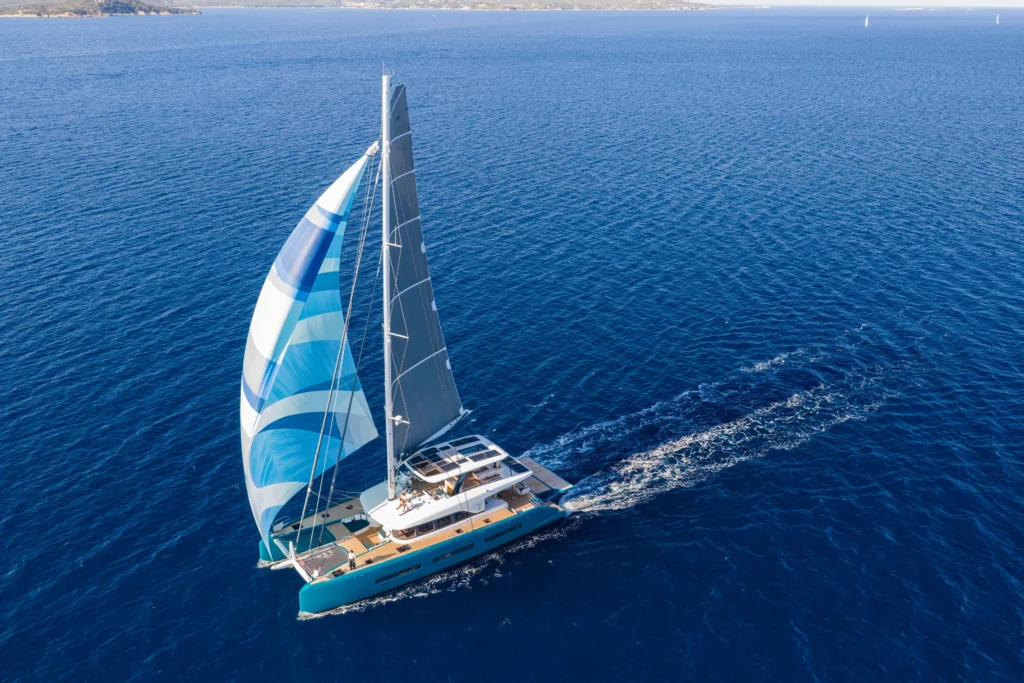
Discovery, our 2025 Lagoon Eighty2 sailing catamaran, makes an ocean passage habitable without making it less of an ocean passage. Sven is Naora’s founder and captain. He plans every weather window and sails every leg himself. That continuity matters because the person making the departure decision remains aboard to live with its consequences.
His presence does not replace a watch system. Offshore responsibility must continue while people sleep, eat and carry out maintenance. A proper handover covers the course and sail configuration, nearby traffic, changes in weather and anything unusual in the yacht’s behaviour. The person coming on watch needs time to understand the situation before the person being relieved leaves it.
At night, the visible world contracts. With the chart light dimmed, the horizon can be difficult to separate from the sky. A mug warms the hands while the air cools the face. The sounds become more distinct: water passing the hull, a small change in the pull of a sail, something unsecured tapping with each movement. The apparent stillness contains work.
A light holding a steady bearing while drawing closer needs attention. AIS does not show every vessel, and neither an alarm nor a screen replaces a lookout. Changes in wind and cloud matter even when the course remains unchanged. The discipline is sustained observation, followed by action early enough that it can be unhurried.
Guests should understand before departure what participation involves. Someone who wants to learn needs a clear role, instruction and supervision appropriate to their experience. Interest is welcome, but interest alone does not qualify someone to keep an independent watch. The responsibility for safe navigation cannot rest on an assumption that enthusiasm will become competence once land disappears.
There is pleasure in this working rhythm even for someone who is not handling the yacht. The boat is being looked after. Decisions have reasons. An explanation of why sail was reduced can make the following hours more interesting, without making the guest responsible for the decision.
Making An Absence Possible Ashore
The preparation most easily overlooked has nothing to do with the yacht. For someone carrying substantial responsibility ashore, an ocean crossing needs an arrangement that works without their constant intervention. Taking a laptop aboard is not that arrangement.
Useful delegation is specific. Someone needs the authority to make ordinary decisions, clarity about which matters can wait, and a way to distinguish an inconvenience from something genuinely urgent. Access to necessary documents and approvals should not depend on reaching a person whose connection may be interrupted. A short trial absence before departure can reveal gaps while they are still straightforward to repair.
We do not promise uninterrupted connectivity at sea. Even when a connection is available, conditions may make a scheduled call impractical. An awkward sea, a sail change or simple fatigue does not consult the meeting invitation. Work that tolerates delay fits offshore life more readily than work requiring immediate, continuous response.
This is also a conversation at home. People ashore deserve realistic expectations about contact, progress and changes to the arrival estimate. Privacy aboard does not mean leaving those who care about you uncertain about the plan.
None of this guarantees that you will stop thinking about work. You may continue composing replies in your head long after the coast has gone. The useful change is smaller and more concrete: the people ashore have what they need, and an unanswered message does not automatically mean something has been neglected.
Living Well Without Leaving The Sea Out
Comfort offshore depends on accepting motion rather than pretending it has been removed. A catamaran offers space and a different pattern of movement from a monohull, but it still pitches, accelerates and responds to crossing seas. A handhold used before it seems necessary is a better habit than catching yourself afterwards.
At breakfast underway, even pouring coffee becomes a small act of attention. The cup is not filled to the rim. A hand waits through a movement before the pot is tipped. There is toast in the air and salt on the outside surfaces, and the horizon shifts beyond the table while everything close at hand needs somewhere secure to rest. None of it is dramatic. It is simply breakfast on a moving boat.
The galley follows the same logic. Food that can be prepared in stages, served in a bowl and eaten comfortably may be preferable to something requiring last-minute knife work or several hot pans. Securing equipment, protecting the cold chain and keeping passage meals manageable are part of cooking well. An elaborate dinner has little value if preparing it leaves someone exhausted or exposes them to a burn.
Sleep needs similar protection. Quiet near resting cabins, shaded spaces during daylight and restraint about unnecessary activity all matter when the yacht is operating continuously. Seasickness deserves a conversation with a clinician before departure, including how any proposed medicine may affect alertness. It is easier to make a sensible plan ashore than to improvise one when eating and drinking have become difficult.
There may also be boredom, irritation or an afternoon when you would rather be elsewhere. A crossing does not become false because it contains those hours. Nor is it an anchorage holiday with open-water swimming whenever the mood arrives. Meals, books, conversation and the changing sea have to carry much of the day. For some people that is exactly the appeal. For others, it is useful to recognise the difference before choosing the passage.
Choosing A Place In A Longer Voyage
The Naora Global Expedition is a private sailing expedition around the world, planned for five years from 2027 to 2031, covering roughly 49,000 Nm across 166 legs. An Atlantic crossing belongs within that continuity. It is one substantial chapter in a yacht’s working life, rather than a separate event built around a single group of arrivals and departures.
Through Naora’s private circle, members choose when they join, where along the route they step aboard and how long they stay. Discovery continues around the world between those visits. That makes it possible to give the expedition the amount of time that fits a particular stage of life, without pretending everyone wants or can accommodate an ocean passage.
The freedom is real, but it has a geographical boundary. Once committed to a crossing, joining and leaving are no longer everyday choices. They belong at suitable landfalls, subject to weather, access and formalities. Choosing an offshore chapter means accepting that interval of commitment, just as choosing a shorter coastal chapter means valuing a different rhythm.
This is where the comparison with the Ferrari becomes useful again. There is no need to decide which pleasure says something better about you. There is only the more exact task of recognising what each one asks. The crossing requires protected weeks, preparation on both sides of the shoreline, and consent to a plan that can change for sound reasons.
It cannot promise a revelation at landfall. It can give you the experience of having stayed with something that could not be compressed into the space between other commitments.
The Ferrari can still be in the garage when you come home. You may be glad to see it. The weeks will have belonged to something else.