At night, looking down at a bright screen can make the horizon disappear when you look up again. The sea has not changed. Your eyes have. Offshore sailing becomes understandable through hundreds of corrections like this, small enough to escape a documentary, important enough to change how you move through the next hour. Lower the brightness, give your eyes time, and what seemed to be empty darkness begins to contain information.
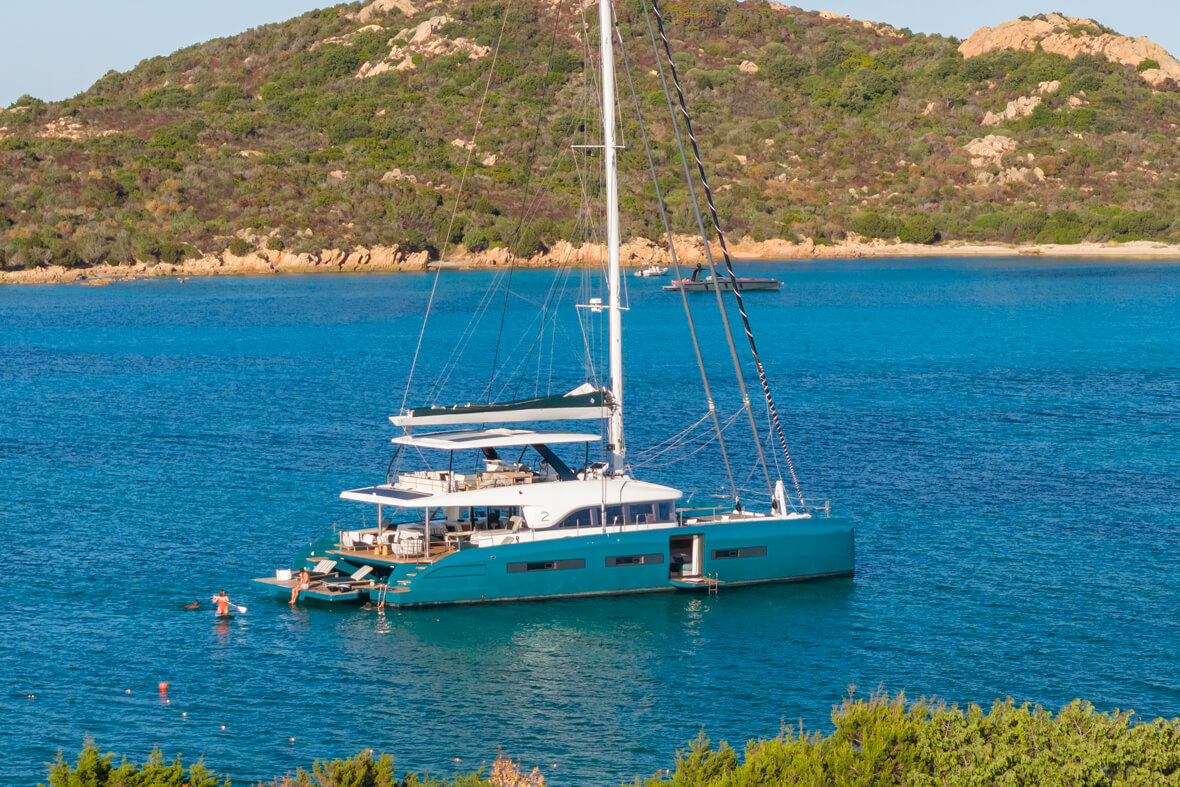
A good sailing lesson can explain that before you leave shore. It can explain reefing, weather systems and collision risk with a clarity that a moving boat does not always permit. We value that preparation. But aboard Discovery, the Lagoon Eighty2 sailing the Naora Global Expedition, those separate subjects occupy the same evening. The weather affects the sail plan. The sail plan affects the motion. The motion affects sleep, and sleep affects the person interpreting the weather. Living inside those relationships is the part that cannot be watched from elsewhere.
Offshore Sailing Begins Before Departure
The first useful lesson of an Atlantic passage may be a departure that does not happen. There is little spectacle in waiting for another forecast, checking how the sea state is developing or deciding that an acceptable window is not yet a sensible one. A filmed passage naturally gives more attention to movement. The judgement that makes movement possible often takes place with the boat still secured.
For an Atlantic passage towards the Caribbean, the northern winter generally brings established northeasterly trade winds across the tropical North Atlantic. That is a seasonal tendency, not a promise for a particular departure. Weather systems farther north can send swell into otherwise favourable sailing conditions. Squalls can bring brief increases in wind and abrupt changes of direction. Following the tradewinds means working with a useful prevailing pattern while continuing to look for what does not fit it.
The important distinction in that planning is between a forecast that looks attractive and one that leaves room for error. Wind direction matters alongside sea state, the evolution of nearby systems, the reliability of the forecast and the conditions expected at the other end. We want a passage that remains manageable when progress is slower or a change arrives earlier than expected.
There is something practical to learn here before touching a line: check when a forecast was issued as well as the time it describes. Compare successive forecasts rather than treating the newest image as an isolated answer. If the timing of a weather change keeps moving, that movement is information. Confidence should reflect it. Waiting costs time ashore or time at the next destination. Departing uses some of the options that waiting preserves.
The Motion Beneath The Numbers
A forecast wave height is an incomplete description of the day ahead. A period of six seconds rather than twelve seconds means a different spacing and rhythm between waves, even when the quoted height is identical. The motion aboard also depends on the direction and speed of the yacht relative to those waves. A longer swell can still produce substantial movement. The useful question is how this particular sea will meet this particular boat.
You feel the answer through your feet before you have language for it. A movement that looks modest from a seat may interrupt the short walk across a cabin. A cup needs somewhere secure before a cupboard can be opened. These are ordinary adjustments, but repeated through a day they help explain why two passages with similar wind speeds can leave people feeling quite different.
A cruising catamaran introduces another distinction. Its resistance to heeling means a comparatively level deck is not evidence that the rig is lightly loaded. Waiting for the boat to lean dramatically is the wrong cue for reducing sail. The decision belongs to the wind, the sea state, the sail configuration and the limits of the vessel, with allowance for gusts rather than only the number currently displayed.
The arithmetic makes this less abstract. If airflow over a sail increases from twenty knots to thirty knots, aerodynamic pressure becomes more than twice as great, all else equal. That does not predict the exact load in a particular rope or fitting, but it explains why a seemingly moderate increase deserves attention. This airflow is the apparent wind, the wind the moving yacht experiences. Changes in course and speed alter it. A reef put in while the work is straightforward can be a decision about the coming hours, not a response to discomfort already felt.
Offshore Sailing At The Watch Handover
On a dark watch, the water can be easier to hear than to see: a continuous wash alongside the hulls, then a different note as the boat meets a wave. The temptation is to look at the illuminated instruments because they are clear and the sea is not. Good watchkeeping keeps bringing attention back outside. The display provides information. It does not contain the whole situation.
Allowing roughly twenty to thirty minutes for your eyes to adjust is useful, although adaptation varies and bright light can disrupt it. Instrument brightness needs to remain sufficient for reading essential information without overwhelming the view beyond the boat. A phone brought into the cockpit can undo part of that patient adjustment in a moment. What looks like a minor courtesy is also a practical contribution to the watch.
The handover is where apparently quiet sailing reveals its discipline. The incoming watch needs to understand the position, course, sail plan, nearby traffic, weather trend and anything requiring closer attention. An unexplained light is not something to leave for the next person to discover. Nor is a developing cloud, an instrument behaving oddly or a small change that has not yet become a problem. Continuity depends on passing on uncertainty as carefully as established facts.
One observation worth carrying away is that a light holding a nearly constant bearing while its range closes can indicate collision risk. Its smallness is no reassurance. Electronic traffic information helps, but not every vessel transmits it, and equipment has limitations. A guest observing a watch can begin to understand these relationships without becoming responsible for them. Participation has to match experience and conditions. The professional watch remains responsible for the boat, including while explaining what it sees.
The Body Has Its Own Learning Curve
Before sunrise, the warmth of a cup in both hands can feel more immediate than the distance still to sail. There is the slight effort of keeping the drink level, the need to settle into the boat’s movement rather than resist every part of it, the discovery that a familiar task now requires a little forethought. This is physical learning. Knowing why the yacht moves does not immediately teach the body how to live with that movement.
For some people, the adjustment includes seasickness. It is a physiological response, not a measure of courage or suitability for sailing, and it deserves attention early rather than embarrassment. Going below to read may make symptoms worse. Looking towards the horizon, taking small amounts of fluid and finding a safe, supported position can help. Medication is something to discuss before departure with a clinician or pharmacist, particularly because some options cause drowsiness. Persistent vomiting or an inability to keep fluids down should be reported promptly.
Sleep is equally practical. A person may feel alert during an interesting conversation and discover how tired they are only when asked to concentrate on something ordinary. Off-watch rest needs protection from unnecessary noise and from the temptation to remain involved in everything. There is no merit in staying awake to prove enthusiasm. For anyone accustomed to making themselves available all day, accepting that rest has a place in the plan can take practice.
The galley makes these connections tangible. Hot liquid, loose equipment and an unexpected movement are a poor combination, so preparation includes securing things before the task becomes absorbing. A simple meal that is easy to manage can be more considerate than an elaborate one. Eating, drinking and resting are part of keeping people well enough to enjoy the passage and make sensible decisions. None of it needs to feel clinical. Much of good care is a meal arriving before someone has noticed they need it.
Distance Becomes Time
Offshore, a small difference in sustained speed accumulates. One knot maintained over twenty-four hours represents twenty-four Nm. That is arithmetic, not a performance prediction for Discovery, but it explains why an apparently minor change in average progress can alter an arrival. Over several days, the difference may move an approach from daylight into darkness or change which part of a weather system the yacht encounters.
The fastest instantaneous speed is therefore a poor summary of a passage. Speed through the water and speed over the ground are different quantities, because current can help or hinder progress. An uncomfortable course may also cost more than it gains if it interrupts rest or increases strain on the boat. A useful passage plan considers sustainable progress and keeps revising the estimate as observation replaces assumption.
This is where the freedom of Naora needs to be understood honestly. Members choose when they join, where along the worldwide route they step aboard and how long they stay. The yacht continues around the world. But joining an ocean passage means accepting that its arrival is an estimate governed by conditions, not a fixed appointment. You cannot step out halfway because a meeting has moved. If a firm return date matters, choosing a suitable coastal section and leaving a sensible margin may be the better decision.
That choice does not diminish the experience. It makes it fit the person. A week aboard can offer meaningful contact with sailing without asking someone to pretend that their responsibilities ashore have ceased to exist.
The Landfall Still Requires Attention
A Caribbean coastline after an Atlantic passage carries an emotional weight that a photograph cannot reproduce. Yet the first sight of land is also the beginning of a different kind of work. Open water gives way to hazards, traffic, shallower depths and decisions that may need to be made closer together. The desire to arrive is understandable. It is not navigational information.
An approach should be prepared before tiredness and anticipation narrow attention. Charts and relevant local information need to be considered together. The planned track must make sense for the yacht’s draught, the expected water level and the conditions at the entrance. Daylight may make hazards easier to identify, but daylight alone does not make an approach suitable. Where tidal streams matter, high water does not automatically mean slack current. Height and flow answer different questions.
The learning here is partly about resisting a story. After days at sea, everyone wants the passage to end neatly. A professional decision may be to slow down, remain clear or wait for better conditions rather than let the imagined arrival determine the actual one. A plan is stronger when it includes somewhere to pause before the options become narrow.
There is also work after the yacht is secured. Clearance requirements, checks, tidying equipment and assessing anything that needs attention belong to arrival, even if they rarely appear in its photograph. For the people resting aboard, that work should be unobtrusive. For someone interested in how sailing really functions, it reveals that reaching land and finishing the passage are not quite the same moment.
Experience Needs Time To Become Judgement
Simply being aboard does not make every impression accurate. A decision can be good and still produce an uncomfortable afternoon. A poor decision can be followed by benign weather. If we judge only by the outcome, the sea can teach the wrong lesson. What matters is understanding what was known at the time, which alternatives existed and why one was chosen.
A small notebook can help. Record the expectation before the outcome is obvious: the forecast change, the reason for shortening sail, the arrival estimate. Return to it later. Memory has a habit of making an uncertain situation look inevitable once it is over. Writing down what was actually expected preserves the useful gap between prediction and experience. It also gives a conversation with the captain something concrete to turn on.
There is a right time for that conversation. During a manoeuvre, clear communication takes precedence over explanation. Afterwards, a question about why something happened early, slowly or differently from the original plan can reveal more than a long discussion of equipment. Time aboard does not certify anyone to take command offshore. Structured instruction and supervised practice have their own necessary place. What an expedition offers is the chance to see decisions connected to the life around them.
The Naora Global Expedition is planned across roughly 49,000 Nm over five years, from 2027 to 2031. That continuity matters more than the size of the number. Maintenance done now belongs to a later passage. Rest taken tonight belongs to tomorrow’s judgement. The person joining for one part of the route enters something that was being cared for before they arrived and will continue to need care after they leave.
And nobody has to turn every hour into a lesson. You can listen to the reasoning, understand a little more, then go below while the watch continues. There is a particular ease in hearing water move past the hull from your berth and knowing that it does not require your attention. Someone is keeping watch.