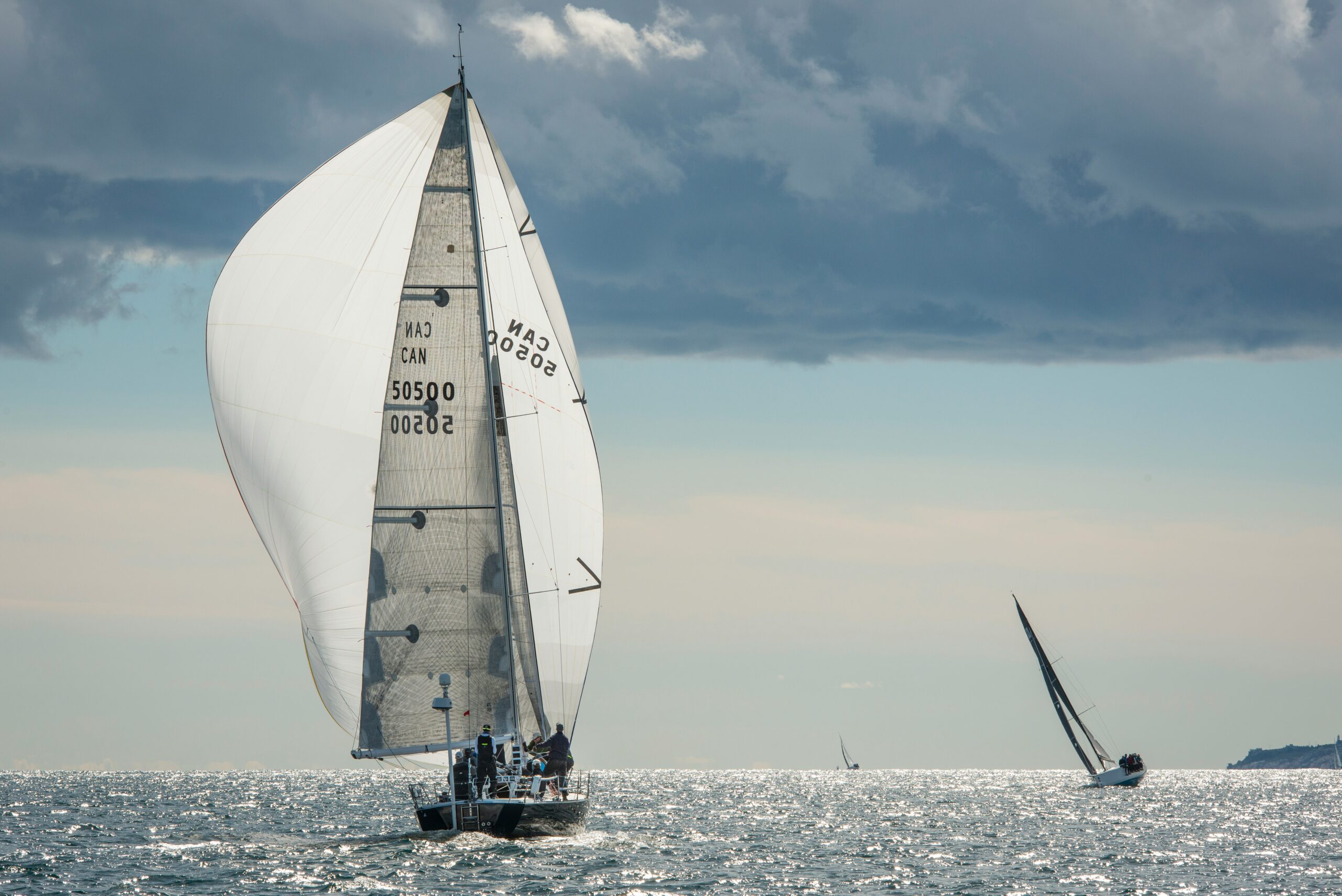
A departure from Las Palmas can look modest: fenders lifted inboard, lines stowed, someone watching the water beyond the harbour entrance. A sailing school boat and a yacht bound for Barbados may do much the same things here. The sailing school vs Atlantic crossing comparison only becomes useful when we consider what must keep working after the coast falls astern.
We do not think of an ocean crossing as the prize for finishing sailing school. A good course has value of its own, and a person can cross an ocean without acquiring the competence to command the boat that carried them. The more interesting difference is what happens to a skill when it has to support a life, continuously, for weeks. Navigation becomes the reason someone can sleep. Sail handling becomes the reason supper remains manageable. Preparation becomes something you live inside.
Sailing School Vs Atlantic Crossing: The Purpose Of Each
A sailing school in Gran Canaria gives learning a deliberate structure. An instructor can explain a manoeuvre, demonstrate it, let the student try, then repeat it while the explanation is still fresh. That opportunity to repeat matters. You can change one thing, the timing of a turn or the amount of sail carried, and begin to understand its effect rather than merely remember that something happened.
The RYA pathway also distinguishes between starting to sail and starting to skipper. Competent Crew introduces the newcomer to useful participation aboard. A Day Skipper practical course normally lasts five days and builds on previous sailing experience and basic navigation knowledge. Its purpose concerns skippering in familiar waters by day, not declaring someone ready to take responsibility for an Atlantic passage. Theory and practical work support each other, but they are not interchangeable.
There is considerable judgement in coastal sailing. Traffic, shallow water, harbour approaches and the need to manoeuvre in confined space can put more immediate decisions into an afternoon than a settled offshore day contains. We should not confuse distance from land with the difficulty or educational value of every individual task.
Nor should we pretend that sailing schools stop at the harbour mouth. Some training includes substantial offshore passages. The distinction is the purpose of the voyage, not simply its latitude. A course arranges time around learning objectives. On Naora, the passage itself comes first. There is room to understand what is happening, and to take part where appropriate, but the boat will not repeat an approach or delay a necessary sail change to complete somebody’s lesson.
Leaving Las Palmas With A Weather Window
We treat 22 days for Las Palmas to Barbados as a planning estimate, never as a promised arrival. That is roughly three weeks in which the weather, the condition of the yacht and the wellbeing of the people aboard must be considered together. A calendar cannot settle those relationships in advance.
During the northern winter, established northeast trade winds can bring 15 to 25 knots of true wind across this part of the Atlantic. That range describes a useful sailing pattern, not a continuous forecast. The subtropical high-pressure system can strengthen, weaken or shift. There can be lighter intervals, squalls and swell arriving from weather far beyond the local horizon. Wind from behind does not necessarily mean that every wave arrives neatly from behind as well.
The Canaries add their own complication. Wind accelerated around an island and disturbed air in its lee can make the first hours unrepresentative of the wider ocean. A quiet berth in Las Palmas tells us about shelter. It does not tell us what sail area will be appropriate once that shelter is gone. The departure assessment has to connect local conditions with the larger weather pattern rather than allowing either to stand in for the other.
Sven, Naora’s founder and captain, plans every weather window and sails every leg himself. The useful work is not finding a forecast image that looks favourable. It is examining how the forecast develops, how confident that picture deserves to make us, and what would change the decision. A route that appears quick on a screen may impose an uncomfortable sea angle or repeated sail handling. Those costs belong in the calculation.
A sustained difference of one knot changes a day’s run by 24 Nm. Across a long passage, a small change in average speed becomes meaningful time. This is why passage planning needs reserves and why the fastest moment on the instruments is a poor measure of how well a crossing is going.
The Boat That Keeps Going While You Sleep
A course can pause a discussion and return to it later. An offshore yacht continues moving while the people aboard eat, wash and sleep. The work must pass from one rested person to another without losing the thread. That continuity is one of the least photographed and most important differences between a sailing week and an ocean passage.
A useful watch handover explains more than heading and speed. The incoming watch needs to understand the sail configuration, relevant traffic, changes in the weather and anything being monitored. It also needs clear instructions about when to call the captain. An unresolved concern should not disappear because its first observer has gone below. Writing something down helps, but a log entry does not replace a conversation about what it means.
On a moonless watch, the horizon can disappear into cloud. A dim instrument panel lights the edge of a hand; the water is heard more clearly than it is seen. Below, a cupboard latch becomes a surprisingly loud sound. Small noises matter because someone nearby is trying to sleep, and that person’s rest belongs to tomorrow’s safety.
Electronic information is valuable here, but it does not remove the need for a lookout. Not every vessel transmits AIS, and neither an AIS display nor radar should be treated as a complete account of the water around the yacht. Good watchkeeping joins the instruments to what can be seen and heard. It also recognises fatigue early. Missing an obvious detail or repeatedly rereading the same information is a reason to seek relief, not to prove endurance.
Why A Catamaran Asks For Early Decisions
Discovery, the 2025 Lagoon Eighty2 sailing catamaran carrying Naora around the world, offers a different physical experience from the smaller training yachts many sailors first encounter. The space is immediately apparent. The less obvious difference is how the boat communicates load. A cruising catamaran generally sails with less heel than a monohull, so an upright saloon cannot be used as evidence that the rig is lightly loaded.
That makes disciplined attention to wind, sail configuration and the manufacturer’s operating guidance important. True wind describes the movement of air over the water. Apparent wind is what the moving yacht experiences. Sailing downwind can make the apparent wind feel relatively modest even when the true wind is substantial. A change in heading or an approaching squall can alter that relationship quickly.
Reefing is therefore a decision to make from the conditions and their likely development, not from how reassuring the deck feels underfoot. Reducing sail while the crew can work calmly is preferable to waiting until the weather makes the same task harder. The exact decision belongs to the captain and the circumstances, rather than to a universal wind number borrowed from another boat.
The longer passage also gives small defects time to develop. A line rubbing against an edge may look insignificant during a short outing; continuous movement can turn it into a maintenance problem offshore. Looking for chafe, changes in sound and movement where there should be none is part of living attentively with the yacht. The aim is to notice while the remedy is still simple.
Food And Rest Are Part Of The Passage
Provisioning for an Atlantic crossing begins with meals, not with an impressive quantity of groceries. We have to consider what can be stored safely, what will deteriorate first and what can be prepared when the motion makes cooking less comfortable. The passage estimate is the starting point. Food for additional time and practical alternatives to refrigerated ingredients belong in the plan as well.
Local buying in Gran Canaria makes sense where quality and storage life support the passage. Delicate leaves belong early in the meal plan. Sound cabbages and whole squash can remain useful later if their storage conditions suit them. Produce needs inspection during the voyage, because one damaged item can spoil neighbouring food. Dry stores and tins should form meals people would actually want to eat, rather than an emergency collection nobody has thought through.
In a moving galley, the body begins working before the knife does. A hip finds a steady position against the counter. Feet adjust to a movement that arrives slightly sooner than expected. The smell of softened onions can make the room feel domestic even while the cupboard doors need securing. A stew prepared before conditions become tiring, served in a bowl that is easy to hold, may be a more thoughtful meal than something elaborate requiring constant attention at the stove.
Water deserves the same practical restraint. Onboard production does not remove the need to monitor tank levels, understand consumption and retain a margin for equipment trouble. Self-reliance is strongest when it includes an honest account of what happens if a system stops working.
Then there is appetite, which the sea can change without asking. Seasickness is not a failure of character. Anyone prone to it should discuss suitable medication and its possible effects with a clinician before departure, rather than trying something unfamiliar offshore. Aboard, reporting symptoms early allows the crew to respond before poor fluid intake and missed sleep compound the problem. Nobody needs to earn supper by looking unaffected.
Taking Part Without Being Examined
You do not need a sailing qualification to join Naora as a guest. That does not make suitability for an ocean passage a trivial matter. Previous experience of motion, health needs, mobility, sleep and the ability to remain comfortable without an easy way ashore are more useful subjects for conversation than confidence expressed in the abstract. A shorter coastal passage can be a sensible way to discover what living on a moving boat feels like before choosing a crossing.
Participation can be quiet and still be meaningful. Comparing the wind felt on your face with the instrument reading is a beginning. So is learning why a course changes when the destination has not, or watching how an approaching cloud affects the crew’s attention. Someone with more experience may take part in sail handling or supervised watchkeeping when the captain judges it appropriate. Interest does not turn a guest into an essential part of the watch roster.
There are responsibilities shared by everyone, however. Knowing how to move safely, understanding the yacht’s lifejacket and harness procedures, and following instructions promptly are part of being aboard. These are practical habits, not a test of enthusiasm. Asking for an explanation is welcome; the moment of an urgent manoeuvre may simply not be the time for it.
A school gives feedback against defined skills. A passage offers a different kind of feedback, often slower and less tidy. You may discover that you enjoy understanding the weather but have little interest in steering. You may prefer a quiet conversation during a watch to the idea of becoming a skipper. Neither discovery diminishes the voyage.
Sailing School Vs Atlantic Crossing: Choosing The Commitment
The Naora Global Expedition covers roughly 49,000 Nm across five years, from 2027 to 2031. Members choose when they join, where along the worldwide route they step aboard and how long they stay. The yacht keeps sailing as people step into and out of its life. That freedom allows very different relationships with the sea, from a shorter stay near land to the sustained commitment of an ocean passage.
The Atlantic makes an important limit clear. Freedom to choose a crossing does not mean freedom to shorten it once offshore. Between Las Palmas and Barbados, the days belong to the passage. Work that depends on an immovable call or uninterrupted connectivity needs an alternative arrangement. Commitments immediately after the expected landfall need room for the ocean to take longer. Private time becomes more restful when its practical consequences have been acknowledged before departure.
If the purpose is to learn to skipper, structured training deserves its place. If the purpose is to understand how life feels when land remains beyond reach and the boat must carry everything forward, an Atlantic crossing offers that experience. Neither replaces the other. Nor does either require a grand account of personal transformation afterwards.
Some of what remains may be very ordinary: learning to put something back where another person can find it, recognising a change in the motion, or sleeping through the sound of water because the work outside your cabin is being done carefully. The quiet in a cabin at night is someone else keeping watch.