Through a mask, a reef can appear almost motionless until you notice the fish facing into the same invisible flow. Your body feels it next: a steady pressure against the fins, although the surface looked quiet from the boat. A comparison between an Antarctic expedition cruise and a Coral Triangle sailing passage can begin with that small discrepancy. What a place looks like, and what it requires of the people entering it, are different things. Warm water does not necessarily make an easy sea. Ice does not make every encounter a struggle.
There are really two comparisons here. One concerns ecosystems, the cold seasonal productivity of the Antarctic and the intricate tropical habitats of the Coral Triangle. The other concerns vessels and the lives they make possible. Confusing them produces an appealing but unreliable argument in which a small yacht automatically means deeper access and a warm reef automatically means more life. Neither claim survives much time on the water.
What An Antarctic Expedition Cruise Makes Possible
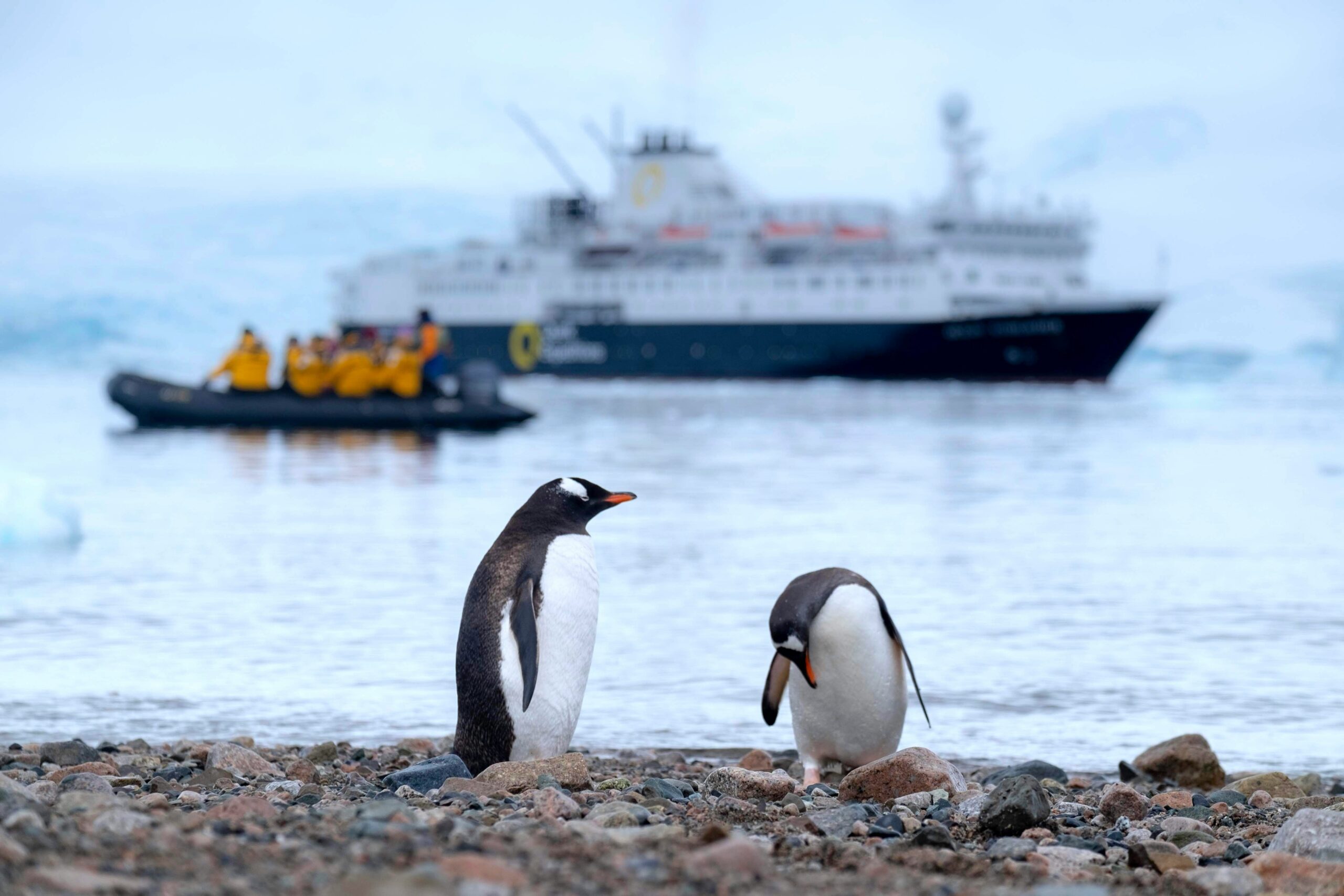
The Antarctic Peninsula is approached during the austral summer, when longer daylight and the seasonal retreat of sea ice make many coastal operations possible. Summer does not remove the weather. Across the Drake Passage and along the Peninsula, wind, swell and ice still govern the practical shape of a voyage. A landing shown on an itinerary remains a proposal until the expedition team has assessed the approach, the landing place and the prospect of getting everyone safely back aboard.
This is one of the strengths of a well-run expedition ship. It brings specialist people, equipment and operating experience into a place where improvisation has a narrow margin. Naturalists can give meaning to what appears, at first, to be a landscape of immense simplicity. A bridge team and shore team can divide responsibilities that would fall on far fewer people aboard a yacht. Shared organisation is sometimes treated as a dilution of adventure. In polar water, it is often what makes an encounter possible at all.
Seawater can remain liquid down to about minus 1.8°C, depending on salinity. That number matters less as a description of a view than as a reminder that an unexpected immersion is an emergency, not an inconvenience. Protection, communication and recovery arrangements belong at the centre of the day. Even without entering the water, a person sitting still in a small landing boat cools differently from someone walking ashore. Gloves that allow the hands to work, dry layers and a realistic understanding of exposure are part of seeing the place well.
Temperature, Abundance And Diversity
The Antarctic is sometimes described as having little biodiversity but spectacular wildlife. That is too blunt. Penguins, seals and whales are the conspicuous part of ecosystems that also contain rich communities of seabed invertebrates. Sponges, worms, crustaceans and other animals do not become ecologically unimportant because they are less visible from a landing boat. Nor does a gathering of many animals tell us, by itself, how many species the wider environment supports.
The useful distinction is between abundance and diversity. Seasonal light can drive substantial phytoplankton growth in Antarctic waters, supporting food webs in which krill are important. Sea ice also provides habitat and feeding opportunities, particularly for young krill. The large animals encountered by visitors are connected to these much smaller organisms and to seasonal processes that may be invisible during the visit. A whale surfacing beside ice is a moment. The conditions supporting it extend far beyond that moment.
The Coral Triangle supports more than 500 species of reef-building coral. That figure describes an exceptional range of living structures, not a promise that one dive will reveal them all. Branching, massive and plate-like colonies create different kinds of shelter and feeding space. Many tropical reef-building corals depend on a partnership with microscopic algae living in their tissues, helping explain why light, water clarity and depth influence the reef’s form. Warmth alone does not explain this diversity. Geography, evolutionary history and connections between habitats matter too.
Shallow reef water in much of the region commonly sits around 26 to 30°C, a broad expectation rather than a forecast for a particular anchorage. Upwelling and currents can bring colder water to a dive. Prolonged unusual heat can stress corals and disrupt their relationship with their algae. The temperature that feels agreeable to a swimmer is therefore a poor measure of reef health. Comfort and ecological wellbeing are not the same reading.
Access On An Antarctic Expedition Cruise And Under Sail
A common operating limit for Antarctic landings is 100 passengers ashore at a time, with tighter limits at some sites. Its practical consequence is rotation: a ship’s total passenger count does not tell you how many people will share a landing. Site layout, wildlife behaviour and the conditions for transferring people matter as well. Cleaning footwear and equipment between landings is another part of access, intended to reduce the movement of organisms between places. Time spent on these procedures is time spent protecting the reason for going.
Some polar operators offer specialist diving or snorkelling, subject to equipment, experience and conditions. Others do not. It would be misleading to compare an assumed absence of water access in Antarctica with an assumed unrestricted diving programme in the tropics. The relevant questions concern the actual voyage: what activity is supported, who supervises it, what experience is required and what happens when the conditions are unsuitable.
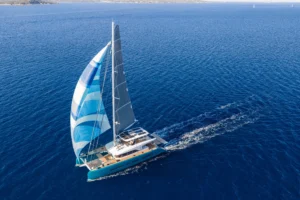
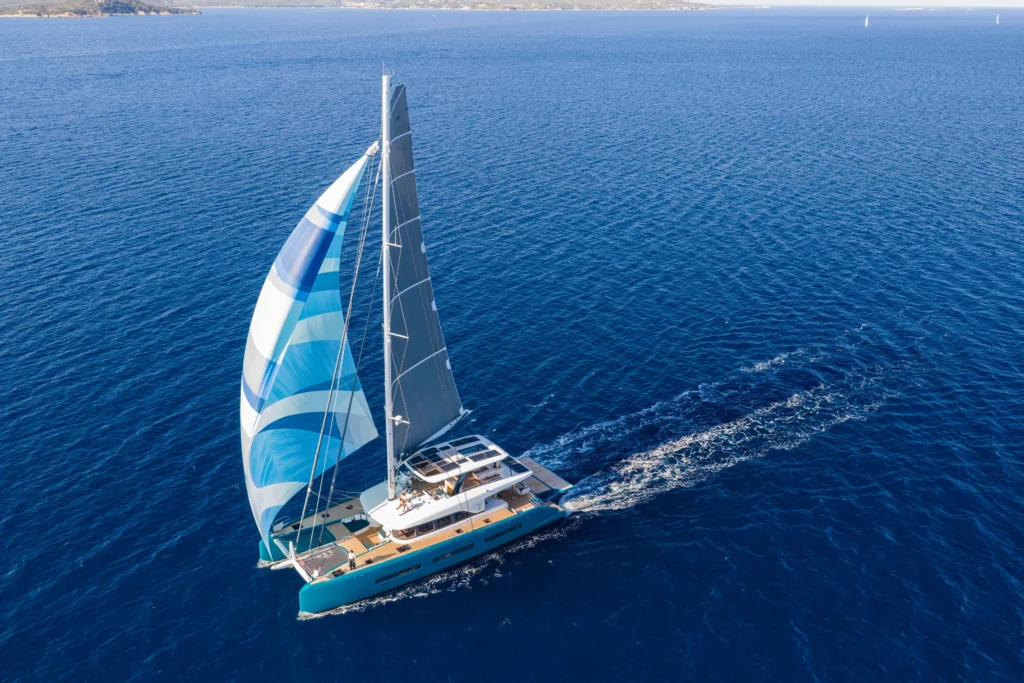
Discovery, the Lagoon Eighty2 sailing catamaran sailing the Naora world route, offers a different scale of daily decision. A smaller private group can make it easier to adjust time ashore or leave an afternoon uncommitted. It does not remove protected-area rules, local permissions, anchoring restrictions or the rights of people who use these waters for their livelihoods. A shallow-looking bay may be inaccessible for perfectly sound reasons. Fewer people aboard changes the conversation. It does not confer permission.
Reading The Current Before Entering
In the Coral Triangle, the important feature of a beautiful channel may be the volume of water trying to pass through it. Islands and reef formations constrict and redirect flow. Tide, wind-driven circulation and larger ocean currents can combine in ways that are not obvious from the surface. Seasonal monsoon changes affect exposure across much of the region, but shelter from the prevailing wind does not necessarily mean shelter from current or incoming swell.
A current of 2 knots carries water 1 Nm in half an hour. That is not an extreme-sounding number on a navigation display. In the water, it explains why a recovery plan matters more than confidence in one’s swimming. It also explains why the point where people enter may be unsuitable as the place where they are expected to leave. A drift can be an appropriate part of a properly supported dive. An unplanned separation from the boat is something else.
High water and low water do not automatically coincide with slack current in a channel. Local geography can delay or complicate the relationship. Before choosing an entry, we need the tide information, the forecast, local knowledge where available and a fresh look at what the water is actually doing. Current lines, water boiling over submerged features and the behaviour of floating material offer clues. None replaces a site assessment by people competent to make it.
The decision also depends on the people entering. Experience, fatigue, equipment familiarity and comfort with a moving pickup all matter. The plan needs to establish who remains responsible for surface support, how the group stays together and how an early exit will be handled. If those arrangements cannot be made adequately, the answer is another site or another day. Nobody needs to enter the water to justify having travelled a long way.
What The Reef Allows Us To See
At the surface, with the ears just below the water, conversation from the boat becomes indistinct. A shallow reef can carry its own crackling sound, much of it made by snapping shrimp. Sunlight moves across the bottom as the surface changes above it. Stop chasing the largest fish and the scene becomes more legible: a small animal leaving shelter and returning, a grazing fish working along a surface, others holding position where the current brings food. The reef is busy without arranging itself for us.
This is where species counts become less useful than behaviour. A list can tell you what might occur in the region. It cannot tell you why the fish in front of you repeatedly approaches the same patch of reef, or why a sheltered recess holds juveniles while larger fish remain outside it. Looking for relationships gives an ordinary encounter depth. It also removes some of the pressure to find a particular animal before the swim can count as worthwhile.
How we move changes what remains visible. Repeated pursuit can interrupt feeding or drive an animal into cover. Poor buoyancy can damage the very structures we have come to examine. For scuba divers, buoyancy and equipment checks belong away from vulnerable coral, before committing to the reef. For snorkellers, a shallow coral head is not somewhere to stand. A photograph is never a reason to touch, corner or rearrange marine life.
Observation still has limits. Bleached coral can be alive, while a reef with abundant fish in one view may face pressures that a visitor cannot see. Colour alone is not a diagnosis. What we can honestly describe is the condition encountered, at that depth and on that day. Repeated visits may deepen the picture, but they do not turn a guest into a reef scientist. There is pleasure in learning enough to notice more, without pretending to know everything.
The Seamanship Between The Swims
A reef passage includes the water between the reefs. On Discovery, that means an offshore sailing life in which weather, navigation, maintenance and rest cannot be separated from the pleasures of an anchorage. Sven, Naora’s founder and captain, plans every weather window and sails every leg himself. The continuity matters because decisions about arrival are already being made before departure: the likely light, the approach, the alternatives and the amount of rest available to the people responsible for the boat.
Daylight can make reef pilotage more informative, but bright sun is not a guarantee of a readable bottom. Glare, cloud, rain and the angle of the light all affect what can be distinguished. Charts and electronic position information need to be considered alongside direct observation, not replaced by an attractive shade of turquoise. If the approach cannot be assessed with enough confidence, waiting or choosing a different anchorage is a practical decision, not a failure of nerve.
At anchor, pale sand deserves inspection rather than assumption. Holding ground, water depth through the tide, swinging room and the position of nearby coral all enter the choice. So does the possibility of leaving if the wind changes. Discovery offers the living space and stability of a large catamaran, but that does not remove windage, motion or the loads on anchoring equipment. The quiet after the engines stop is only restful when the work preceding it has been done properly.
Water production and independent energy systems help a yacht remain away from shore infrastructure. They still depend on functioning equipment, energy, consumables and maintenance. Sailing also does not mean the engines will never be needed. A careful passage plan allows for manoeuvring, adverse current and changing weather rather than treating fuel use as an embarrassment. Moving with care begins with an honest account of what the boat requires.
Joining A Voyage That Continues
The Naora Global Expedition extends across roughly 49,000 Nm over five years. Those dimensions matter because a guest’s time aboard is part of a voyage already in motion. Through Naora’s private circle, or the private hire of Discovery for family or friends, guests choose when they join, where along the worldwide route they step aboard and how long they stay. The yacht continues sailing around the world after they leave. A Coral Triangle passage belongs within that continuing life, rather than needing to contain the whole experience of an expedition.
That freedom still needs workable joining points, formalities, transfer arrangements and allowance for weather. A guest may have a fixed return commitment. The sea has no corresponding obligation. The professional response is to discuss those limits early and preserve sensible margins, rather than letting the promise of flexibility become pressure on the captain. A smaller party permits more conversation about preferences, but safety decisions cannot become a vote.
An Antarctic expedition cruise may suit someone who wants polar expertise, a supported sequence of landings and the particular experience of ice, wildlife and southern light. A Coral Triangle passage under sail offers a different relationship with the day, including the passages, the waiting and the ordinary domestic life around time in the water. Neither format guarantees understanding. Both can create the conditions for it when expectations are honest and attention is allowed to settle.
Temperature changes what the body feels first. Vessel scale changes how the day is organised. Beyond those first differences, the deeper pleasure is remarkably similar: noticing something that was present all along, but that you did not yet know how to see.