The microphone hears the breeze differently from the person holding the camera. A light flow across the deck can become a rough, low roar in a recording, swallowing a sentence while the water beyond the stern looks almost motionless. It is a useful first observation about sailing live streams: a clear picture does not necessarily give a clear account of being there.
For Naora, the intention is to make a record that brings those things closer together. Photographs, films, recorded conversations and selected live transmissions would follow the Naora Global Expedition through five years, from 2027 to 2031. The route covers roughly 49,000 Nm. Much of that distance lies between the images people usually associate with sailing: the departure and the landfall, the reef and the dinner ashore. Those intervening days deserve attention too.
The completed archive does not exist yet. Its final size cannot honestly be known, and a particular anchorage cannot be promised as a broadcasting location. What we can describe is the standard the record should meet: enough context to understand what happened, enough patience to notice ordinary life, and enough restraint to leave some of it alone.
What Sailing Live Streams Can Show
The intended home for this record is naora.world, with material shared through the private circle before wider release where appropriate. That sequence is an editorial intention, not permission to publish everything recorded aboard. Some material may remain private. Some should never be recorded. The distinction belongs at the beginning of the work, rather than in an uncomfortable conversation after a film has been edited.
Live footage offers something particular: duration that has not yet been shortened into a story. A boat turns gradually to the wind. Someone waits for a sentence to finish. Cloud crosses the sun and changes the colour of the water without producing an event. These are small things, but they help a person ashore understand the pace of a place.
A live view also leaves much out. It cannot explain an anchoring decision unless someone supplies the context. It cannot tell the viewer what happened before the camera was switched on. A recording made yesterday and uploaded today may be more useful, provided it is clearly labelled. Recording time and publication time are different facts.
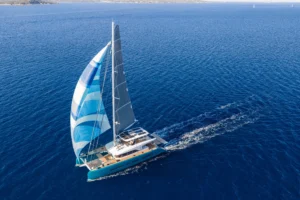
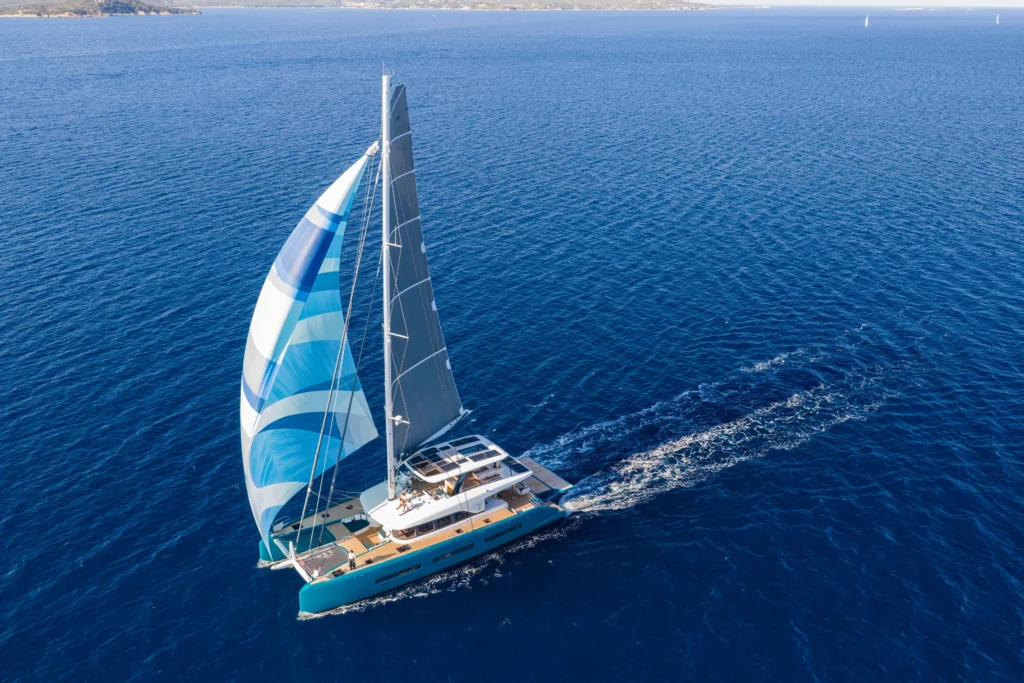
Discovery, the Lagoon Eighty2 sailing the expedition, gives the archive its continuity. Across a planned 166 legs and more than 187 destinations, the same yacht encounters different demands. A quiet morning in a Bodrum loop and a passage day in the Pacific belong to one unfolding life, rather than separate productions. The interest lies partly in watching the familiar adapt: how provisions change, how equipment is cared for, how the day is organised around the next stretch of water.
Why Sailing Live Streams Sometimes Wait
A remote anchorage can offer shelter without offering a dependable connection. Satellite communication extends what is possible offshore, but performance still depends on coverage, equipment, service conditions and the terminal’s view of the sky. Obstructions can interrupt that view; heavy rain can weaken some satellite links. A connection that carries messages comfortably may still struggle with sustained video.
The useful distinction is between download speed and upload capacity. A film leaving the yacht needs the latter, consistently, with room for other traffic. As an illustration, a ten-minute transmission at four megabits per second carries approximately 300 megabytes before additional network overhead. That is not a specification for Discovery. It shows why sending moving pictures is a different demand from sending a short written update.
Weather downloads and necessary communications take precedence over an audience waiting for a picture. So does the work on deck. Sven, Naora’s founder and captain, plans every weather window and sails every leg himself. A departure decision cannot acquire a second deadline because a broadcast has been announced. If conditions require attention, the camera can wait, or be put away.
Recording locally and transmitting later also has editorial advantages. Sound can be checked, an unclear explanation corrected, and an identifiable person asked about publication without the pressure of already being live. The important discipline is to make the delay visible. A film from an earlier anchorage must not masquerade as the yacht’s current position.
Nor should a gap in coverage be dressed up as drama. Sometimes there is insufficient bandwidth. Sometimes the useful work is elsewhere. The archive needs room for a plain explanation without turning every interruption into a story about adversity.
Reading The Water Before Filming It
At a Polynesian atoll, the most beautiful water can also be the water that requires the closest reading. In the Tuamotu, a reef pass connects a large lagoon to the ocean through a comparatively narrow opening. Water moving through that restriction can become fast and turbulent. Its appearance is not a reliable invitation to enter.
A predicted high or low tide outside the reef does not, by itself, identify slack water in the pass. Swell breaking over the reef can feed the lagoon and help sustain an outward flow. Local knowledge, recent conditions and direct observation matter alongside tidal information. Daylight helps with reading reef features, but cloud and glare can flatten the visual cues. Water colour is useful evidence, not a depth measurement.
A film of an arrival becomes more valuable when it preserves that reasoning. Why was entry delayed? What changed in the water? What made the approach unsuitable earlier? There is no need to turn the scene into a navigation lesson while the manoeuvre is happening. The explanation can come afterwards, when nobody needs to divide their attention.
The Brothers Islands in the Red Sea raise a related problem underwater. Offshore exposure, current and the arrangements for recovering divers matter before the camera enters the water. Pelagic animals, including sharks, do not appear to a production schedule. A diver following an animal for a better frame can lose awareness of depth, gas, a buddy or the route back. The useful footage is footage obtained within the dive plan, not footage used to justify abandoning it.
At Aldabra, the question begins with access and conservation. This protected Indian Ocean atoll has resident conservation staff and tightly controlled visitation. Its giant tortoises are not props, and the absence of resort infrastructure does not make it an unoccupied stage. Permission to land, the conditions attached to a visit and the effect of a camera’s presence would come before any plan to transmit.
These places carry different obligations. None becomes ours because we can reach it by water. An honest archive should make that visible, including the occasions when the appropriate result is no footage at all.
The Sound And Work Of Ordinary Days
A night watch is easy to misrepresent. Turn a bright screen towards a face and the camera may gain an image while the person loses useful dark adaptation. The sea beyond the light becomes harder to read. Bring the brightness down and details slowly return: the edge of the deck, the line of the horizon, a light whose movement needs watching. Darkness aboard is a working condition, not a defect to be corrected for the viewer.
The same care applies to sound. Wind protection around a microphone can preserve speech, but positioning matters too. A microphone touching a hard surface may collect vibration through the yacht. Someone holding it near loose clothing can produce noise louder than the conversation. Listening to a short test recording before beginning is a modest habit that can save a long, otherwise unusable account.
Not every worthwhile recording needs a person explaining the voyage. The click of a galley latch, water moving in the sink as the yacht changes angle, the pause in a conversation while a pan is secured: these convey something that a wide view of the anchorage cannot. They show that this is a home under way, with work continuing behind the ease.
Before departure, preparation belongs in the record for the same reason. A checked fitting or an awkward maintenance task explains more than a polished reveal. Over time, those early images can acquire meaning: a system inspected before an ocean crossing, an arrangement altered because using it revealed a weakness. The story becomes stronger when it includes what needed changing.
People Who Do Not Become Content
A long passage can produce a conversation that would never have happened over lunch ashore. That does not make it a podcast. The person speaking may be thinking aloud, testing an idea or describing something intended only for the people at the table. Putting a microphone down changes the room, even when everyone initially says they do not mind.
Permission to record and permission to publish need to be separate decisions. A useful conversation before filming establishes the intended audience, the proposed form and the subjects someone would rather leave out. An interview intended for a public channel is different from a private recollection shared within the circle. Neither should quietly become the other during editing.
Privacy also lives at the edges of a frame. A phone screen, a document on a table, a child passing through the background or a name spoken off camera can disclose more than the main subject. Review therefore includes listening as well as looking. A person’s willingness to appear in one film cannot be treated as continuing permission throughout their stay.
Position needs similar judgement. A sensitive transit, including Bab-el-Mandeb, is not an occasion to make live location sharing the default. Navigation, current conditions and security considerations determine the passage; publication can wait. More generally, sensitive wildlife locations need not be accompanied by precise coordinates simply because the camera has stored them.
For someone joining Discovery with family, friends or colleagues, the practical boundary should be uncomplicated. Being aboard does not create an obligation to appear. A record of private sailing must be able to accommodate people who wish to remain entirely outside it.
Keeping A Record That Can Be Understood
An archive begins to fail long before a file disappears. It fails when nobody can tell where a photograph was taken, whether a weather figure was measured or forecast, or why a planned departure moved. A beautiful image with a guessed caption can preserve the wrong memory with considerable confidence.
The remedy starts while the day is still recent. A recording needs a date, a location at an appropriate level of precision and a short note about its context. Time should be unambiguous, particularly when the yacht crosses time zones. Recording time can be retained internally even where public release is delayed. Forecast conditions should be identified as forecasts, not allowed to become observations through casual wording.
The small distinctions matter. A current described as strong is an observation, but not a measurement. A species identification made with uncertainty should retain that uncertainty until it can be resolved. If a caption is corrected later, the correction should remain traceable. Five years gives a minor mistake plenty of opportunities to be repeated.
Storage is another form of seamanship: ordinary discipline protecting something difficult to replace. A sensible copying procedure keeps the original until two independent copies have been checked. Devices stored together remain vulnerable to the same leak, loss or electrical incident, so separation matters as well as quantity. A checksum comparison can verify that copied data matches the original; opening a few files is useful, but does not establish that an entire transfer succeeded.
Preservation and publication are different tasks. High-quality originals may be retained while smaller versions are prepared for transmission. A public copy may require removal of location metadata or identifying details. Keeping material over the long term also involves permissions, storage care and migration as technology changes. Permanent access is not something to promise casually.
Five Years Without A Production Schedule
The world route gives the record a structure, but the voyage must retain the right to change. Naora follows the tradewinds and parts of the Coconut Milk Run because seasons and prevailing weather shape sensible movement. The editorial calendar follows those decisions. It does not overrule them.
This is also what makes the archive relevant to people whose time aboard is intermittent. Through Naora’s private circle, members choose when they join, where along the route they step aboard and how long they stay. Discovery can also be privately hired for a carefully designed voyage along the expedition route. In either case, someone may share one chapter while the yacht continues into the next.
A record can maintain that connection without asking anyone to follow every update. A person returning months later might recognise the galley before recognising the coast outside it. Someone considering a long passage might learn more from an account of watchkeeping and interrupted sleep than from an arrival film. A family might keep a photograph whose importance is invisible to everybody else.
That is a more useful ambition than an output total. The strongest archive would allow a reader to distinguish what was planned from what happened, what was witnessed from what was inferred, and what could be shared from what belonged only to the people present.
There should still be evenings when the camera has been put away, the meal is unfinished and nobody is arranging the conversation for a future listener. The yacht lies to her anchor. The people at the table have their evening to themselves.