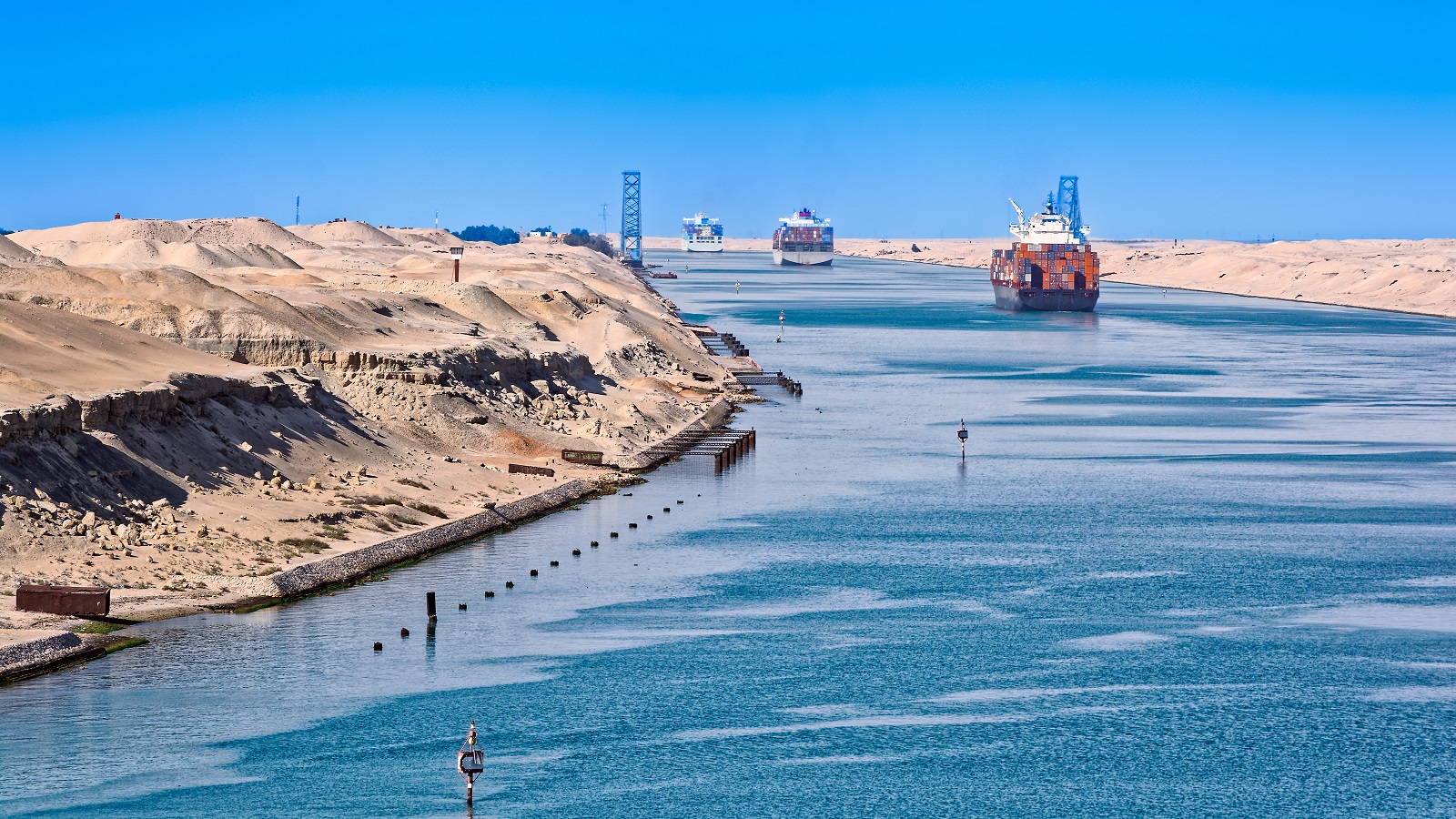
A ship’s superstructure can appear above a canal embankment before its hull comes into view. For a moment, it seems to be travelling over land. A Suez Canal transit rearranges familiar proportions: the ship looks too large for the landscape, the water too narrow for the traffic, the distance between continents surprisingly ordinary. At the helm, the nearer things still matter more. The vessel ahead. The radio. A change in the engine note.
This is a passage we would approach without trying to make it feel effortless. There is pleasure in watching the desert move past, but the ease aboard depends on preparation that began before the entrance. Fuel, machinery, documents, food and rested attention all have to last longer than the most optimistic version of the day.
Planning A Suez Canal Transit
For Naora, the planned northbound passage from the Red Sea into the Mediterranean belongs to the closing part of the world route. Discovery, our Lagoon Eighty2 sailing catamaran, would arrive here after ocean crossings and seasons among islands, then enter a corridor where freedom of movement gives way to precise coordination. Weather, regional security and permission to proceed must be assessed for the actual passage. A line drawn years ahead is an intention, not clearance.
The canal is roughly 104 Nm long, including its approaches. At a steady eight knots, that distance represents about thirteen hours underway. That is useful arithmetic, not a prescribed speed or a reliable timetable: permitted speed, traffic movements, pilot arrangements and any required stops govern the real passage. Eighteen hours is a plausible description of a long transit day. It is not a duration we would promise someone booking an onward flight.
There are also two different clocks. One measures movement through the waterway. The other begins when the yacht arrives ready for formalities and ends when it is clear to continue beyond the exit. Waiting can make the second considerably longer. Depending on the instructions issued for the yacht, movement may be staged or require an overnight pause. We would protect time around the transit rather than build the next departure against its earliest possible finish.
Members choose when and where along Naora’s worldwide route they join, and how long they stay aboard. That choice works best when a canal day is understood before it is chosen. Someone interested in shipping, navigation or Egypt may find it absorbing. Someone hoping for swimming and an unstructured afternoon should know that this particular passage belongs to the traffic system, not to us.
What A Sea-Level Canal Still Demands
Suez has no locks. The yacht does not climb a staircase of chambers or descend towards another sea. That simplicity can encourage the wrong assumption that the water is motionless. Tides, wind and differences in water level still produce currents, with tidal influence generally stronger towards the southern end. The current expected for the passage needs checking locally; a sea-level canal is not a swimming pool cut through sand.
For the helm, the distinction between speed through the water and speed over the ground matters. A favourable current may improve progress without increasing the flow past the rudders. An opposing current can do the reverse. Neither the arrival estimate nor the yacht’s handling should be judged from one number alone. Wind adds another influence. A large catamaran presents substantial area above the water, so a crosswind can require steady correction even where there is little wave motion.
Passing ships bring less visible changes. A large hull moving through a confined channel displaces water ahead of it and draws water along its sides. A smaller vessel nearby may experience a changing set, surge or yaw rather than just the wash that follows. Near a bank, uneven water flow around a hull can also affect its direction. The answer is not a last-minute burst of engine power. It is an appropriate position and speed, established with the pilot and traffic instructions, with space left for the effects to develop.
The visible bank is not a dependable guide to navigable depth. Dredged channel limits, underwater slopes and local restrictions matter more than how wide the surface appears. Nor should open water in the Bitter Lakes be read as permission to choose an anchorage. A canal passage remains controlled navigation even where the landscape briefly resembles a natural lake. The chart, current instructions and the view ahead have to agree.
The Work Before A Suez Canal Transit
Our preparation would begin with the agent and the yacht’s particulars: registration, dimensions, draught, crew and guest documentation, and the machinery available for the passage. Requirements and arrangements need confirmation close to arrival. An account from another yacht can explain the broad experience, but it cannot establish the current procedure for Discovery. Commercial convoy descriptions are especially easy to misread as instructions for a smaller vessel.
Modern parallel channels and the lake sections allow traffic to be managed differently from the canal’s original single-channel arrangement. They do not mean every stretch permits unrestricted passing. The yacht needs its own confirmed reporting instructions, boarding arrangements and movement plan. We would want uncertainty resolved before entering, including what happens if the start is delayed or a technical problem prevents us from maintaining the required progress.
Engine checks acquire a different weight when stopping is no longer a casual option. Cooling-water flow, fluid levels, belts, filters, steering response and starting reliability all deserve attention before the canal, not after a warning appears between banks. Fuel must cover manoeuvring and delay as well as the expected run. We would also check the applicable requirements for lines, fenders, communications and emergency equipment. A yacht can be beautifully prepared for sailing and still be poorly prepared for a sustained engine passage.
The pilot transfer is part of that work. Boarding side, speed and access should be agreed; handholds need to be clear, with a crew member ready at the boarding point. Once aboard, the pilot needs a useful introduction to the yacht’s handling, draught and any limitations. Local pilotage adds essential knowledge, but it does not remove his responsibility for Discovery. Repeating a course or speed instruction clearly is more valuable than concealing uncertainty out of politeness.
Living Well Through A Long Engine Day
On a prolonged engine passage, vibration becomes something the body stops noticing until it changes. A glass touches the table with a faint additional rattle. Outside, light reflects from water and pale ground at once, making a shaded seat more useful than the view suggests. Wind across the deck may feel cooling while thirst develops almost unnoticed. These are ordinary sensations, but over a long day they influence patience, concentration and appetite.
The galley should make the passage easier without creating another demand on the watch. Food that can be prepared ahead and served without everyone sitting down together is more useful than a meal dependent on perfect timing. Soup, bread or a simple rice dish can wait for a quiet interval. Drinking water should be easy to reach. The person maintaining the lookout should not have to leave it because lunch has become an event.
Rest needs the same practical treatment. A departure instruction may arrive after a period of waiting that has already broken the crew’s sleep. Others can maintain the lookout, monitor systems and handle agreed tasks without blurring who has command. Concentration should not depend on the captain carrying every minor responsibility as well as the navigation. For guests, knowing where they can sit without obstructing sightlines or movement removes the uncertainty of wondering whether they are in the way.
There is room for warmth within these arrangements. A pilot is a working person joining the yacht for a demanding stretch, not a piece of equipment delivered with the paperwork. A proper greeting, water and a clear place to work matter. So does allowing quiet when the radio becomes busy. Hospitality aboard is sometimes a conversation. Sometimes it is noticing when not to begin one.
Reading The Banks
The western bank is Africa; the eastern bank is Sinai, part of Asia. Both are Egypt. Crossing between the seas is not the same thing as crossing an international border between the banks, and the geography deserves more care than a dramatic declaration that one continent has been left behind. On a northbound passage, Africa remains beside us for the length of the canal.
Nor is the surrounding country an uninterrupted empty desert. There are settlements, roads, cultivated areas and working infrastructure along the corridor. The contrast can be more interesting than an expanse of sand: a patch of vegetation against pale earth, the orderly edge of an engineered bank, then the immense moving wall of a merchant ship. The canal belongs to a inhabited country as well as to the world’s shipping. People live with the noise, work and restrictions that a visiting yacht experiences for only a short interval.
Later in the day, low light can make the texture of a bank suddenly legible. What looked flat at noon separates into ridges, tracks and heaps of excavated ground. Engine sound remains close and constant while the shore seems unusually quiet. It is a good time to put the camera down and simply look. Where photography is restricted, the instruction should be followed without argument; where people are visible, distance does not make their lives ours to collect.
The History In The Cut
The canal opened in 1869, but the clean line on a modern chart conceals the conditions under which the first channel was made. Early construction depended heavily on corvée, compulsory labour imposed on Egyptian peasants. Large quantities of earth were moved by hand before mechanised excavation and dredging took a greater role. Engineering history often favours the organiser, the machine and the opening ceremony. From a yacht passing through Egypt, the labour belongs in the foreground too.
The canal changed maritime geography by allowing ships to travel between the Mediterranean and the Red Sea without going around Africa. The saving varied with the ports involved and the vessel, so a single claim that it halved a voyage is less useful than understanding the consequence. A narrow passage in Egypt became important to commercial schedules, imperial interests and national sovereignty far beyond its banks. Its usefulness made control of it contentious.
In 1956, Egypt nationalised the canal company. The military intervention by Israel, Britain and France that followed made the waterway central to a crisis over sovereignty and the retreat of European imperial power. Later, after the war of 1967, the canal remained closed until 1975. That interruption lasted longer than Naora’s entire planned voyage around the world. It is a useful correction to the assumption that major infrastructure is permanent in its availability simply because it is permanent on a chart.
The connection also changed the seas themselves. Marine organisms have moved through the canal, notably from the Red Sea into the Mediterranean, altering ecosystems beyond the waterway. For an expedition that spends time observing reefs and coastlines, this matters. The channel shortened shipping routes while opening an ecological connection that continues to have consequences. We can appreciate the engineering without pretending that its effects end at the dredged banks.
When The Canal Releases The Yacht
At the northern end, the Mediterranean is not merely the next colour of water. The governing problems change again. Channel position and traffic instructions give way, gradually, to sea state, wind, exposure and the suitability of the onward passage. A forecast checked before entering may need another look after delays. Mediterranean weather systems do not wait for the yacht to finish its paperwork, and a canal completed successfully is not an argument for continuing into an unsuitable sea.
This is where the condition of the people aboard matters as much as the condition of the engines. A long day of close attention can leave a crew tired without anyone having done visibly strenuous work. Before continuing, we would want an honest assessment of rest, fuel, machinery and the next safe stopping arrangement. The desire to get back under sail is understandable. It should not make the decision.
Naora follows the tradewinds across much of its world route, but an expedition cannot consist only of the passages that fit its most attractive description. There are engine hours, formalities, waiting and places where the right action is to follow an instruction precisely. We plan to reduce our impact where we can; here, we must also acknowledge the fuel required to move safely through a working canal. Care begins with describing that trade-off honestly.
For the people aboard, the lasting impression may be quieter than the scale of the engineering suggests: an unfamiliar voice on the radio, afternoon light on excavated earth, a ship moving beyond a bank. The chart shows a channel between two seas. From the deck, it is also a narrow view into a country whose life continues well beyond either shore.