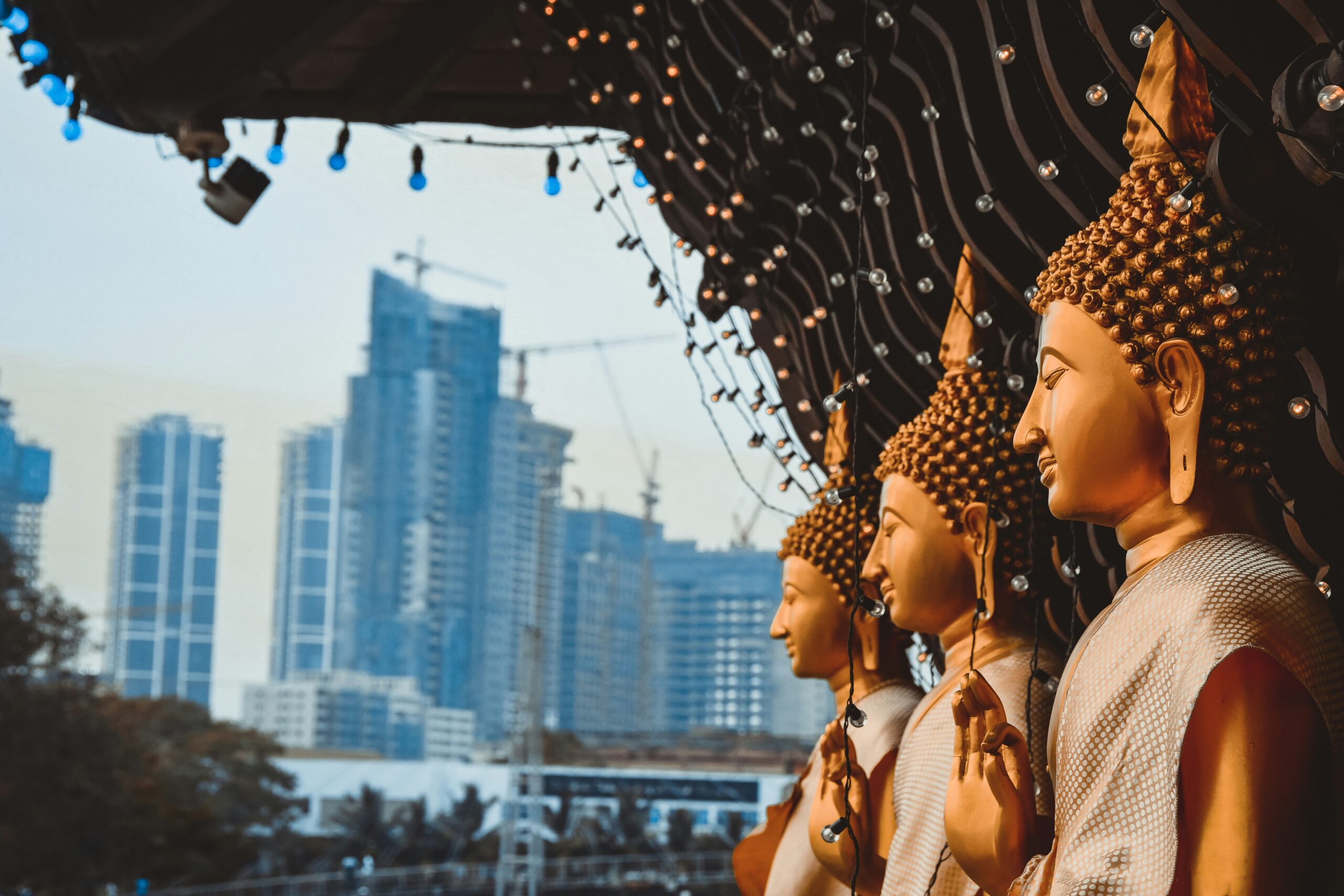
The shoes stay outside, and the street does not entirely disappear. At a Hindu temple in Colombo, an open doorway can carry traffic noise into the same space as a bell, while bare feet register the difference between a sunlit threshold and a shaded floor. Pettah is a working district. Worship belongs to its daily life, alongside deliveries, errands and the opening of shops.
This matters before a passage. Once the boat is preparing to leave, there is a temptation to treat the remaining time ashore as something to fill, to fit one more place between provisioning and departure. We try to resist that. A temple deserves attention that is not already halfway back aboard, and a departure deserves preparation that has not been compressed to accommodate a visit.
The useful question is how to make room for both. In Colombo, the answer begins with accepting that neither the temple nor the Indian Ocean runs to our convenience.
Entering A Hindu Temple In Colombo
We begin by establishing which temple we are visiting, whether visitors are welcome at that time, and what access is permitted. Pettah contains more than one Hindu temple. Their opening arrangements, principal deities and daily services should not be treated as interchangeable. An open entrance is not permission to walk through every doorway beyond it.
Footwear comes off where indicated. Shoulders and knees should be covered, but local requirements can be more specific, so we ask rather than assume that a general rule has settled the matter. Clothing that works on deck may not work here. A light covering carried ashore is useful; deciding what to wear before leaving Discovery is better than trying to improvise at the entrance.
The first task inside is to find somewhere to stand without obstructing anyone. Worshippers may be approaching a shrine, carrying offerings or moving around a prescribed route. Their movement reveals more than a visitor’s instinct to walk towards the most elaborate object. We watch before following, and do not assume that an action is appropriate for us simply because someone else performs it.
None of this requires anxious formality. There is room for a greeting, a smile and a quiet request for guidance. We are guests, not candidates for an examination in correct behaviour. The important distinction is between arriving willing to learn and expecting the people there to reorganise their worship around our uncertainty.
The Tamil City Around The Temple
A Hindu temple in Pettah belongs to Colombo’s Tamil religious life, but the city becomes less intelligible if language, ethnicity and religion are collapsed into the same categories. Many Tamils are Hindu; some are Christian, and Tamil is also spoken within Sri Lanka’s Muslim communities. Sinhala and Tamil are the country’s two official languages. English has a constitutional role as a link language, which helps explain its presence without making it the language of every encounter.
For a visitor, the practical consequence is simple: do not assume that an English sign means an English conversation will follow, or that a Tamil-speaking person shares the religious identity of the temple next door. A little patience with language is part of entering the place properly. Asking someone how to pronounce the temple’s name can be a more useful beginning than asking for a complete explanation of Hinduism.
Sri Lanka’s Buddhist majority, Hindu traditions, Muslim communities and Christian churches are visible in its streets, but neighbouring buildings are not evidence that the island’s history has been uncomplicated. Portuguese and Dutch colonial rule helped shape parts of its Christian and Burgher inheritance. Burgher describes a community with European and local ancestry, not a separate religion.
The civil war lasted from 1983 to 2009. Those dates belong within living memory, not in a remote historical background. We should neither turn a temple visit into an unsolicited conversation about trauma nor describe the religious variety around us as proof of an effortless harmony. Daily coexistence is real. So are histories of exclusion, violence and loss. Both facts require us to look more carefully at the city, and neither gives us permission to ask a stranger for a personal account.
Reading A Hindu Temple In Colombo
The architecture offers a way to orient ourselves without pretending that everything visible is immediately understood. In the South Indian temple tradition that informs many Sri Lankan Tamil temples, a gopuram is an entrance tower. Its crowded figures can draw the eye upwards, but the tallest or most ornamented feature is not necessarily the location of the principal deity.
A mandapa is a hall or pavilion, often forming part of the approach towards the shrine. The sanctum is the innermost sacred chamber. Its restricted access has a religious purpose; it is not an inconvenient barrier between a visitor and a better view. Even where the deity is visible from a public area, that visibility does not imply permission to approach further.
A Shaivite temple centres worship on Shiva. Where Nandi, Shiva’s bull, faces the shrine, his orientation helps make the relationship between the outer space and the sanctum legible. Other deities may have shrines within the same temple. A visitor need not identify every figure to recognise that these spaces have distinct relationships and uses.
One word worth understanding is darshan, commonly described as seeing and being seen by the deity. It explains why looking here is different from looking at sculpture in a gallery. For the worshipper, this is an encounter with divine presence. We do not have to share that belief to recognise that our own curiosity occupies a different place in the room.
What Happens During Puja
Puja is worship through offerings and acts of devotion. Depending on the temple, the deity and the service, it may involve flowers, incense, lamps, water, food, recitation and the ringing of bells. There is no single sequence that can responsibly be promised for every Colombo temple, and no universal dawn opening time on which to build a shore plan.
The rites draw on inherited traditions, including Agamic traditions of temple worship. These are not a single ancient timetable reproduced without variation. A festival service may differ substantially from an ordinary daily puja; the same temple may have quieter periods and times when the congregation fills the available space. Confirming the service matters more than arriving with a description and expecting the ritual to match it.
When a flame is brought before the deity, the light moves. Surfaces that looked flat in the dimness acquire depth; metal catches the brightness and releases it again. A bell can fill a small interior so completely that conversation becomes impossible. Incense is something felt in the throat as well as smelled. This is not necessarily a silent or soothing environment. Worship can be concentrated, crowded and physically immediate.
A lamp may subsequently be brought towards devotees, who receive its warmth with their hands and bring them towards the face or head. Sacred ash, often called vibhuti in Shaivite practice, is different from kumkum, the red powder used in various devotional contexts. Neither should be treated as a decorative souvenir, and neither can be assumed to be offered to every visitor at the entrance.
If something is offered, we take our cue from the person offering it. Quiet uncertainty is preferable to elaborate imitation. Prasada is an offering returned to worshippers as blessed food or another blessed substance; if we do not understand what is being given, or have a dietary restriction, we can ask before accepting it. Respect does not require consuming something we cannot safely eat.
The priest’s attention during a service belongs to the worship. Questions can wait until an appropriate moment, and sometimes the answer is that there is no appropriate moment during our visit. We can leave with something still unexplained.
Being Present Without Taking Possession
Photography is where good intentions often become intrusive. Permission to enter is not permission to photograph. Permission to photograph the building is not automatically permission to photograph the deity, a ritual or a person praying. We establish the rule before taking out a phone, rather than allowing a raised camera to become the question.
The distinction is particularly important in a small congregation. Someone may have come with a private concern, a family observance or an ordinary duty that has nothing to do with our visit. Their presence in an accessible space does not make that moment ours to publish. The discretion we value aboard should travel with us ashore.
With children, a little explanation outside can make the interior less bewildering. Shoes come off because this is sacred ground. Some doorways are not for us. Bells may be loud. Questions are welcome, but can wait if someone is praying. A short visit made with attention is better than keeping a tired child inside until everybody becomes uncomfortable.
Colombo’s heat also belongs in the plan. We arrive hydrated, leave time to retrieve footwear without a rush, and keep water for after the visit. If we wish to bring flowers or another offering, we first ask what is appropriate. Buying something locally can support the people around the temple, but the offering should follow the temple’s practice rather than our wish to arrive carrying an impressive gesture.
The Weather Beyond Colombo
The passage towards the Maldives gives this shore time its setting, but it should not turn the temple into a picturesque prelude to the sea. The visit and the departure each have their own requirements. We make space ashore only when the operational work allows it.
Sri Lanka’s southwest monsoon generally runs from May to September. On the west coast, that seasonal regime can mean more exposed conditions, rain and an unfavourable wind angle for a westward passage. The northeast monsoon generally runs from December to February and can offer a more favourable broad pattern for sailing west. Those are planning seasons, not departure instructions. The conditions on the actual day still decide.
Between the main monsoons, thunderstorms can develop vigorously even when the wider wind pattern appears weak. Light wind on a forecast does not necessarily mean an easy sea, either. Swell can arrive from weather elsewhere, and a new wind sea crossing an older swell can produce an uncomfortable motion without a particularly dramatic wind reading. We look at direction, period and the relationship between the wave systems, not only their height.
Sven, Naora’s founder and captain, plans every weather window and sails every leg himself. For a departure such as this, the useful forecast is the one that follows the boat along its intended track and through the expected passage time. Conditions outside Colombo are only the beginning. The arrival matters too, including visibility, the approach, clearance arrangements and the consequences of reaching it earlier or later than expected.
A passage duration cannot be responsibly attached to the word Maldives without establishing the intended arrival point, the navigable route and the likely conditions. Current and boat speed alter the estimate. So does a decision to slow down for a better arrival. Apparent precision can be less useful than a range with its assumptions understood.
Near Colombo, commercial traffic adds another layer of attention. Electronic identification helps, but does not replace a visual lookout, particularly for smaller craft that may not transmit. The shore plan also has to respect departure formalities rather than assume unrestricted movement once outward clearance is underway. Provisions need stowing, the boat needs securing for sea, and the people taking the first watches need rest. A visit that compromises any of those things belongs on another day.
What Goes Aboard With Us
Back aboard Discovery, our 2025 Lagoon Eighty2 sailing catamaran, the preparations have a different physical language: locker catches tested, loose objects put away, water bottles placed where they can be reached without searching. The heat carried back from the street takes time to leave the body. A place ashore does not vanish at the moment we step onto the boat.
The Naora Global Expedition extends across five years, from 2027 to 2031. Members choose when they join, where along the world route they step aboard and how long they stay; Discovery continues around the world beyond any individual visit. That difference in timescale matters. Someone may have only a short chapter in Sri Lanka, while the voyage itself has a much longer continuity. Neither duration gives us a shortcut to understanding the people whose home this is.
We can make a brief visit more substantial by carrying a question into the time afterwards. The distinction between a tower and a sanctum, or between observing a ritual and participating in it, gives us something precise to think about at sea. It may also leave us better prepared to ask a thoughtful question if we return.
There is no need to describe a temple as timeless in order to value it. Its congregation lives in the present, with work to reach, families to care for and a city changing around them. The worship has its own reasons for continuing after our departure. The space before the shrine belongs to the person praying.