A fingertip moving along a wound guitar string makes a small rasp. In a quiet room, it can reach you almost as clearly as the chord that follows. That closeness is what draws us to flamenco in Cádiz: the possibility of hearing the effort inside the music, the breath before a phrase, the brief space in which the other performers wait to discover how it will end.
Before an Atlantic crossing, there is a temptation to make an evening like this carry the whole significance of leaving. The ancient port, the last mainland streets, the voice we imagine remembering offshore. We would rather leave it some freedom. Cádiz is a possible call when the route and conditions support it, and its music has a life quite independent of our departure. Listening properly begins with recognising that.
Learning To Hear Flamenco In Cádiz
The first useful word is compás. It describes the rhythmic framework, the cycle of beats and accents that lets performers find one another even when a voice seems to stretch beyond the accompaniment. To an unfamiliar ear, a singer may appear to be taking liberties with time. Often, the liberty is possible because the underlying structure is so thoroughly understood.
Cádiz is particularly associated with the cantiñas family of flamenco forms, including alegrías. Alegrías move within a twelve-beat cycle, with an uneven arrangement of accents that gives the music its lift. The name means joys. Brightness, wit and buoyancy belong here as surely as grief does, and arriving with the expectation that every meaningful flamenco performance must sound anguished would mean missing something characteristic of the city.
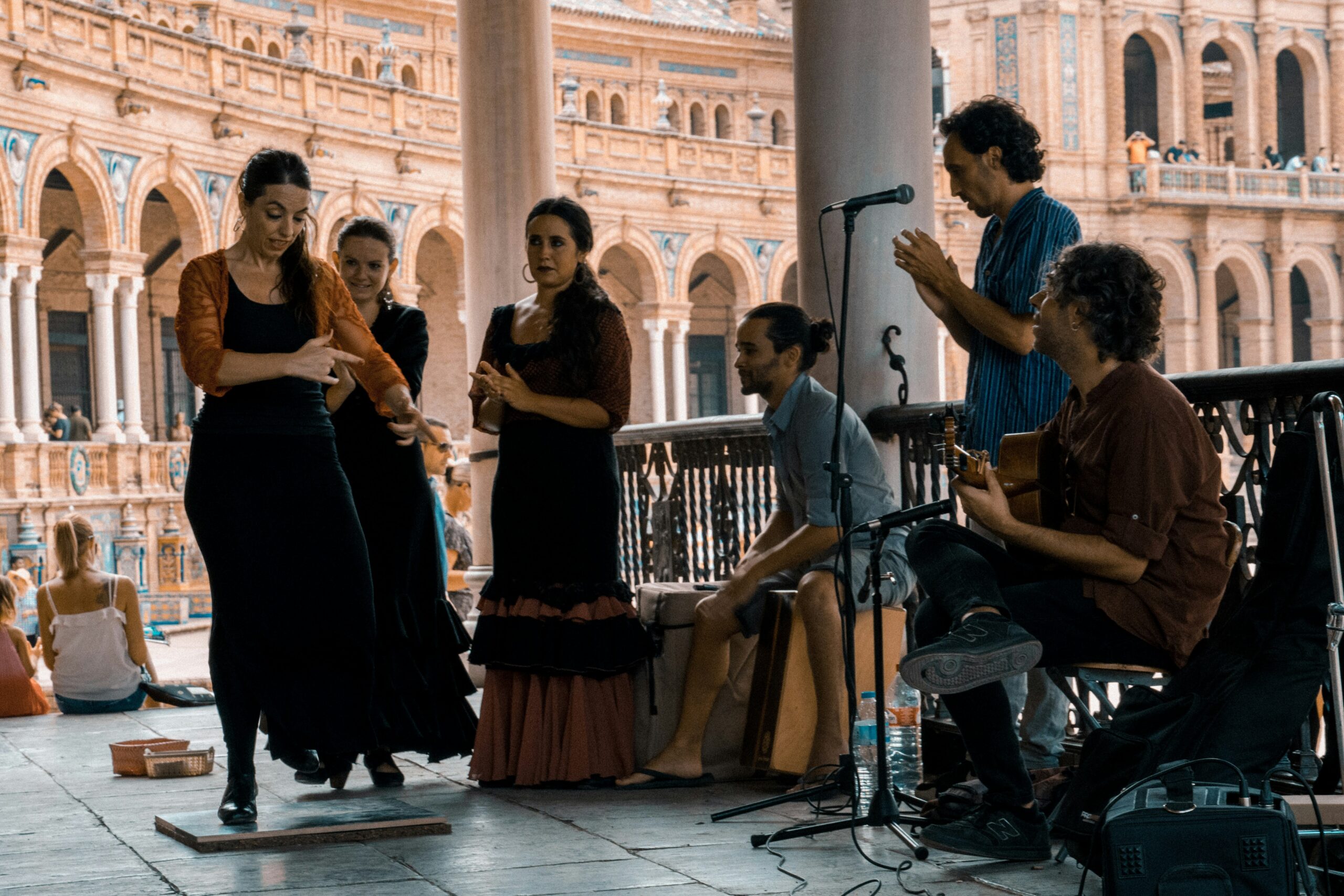
You do not need to count throughout a performance. Listen instead for the way a guitar phrase returns, how the handclapping holds a pattern beneath the voice, and how a dancer gathers the musicians towards an ending. In a small room, the physical detail is part of the explanation: the different sounds made by toe and heel, the dry contact of palms, the torso held almost still while the feet become increasingly articulate.
Other forms organise time differently. Flamenco tangos generally work in a four-beat framework. Cante jondo, usually translated as deep song, refers to a profound expressive tradition rather than to everything sung in a low or rough voice. Soleá and seguiriyas belong to that deeper register, but vocal grain alone tells us little about a singer’s understanding. A weathered sound is not a certificate of truth.
What we listen for is responsiveness. A guitarist leaves room for the singer to finish. The handclapping changes weight rather than merely becoming louder. A dancer signals a transition and the accompaniment answers. The pleasure lies partly in noticing that this apparent freedom is shared work, carried by people who know when to lead and when to leave space.
A Port With More Than One Memory
The Phoenician city of Gadir was here in the first millennium BCE. Cádiz can reasonably be called one of the oldest continuously inhabited cities in Western Europe, but making it the undisputed oldest requires more certainty than the historical record allows. Its age matters less as a ranking than as an explanation of its outlook: this narrow piece of land has lived with arrivals, departures and outside influences for thousands of years.
In 1717, the crown’s administration of trade with its American colonies moved from Seville to Cádiz. That change helped consolidate the city’s role in Atlantic commerce. Wealth depended on ships reaching harbour, cargoes being accounted for and connections extending far beyond the coast. The ocean was a source of employment and uncertainty long before it became a setting for leisure.
That history also includes colonial extraction and the trade in enslaved people. An evening before our own crossing does not need to become a history lesson, but neither should we borrow the port’s past as uncomplicated decoration. Discovery leaving for a voluntary passage is not repeating the meaning of those earlier departures merely because some of the water is the same.
Flamenco also resists a tidy origin story. Andalusian Roma communities have been central to its development and transmission, but they did not arrive carrying the finished art form. Its history includes exchanges among communities, family traditions and professional performance. By the nineteenth century, public venues were helping shape the forms and relationships we now recognise. Reducing that development to a single meeting of Roma, Moorish and Jewish music makes an attractive sentence and an inadequate explanation.
Choosing An Evening Of Flamenco In Cádiz
A tablao is a venue organised around flamenco performance. A peña flamenca is an association formed around the art and its community. Either may offer a worthwhile evening, but the labels do not tell us everything. A peña may have events restricted to members or a programme that does not coincide with our visit. A tablao may employ excellent artists whose professional discipline is precisely what makes the evening work.
We would not dismiss a performance because visitors attend it. Musicians and dancers need paid work, and a room full of travellers can still listen with attention. Equally, a small room and an unpolished entrance do not guarantee quality. The useful questions concern the actual programme: who is performing, whether the emphasis is on singing or dance, how the seating works, and whether food service continues while the artists are working.
Those details change the experience more than a promise of authenticity. Someone hoping to hear unamplified singing may be disappointed by a heavily amplified dance programme, even if the dancing is excellent. A family may find an earlier performance far more absorbing than a late one attended through fatigue. Start time, expected duration and admission arrangements should be confirmed for the evening itself, not assumed from an old listing.
There is also value in going without requiring a private discovery. We do not need to be the only outsiders in the room. The stronger ambition is to become good guests in a place whose purpose already exists. Paying for the performance, arriving on time and giving the artists our attention are more meaningful gestures than finding somewhere that looks untouched by visitors.
The Small Courtesies That Make Room
Flamenco can be an intensely participatory art. The encouragement called jaleo, including a well-placed olé, is part of the relationship between performers and listeners. That does not make every interruption helpful. The encouragement has timing and knowledge behind it. On a first visit, there is no obligation to imitate it.
The same applies to palmas, the handclapping that can function as a precise layer of percussion. Clapping along uncertainly can obscure the very rhythm we are trying to understand. Better to listen, watch how experienced listeners respond and offer applause without trying to become another musician. Silence during a suspended phrase is participation too. It gives the singer somewhere to place the next word.
A phone changes that silence. Its screen draws neighbouring eyes, and recording turns a shared performance into something being collected. We would confirm the venue’s rules and leave filming alone unless it is clearly welcomed. Children deserve a simple explanation beforehand: there may be sudden loud footwork, quiet passages that need quiet in return, and opportunities to move between pieces rather than through them.
Eating before the performance can help everyone settle. Tortillitas de camarones are a particularly local pleasure: tiny shrimp held in a thin batter, commonly made with wheat and chickpea flours, with onion and parsley, then fried until the edges become a delicate lattice. Recipes vary, but thinness matters. A thick batter makes a different mouthful. Eaten promptly, they offer crisp edges and a tender centre; left waiting, steam begins to soften the work of the hot oil.
There is enough satisfaction in that modest sequence: something freshly cooked, time to reach the room without hurrying, a chair from which the stage can be seen. No elaborate dinner needs to compete with the music, and nobody needs to prove their stamina by staying later than they can enjoy.
The Atlantic Decides The Departure
Cádiz cannot be promised as the final mainland call on every Atlantic approach. The departure point from the Mediterranean, the conditions around the Strait of Gibraltar and the developing weather farther west all influence the decision. Sven, Naora’s founder and captain, plans every weather window and sails every leg himself. An appealing evening ashore cannot take precedence over that responsibility.
Around the Strait, the easterly Levante and westerly Poniente matter, but their names are only a beginning. Wind strength, local acceleration and the interaction with currents determine what the water actually does. The broad surface exchange carries Atlantic water eastwards into the Mediterranean, while tidal streams and local effects complicate that picture. A direction printed on a weather map is not enough to choose a comfortable transit.
Once in Cádiz, the southward passage towards the Canary Islands needs its own assessment. We look beyond wind arrows to swell direction and period. Waves arriving from a distant Atlantic weather system can remain after local wind has eased. Their angle to the yacht may affect sleep and movement aboard more than a modest wind speed suggests. A quiet afternoon in the city does not describe the night offshore.
The westbound crossing from the Canaries towards the Caribbean is commonly planned for late autumn or winter, beyond the main North Atlantic hurricane season and with the northeast trade winds in mind. Neither the calendar nor the word tradewinds guarantees settled conditions. The position of the subtropical high, passing fronts and the actual forecast still govern the opening of a passage, while decisions farther across the ocean must respond to fresh information.
This is why fixed promises of a few days to the islands and a precise number beyond them are unhelpful without a route, a departure window and realistic speed assumptions. We plan in ranges and retain margin. And Cádiz, if it is our last Spanish mainland call, is not our farewell to Spain. The Canary Islands remain Spanish land, with their own work of preparation still ahead.
An Evening Ashore Starts Before Sunset
The least romantic preparation often makes the greatest difference to how freely we can listen. Before committing to a late performance, the departure workload needs to be understood. Outstanding repairs, clearance requirements, provisions still to collect and a forecast that requires another decision are not tasks that disappear because everyone has gone ashore.
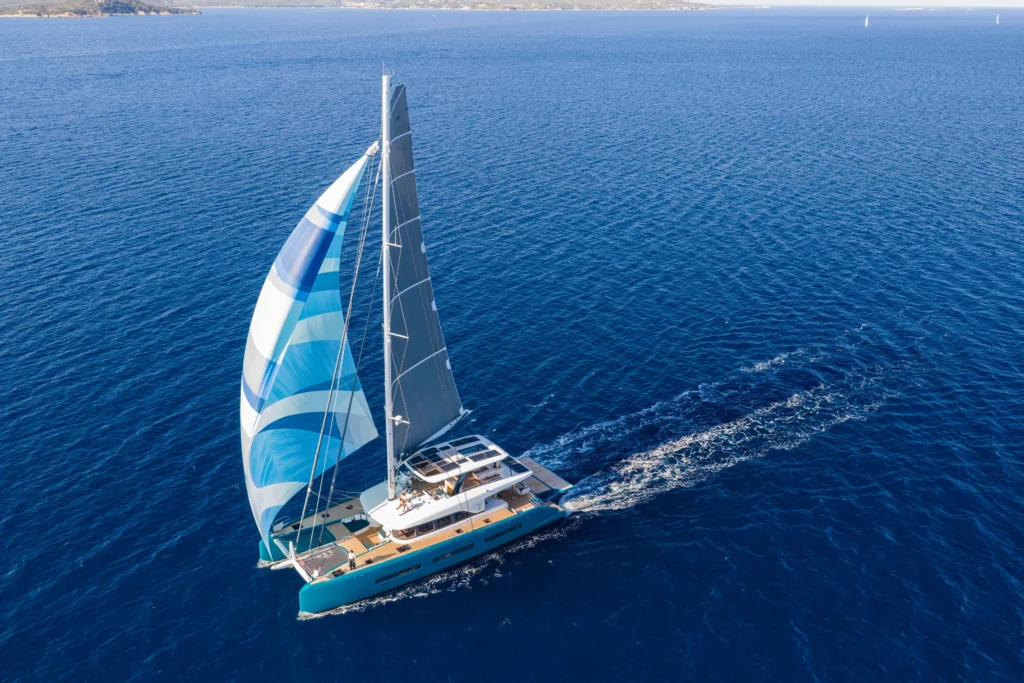
For Discovery, the Lagoon Eighty2 sailing the Naora Global Expedition, passage readiness includes the ordinary physical details that become inconvenient once the yacht is moving. Loose items need secure homes. The first meals should be possible to prepare without a lengthy search through lockers. Equipment needed promptly must be accessible rather than buried beneath things bought ashore. These are small acts of consideration for the people who will live with the motion.
Sleep deserves the same attention. The watch plan must protect adequate rest, especially for those responsible for the departure and the opening hours offshore. A late return followed by an early start spends that reserve before the passage has properly begun. We would rather hear flamenco earlier in the stay, or miss an evening, than manufacture the perfect farewell at the expense of alertness.
Return arrangements should also be settled before leaving the yacht, including how to make contact if plans change. Privacy does not require everyone to spend every evening together. Some may prefer the performance, others supper aboard and an early night. A good shore plan accommodates that difference without leaving uncertainty about who is returning and when.
This is the quiet advantage of preparing properly. Once seated, there is less unfinished work following us into the room. We can feel the chair beneath us, hear a shoe brush the wooden floor before the next firm strike, and notice the singer drawing breath. Attention becomes available because the practical questions have already been given theirs.
What We Carry Out To Sea
The Naora Global Expedition runs across the world from 2027 to 2031. Members choose when they join, where along the route they step aboard and how long they stay, within the practical requirements of the voyage. Some may want the coastal chapter without an ocean passage. Others may join for the distance itself. Discovery continues around the world as people step in and out where sailing fits their lives.
That freedom changes how we think about an evening in Cádiz. It need not be a shared farewell, and nobody has to experience it as a turning point. For one person, the useful discovery may be the structure beneath alegrías. For another, it may be the pleasure of sitting beside someone familiar without having to speak. The city can be encountered without being made responsible for what comes next.
If weather permits the call, and the right evening is there, we would like to leave room for it. The passage plan can remain aboard. In the performance, a singer may hold the final syllable a little longer while the guitarist waits, hands ready, resisting the easy impulse to fill the space. For that moment, there is nothing to add.