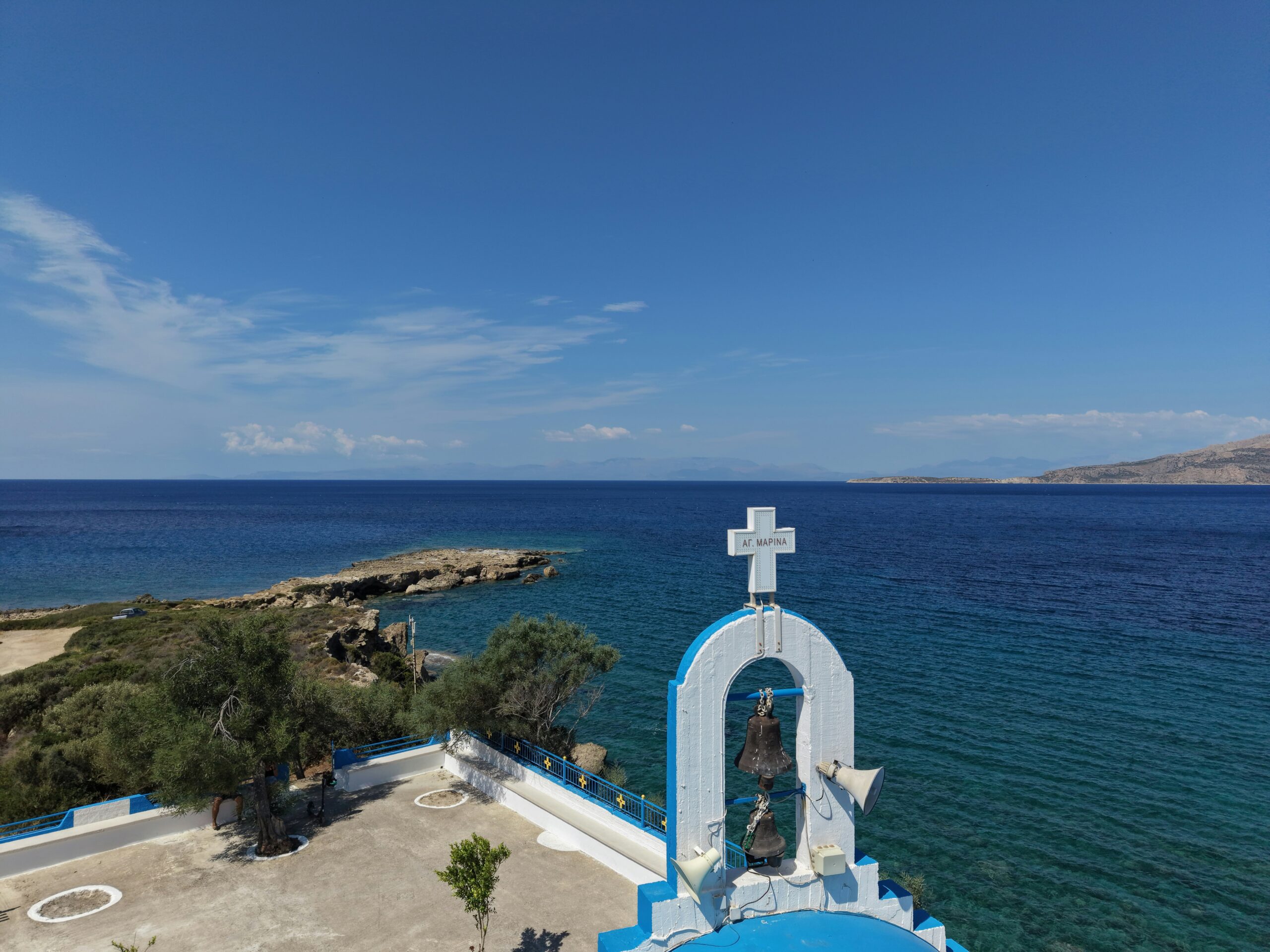
A candle flame needs shelter as soon as it leaves the church doorway. A hand curves around it, shoulders turn against the draught, and walking becomes slower than walking usually is. For a sailor spending Greek Orthodox Easter in the Dodecanese, this is an immediate point of recognition: the wind that matters out in the anchorage also matters here, in the small space between a palm and a wick.
What interests us about arriving by water is the responsibility that remains on both sides of the harbour. Ashore, we are visitors to a celebration with its own meaning, its own obligations and people who have waited for it. Aboard, the yacht still needs a sound anchorage and a sensible return plan. Getting those ordinary things right allows us to stop thinking about ourselves for a while. That is a better beginning to Easter than expecting the island to provide an experience.
The Calendar Of Greek Orthodox Easter
The first preparation is checking the date for the actual year of the visit. Greek Orthodox Easter does not reliably coincide with Western Easter, although the two sometimes fall together. The churches use different Easter calculations, so a familiar public holiday in a guest’s home calendar is not sufficient for planning a passage or an arrival. Local service times need checking as well. Midnight is the point everyone remembers, but arriving at midnight means missing the gathering that leads towards it.
Easter is the central feast of the Orthodox year, and its force comes partly from what precedes it. The forty-day fast of Great Lent leads towards Holy Week. For those observing the fast, abstaining from meat, dairy and eggs gives the later feast a bodily significance as well as a religious one. Practice differs between individuals and households. It would be a mistake to assume that everyone in a square has kept the same fast, or that someone who has not fasted feels less attached to the occasion.
Good Friday offers a different register from Saturday night. The Epitaphios, the cloth depicting Christ laid in the tomb, is honoured and commonly carried in procession on a flower-decorated bier. The mood is mourning rather than anticipation of fireworks. Following quietly, without pushing ahead for a photograph, lets a visitor understand something of the movement from grief towards resurrection. Easter is not a single midnight event with a large lunch attached. Arriving earlier in Holy Week changes what that midnight means.
Choosing The Anchorage For The Return
From Discovery, our Lagoon Eighty2, the church lights would only be one part of the anchorage decision. The more important question is what the bay will be doing when people want to come back. Spring in the Dodecanese should not be planned as though it were settled summer. Passing weather systems can bring rain, stronger winds and changes of direction. An anchorage sheltered during the afternoon may become uncomfortable, or unsuitable, before the service ends.
Sven, Naora’s founder and captain, plans every weather window and sails every leg himself. For an evening ashore, the relevant window includes the return and the hours that follow it. We need to understand the forecast wind shift, the exposure to swell, the available swinging room and the landing itself. A quay can sit inside a sheltered harbour while the tender route to it crosses water exposed to a different direction. The boat and the landing are separate problems.
Holding ground matters more than proximity to the church. Suitable sand, where anchoring is permitted, is preferable to dropping into seagrass, both for reliable holding and to avoid damaging the meadow. The chain’s sweep matters too. Scope is measured against the vertical distance from seabed to bow roller, not merely the depth displayed at the helm. As an illustration, a 5:1 scope over a vertical distance of 8 metres means 40 metres of rode. That explains the arithmetic, not the correct setting for Discovery: conditions, equipment, seabed and room determine the actual decision.
The generally small tidal range does not remove the need to inspect the landing. Wind-driven water-level changes, surge and wash can make a low step awkward later. We would rather accept a less convenient landing with a dependable return than the shortest walk to church. Sometimes the right decision is to remain aboard. A religious calendar gives us a reason to hope for a particular evening, not a reason to lower the standard of the anchorage.
Greek Orthodox Easter At The Midnight Service
Anastasi means Resurrection. Around midnight on Holy Saturday, the light is shared from the priest’s candle through the congregation, and the proclamation of the Resurrection changes the character of the gathering. The greeting is Christos Anesti, Christ is risen. The customary reply is Alithos Anesti, truly he is risen. Learning both before going ashore is a small courtesy. There is no need to pronounce them theatrically or to turn the exchange into a performance of belonging.
In a congregation holding candles, the light falls upwards across faces rather than down from a ceiling. Someone nearby shields a wick while another person leans in to relight theirs. Warm wax gathers above the fingers. Beyond the press of bodies, the spring night feels cooler, especially after standing still. Bells, chanting and conversation can overlap rather than take orderly turns. The service is solemn, but the people around it are still people: tired children, relatives finding one another, someone making room for a person who cannot stand comfortably.
Visitors are generally welcome to attend respectfully, but welcome is not permission to treat the church as a viewing platform. Dress modestly, keep doorways and processional routes clear, and leave the phone down during prayer. Non-Orthodox visitors should not receive Communion. Nor should we assume that the midnight proclamation ends the service. Worship continues afterwards, even as some people leave to break their fast. Remaining or leaving quietly both require attention to what is happening around us.
There is also a practical distinction between bells and pyrotechnics. Easter celebrations in parts of the Dodecanese can include powerful firecrackers and other explosive customs. Their noise and unpredictability deserve respect, especially with children or anyone sensitive to sudden sound. Asking locally where they are likely to happen is more useful than discovering it from the middle of a crowd. We can stand farther back, use hearing protection or choose another position. Being a considerate visitor does not require standing close to a hazard.
The Crossing Back In Darkness
The return begins before anyone leaves Discovery. Someone must have responsibility for the yacht, the tender operator must remain sober, and people need to know how an early return will work. Not everyone will want the same length of evening. A child may be exhausted before midnight; an older guest may find standing harder than walking. Giving those possibilities a practical answer prevents a quiet discomfort from becoming the defining memory of the night.
Distance looks different across black water. In a simple planning example, a 1 Nm tender crossing at 5 knots takes twelve minutes, before boarding, manoeuvring or slowing for chop and harbour traffic. That is long enough for an exposed passenger to become cold after leaving a crowded square. A warm layer and a dry place for a phone are small preparations with a disproportionate effect. Lifejackets are worn, navigation lights must work, and a means of communication belongs with the operator rather than somewhere back aboard.
Once the tender moves away, the sound of the waterfront thins. Conversation becomes harder over the engine, the air finds the damp cuffs of a jacket, and the yacht’s light has to be distinguished from every other light behind it. This is why we identify the route and its obstructions in daylight rather than relying on recognition after the celebration. We also extinguish candles before boarding. The custom of taking the Easter flame home does not oblige us to carry a live flame among sleeves and moving passengers. A candle can come back to Discovery without remaining alight.
What The Easter Table Means
The first meal after the Resurrection is often not the Sunday lamb but magiritsa, the soup traditionally eaten after the midnight service. Common versions use lamb offal, greens, herbs such as dill, and an egg-and-lemon finish. Recipes vary, as does the decision to eat it at all. Its place in the evening makes sense: after a long service and, for some, a long fast, a bowl of hot soup marks the passage back into feasting without beginning with a plate of roast meat.
The egg-and-lemon finish, avgolemono, is also a useful piece of galley knowledge. Hot broth is gradually whisked into the egg and lemon mixture before it returns to the pot, so the eggs warm without abruptly setting. After that, fierce boiling can split the mixture. The result should be a broth given body and brightness, not scrambled egg suspended in soup. Knowing the technique makes the dish more intelligible when it arrives at the table: the richness has been handled, not simply added.
On Sunday, lamb is widespread, but goat also belongs to island Easter cooking, and an oven-roasted dish can be as much part of a household’s celebration as a turning spit. Kokoretsi is made with seasoned offal wrapped in cleaned intestines and roasted. It is sensible to explain that plainly to someone unfamiliar with it rather than presenting it as an anonymous grilled speciality. Asking what a dish contains is respectful, particularly when allergies or dietary restrictions are involved. Guessing is not.
Tsoureki brings a softer texture to the table, a rich, braided bread often scented with mahlepi or mastic, depending on the recipe. Red-dyed eggs are used for tsougrisma, the tapping game in which people test one shell against another. The red is commonly associated with Christ’s blood; the cracking shell carries the association of new life. The game can be light-hearted without making the symbolism trivial. These foods have survived because they belong to repeated household acts: kneading, dyeing, tending heat, setting places and feeding people who have come home.
Accepting Hospitality Without Expecting It
The whole village does not necessarily sit down at one table. Easter meals may be held within a family, among neighbours, in a courtyard or at a taverna. Some celebrations are public; others are not. Going to the service does not earn an invitation to lunch, and arriving by yacht does not confer a special claim on anyone’s generosity. The honest pleasure of an invitation depends on its being freely offered.
That leaves plenty of room for warmth. Buy bread from the local bakery. Ask before the holiday which shops will close, rather than expecting someone to interrupt their Easter to supply the boat. If eating ashore, establish the arrangements in advance and understand that a festive kitchen may not be operating its ordinary menu. Local sourcing means adapting to the place’s working life, including the hours when people stop working.
If an invitation does come, we ask what to bring and make dietary needs clear without turning the host into a problem-solver at the last moment. Photographs need permission, particularly around children and inside a home. So does sharing those photographs later. Privacy works in both directions. The people who welcome a visiting sailor have not agreed to become part of the sailor’s public account. Sometimes the most accurate record of a generous afternoon is the one kept in memory rather than posted.
The Island’s Time On A World Route
The Dodecanese belongs to the Mediterranean part of the Naora Global Expedition, a five-year passage around the world from 2027 to 2031. That larger scale changes how we think about an island celebration. We are not trying to compress everything worth knowing into one shore visit. The route continues, and the life of the place continues after we leave. Where Easter fits the sailing plan, it offers a chance to notice a community organising its time around something other than the visitor’s timetable.
Members choose when they join, where along the route they step aboard and how long they stay. That freedom is valuable partly because it allows different degrees of attention. Someone may have a week; someone else may be able to remain longer. Neither duration makes a person an insider. What matters is how the available time is used: arriving without hurry, listening before making assumptions, allowing a procession or a closed shop to alter the day rather than treating it as an inconvenience.
Discovery gives us somewhere private to return to, a galley, a berth and the familiar order of life aboard. It does not need to insulate us from the meaning of the shore. At Easter, the distance between the two can be crossed carefully, with the weather understood and nothing demanded of the people waiting beyond the landing. The island’s Easter belongs to the island, including the parts we never see.