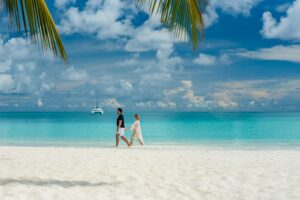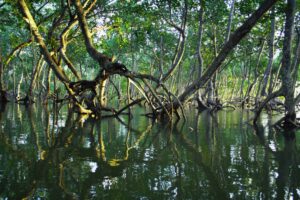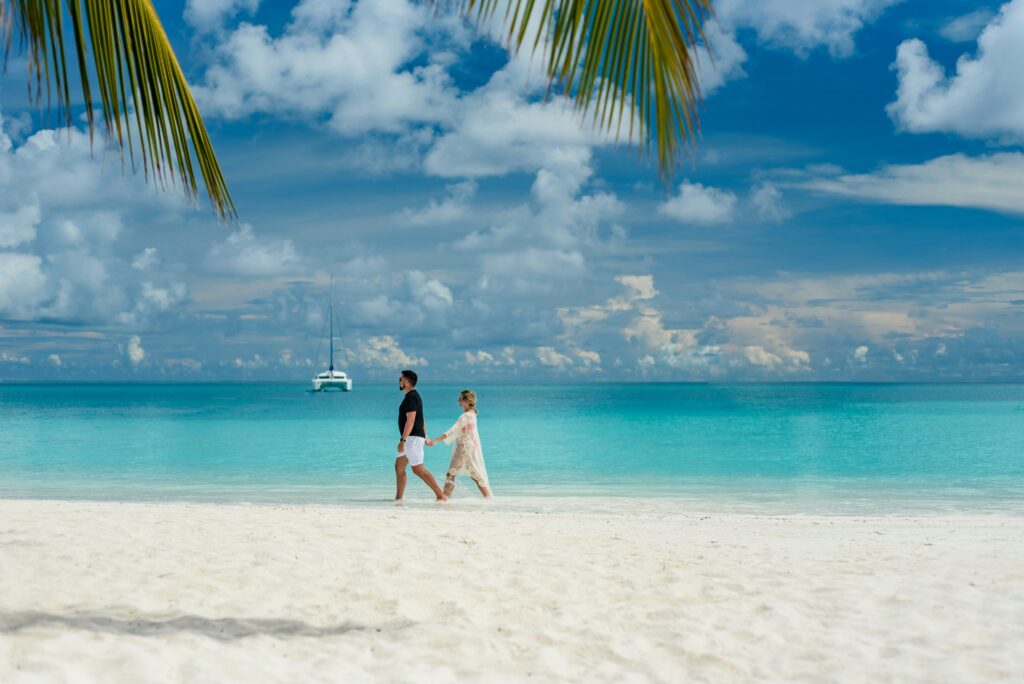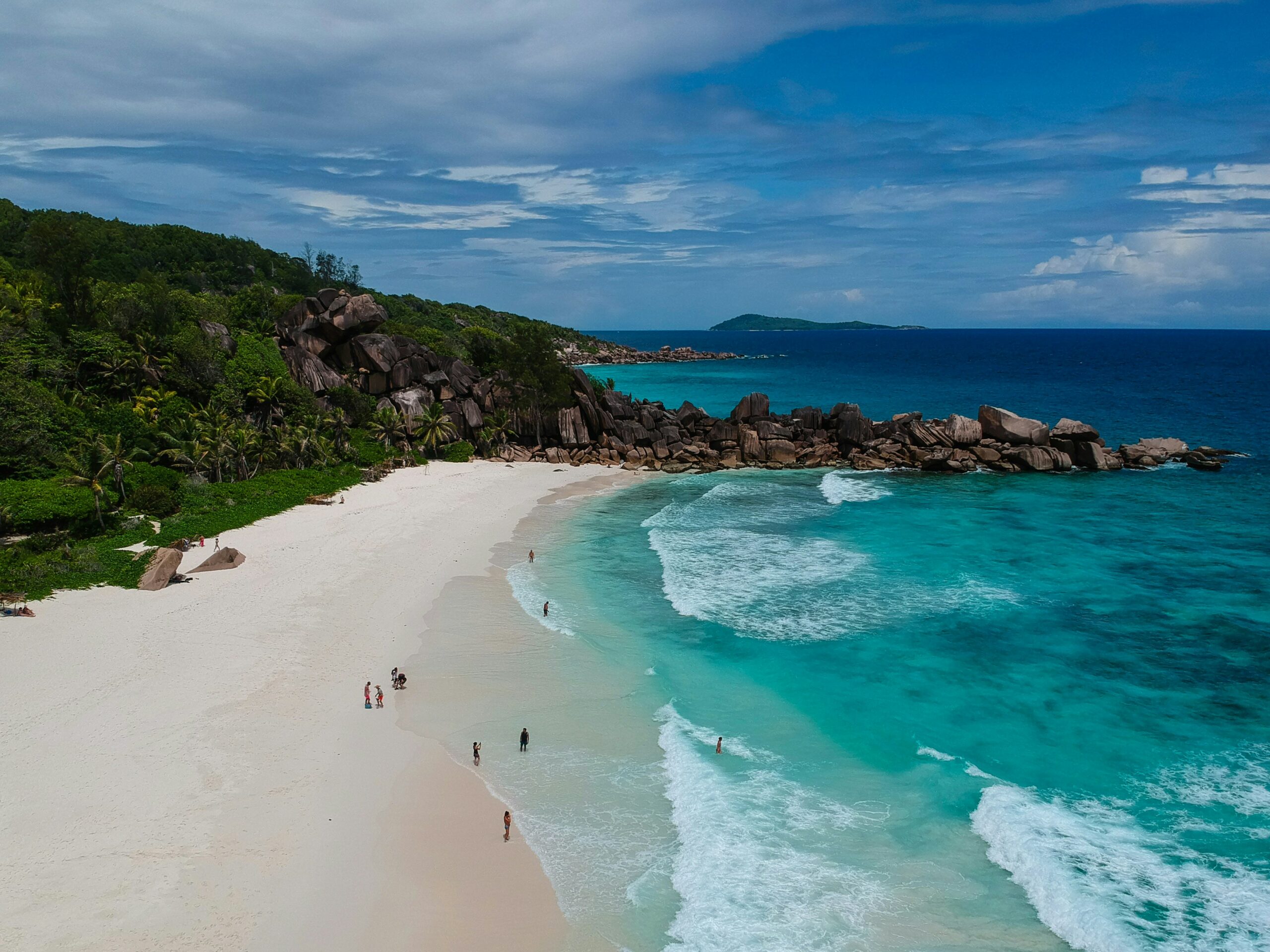
At Anse Lazio, the granite shoulders around the beach give an impression of protection that the sea does not always confirm. A long swell can enter beneath light wind, lifting water that looked almost motionless from farther out. In the Seychelles Inner Islands, this is an important distinction: the shape that makes a bay beautiful is not necessarily the shape that makes it a comfortable place to sleep.
We begin with that distinction because almost everything worthwhile here follows from paying closer attention. Granite is more than scenery. Clear water is not a report on the health of a reef. A palm forest is not understood by finding its largest seed and moving on. Arriving aboard a yacht gives us time to look, but it does not do the looking for us.
Reading The Seychelles Inner Islands From The Water
Mahé, Praslin and La Digue rise from a fragment of continental crust, rather than from the volcanic construction that formed so many oceanic islands. Their granite belongs to a much older geological history than the present arrangement of the Indian Ocean. The Seychelles separated from India roughly 65 million years ago, during the later breakup of Gondwana. The rock was already ancient when that separation happened.
That distinction matters because it changes how we read the coast. These are not recently assembled piles of lava. They are the exposed remains of continental material, weathered along fractures, softened into rounded masses and gradually uncovered as surrounding material broke down. Tropical rain and chemical weathering have done much of the work that the eye is inclined to attribute entirely to waves.
From the water, the result is unusually legible. A dark seam divides a boulder. Vegetation occupies the seam. Below it, another rounded surface disappears beneath the sea, where the same rock becomes habitat for algae, corals and fish. The shore does not end neatly at the waterline.
It does not end there for navigation either. Visible granite should make us attentive to submerged rock, not confident that every obstruction announces itself. A pale patch may be sand, but reflected cloud, surface glare and depth can alter what we think we see. Charts, soundings and a properly positioned lookout need to agree. Attractive water deserves the same scrutiny as an uninviting harbour entrance.
The Weather That Chooses The Anchorage
The broad seasonal pattern is useful. Southeast trade winds generally dominate from May to October, bringing more persistent wind and rougher conditions on exposed coasts. The northwest monsoon generally occupies November to March, with wetter weather and a different set of exposed shorelines. These are planning patterns, not appointments the atmosphere is obliged to keep.
The transition periods can bring lighter winds, but light wind does not mean an absence of swell, squalls or current. A forecast needs to be read for the night ahead as well as the afternoon arrival. We are interested in what will happen after everyone has stopped looking at the horizon and gone below.
Anse Lazio, on the northwestern side of Praslin, illustrates the problem well. It is an open bay, not a sealed lagoon. A favourable wind direction may make it appealing, while swell arriving from another direction can still make the anchorage uncomfortable or a tender landing unsuitable. Shelter from wind and shelter from waves are separate things.
Depending on departure and arrival points, Mahé to Praslin is roughly 25 to 30 Nm. That is an approximate passage distance, not a prescribed Naora track. It is short enough to look undemanding on a regional chart, yet long enough for opposing wind and a short sea to turn a pleasant crossing into several hours of tiring motion. A catamaran’s generous living space does not cancel the effect of repeated impacts beneath the bridgedeck.
Changing departure time, reducing speed or choosing a different approach can be more useful than insisting on the shortest line. For guests, those decisions may appear as an unhurried breakfast or a different coast coming into view. The reasoning belongs in the passage plan, not in their laps.
Anchoring In The Seychelles Inner Islands
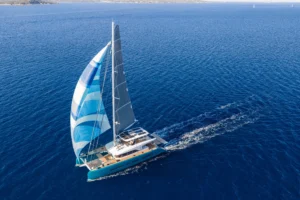
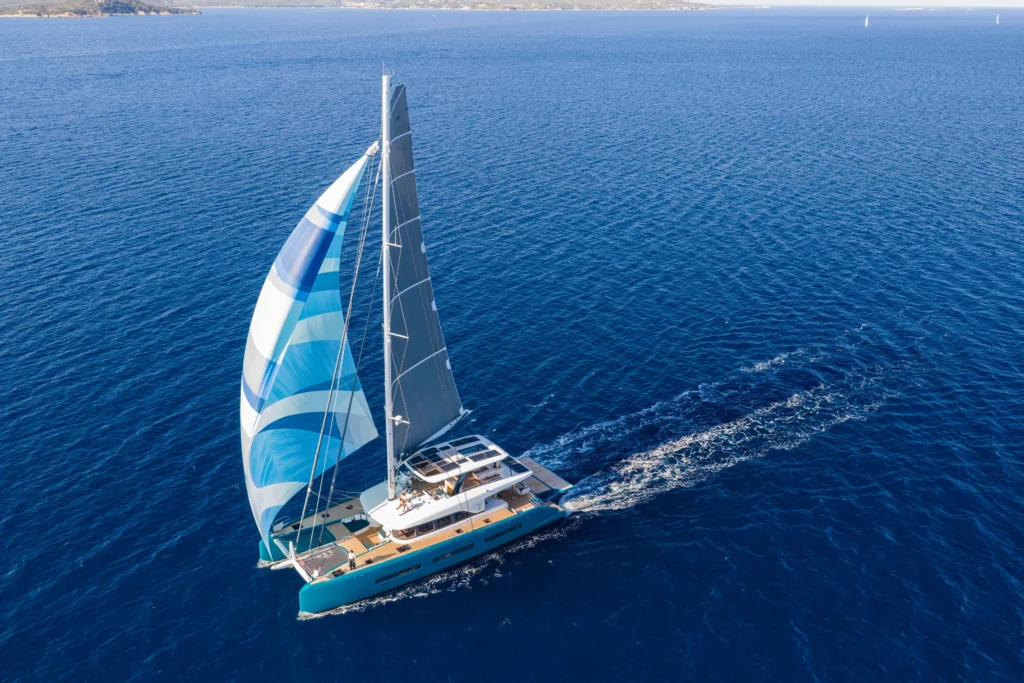
For Discovery, our Lagoon Eighty2 sailing catamaran, anchoring begins well before the anchor is lowered. We need suitable depth, dependable holding, room for the yacht to swing and a way out if conditions deteriorate. The space must accommodate the whole boat and the ground tackle, not merely the point where an anchor symbol appears on a screen.
A clean patch of sand is the first preference where anchoring is permitted. Coral, seagrass and rock are not alternatives simply because they lie beneath appealing water. It is also necessary to consider where the chain will travel as the yacht moves. An anchor placed in sand can still leave chain sweeping across a neighbouring coral head.
There is no honest single anchoring depth to prescribe for Praslin. The precise position, tide, chart datum and actual seabed determine the decision. When calculating scope, the relevant vertical distance includes the height of the bow roller above the water, not just the depth below the surface. The expected rise of tide must also be allowed for. These details become especially important when someone looks at shallow water and assumes that little chain will be needed.
After setting, the question is whether the anchor has actually taken hold. That means a controlled load on the ground tackle, observation of the yacht’s position against fixed references and continued monitoring, rather than treating the disappearance of chain over the bow as the completion of the job. An anchor alarm supports that judgement. It does not replace it.
Even a sound anchorage does not automatically provide a sound landing. At a sandy beach, swell steepens as it reaches shallow water; the quiet interval between sets can be misleading. We need to consider the return journey too, when light, tide or wind may have changed. Sometimes the right decision is to remain aboard or land elsewhere, even with an inviting strip of sand close enough to hear.
The Long Work Of The Coco De Mer
The Vallée de Mai takes the eye away from the horizon and puts it overhead. Broad palm leaves overlap above the paths, breaking sunlight into separate pieces. After rain, water continues to fall from the canopy when the open sky has already cleared. The air beneath it is humid and still, and the sound of stiff leaves moving against one another is very different from the softer rustle of ordinary woodland.
This protected forest on Praslin holds an important population of coco de mer palms. The species occurs naturally on Praslin and Curieuse, rather than only inside the Vallée de Mai. Its fame rests on the largest seed in the plant kingdom, which can exceed 15 kilograms. That weight is a considerable investment by a tree, not merely a botanical curiosity to pose beside.
A fruit generally takes about six to seven years to mature. The time involved helps explain why taking seeds, damaging young plants or treating the forest as a collection of souvenirs carries consequences far beyond a single visit. Replacement is slow.
The palms have separate male and female trees. Male trees bear long catkins; female trees carry the enormous fruits. Once that difference has been pointed out, the forest becomes easier to read. So does the arrangement of the leaves, which helps direct rainwater and organic material towards the base of the palm, concentrating scarce resources where they can be used.
A good local guide can make these relationships visible without turning the walk into a catalogue. There is the Seychelles black parrot to listen for, often easier to detect by its call than to distinguish among the foliage. There are seedlings below mature trees, and leaves in different stages of opening and decay. We would rather leave time for those connections than organise the visit around a photograph of a nut.
What A Coral Garden Can Tell Us
The phrase coral garden suggests a finished arrangement, healthy and colourful by definition. The reefs around the inner islands are less obliging. Coral grows among granite, sand and rubble, and Seychelles reefs have suffered repeated bleaching during marine heatwaves. Conditions differ between sites and can change substantially over time. We cannot promise an underwater scene from an old photograph.
Bleaching occurs when stressed corals lose the microscopic algae that provide much of their energy and colour. A pale coral is not necessarily dead. Prolonged stress can kill it, however, after which algae may occupy the exposed skeleton. Fresh white tips can also be normal growth. A single glance is not enough to diagnose the whole reef.
What interests us is the combination of signs: living coral tissue, young colonies, structural shelter and fish using the habitat in different ways. A parrotfish scraping a surface is feeding, not tidying the reef for our benefit. Fish gathering around a rock may be using shelter or a feeding opportunity created by water movement. Watching their behaviour is often more revealing than collecting species names.
Before entering, the practical questions come first. Where is the current carrying surface water? Can everyone return comfortably? Is there boat traffic? Where can someone leave the water without standing on coral? Clear visibility can make distances deceptive, particularly when a swimmer follows something interesting away from the yacht.
We keep the experience within the ability of the people in the water, with appropriate surface oversight and companions who remain attentive to one another. Fins stay clear of the bottom. Wildlife is neither fed nor pursued. Freedom to spend longer at a reef is worth very little if our presence makes the place worse.
Going Ashore With Attention
The islands are not an empty natural setting that becomes meaningful when a yacht arrives. Their coconut and cinnamon plantations belonged to a colonial economy whose history includes slavery and unequal ownership. Tourism later changed employment, land use and the waterfront. The people working around an anchorage are living within that history and its present consequences, not providing background to our visit.
Seychellois Creole is an everyday language, alongside the wider use of English and French. A greeting, a request before taking a photograph and patience when an arrangement needs clarifying are small acts, but they change the quality of an encounter. There is no need to manufacture intimacy. Ordinary courtesy is enough to begin with.
Food gives us another way to pay attention. A Creole meal may bring grilled fish, rice, lentils and a sharp chilli accompaniment to the table, with lime supplying acidity rather than decoration. Coconut milk lends richness to curries and to ladob, the slow-cooked sweet preparation made with ripe banana or cassava and aromatics such as vanilla and nutmeg.
For the galley, buying locally still requires judgement. We need to know what a fish is, how it was caught and how it has been kept. Once bought, it needs prompt chilling and sensible preparation, not an afternoon displayed on deck. Delicate fish benefits from restraint: dry the surface before cooking, avoid crowding the pan and add lime near serving so the flesh retains its texture.
Supporting local food and local knowledge gives more of our spending a place ashore. It does not, by itself, erase the environmental cost of bringing a yacht here. That distinction is worth keeping honest.
Time Aboard Discovery
The useful difference between a day visit and living aboard is not that one group deserves a beach more than another. Day boats give many people access to these waters and support local livelihoods. A private yacht has no greater claim on an anchorage, a reef or a forest path.
What changes is the arrangement of time. We can consider going ashore when conditions suit the landing, leave room for a longer forest walk and avoid making the swim, the crossing and dinner compete for the same afternoon. That flexibility still has limits. Protected-area rules, clearances, weather and the needs of the boat remain real.
Within the Naora Global Expedition, the Seychelles belong to a continuous voyage around the world, not a self-contained circuit repeated for successive groups. Members choose when and where along the world route they join, and how long they stay. Discovery continues sailing beyond their time aboard. The freedom lies in choosing a chapter that fits a life, while allowing that chapter to remain a genuine sea passage rather than a fixed sequence of appointments.
Sven, Naora’s founder and captain, plans every weather window and sails every leg himself. Here, that responsibility connects the apparently separate parts of a day: the forecast that determines the anchorage, the anchorage that determines the landing, and the landing that determines how much time can be spent beneath the palms without hurrying back.
There is a particular comfort in knowing that the return has been considered before going ashore. It leaves attention available for smaller things: the coolness beneath a leaf, a bird heard but not seen, the faint movement of water against granite. None of them needs to become an event.