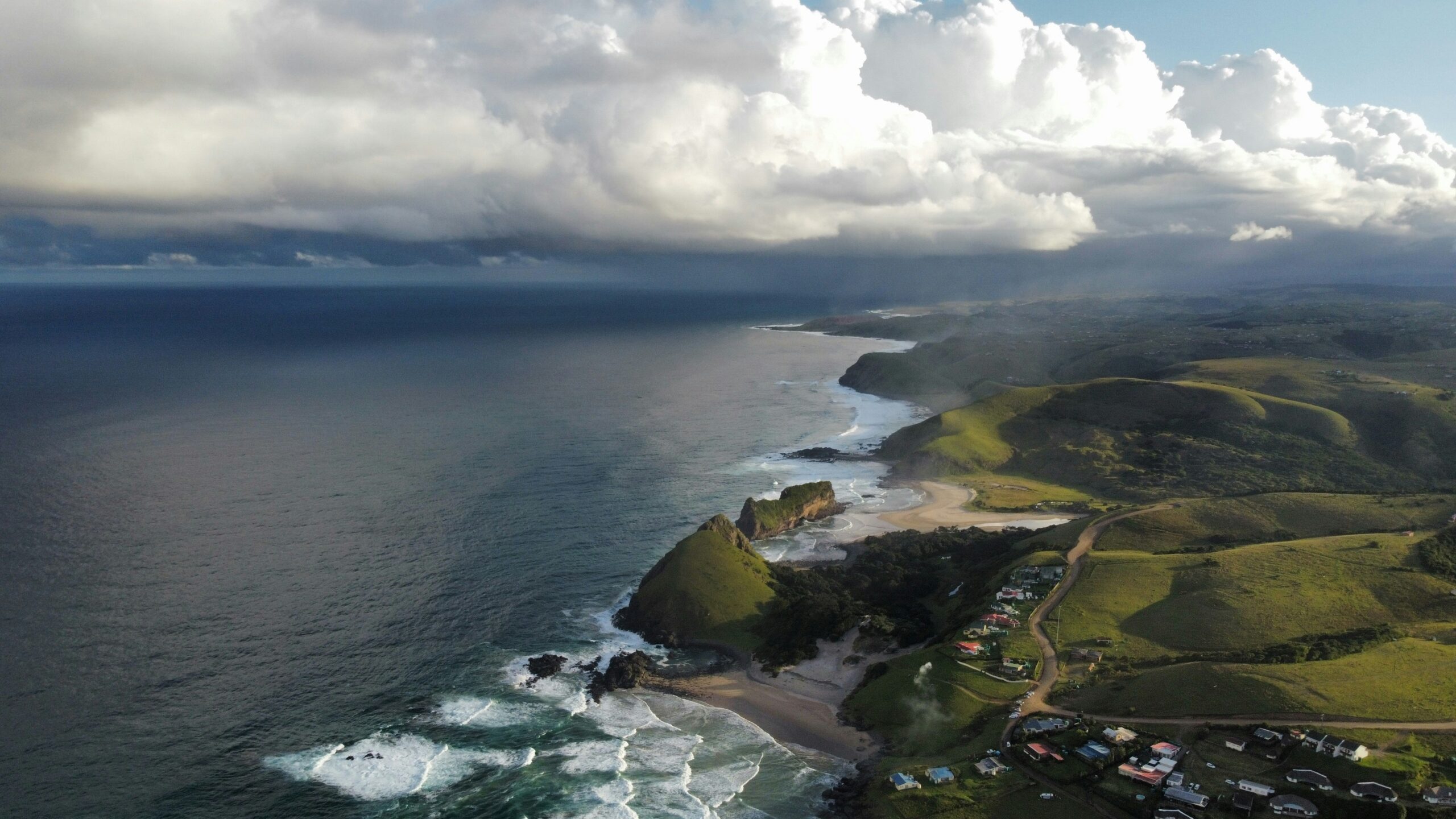
A river mouth can look sheltered from offshore until a swell arrives and a white line runs across its entrance. Wild Coast sailing asks us to recognise that difference before we need shelter, not while looking for somewhere to stop. The green land behind the entrance may be inviting. The water between the yacht and that land has its own conditions.
This is the central fact of the passage from Durban to East London. A coastline can remain visible for much of a voyage without providing a dependable place to interrupt it. Looking at land and having somewhere safe to go ashore are different things.
For Naora, this stretch of South Africa belongs to the working life of a yacht sailing around the world. Discovery, our Lagoon Eighty2 sailing catamaran, will carry the same domestic life through it that she carries elsewhere: meals, sleep, conversation, someone wanting a quiet corner with a book. Making that life comfortable begins before departure, with an honest understanding of what this coast permits.
The Weather Window For Wild Coast Sailing
Durban to East London is a passage of roughly 260 Nm, depending on the offshore track and port approaches. At an illustrative average of 8 to 10 knots over the ground, the arithmetic gives about 26 to 33 hours underway. Those figures are not a performance promise for Discovery. They explain why this cannot be treated as a pleasant afternoon sail extended until the next harbour: an overnight passage and a change of weather may both fall inside it.
The departure decision therefore concerns the whole period at sea, including the approach at the other end. A forecast that looks comfortable outside Durban can be inadequate if it deteriorates farther south before the yacht can arrive. We need room for a slower passage, an inconvenient arrival time and uncertainty in the timing of a wind change. The fastest plausible arrival is not a sound basis for the decision.
A northeasterly wind can favour a southbound yacht, but its direction alone does not describe the sea. Residual swell may still arrive from another direction, and wind strength can vary along the coast. Particular attention belongs to a strengthening southwesterly, blowing against the southwest-flowing Agulhas Current. The forecast must be read geographically, along the intended track, rather than as one wind symbol beside the departure port.
Sven, Naora’s founder and captain, plans every weather window and sails every leg himself. Here, that responsibility includes accepting a delay without trying to recover the lost time through a narrower margin later. Before departure there is also ordinary harbour work: confirming movement arrangements, understanding commercial traffic and having propulsion ready for the channel. The ocean passage begins in a working port, not at the moment the shoreline becomes attractive.
Wild Coast Sailing In The Agulhas Current
The Agulhas can make a southbound passage feel unusually productive. In a strong part of the flow, a favourable set of 2 to 4 knots is quite possible. That is substantial assistance over a passage of this length, but it is borrowed movement. The yacht has not acquired more speed through the water simply because her position advances faster over the seabed.
This distinction matters at the instruments. Speed through the water tells us something about how the yacht is sailing. Speed over the ground tells us how quickly she is travelling across the chart. Comparing heading and water speed with course and speed over the ground, while allowing for leeway and imperfect instruments, helps reveal what the current is doing. A gratifying number on the plotter is useful evidence, not a reason to stop examining the conditions around it.
The strongest current is not reliably found by sailing close to the beach. Its position is related to the continental shelf edge, and its strength and boundaries change. Meanders and eddies complicate the picture. We use the available current information to form an expectation, then compare that expectation with the yacht’s actual progress. There is no permanent narrow lane beside the cliffs that can be followed for a guaranteed lift south.
The same current becomes a serious consideration when waves travel against it. Opposing flow can shorten and steepen the waves, creating a sea that is much less forgiving than wind strength alone suggests. A following current is therefore not automatically a favourable condition. Moving inshore may change the exposure in some circumstances, but it can also introduce shoals, breaking water and less room to manoeuvre. Neither chasing the strongest flow nor retreating towards land is a universal answer. The departure window must be sound before these choices arise.
The Coast Is Inhabited, Not Empty
From offshore, the Wild Coast resolves slowly. Grass slopes, pale beaches, darker patches of coastal forest and river valleys take turns along the land. It is not an uninterrupted wall of cliffs. In low light, the folds of the terrain can be clearer than the buildings, which helps explain why photographs so often make the coast look less inhabited than it is.
The Eastern Cape shore has communities, roads, accommodation and an established life of visiting and hosting. What it lacks along much of this stretch is the convenient sequence of sheltered yacht harbours that a sailor might know elsewhere. Road access can be indirect and affected by rain, but describing the coast as inaccessible erases the people who travel those roads for ordinary reasons, not for an adventure.
Transkei also carries a political history. It was the name of an apartheid-era homeland, not merely a poetic alternative to Wild Coast. The communities here cannot be understood by treating their homes as an unchanged background to our passage. Fishing, livestock, work elsewhere, family obligations and tourism all belong to the contemporary coast. A view through binoculars tells us very little about the balance of those things in a particular household.
IsiXhosa is widely spoken here. Molo addresses one person; molweni addresses more than one. If a separately planned visit ashore becomes possible, learning to use a greeting properly is a modest beginning, followed by introducing ourselves and asking before taking someone’s photograph. Passing Coffee Bay or the Bulungula River mouth from the water does not, by itself, amount to knowing either place. Respect includes being accurate about the limits of our encounter.
River Mouths Are Not Harbours
A river entrance is an opening in the land, but not necessarily an opening available to a yacht. Sand moves. Bars change depth and position. After rain, a river can carry stronger flow, sediment and floating debris into the coastal water. Where an outgoing stream meets incoming swell, the waves may steepen and break precisely across the route that looks most sheltered on a small-scale chart.
The tide is part of that assessment, but more water over a bar does not automatically make an entrance safe. Swell direction, wave period, river discharge and the shape of the channel all matter. Local knowledge must also be current knowledge. The fact that a small local craft uses a mouth does not establish that Discovery can enter it, or that the entrance will behave the same way later.
This changes how we look at landmarks. Hole in the Wall near Coffee Bay is worth recognising, but recognition does not require bringing the yacht close to the breaking water around it. From a sensible offshore track, light, visibility and swell may allow a clear view or only a suggestion of the feature. We accept that difference. An attractive stretch of shore does not become a scheduled landing, swimming stop or anchorage simply because it appears beside the route.
The Watch And The Galley
On a dark watch, the coast may reduce to scattered lights above an almost invisible edge. A mug is warm against the palm while the air cools the back of the same hand. The water alongside is heard more readily than seen, and a bright screen can make the darkness beyond the cockpit seem impenetrable. Keeping displays appropriately dim preserves the ability to look outside. Comfort and attention begin to depend on very small decisions.
The watch handover needs more than a position and a course. The person taking over should understand nearby traffic, the observed current, any difference between forecast and actual conditions, and the point at which Sven wants to be called. A useful handover transfers the reasoning as well as the information. Someone waking from sleep should not have to reconstruct an uncertain situation from a collection of numbers.
Meals belong in this preparation. On a passage where motion may increase, food that can be finished and served without prolonged work at the stove is a practical kindness. A thick stew or a cooked grain dish is easier to manage than a meal requiring several hot pans at once. Ingredients can be washed and cut before departure, loose equipment secured and drinking water made easy to reach. The aim is to reduce the work required when the boat is moving most.
For the people aboard, this can make the difference between tolerating a passage and settling into it. There should be no need to earn a place at the table by being unusually resistant to seasickness, or to stay awake because the coast is supposed to be worth seeing. A warm meal, an early rest and permission to miss a view are part of looking after people. The voyage continues while someone sleeps.
Humpbacks On Their Own Passage
Along KwaZulu-Natal, humpbacks are generally associated with the migration season from about June to November, though timing and numbers vary between years. Northbound animals pass during the austral winter, with southbound movement continuing through spring. The coast is an important migration corridor towards and away from warmer breeding waters farther north, not one continuous breeding ground in which every whale is engaged in the same activity.
That distinction makes sightings more interesting. An animal travelling steadily has different immediate needs from a group interacting at the surface. A mother and calf may move together without surfacing together every time. Seeing one blow does not tell us where every animal in the group is. Nor does the absence of another blow mean that the water ahead has become clear. The whale remains an underwater presence for most of the encounter.
A blow can be surprisingly difficult to keep in sight from a moving yacht. Against darker water it may stand out briefly, then disappear into glare as the boat rises. The useful response is to note its bearing, keep a lookout and understand the yacht’s movement relative to the animal. Reaching for a camera comes later. An offshore position offers no exemption from the responsibility to avoid disturbing wildlife.
South African approach restrictions apply to private yachts too. For an unpermitted vessel, rounding the statutory whale approach limit outwards gives a planning buffer of 0.17 Nm. That is a minimum to respect, not a viewing distance to aim for, and current restrictions must be checked before the passage. More space may be needed to avoid altering an animal’s behaviour. We do not cut across its track, follow it for a closer photograph or place the yacht between a mother and calf.
If a whale surfaces unexpectedly close, the immediate navigation situation matters: avoid sudden manoeuvres, reduce speed or take propulsion out of gear when safe, and let separation increase without pursuing it. Nothing about a whale’s apparent curiosity makes its intentions predictable. On Discovery, a distant sighting that leaves the animal undisturbed is a complete encounter. There is no missing final act in which it needs to come alongside.
The Time Allowed For Arrival
East London is not simply the end of a line on the chart. The port approach belongs inside the passage plan, with entry conditions, traffic and harbour communications considered before the yacht is close enough for fatigue or changing weather to narrow the choices. A favourable current can bring arrival forward as readily as an adverse condition can delay it. We need to think about both.
This is where the freedom of Naora’s worldwide route meets the reality of a particular coast. Members choose when they join, where along the route they step aboard and how long they stay. That freedom does not require the sea to honour a fixed departure hour. For someone with a flight or an important commitment after a passage, leaving time ashore around the sailing is often more useful than trying to make the yacht’s arrival exact.
There is a different quality of attention available when every mile does not have to produce an image. We can notice the way a river stains the sea after rain, or watch a distant whale without changing course towards it. We can also admit that much of the land remains unknown to us. Beyond the white water are homes, conversations and mornings we have not entered. From offshore, their distance is something to respect.