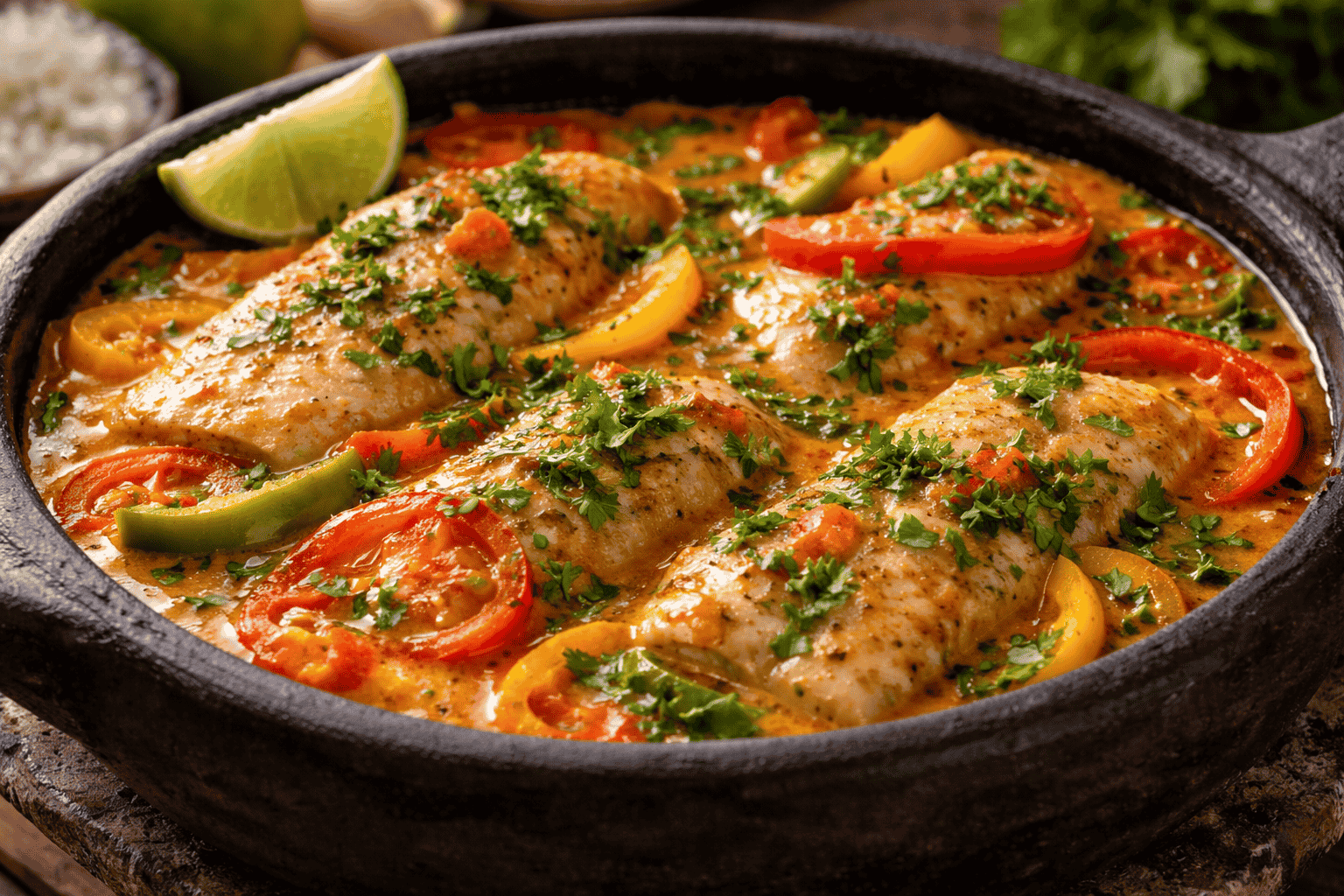
The dorado went into the pot in thick pieces, with enough substance to remain fish rather than disappear into the sauce. Our moqueca de peixe began with the catch from the trolling line on the eighth day of an Atlantic crossing, but its direction had been decided before we left Las Palmas. A Brazilian member had brought dendê oil and dried shrimp in his provisioning bag. Coconut milk, tomatoes, onions, coriander and lime were already among the stores.
There is a particular stage in this stew when the coconut milk takes on the orange of the dendê and the ingredients stop looking separate. Warm steam carries the smell of onion and fish; the coriander brings something greener, sharper. The temptation is to stir. Usually, that is the moment to leave the fish alone. Much of making a good moqueca consists of preparing carefully enough that very little needs doing once the fish enters the pot.
What Moqueca De Peixe Carries
Moqueca belongs to more than one Brazilian coastal tradition. The Bahian version is closely associated with dendê and coconut milk, and with a food culture shaped by Indigenous knowledge, African foodways and Portuguese colonisation. Those influences cannot be separated into a tidy allocation of ingredients, as though one people supplied the fish, another the pot and another the seasoning. Cooking develops through households, work, exchange and necessity. Its history is less orderly, and more human, than a formula.
The African inheritance in Bahian cooking is particularly visible in dendê, the red-orange oil pressed from the fruit of the African oil palm. Its flavour is assertive, earthy and sometimes faintly nutty. It is different from palm kernel oil, which comes from the seed rather than the surrounding fruit. A neutral cooking oil can provide fat, but it cannot provide this taste. Leave dendê out of a Bahian preparation and the result may still be a good fish stew. Something recognisable has nevertheless changed.
Moqueca capixaba, from Espírito Santo, is not an imitation. It has its own tradition, generally without coconut milk or dendê, often coloured with annatto and closely associated with clay-pot cooking. Knowing that distinction makes us better guests at a Brazilian table. There is no need to diminish one regional kitchen to understand another.
The history also requires a little restraint from anyone writing about it at sea. Enslaved Africans carried culinary knowledge to Brazil under conditions of violence and forced displacement. That is part of what this food carries. We cross the Atlantic by choice. A shared ocean does not make those crossings comparable.
The Catch Before The Cooking
Dorado, also known as mahi-mahi, suits a stew because its flesh can hold together in substantial pieces. That does not make it forgiving of poor handling. The most important work happens before the sauce exists: dispatching the catch promptly, keeping hooks and knives under control, cleaning the fish hygienically and getting the flesh cold. Freshly caught is a description of elapsed time. It is not, by itself, a guarantee of safe food.
Dorado can develop histamine if it is held too warm. The fish may still look and smell acceptable, and cooking or freezing will not remove histamine once it has formed. We therefore treat the cold chain as part of the preparation, not as something separate from cooking. Flesh should be chilled promptly and kept at 4°C or colder, preferably close to the temperature of melting ice, with meltwater draining away rather than collecting around it. In a warm offshore galley, leaving a handsome catch on display is an expensive use of its remaining quality.
The work surface matters too. A clean board for the portioned fish, hands washed after handling the whole catch, and washed herbs kept away from raw-fish juices are ordinary kitchen disciplines with particular value far from shore. There is no reason to make them theatrical. They should happen before anyone has to ask.
Nor should a passage menu depend on the trolling line. Fishing is an opportunity, not a provisioning plan. We need another meal available if nothing is caught, and enough cold storage for anything we retain. Taking a fish creates an obligation to use it well. The sea does not make waste more acceptable simply because the ingredient arrived without a market receipt.
What The Provisioning Bag Made Possible
The member’s contribution was small in volume and large in consequence. Dendê was the ingredient he had chosen not to leave to chance in Las Palmas. That is different from saying it cannot be found there. Specialist groceries come and go, and a provisioning plan should not rest on an assumption about what a particular shop will stock when the boat needs to leave. For an ingredient that defines a dish, confirming supply beforehand is more useful than hoping.
Dried shrimp bring concentrated savouriness and salt, but they are not compulsory in every moqueca baiana. They belonged to this preparation. Their strength varies, so they need tasting before the final seasoning is decided; depending on the product, rinsing or soaking may be appropriate. They also turn a fish dish into a shellfish-containing dish. That needs to be understood before cooking, not discovered over the first bowl. An ingredient that almost disappears into a sauce does not disappear for someone with an allergy.
Coconut milk earns its cupboard space offshore because an unopened shelf-stable container does not ask for refrigeration. Once opened, it becomes perishable. Tomatoes soften and release liquid, onions provide sweetness, and lime allows the finished stew to be adjusted without adding more salt. Coriander is less patient in storage. Keeping it dry and refrigerated helps, but leaves still need sorting rather than being used simply because they were bought for this meal.
These are the quiet decisions behind a dinner that seems spontaneous. The catch may be unexpected. The ability to turn it into something worth sharing rarely is.
A Clay Pot In A Moving Galley
The Brazilian member had also brought a clay pot. Earthenware belongs to the cooking traditions of moqueca, but it deserves a more precise explanation than the suggestion that old clay automatically lends a stew depth. A suitable pot can distribute heat gently and retain it after the burner is lowered. Its response is slower than that of a thin metal pan, which is helpful until the cook forgets that retained heat continues cooking the fish.
Not every earthenware vessel is suitable for direct heat. The pot must be food-safe, intended for the cooker being used, and prepared and maintained as its maker requires. Sudden temperature changes can crack it. A hot pot should not be put onto a cold, wet surface, and a damaged pot should not be excused because it has travelled a long way or carries sentimental value.
At sea, there is another test: can it be secured properly? A broad base alone is not a restraint. On Discovery, the Lagoon Eighty2 sailing Naora’s world route, the space of the galley does not cancel the movement of the boat. A cook still needs a stable stance, a clear surface and somewhere safe to put a hot lid. Motion reaches the knees before the hands have finished their work. Carrying a full pot is something to plan, not improvise.
If earthenware cannot be secured safely, a suitable heavy metal pan is the better choice. The recipe can tolerate that substitution. People should not have to tolerate an unsecured vessel of hot liquid for the sake of culinary appearance.
Cooking Moqueca De Peixe Gently
For a home-sized pot, a useful starting proportion is about 400 ml of coconut milk to 1 kg of prepared fish. This is a working guide, not a fixed definition of the dish, and it is not a measurement of our Atlantic catch. Tomatoes contribute liquid of their own. The aim is enough broth to cook and sauce the fish, rather than so much coconut milk that everything tastes primarily of coconut.
Cutting the flesh into pieces roughly 3 to 4 cm thick gives it a better chance of remaining intact. They should be reasonably even, because a thin tail piece and a thick section from the shoulder will not finish together. A little lime can season the fish before cooking, but a long acidic marinade is unnecessary. Acid changes the proteins at the surface; it does not replace refrigeration or make raw fish reliably safe.
There are different household methods for assembling moqueca. One practical approach in a galley is to let the onions and tomatoes soften before the fish goes in, then bring the coconut milk and seasonings to a gentle simmer. This avoids trying to finish firm vegetables while the fish overcooks around them. Dendê should be added with attention and tasted in the broth. Its purpose is to give the dish its characteristic flavour, not to overwhelm the fish beneath a heavy layer of oil.
Set the pieces into the hot sauce without packing them tightly. Once the gentle simmer returns, pieces of this size may take approximately 8 to 12 minutes, depending on their thickness, starting temperature and the heat of the pan. Time is only a guide. A useful food-safety endpoint is 63°C in the thickest part, checked with a clean probe rather than inferred from the colour of the surface. Gentle cooking describes the treatment of the fish, not permission to leave its centre undercooked.
A hard boil makes the pieces knock against one another and encourages the sauce to separate. Repeated stirring breaks the fish for no benefit. Spoon a little broth over any exposed surfaces instead. Finish with coriander and adjust the lime and salt after tasting the sauce with a piece of fish. If the broth needs substantial reduction, that work should happen before the fish is added. Once it is cooked, further simmering takes more than it gives.
Rice, Farofa And The Watch
The rice was white, and the farofa had come from the member’s provisioning bag. Both had work to do. Rice receives the broth without competing with it. Farofa brings dryness and texture to a meal otherwise made of tender fish and liquid. Made here from toasted cassava flour, it should remain loose enough to scatter. Farinha de mandioca, the cassava flour used for this kind of farofa, is not interchangeable with tapioca starch, which would thicken the liquid rather than provide the same toasted texture.
Farofa is best offered separately. Add it at the table and the first mouthful still has a little grain against the soft fish. Leave it sitting in the stew and that contrast fades as it absorbs the sauce. The coconut rounds the flavour; lime brings the fish back into focus. A little orange broth reaches the rice at the edge of the bowl. Nothing needs arranging with much precision, but each part makes more sense because the others are there.
Twelve people ate that moqueca on the Atlantic. Offshore, a shared meal still has to fit around watchkeeping. The person attending to navigation and traffic cannot simply disappear into dinner, and a portion saved for later needs proper handling rather than being left lukewarm beside the cooker. Rice deserves the same care as fish: cook it close to service where practical, and cool and refrigerate leftovers promptly.
This is one of the useful disciplines of passage cooking. Generosity includes the person who eats later. Their meal should not be the dried edge of a pot kept warm long after everyone else has finished.
The Food People Bring With Them
Bahia was present through the dish rather than through a landfall. The fish came from the water around the boat, while the knowledge of what to do with it had arrived in someone’s luggage. We did not need to call the result the definitive moqueca. It was the version a Brazilian member chose to make and share, with ingredients he had taken the trouble to bring.
That distinction matters on a world route. Learning through food is not the same as collecting dishes and treating them as possessions. A familiar name may describe several preparations, and the cook who knows one well may still be curious about another. Respect begins with allowing those differences to remain. There is room to ask why the oil goes in at that stage, why this household uses dried shrimp, or why another would not.
Within Naora’s private circle, people choose when they join, where along the worldwide route they step aboard and how long they stay. Discovery continues sailing as the company changes. The galley is one place where that freedom becomes tangible: someone arrives with an ingredient, a method, or a food they would like others to understand. It is worth making room for that contribution without turning it into a performance.
The dendê had occupied very little space in the provisioning bag. At the table, it gave a familiar taste room to reach other people. Far from land, home could still be passed from one person to the next.