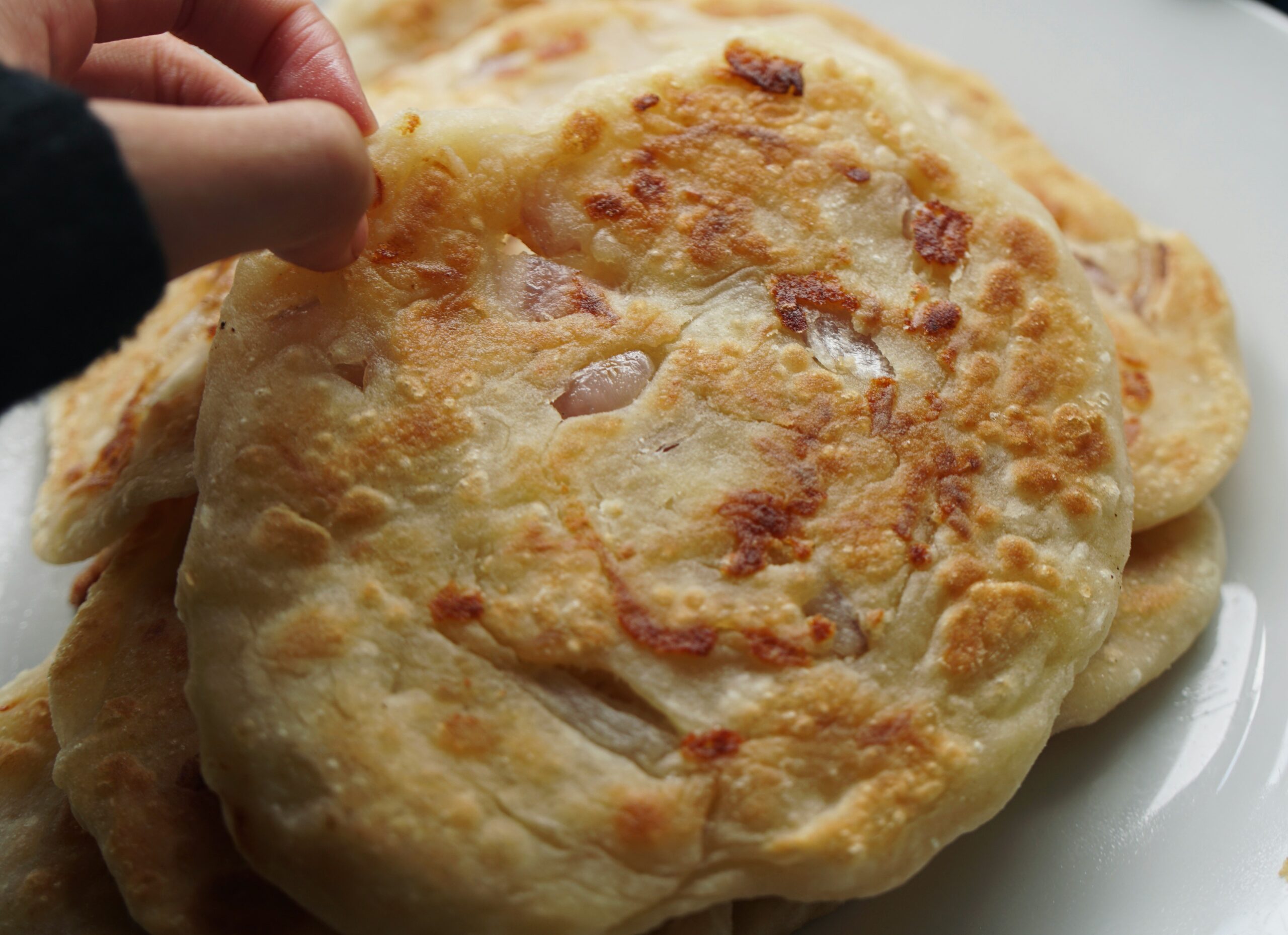
The first tear in a warm pol roti reveals a softer centre beneath the brown patches, with grated coconut caught through the dough. Eat that piece with sambol and the mouthful changes halfway through: the bread gives way to lime, raw onion and chilli, then the coconut becomes noticeable again. With pol roti and coconut sambol, much of the pleasure comes from those separate textures remaining distinct. Neither needs to be made elaborate.
This is the breakfast we have in mind for Galle, in the Indian Ocean chapter of the Naora Global Expedition. Aboard Discovery, the Lagoon Eighty2 sailing the world route, doing it well would begin before anything reaches the table, with the coconut we buy, the way we handle it and the time we leave for cooking. The view cannot compensate for a roti that is scorched outside and raw within.
Galle Harbour And The Town Behind It
Galle stands on Sri Lanka’s southwestern coast. Its fort occupies a headland west of the working harbour, rather than forming a wall immediately above every possible yacht position. That distinction matters when imagining a morning here. The familiar photographs of ramparts and lighthouse show one part of a larger coastal town, not the arrangement of a yacht’s berth or the practical route ashore.
The Portuguese established early fortifications, the Dutch substantially rebuilt and extended them, and British rule followed. Galle’s maritime trading history reaches further back than those successive colonial occupations. The walls are worth walking, but treating them as the whole story reduces a living place to the part most readily photographed. Food offers another way in, through ingredients that belong to ordinary kitchens rather than to the presentation of the fort.
Pol means coconut in Sinhala. Pol roti is coconut bread, usually made with wheat flour, and pol sambol is the grated coconut accompaniment whose chilli, onion, lime and salt give this breakfast its sharper edge. Neither belongs only to Galle, and roti is not confined to breakfast. There are household variations, different accompaniments and different opinions about how much chilli is enough. We should arrive ready to notice those differences, rather than expecting every kitchen to reproduce the same plate.
The Coconut In Pol Roti And Coconut Sambol
The ingredient shared by both dishes is not interchangeable with every product labelled coconut. The useful starting point is the firm white flesh of a mature coconut. The soft, almost spoonable flesh inside a young drinking coconut behaves differently, while dry desiccated coconut lacks the moisture and tenderness of freshly grated flesh. A substitution can produce something pleasant, but it changes the work.
For the roti, the coconut interrupts the wheat dough and contributes moisture, fat and a gentle sweetness without added sugar. In sambol, it remains uncooked, so its quality has nowhere to hide. A clean, fresh coconut should smell mild and sweet. Sourness, mustiness or a rancid smell are reasons to reject it, although a pleasant smell alone cannot establish that a prepared ingredient has been handled safely.
Grating is part of the texture. Long, coarse strands make a roti harder to press evenly and leave sambol awkward to gather with bread. At the other extreme, processing coconut into a wet paste loses the loose, granular character of the condiment. The aim is a fine scrape that still has substance between the fingers.
If we buy coconut already grated, the useful questions concern when it was prepared, how it has been stored and how quickly we can get it back to refrigeration. The convenience is real. So is the extra responsibility once the protective shell has been opened.
Getting The Dough And The Griddle Right
There is no single ratio that settles every version of pol roti. Coconut moisture varies, flour absorbs water differently, and some cooks add onion, green chilli or curry leaves. For a straightforward working batch, a reasonable starting point is 300 g of plain wheat flour with 150 g of freshly grated coconut and salt. That proportion gives enough coconut to be evident without making the bread difficult to handle. It is a starting recipe, not a claim about the only correct Sri Lankan method.
Mix the flour, coconut and salt before adding water. Begin with about 100 ml, then add more a little at a time until the dough comes together softly. The measured water is only the first addition, not a target to defend against what the bowl is telling you. Coconut that has just been scraped may contribute appreciably more moisture than coconut that has been standing.
A short covered rest allows the flour to hydrate. This is an unleavened dough, so the purpose is not to wait for it to rise. There is also little reason to knead it as vigorously as a loaf whose structure depends on a strong gluten network. We want a bread that holds together when lifted but breaks readily at the table, not one that fights the teeth.
Press the portions evenly with lightly dampened or oiled fingers, aiming for roughly 5 mm thickness. The middle needs to be as thin as the edges. Cracks around the perimeter suggest that the dough may need a little more water; persistent sticking suggests too much moisture or insufficient resting. Repeatedly dusting a sticky dough with flour can solve the handling problem while quietly making the finished bread heavier.
On a heavy griddle over moderate heat, allow approximately three to four minutes on each side as an initial guide, then judge the bread itself. At the pan, the damp surface becomes matt, the edges firm and a toasted smell develops before the darkest patches appear. Excessive heat can produce those patches while the centre remains pasty. Sacrificing the first roti to check its middle is more useful than serving an entire batch on the strength of its colour.
Keep the cooked bread under a clean cloth while the remaining portions finish. A tightly sealed container traps condensation and softens the surface too much. Small batches require someone to remain at the griddle, but they also mean that the last person served receives warm bread rather than the oldest piece from a cooling stack.
The Balance Of Pol Roti And Coconut Sambol
Sambol is quick to assemble, but haste can make it crude. Coconut, finely cut red onion or shallot, dried red chilli, lime and salt need to become a mixture without losing all their individual texture. The chilli provides heat; the onion brings pungency and moisture; the lime makes the whole mouthful feel brighter. More of any one ingredient does not necessarily make it better.
A mortar is useful because pounding bruises and combines rather than simply slicing. Work the onion, chilli and salt together first, then incorporate the coconut without reducing it to a paste. Add lime gradually and taste with a piece of roti. A spoonful eaten alone can seem too sharp or too salty yet make sense against the mild bread. Equally, a sambol that tastes comfortable by itself may disappear beside it.
Maldive fish, a cured and dried fish product usually made from tuna, is a customary addition in many versions, but it is not universal. Finely crushed, it brings a concentrated savoury depth and a little chew. Large hard fragments interrupt the texture. Its saltiness also varies, so it belongs in the bowl before the final decision about seasoning.
This is worth discussing plainly at a shared table. A coconut condiment can contain fish even when that is not obvious from its appearance. For someone avoiding fish, a separately prepared version needs clean utensils as well as an omitted ingredient. Fish-free sambol has its own complete balance; it does not need to be described as a diminished version.
Chilli strength is another judgement rather than a fixed measure. Start with restraint, taste, and leave room to add more. There is nothing gained by making the first breakfast in a new place an endurance exercise. The useful test is whether another mouthful still allows the coconut and lime to be tasted.
Keeping Fresh Coconut Fresh Aboard
Freshly grated coconut is a perishable ingredient, not a dry store simply because it came from a hard shell. Opening, grating and mixing increase handling and exposed surface area. In the warm, humid conditions of southern Sri Lanka, the interval between preparation and eating deserves attention, particularly when buying ashore also involves a walk, a vehicle transfer or a tender journey.
Our preference would be to buy or grate close to the meal, transport chilled ingredients in an insulated carrier and return them promptly to refrigeration. Keeping them at 5°C or below is a useful cold-storage target. It does not repair poor handling earlier in the day or make an uncooked mixture suitable for indefinite storage. The quantity prepared should still follow the number of people eating.
The sambol needs clean preparation equipment, separate from anything used for raw fish or meat. Lime supplies acidity and flavour, but adding it is not a reliable preservation process. Nor does the presence of dried fish make the fresh coconut around it shelf-stable. The sensible arrangement is to bring out a small serving bowl and replenish it from a chilled portion, rather than leave the whole batch in the warmth while breakfast extends.
These decisions affect the food as well as its safety. Onion continues to release moisture, lime changes the mixture as it stands, and sambol gradually loses its freshly made character. Buying locally is valuable, but it does not remove the need to manage transport, refrigeration and waste. The most respectful quantity is often the amount we can use well.
Kithul Treacle At The Breakfast Table
Kithul treacle gives the same bread a different direction. It is made by concentrating the sap of the kithul, or fishtail, palm, not from coconut. Its flavour can carry deeper cooked-sugar notes than its sweetness first suggests, with variation between producers and batches. It is worth asking what is in the bottle rather than assuming that every dark palm syrup is identical.
With roti, a little goes a long way. A small separate bowl lets someone keep the first pieces savoury and finish with a sweet one, without turning the entire breakfast into a compromise. There is no need to claim that every Sri Lankan household serves this combination, or that treacle automatically arrives with an order of bread. It is one possible pleasure at the table.
The physical contrast is enough. Tear the bread while it is warm and it yields around the coconut; drag one edge through the treacle and the syrup clings to the rough surface. The sambol leaves chilli on the lips, while the next plain piece gives the mouth somewhere quieter to go. Tea can wait between mouthfuls. This is a breakfast that rewards eating slowly without requiring a speech about slowing down.
A Breakfast That Fits The Harbour
None of this establishes where Discovery will lie in Galle Harbour. The permitted berth or anchorage, arrival formalities and arrangements for going ashore have to be confirmed through the current port procedures. An attractive view of the fort is not evidence of suitable holding ground, adequate room or a safe landing. We would not build breakfast around an assumed outer-harbour anchorage.
Season matters on this coast. The southwest monsoon, broadly from May to September, can bring wind, rain and a more demanding sea state to southwestern Sri Lanka. Swell also needs its own assessment: the wind at breakfast does not tell us everything about water moving through a harbour or conditions at a tender landing. Apparent shelter and an easy transfer are not the same thing.
Sven, Naora’s founder and captain, plans every weather window and sails every leg himself. A morning ashore must fit that responsibility. If conditions or formalities make a food collection awkward, the answer is to change the breakfast arrangement, not press someone into a hurried journey for the sake of a story. Having the ingredients aboard gives us a useful alternative. Good provisioning creates room to make the safer decision without making the morning feel deprived.
Members choose when they join Naora, where along the worldwide route they step aboard and how long they stay. Someone may share only a short stretch of the Indian Ocean chapter; someone else may remain through a succession of landfalls. Discovery continues around the world. That makes an ordinary breakfast worth taking seriously: it may be one person’s first taste of the place and another’s last unhurried meal before a passage.
We do not need to load the table with every dish associated with Sri Lanka. Warm roti, a carefully balanced sambol and perhaps a little treacle leave enough space to notice what each ingredient does. Beyond the meal are the formalities, the weather and the next departure. For a while, there is a piece of bread to break, and time to eat it while it is warm.