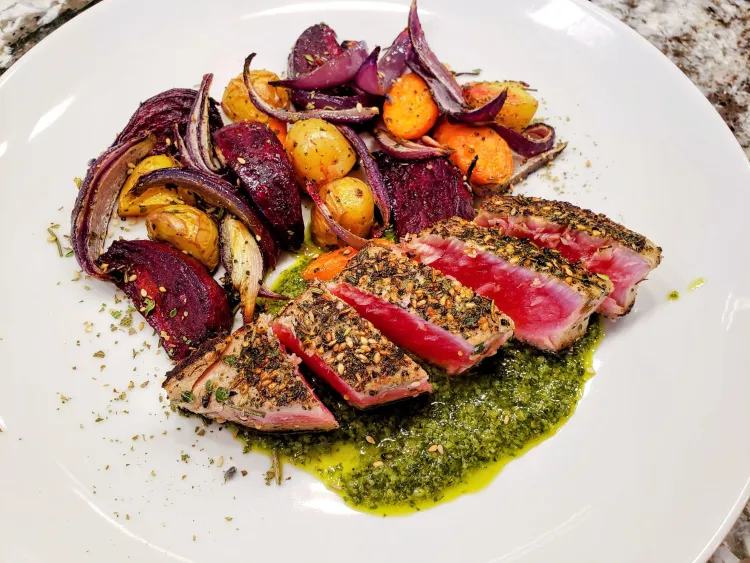
Warm bread beneath smoked yellowfin tuna, a caper berry on the side, the Marquesas still somewhere beyond the horizon. This is the breakfast we picture for day nineteen of the Pacific passage aboard Discovery. We can prepare for parts of it. We cannot promise the fish, the wind, or that the nineteenth morning will be the last one at sea.
That distinction matters because the pleasure of this breakfast depends on things that are less picturesque than the plate. It depends on the fish being cooled properly when it comes aboard, on the person preparing it having had enough rest, on the bread coming out of the oven without a hot tray becoming a problem in a moving galley. It also depends on someone continuing to look beyond the table. Near landfall, anticipation can occupy rather more attention than it deserves. The yacht still needs sailing.
The Catch Is A Commitment
A yellowfin caught on day sixteen gives us the beginning of this breakfast, three days before the morning we have in mind. At twenty-two kilograms, it would also give us a substantial responsibility. That is the weight of a whole fish, not twenty-two kilograms of neatly trimmed portions, but even after dressing and filleting there is a great deal to handle. The useful question is how much can be cooled promptly, prepared cleanly and eaten without waste. The answer belongs to the galley and its cold storage, not to the excitement at the stern.
Before a line goes out, there needs to be capacity for what might come back. A large pelagic fish brings hooks, a slippery working surface and powerful movement into an environment that is already moving. Clear space, secure footing and a plan for handling the catch matter more than photographs. If the boat needs attention, fishing gives way. Once enough food has been taken, the line can stay aboard. Catching locally has little meaning if the result is more than we can look after.
Yellowfin range widely through tropical and subtropical waters, following feeding opportunities rather than the convenience of our route. Temperature boundaries can help concentrate prey, but a strike on a lure does not establish that the yacht has crossed a particular meeting of currents. We would rather leave that uncertainty intact than give one fish an elaborate geographical explanation. What we can know is its condition when it comes aboard, how it is handled and where every usable portion is going.
Smoked Yellowfin Tuna Begins With The Cold Chain
The most important work happens before any smoke is made. Prompt humane dispatch, careful bleeding and clean preparation belong together, but bleeding is not refrigeration. A large tuna can retain heat deep within its flesh while the surface already feels cool. Chilling has to reach the interior. Properly prepared portions cool more readily than an intact body, and the available ice and refrigeration need to be sufficient for the load rather than merely sufficient for yesterday’s provisions.
For refrigerated fish, 4°C or below is a useful working limit, with fresh fish preferably held closer to the temperature of melting ice. The significance is practical: the fish must get cold promptly and remain cold through preparation and storage. The refrigerator display alone cannot tell us how quickly the centre of a thick portion cooled. Raw fish also needs separation from bread, dairy and anything else that will be eaten without further cooking. Boards, knives, hands and work surfaces are part of the same chain of care.
Tuna deserves particular attention because poor temperature control can allow histamine to form. This is not reliably revealed by appearance or smell, and cooking, smoking or freezing will not remove histamine that has already developed. There is no useful rescue recipe for a doubtful cooling history. Nor is the interval from day sixteen to day nineteen a storage instruction. Portions intended for later meals need an early decision about freezing or a properly controlled cooking and chilling process. We should not wait until the third day to decide that smoke might make the remaining fish last.
What Smoke Can And Cannot Do
Cold smoking is attractive in the telling: fish on a rack, smoke moving through the darkness, breakfast acquiring its flavour while everyone else sleeps. But cold smoking does not cook the fish. An overnight duration, however patiently observed, is not evidence of safety. Curing, temperature control, hygiene and subsequent storage all matter, and a warm offshore environment makes an improvised process harder to control. Smoke can change flavour and texture. It cannot stand in for a safe handling method.
For this breakfast, a controlled hot-smoked preparation is the more defensible direction, provided suitable equipment and conditions are available. A minimum cooking reference for fish is a core temperature of 63°C, checked at the thickest point with a clean probe rather than inferred from the colour outside. That number describes cooking, not shelf stability, and it does not cancel any earlier mishandling. Fish prepared ahead still needs prompt cooling and refrigerated storage. If we cannot control the smoking process properly, we cook the fish another way. The menu is allowed to change.
There is a separate seamanship question. Smouldering wood chips are a heat source on a moving yacht, and an improvised box on a stern platform does not become suitable equipment because the evening looks settled. Security, ventilation, nearby materials and the consequences of a change in wind all need consideration. A watchkeeper’s principal responsibility remains the vessel, traffic and weather, not tending a culinary experiment. The breakfast should fit the safe operation of Discovery. We would never reverse that relationship for the sake of a better story.
Bread, Capers And A Moving Galley
The plate itself asks for restraint. Tuna is generally leaner than the oily fish people often associate with smoking, so excessive heat and heavy smoke can leave it dry and one-dimensional. Properly cooked smoked tuna belongs in tender flakes or pieces rather than being forced to imitate the translucent slices of a cold-smoked preparation. A little crème fraîche provides richness and acidity. Caper berries bring a sharper, briny interruption, with the small resistance of their seeds. It is worth tasting and draining them before adding more salt to anything else.
The bread matters because it supplies warmth against the chilled ingredients. Warm is enough. Bread straight from fierce oven heat can soften the cream into a puddle and warm fish that should not be sitting around. We would assemble only what is about to be eaten, keeping the remaining fish and dairy refrigerated. Crème fraîche is itself a provisioning decision: it needs dependable cold storage and a suitable usable life. If it cannot be carried sensibly for this part of the passage, the breakfast changes rather than the standard of care.
Fresh bread also has to fit the watch pattern. Dough can be prepared around the available working time, but its fermentation responds to temperature, not to a recipe’s confident timetable. A warm galley can shorten the rise considerably, so the dough needs observing. Offshore, the oven, bowls and hot tray all require secure handling; a change of course or a more awkward sea may be reason enough to postpone baking. We want the smell of bread in the saloon. We do not want it purchased with someone’s necessary sleep or an avoidable burn.
Smoked Yellowfin Tuna At The Breakfast Table
If the morning comes together in this form, the first mouthful would hold several temperatures and textures at once. Bread still carrying a little heat into the fingertips. Cool cream against the smoke. The caper berry yielding with a small crunch. Around the table there would still be the ordinary sounds of a yacht under way, water against the hulls, air in the rig, a voice carrying from elsewhere aboard. The meal does not require the Pacific to become silent or flat in order to be good.
It would not necessarily be a breakfast everyone eats together. Passage life gives people different mornings. Someone finishing a watch may want food before sleep; someone else may prefer to go straight to their cabin. The considerate gesture is to ask, then keep a properly chilled portion for later rather than leave a plate out in the hope that they appear. A meal can be generous without becoming an appointment. Especially after many days at sea, being allowed to follow the needs of your own body is a substantial kindness.
By day nineteen, a simple meal can carry more feeling than its ingredients seem to explain. The bread recalls the work of the galley; the fish, the decision to keep a catch and care for it; the capers, a provision chosen before the open ocean made shopping irrelevant. Nothing on the plate needs to be rare. What changes it is the distance from the place where we would normally take these things for granted, and the knowledge that somebody has continued to make ordinary life possible throughout that distance.
The Last Day Is Still A Passage
The Marquesas give this breakfast its particular tension. Land is becoming plausible, but plausibility is not arrival. At an average speed over the ground of six knots, a yacht covers 144 Nm in a day. That is useful passage arithmetic, not a prediction that the next day will deliver the same distance. Changes in wind, current or the course needed for a sensible approach can move the estimate. A day nineteen breakfast may be the last offshore breakfast of the crossing. It may not.
The south-east trades help explain the broad logic of this part of the Pacific route, but a trade-wind passage is not a succession of identical days. Squalls can change wind strength and direction quickly, while the sea state may remain awkward after the immediate weather has passed. Near the end, there is a temptation to interpret every favourable change as confirmation of the hoped-for arrival time. Sven is Naora’s founder and captain. That work continues when everyone else has begun mentally stepping ashore.
The Marquesas are high volcanic islands, not an atoll rim enclosing a lagoon. Their terrain matters to the approach: wind can accelerate around headlands, and shelter from the prevailing breeze does not necessarily mean shelter from swell. A prospective anchorage needs to be assessed for the actual conditions, its depths, holding ground and room to manoeuvre. A beautiful outline on the horizon answers none of those questions. Daylight can make unfamiliar coastal features and the final approach easier to interpret, which is a reason to adjust timing rather than hurry blindly towards an evening arrival.
Rest belongs in that calculation too. A long passage should not end with everyone tired at precisely the moment pilotage, communications and anchoring demand fresh attention. Breakfast can remain unhurried because the approach has been thought through, not because the work is finished. There is considerable comfort in knowing that the person looking forward to landfall most carefully is also prepared to delay it.
A Morning Within The World Route
Discovery, our Lagoon Eighty2 sailing catamaran at the centre of the Naora Global Expedition, is intended for this continuity of life across the world route. A passage is not an interval between the worthwhile parts. It has its own work, meals, sleep and small accommodations. The galley cannot depend on a fish arriving when the menu would like one, so the stores must support a satisfying breakfast without a catch. Fishing adds a possibility. It is never the provisioning plan.
Within Naora’s private circle, members choose when they join, where along the route they step aboard and how long they stay, with practical arrangements shaped by access and conditions. Choosing a long ocean passage also means accepting its particular commitment. Once offshore, the next convenient exit is not available on demand. That deserves a plain conversation before departure, especially for someone balancing family needs or responsibilities ashore. The freedom lies in choosing the right stretch of the voyage, while Discovery continues around the world.
We cannot know in advance which part of that stretch will remain with someone. It may be the first sight of the Marquesas. It may be something less easily announced: being left to sleep, finding a portion kept aside, eating warm bread without looking at the time. In the morning we are imagining, there is still a little warmth in the bread. The islands have not yet appeared.