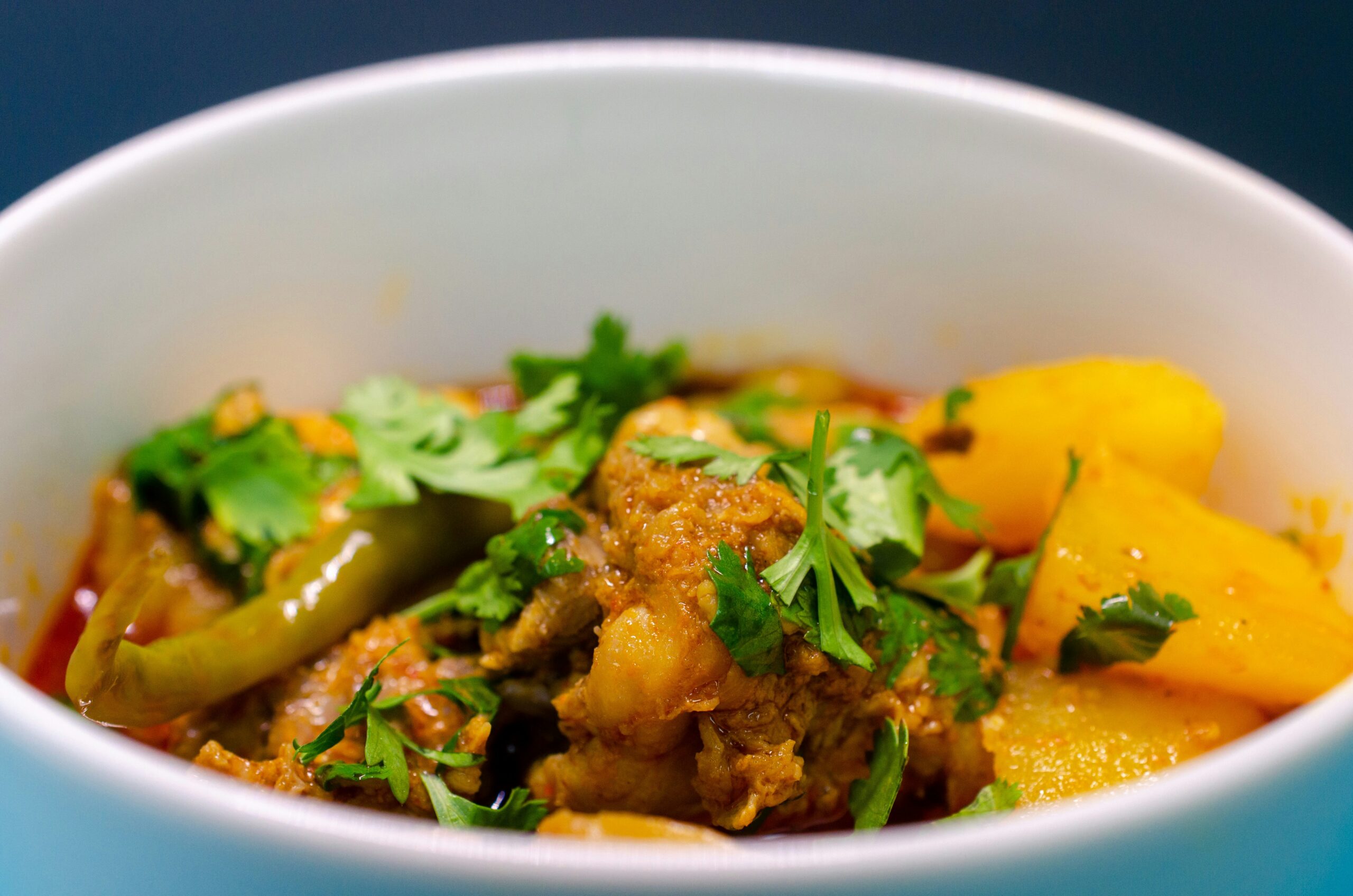
The village elder showed the quantities with her hands. There was no written recipe for the Solomon Islands sweet potato curry, no weight for the ginger or measured allowance of chilli. She knew the ingredients she was using. Putting that knowledge on a page requires a little care, because a recipe can preserve the contents of a pan more easily than it can preserve the judgement of the person cooking.
The measurements below are our suggested translation for a yacht galley, not a transcription of her recipe. They give someone unfamiliar with the dish a place to begin. They cannot establish how every household in the Solomon Islands cooks sweet potato, or turn a conversation on a beach into a complete understanding of the place.
For the Pacific chapter of the Naora Global Expedition, this is the kind of knowledge worth carrying aboard Discovery, our Lagoon Eighty2 sailing catamaran. A meal made from ingredients available ashore can change what we notice there. We begin to look beyond the coastline towards gardens, kitchens and the ordinary work of feeding a family.
What A Shared Recipe Asks Of Us
The elder offered a method built around sweet potato, coconut milk, chilli, lemongrass and ginger. Its apparent simplicity can be misleading. Cooking with a short list leaves little room to disguise an ingredient that has been poorly chosen or handled. The texture of the sweet potato matters. So does the strength of the coconut milk, and the point at which the ginger stops smelling raw without beginning to catch against the pan.
Watching someone experienced cook without measurements is useful only if we notice what they are responding to. The useful question is not merely how much water went in, but what the pan looked like before it was added. Was the sauce catching? Were the roots still firm? Had the coconut milk reduced more quickly than expected? Those relationships are what allow a recipe to survive a change of kitchen.
The same attention belongs to the exchange itself. Being welcomed ashore does not make every garden, cooking space or family conversation available to us. Permission to land, an invitation to enter and permission to photograph are separate things. Someone sharing a dish should be able to do so without becoming responsible for the rest of our afternoon.
We can also accept a lesson without collecting everything around it. Sometimes the appropriate thing to take back aboard is a method, with thanks, rather than another photograph or a bag of ingredients that was never offered.
The Ingredients In Solomon Islands Sweet Potato Curry
Sweet potato is a staple in the Solomon Islands, commonly called kumara in Solomon Islands Pijin. The familiar name does not mean that every root behaves alike. Some cook into a relatively dry, firm flesh; others become soft and moist much earlier. Colour alone is an unreliable guide to that behaviour. For this dish, the useful characteristic is flesh that becomes tender while retaining enough structure to lift on a spoon.
At a market, asking how a particular sweet potato cooks is more useful than choosing solely by appearance. A variety preferred for roasting may behave differently in coconut milk. Back aboard, the first pieces tested in the pan tell us more than an insistence on the cooking time written down. If they begin to collapse early, reduce the stirring and watch the remaining pieces closely.
Coconut milk is the liquid extracted from grated mature coconut flesh, usually with added water. It is not the clear coconut water inside the nut. That distinction matters when provisioning: a young drinking coconut and a mature coconut intended for grating answer different needs. Freshly pressed milk also varies in richness with the amount of water used, so the same volume can produce quite different sauces.
Packaged coconut milk is a sensible alternative when fresh milk cannot be prepared and chilled properly. Plain coconut milk, rather than sweetened coconut cream, gives the right starting point. A thicker product will need more water. Keeping the sauce fluid enough for the sweet potato to cook is more important than reproducing a particular brand or an imagined ideal of freshness.
The ginger shared with the dish came from the elder’s garden. Garden-grown does not necessarily mean young: mature ginger can still be fibrous, and grating it finely makes those fibres less intrusive. Lemongrass needs similar attention. Its fragrance belongs in the sauce; its tough outer leaves do not belong between someone’s teeth.
A Measured Version For The Galley
For four generous portions, we would begin with 1 kg of sweet potato, weighed after peeling, 400 ml of coconut milk and about 300 ml of potable water. The yield is an allowance rather than a promise about appetite. Served with something else, the pan will stretch further; eaten as the centre of dinner after an active day, it should be portioned more generously.
Add roughly 25 g of fresh ginger, finely grated, along with bruised lemongrass, a little neutral cooking oil, salt and fresh chilli. These are deliberately starting quantities. The coconut milk may be thick or thin, and the sweet potato may absorb liquid or soften quickly. Keep additional water available rather than deciding in advance that the pan must use exactly what has been measured.
For the lemongrass, strip away the dry outer layers, trim the woody base and bruise the remaining section so that it releases its oils. Leave it large enough to find and remove before serving. Finely slicing the tender inner part is another approach, but a hurried cut through a woody stalk produces fibres that no amount of simmering will make pleasant.
Chilli deserves restraint until its strength is known. Small size does not reliably tell us how hot a pepper will be, and an amount comfortable for an experienced local cook may overwhelm someone else. Much of the heat is concentrated around the pale inner tissue rather than produced by the seeds themselves. Removing that tissue can reduce the heat, although it does not make the flesh reliably mild.
We would keep the main pan gentle and offer additional chilli separately. Children and adults should be able to enjoy the same meal without the cook treating tolerance for heat as a test of character.
Cooking Solomon Islands Sweet Potato Curry Aboard
Wash the roots before peeling, then cut the flesh into pieces approximately 2 cm across. Their similarity matters more than their exact shape. Large pieces remain firm while small ones dissolve, leaving the cook with a choice between a watery mash and an undercooked centre. Even cutting gives the pan a reasonably consistent finishing point.
Warm the oil gently, then add the ginger, bruised lemongrass and the initial allowance of chilli. The lemongrass scent arrives before much seems to be happening in the pan. Ginger follows with a sharper warmth, and there should be only a quiet hiss beneath it. Loud crackling or ginger rapidly darkening at the edges means the heat is too high for this method.
Turn the sweet potato through the aromatics, then add the coconut milk and water. Season lightly and bring the liquid to a gentle simmer. Partly cover the pan, adjusting the lid so that steam can escape without the sauce reducing too quickly. There is no advantage in a rolling boil. It knocks the softening pieces together and can leave the outside breaking apart before the centre is ready.
Allow roughly 15 to 25 minutes of gentle simmering, using the range as a checking window rather than a deadline. Variety, maturity and the actual size of the pieces all change the result. Test one of the larger pieces with the point of a knife. It should offer little resistance through the centre, without a hard or chalky core.
If the pan starts looking dry while the roots are still firm, add a little water and lower the heat. If everything is tender but the sauce is thin, press some softened sweet potato against the side of the pan and fold it back through. This thickens the liquid without requiring an extended boil that would sacrifice the remaining pieces.
Remove the lemongrass and taste again for salt and heat. A little coconut oil separating at the surface is not necessarily a failure; coconut milk is an emulsion, and cooking can separate it. The useful judgement is how the dish eats. The sauce should coat the sweet potato while remaining loose enough to spoon, rather than becoming a heavy paste.
The Quiet Work Around A Hot Pan
A yacht galley changes the conditions around an otherwise straightforward recipe. A secure cutting board, dry hands and a pot with room below its rim matter even at anchor. A passing wake can arrive in a sheltered bay, and two hulls do not remove the need to work deliberately around hot liquid. We would finish the awkward peeling and chopping before getting under way if the expected motion made that sensible.
The menu also has to fit the passage plan. A dish that needs someone leaning over it continuously is less useful when the same person needs rest before a watch. This curry asks for attention at the beginning and towards the end, with a quieter interval between. That makes it adaptable, but it still needs an assigned cook. A low flame is not permission to leave a pan unattended.
Before serving, lift a piece onto a spoon and let its steam subside. The centre can retain considerable heat beneath a surface that looks ready to eat. The first impression should be soft flesh and coconut, followed by ginger and the cleaner fragrance of lemongrass. If chilli arrives first and obscures everything else, we have learned something useful for the next pan.
Fresh coconut milk needs prompt refrigeration, and cooked curry should not spend the evening sitting warm on deck. In a hot galley or tropical outdoor setting, a conservative rule is to portion leftovers into shallow containers and refrigerate them within an hour. Smaller portions cool more readily than a deep pot. Reheating does not reliably rescue food that has been left warm too long.
There is nothing inhospitable about putting food away while conversation continues. It leaves the table free for the evening and keeps tomorrow’s meal from depending on a hopeful judgement about last night’s heat.
Provisioning With The Next Meal In Mind
Sweet potatoes are useful passage provisions because sound, unpeeled roots can be stored without occupying refrigerator space. They still need suitable conditions: somewhere dry, shaded and ventilated, protected from crushing. A sealed bag holding tropical moisture is a poor substitute for storage. Wash them when preparing to cook rather than putting damp roots away for an uncertain interval.
Inspect them regularly and bring those with minor handling damage forward in the cooking plan. Discard roots showing mould or substantial soft rot rather than trying to make a curry conceal deterioration. Storage life changes with the variety, condition at purchase and conditions aboard. Assigning every purchase a confident number of weeks would be less useful than looking at it each day.
Buying locally also requires more judgement than simply finding something fresh. A garden or market stall serves people who live there. What is available to sell or share is theirs to decide, and a visiting yacht should not plan its meals around an assumed invitation. We need sufficient stores aboard to accept that a hoped-for purchase may not happen.
That reserve gives us the freedom to buy a modest amount of something good rather than press for a supply that is inconvenient to provide. It also reduces the temptation to accept more perishable food than we can use. Respect for an ingredient includes what happens after it reaches the boat.
Whole roots, shelf-stable coconut milk and sound aromatics can therefore sit alongside fresh purchases without contradiction. The pantry supports the encounter ashore. It should not make that encounter responsible for feeding everyone aboard.
A Recipe That Can Travel
On Naora, members choose when they join, where along the world route they come aboard and how long they stay. Discovery keeps sailing as those different lives intersect with the expedition. Food can provide a quiet continuity between them, although it should never suggest that eating a dish elsewhere is equivalent to knowing the place where it was shared.
The most useful galley note would record more than the ingredients. It would say whether the sweet potato held its shape, whether the coconut milk needed diluting and how cautiously the chilli was used. That turns a recipe into something another cook can understand. It also leaves room for the next purchase to require a different decision.
Remembering the elder means keeping that flexibility, rather than claiming that our measured version captures everything she knew. Her confidence came from familiarity with her ingredients and the people she fed. We can carry the method, practise it and become more attentive in our own kitchen. That is already a substantial thing to have been given.
If we have judged it well, the sweet potato holds its shape until the spoon touches it. Ginger arrives after the coconut, and the chilli leaves room for both. For a while, there is nothing else the meal needs to do.