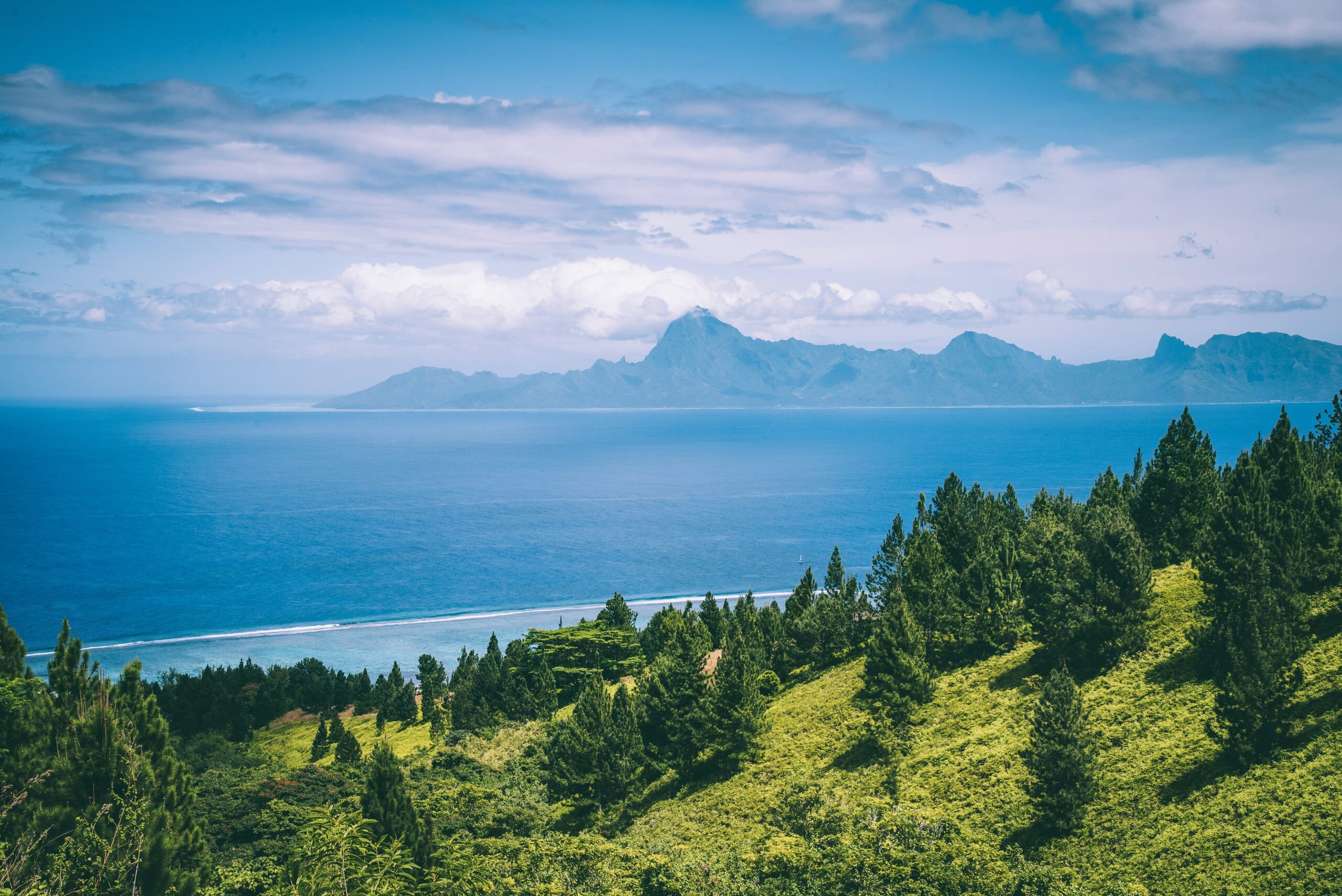
The arrival date on an Auckland to Papeete ticket can be earlier than the departure date. For anyone boarding in Papeete, that small reversal is worth noticing before anything else: the hotel night, the transfer and the meeting aboard must all belong to the date in Tahiti, not the date still showing on a phone set to home. The Pacific begins rearranging familiar assumptions before the aircraft reaches it.
This is one reason we think about joining a yacht as a passage in its own right. There is the distance through the air, then the less measurable distance between arriving with a full head and becoming comfortable aboard. A well-considered arrival leaves room for both.
As we prepare the Naora Global Expedition, Papeete has a practical significance for people based in Australia and New Zealand. It offers a way into the French Polynesian chapter without first travelling to Europe. Discovery, our Lagoon Eighty2 sailing catamaran, will already be following her world route. The person joining her does not need to begin where the yacht began.
A Pacific Entry Point, Not A Detour
A world route looks different depending on where you place yourself on the map. From Europe, French Polynesia can appear to be the distant middle of the expedition. From Auckland, it belongs to the ocean immediately beyond the coast. Neither perspective changes the distance on the water, but it changes how naturally a period aboard can fit into a life ashore.
A nonstop Auckland to Tahiti flight takes roughly five hours. That makes the air journey manageable without making the ocean itself small. An Australian itinerary may involve a connection, and the Auckland flying time should never be borrowed to describe a departure from Sydney, Melbourne or Brisbane. Total elapsed time, the connection margin and the local arrival hour matter more than the shortest segment printed on a ticket. Airline schedules also need checking for the actual travel date, particularly for an expedition running from 2027 to 2031.
Papeete is French Polynesia’s capital and principal international gateway. Its usefulness extends beyond the airport: a working port and a substantial town provide access to provisions, services and ordinary errands that become less straightforward farther into an archipelago. Those things matter when someone has forgotten a necessary item, when fresh food needs choosing, or when the yacht needs attention before moving on.
This does not make Papeete the right joining point for everyone. Some people will want a different region or a longer offshore passage. Its value is that Australasia does not have to sit at the edge of the Naora story. There is a sensible entrance here, close to the lives many people already lead.
Planning Your Arrival For Boarding In Papeete
Tahiti keeps UTC minus 10 throughout the year. New Zealand’s main islands are 22 hours ahead during standard time and 23 hours ahead during daylight saving. On a clock face, that can look like a difference of only one or two hours; on a calendar, it can put the two places on different days. The body may have relatively little clock adjustment to make while the booking arrangements require considerable care.
We would begin by putting every relevant event into Tahiti local time: landing, accommodation, the agreed boarding appointment and any onward departure. A calendar invitation that converts automatically is useful, but the written local date remains worth checking. The return journey needs the same attention. A meeting marked for the morning after leaving Tahiti may be much less generous than it first appears.
Arriving the evening before sailing is sometimes workable. It should not become a universal rule. A delayed connection, missing bag or poor night’s sleep can consume that margin quickly. Two nights ashore can be a sensible allowance for a complicated itinerary or a family travelling with children, though that is a planning judgement rather than a fixed requirement. The actual flight pattern and the proposed sailing leg should decide it.
The same discussion needs to distinguish arrival at the airport, boarding Discovery and departure from the harbour. These are separate events. The agreed meeting place must be confirmed for the particular leg; a general description of Papeete cannot establish a berth or a transfer arrangement.
Essential medication, travel documents and a change of clothes belong in hand luggage. Entry permission and any onward travel requirements need checking against the traveller’s nationality and circumstances, including the fact that departure may be by yacht. Such details are easier to resolve at home than at an airline desk. Privacy aboard does not remove the ordinary obligations of crossing a border.
Time Ashore Before Going To Sea
After a flight, the weight of a bag against one shoulder can become surprisingly noticeable in warm, humid air. Road noise replaces the steady sound of the aircraft cabin. A person can feel relieved to have arrived and still be too tired to absorb much. This is a poor moment to compress a meal, several errands and an important briefing into the appearance of an effortless transfer.
Papeete deserves more than that hurried interval. It is a town where people work, shop and travel home, not a quiet anchorage arranged around visiting yachts. Traffic and deliveries belong to it as much as the waterfront does. Allowing time ashore helps a visitor begin to distinguish the place itself from the tiredness they have brought into it.
For the galley, a market visit is also a practical assessment. We need to consider what is genuinely local, what is ripe now, what will withstand movement and how much refrigeration the coming passage requires. A ripe papaya is useful for an early breakfast; buying more delicate fruit than can be eaten or kept properly merely transfers waste from shore to sea.
Poisson cru, commonly made with raw fish, citrus and coconut milk, offers another useful distinction. The citrus changes the fish’s texture, but it does not make careless handling safe. Suitable fish, reliable cold storage and clean preparation matter before the coconut milk enters the bowl. Local food deserves the same seriousness as navigation.
The shore allowance has a cost in time. It may mean leaving home earlier or spending less of a short holiday under sail. In return, it can give the first day aboard a better beginning: appetite restored, necessary purchases finished, and nobody trying to learn an unfamiliar boat through exhaustion.
The First Hours After Boarding In Papeete
A yacht can be beautifully arranged and still be unfamiliar underfoot. The first step across the boarding point asks the body to notice movement again. A bag occupies a hand that would be better used for support. Inside, the sound changes: voices soften, machinery becomes more distinct, and small movements of water can be heard against the hull.
That transition deserves an unhurried welcome. Luggage can wait while someone finds a secure handhold. A cool drink and a place to sit may be more useful than an immediate tour of every space. Ease begins with recognising what the arriving person can comfortably take in.
Before departure, however, familiarity has to become practical. A guest needs to know how to move safely around Discovery, where to find their lifejacket and how it fits, what to do if an alarm sounds, and how to call for assistance. Knowing that safety equipment exists is different from being able to use it. Instructions should be demonstrated where they apply, then revisited when necessary.
For children, participation has to match age and ability. For adults, previous sailing experience should never be assumed from confidence. Mobility needs, food allergies and medicines requiring particular storage are better discussed before arrival, quietly and specifically. Someone concerned about motion sickness should seek appropriate medical advice before travelling rather than discover at departure that their chosen remedy needs more time to act.
Sven, Naora’s founder and captain, plans every weather window and sails every leg himself. A flight arriving on time does not oblige him to leave harbour at an unsuitable moment. Equally, a suitable forecast does not make a tired, unbriefed group ready for sea.
Departure readiness includes the people. That can be overlooked in descriptions of luxury, where attention settles on what has been provided rather than whether the person receiving it has had time to feel at home.
What The Season Changes
In the Society Islands, May to October generally brings cooler, drier conditions and more persistent trade winds. November to April is generally warmer and wetter, within the broader South Pacific tropical cyclone season. These are planning patterns, not promises attached to a month. Rain occurs in the drier season, and fair weather occurs in the wetter one.
The distinction matters because a pleasant temperature ashore says little about the comfort of the next passage. The mara’amu, periods of stronger southeasterly wind, can produce a demanding sea despite bright skies. A protected waterfront may give little indication of the conditions beyond its shelter. Swell generated by distant weather can also remain after the local wind has eased.
We therefore need to read wind direction, wind strength and swell separately, then consider how they meet the intended course. A following wind and a headwind of similar strength are different propositions for sleep, meals and movement aboard. The catamaran’s broad platform does not abolish motion; short, steep seas can still make an ordinary task require care.
The Tuamotu introduce another layer. Atoll passes carry water between ocean and lagoon, and their currents cannot safely be reduced to an assumption that a published high or low tide means slack water. Waves washing over a reef can add water to the lagoon and sustain outward flow. Timing an entrance involves the particular pass, recent conditions and what is actually observed on arrival.
For someone joining in Papeete, the useful lesson is not to become a forecaster before boarding. It is to understand why the first proposed movement may change. Leaving later, shortening a passage or allowing more time in shelter can be the decision that preserves the quality of the days ahead.
Choosing Time Rather Than Counting Islands
The Society Islands, the Tuamotu and the Marquesas are not interchangeable stops in one compact sailing area. They have different forms, different approaches and substantial stretches of sea between them. Naming several archipelagos in an article does not make them a sensible itinerary for a short stay.
Before choosing a period aboard, we would want to understand the desired balance between passage time and time in a place. Someone may be drawn to a night at sea, the changing watch and the gradual appearance of land. Someone else may want repeated swims, meals ashore and enough time to recognise a waterfront. Both belong to Naora. They ask different things of the calendar.
The route extends across roughly 49,000 Nm, but that number describes the yacht’s undertaking, not a distance each member needs to complete. Guests joining through Naora’s private circle choose when, where along the route and how long they sail, one week or many. Discovery continues around the world after they step ashore.
That freedom works within real joining points, formalities and sailing conditions. It does not mean that every anchorage can serve as an airport connection or that a fixed return flight can determine a safe arrival at sea. The departure end of a stay deserves as much planning margin as the beginning.
For anyone keeping contact with work, Tahiti’s calendar difference should also be carried into meeting arrangements. Agreeing which calls are genuinely necessary is more useful than assuming every day can accommodate them. Connectivity cannot be treated as uninterrupted, and a passage may require attention elsewhere. A smaller number of deliberate commitments can leave more room for both work and the sea.
An Ocean With Its Own Histories
For a visitor from New Zealand, the Pacific may feel geographically familiar while its voyaging history asks for a deeper kind of attention. Māori ancestors reached New Zealand from eastern Polynesia through skilled ocean navigation. That history belongs to living peoples and relationships. It should not be assigned automatically to everyone departing from Auckland, or used to give a contemporary yacht voyage borrowed significance.
Polynesian voyaging traditions are also not one undifferentiated technique. Knowledge of stars, swell, winds and birds belongs within particular traditions of teaching and practice. A bird is useful information only if its species and habits are understood. Swell becomes navigational information through trained observation, not simply by noticing that the boat is moving.
We sail with modern instruments and forecasts. Respect begins by being clear about that difference, and by recognising that the waters ahead have names, histories and uses that long precede our arrival. A greeting learned properly, permission sought before entering a private space, or a photograph left untaken can express more understanding than a grand statement about connection.
Papeete is a good place to begin that attention because it resists the idea of the Pacific as empty distance. There are conversations beyond our hearing, shopping to be carried home, boats departing for reasons unrelated to ours. French and Tahitian belong to the ordinary life around us.
Before the lines are released, there can be a quiet interval aboard: a glass set down securely, the warmth of the morning reaching the deck, the sound of the town still carrying across the water. There is time to let Papeete be a place before it becomes the point we sailed from.