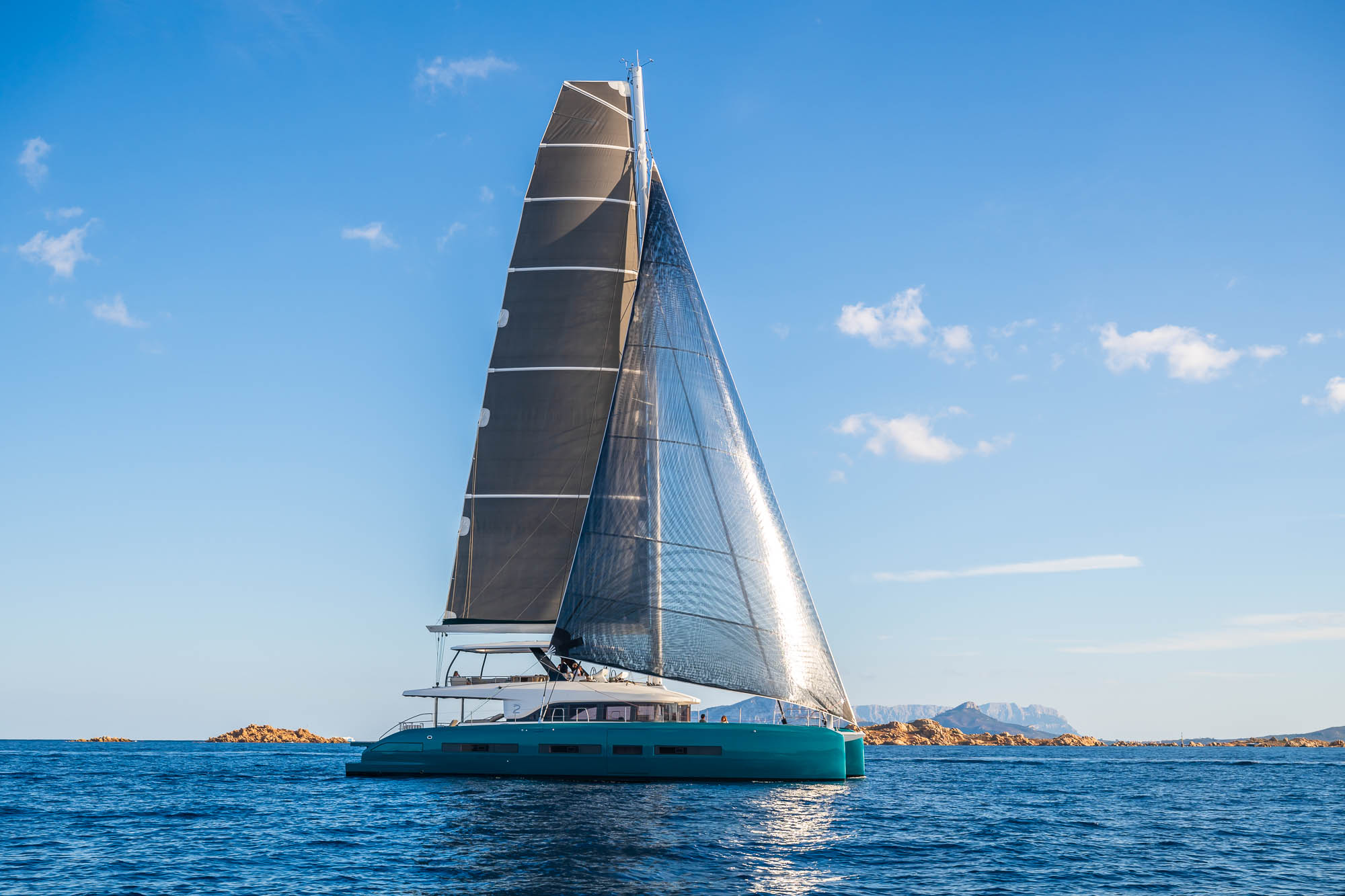
A mug needs somewhere secure to stand before anyone needs a photograph of the horizon. In offshore sailing, that small fact matters: the surface beneath breakfast is moving, and attention begins with things close enough to touch.
Forty-nine countries might represent years of curiosity, friendships maintained across languages, or a collection of arrivals that have begun to resemble one another. We cannot tell from the number. There is nothing inherently shallow about keeping a record of where you have been, and nothing inherently profound about crossing an ocean. A passage can become another achievement to display if that is what someone needs it to be.
What interests us is the interval that cannot be skipped. On a Pacific passage towards the Marquesas, arrival follows days in which the destination remains beyond sight, while the immediate world becomes unusually legible: the direction of the swell, the sound of water beneath the hulls, the person who needs to sleep. There is less novelty to consume. There is more time to notice what is already there.
How Offshore Sailing Changes The Meaning Of Distance
Air travel makes distance largely someone else’s work. That is one of its great advantages. At sea, even with a professional crew carrying the responsibility, distance remains present in the motion of the boat and in the time between meals. You do not need to navigate to feel that a coast is a long way away.
The arithmetic is simple enough to be useful. One knot means one Nm per hour. At a constant speed over the ground of eight knots, a yacht covers 192 Nm in a full day; at six knots, it covers 144 Nm. These are illustrations, not performance forecasts for Discovery. The difference matters because a modest change in average speed, sustained through successive days, changes the arrival estimate considerably.
Speed through the water and speed over the ground are also different things. Current can help or hinder progress without any obvious change in the way the yacht feels. A favourable wind may require a course that adds distance, while the shortest line on the chart may lead into a less comfortable sea. Passage planning has to reconcile these facts rather than choose whichever number looks most attractive.
This is why a crossing duration belongs to a particular departure point, season and weather pattern. We would not attach a fixed number of weeks to reaching the Marquesas without those details. For the person aboard, the useful change is quieter: distance stops being an abstraction between two reservations. It becomes something the body has lived through, breakfast to breakfast.
The Decisions Made Before Departure
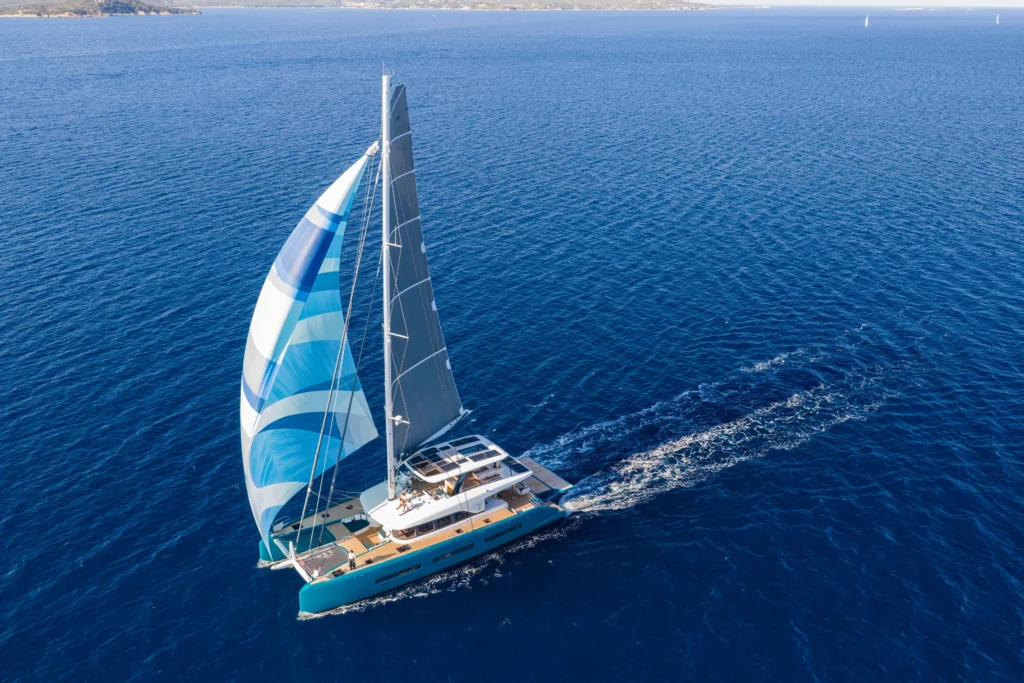
Discovery, the Lagoon Eighty2 sailing the Naora Global Expedition, gives us room to live well offshore. Space does not cancel the obligations of a passage. Sven, Naora’s founder and captain, plans every weather window and sails every leg himself. That continuity connects the route on paper with the condition of the yacht and the people actually aboard.
In the tropical South Pacific, the southeast trade winds provide a broad westward logic, not a promise of identical days. Squalls, unsettled zones, variations in wind strength and swell arriving from distant weather systems all complicate that picture. The South Pacific tropical cyclone season generally runs from November to April. The Marquesas have relatively low cyclone exposure, but that does not make the wider passage independent of seasonal risk.
A useful weather window has to be read across the passage, not merely at departure. We consider the wind direction alongside wave height, period and direction. Closely spaced waves can make a modest-looking forecast tiring; a longer swell may allow an easier motion, depending on its direction relative to the yacht. Forecast uncertainty increases farther ahead, so the departure decision also needs room for later adjustment.
The less visible preparation is equally important. Steering, rigging, communications and safety equipment need attention before their reliability becomes urgent. Water production extends our reach, but still depends on power, pumps and serviceable components. It does not remove the need for a drinking-water reserve. Provisions must include food that can be prepared safely when standing at the galley requires concentration. The first uncomfortable day offshore is a poor time to discover that dinner needs elaborate knife work.
The Working Rhythm Of Offshore Sailing
After dark, the horizon can disappear before the sea sounds any different. Water still passes along the hulls; a fitting gives a small, repeated sound; the wake briefly catches what light there is. A bright phone screen can make the surrounding darkness seem suddenly deeper. Preserving night vision is practical seamanship, not an atmospheric preference.
Good watchkeeping gives those hours a structure. The person taking over needs to understand the course, sail configuration, nearby traffic, expected weather and anything that has changed. A contact on a screen is not the whole traffic picture, and an electronic alarm does not replace a lookout. A handover should leave no uncertainty about what requires attention or when the captain should be called.
For a guest, learning can begin with noticing rather than taking responsibility. There is value in seeing how a vessel’s bearing changes, or understanding why a cloud line deserves a second look. But willingness to stay awake is not a watchkeeping qualification. Participation must be agreed, appropriate to experience and supervised where necessary. Safe operation cannot depend on someone proving themselves while tired.
Reducing sail belongs to the same discipline. On a cruising catamaran, increasing load does not necessarily announce itself through the familiar heel of a monohull. We need to pay attention to wind, gusts, sea state and the yacht’s operating guidance rather than wait for discomfort to make the decision. Reefing while the task remains manageable is usually easier on both equipment and people. The unremarkable evening that follows is part of the point.
Learning To Live With The Motion
At first light, a cabin can brighten in small movements as reflected water shifts across the ceiling. Getting out of bed means finding balance before reaching for anything. In the galley, the smell of warm food may be welcome to one person and too much for another. The same boat, on the same morning, can contain very different experiences.
We should be honest about that before anyone joins a long passage. A large catamaran offers space and considerable initial stability, but it is not a stationary house. Pitching, rolling and abrupt motion in confused seas can interrupt sleep or bring on seasickness. Previous comfort on a sheltered coastal trip does not guarantee comfort offshore, and feeling unwell is not a failure of character.
Anyone concerned about motion sickness should discuss prevention with a clinician before departure, including timing, side effects and suitability for their health. Waiting until symptoms are severe can make management harder. A view of the horizon, fresh air and avoiding prolonged close visual work help some people. Persistent vomiting, inability to retain fluids or unusual symptoms need to be reported early, not endured privately.
The domestic response matters too. A securely placed bowl, a modest portion and drinking water within reach can be more useful than an impressive meal. Handholds should become familiar while conditions are easy. Sleep needs protection from unnecessary noise and obligations. We would rather someone rest than remain at the table out of politeness. Warmth aboard often consists of removing a small difficulty before it becomes an exhausting one.
Choosing A Passage That Fits Your Life
The Naora Global Expedition is planned across five years, from 2027 to 2031, covering roughly 49,000 Nm. Those figures describe a continuing operational commitment: maintenance, provisioning and seasonal decisions have to hold together across the world. They do not prescribe how much of it any one person should sail.
Through Naora’s private circle, guests choose when they join, where along the worldwide route they step aboard and how long they remain. Discovery can also be privately hired for a carefully designed voyage. The yacht’s wider passage continues beyond each individual stay. That makes it possible to choose a period of sailing for its character, rather than feel obliged to complete a geographical collection.
There is an important limit to that freedom. Joining and leaving require suitable places, practical access and the necessary formalities. An ocean crossing does not offer an intermediate exit simply because a work commitment changes. Its suitability depends on health, appetite for sustained motion, time away and the ability to tolerate an arrival estimate that may move.
For someone new to offshore life, a shorter passage that includes a night at sea can reveal more than another round of beautiful photographs. It gives some experience of sleeping underway, living with motion and sharing space without an immediate shore option. Leave margin around travel arrangements, and do not make an essential call or a fixed event depend on the earliest plausible landfall. Connectivity may support contact with home, but it should not be treated as uninterrupted. Choosing less sea time with a clear understanding of it is better judgement than choosing an ocean to satisfy an idea of yourself.
Approaching The Marquesas
The Marquesas are an archipelago within French Polynesia, not a separate country. That distinction matters here because the islands deserve to be understood as a place, rather than recruited into an argument about passport stamps. They are high volcanic islands, quite different from the low atolls elsewhere in French Polynesia. Their coastlines do not offer the same shelter as an enclosed lagoon behind a barrier reef.
Many bays can receive swell even when they appear protected from the prevailing wind. Waves bend around headlands, and reflected seas can complicate the motion close to steep shores. A coastline that looks reassuring after days offshore still needs to be approached with the chart, current conditions and a clear assessment of the anchorage. Relief is a feeling, not a navigational aid.
For an unfamiliar approach, daylight can be more valuable than an earlier arrival. Sometimes the sensible decision is to adjust speed offshore rather than force the final part in darkness. Fatigue also deserves attention at this stage: after a long passage, the temptation to finish can become stronger precisely when the demands of pilotage increase.
Anchoring needs more than a suitable depth on the display. We need to know what that reading represents, including the instrument’s reference point, and allow for tidal change, the height of the bow roller, the available swinging room and the nature of the bottom. Charted information needs checking against what is actually found. Holding ground and protection take precedence over the best view, and coral is not an acceptable place to lay an anchor.
Arrival formalities must also be confirmed before making plans ashore. Clearance arrangements determine where and how an international arrival can be completed. Once anchored, secured and satisfied that the yacht is holding, there is still the ordinary work of checking the boat. The first coast after a crossing deserves excitement. It also deserves a crew who finish the passage properly.
Remaining Long Enough To Notice
There is a physical pleasure in stillness after sustained motion. A glass remains where it is placed. A door no longer needs the same small calculation before being opened. Ashore, the ground may initially seem to move beneath the feet. Even an ordinary walk can feel unexpectedly absorbing because the body has been occupied with balance for so long.
That heightened attention is useful only if it extends beyond our own arrival. The islands are not waiting to provide a conclusion to someone else’s crossing. People have work, family obligations and reasons to be elsewhere. French is widely used, but Marquesan language and identity should not be treated as interchangeable with those of every other Polynesian island group. Learning a local greeting properly is a better beginning than assuming a familiar one belongs everywhere.
Food offers another way to slow down. Breadfruit, where available, asks us to understand an ingredient rather than merely recognise a flavour. A firm, mature fruit used for its starch behaves differently in the kitchen from one that has softened and become sweeter. Asking how it is prepared locally can be more rewarding than trying to reproduce a menu conceived far away. For our galley, sourcing locally also means buying with regard for what a community can spare, not assuming every small supply exists for visiting yachts.
The same care applies to photographs and craft. Ask before making someone’s image part of the record of your voyage. Take time to understand who made an object and what its materials are. Privacy aboard should make us more attentive to other people’s privacy ashore. An unhurried conversation does not become less valuable because it produces nothing to publish.
We would rather leave enough space in a visit to return somewhere without needing a new reason. A second walk can reveal what the first missed; a familiar face can make a place less abstract. None of this requires abandoning the record of countries visited. It simply allows a different record to form, less tidy and harder to total.
The shore has its own life. For a little while, there is time to notice it.