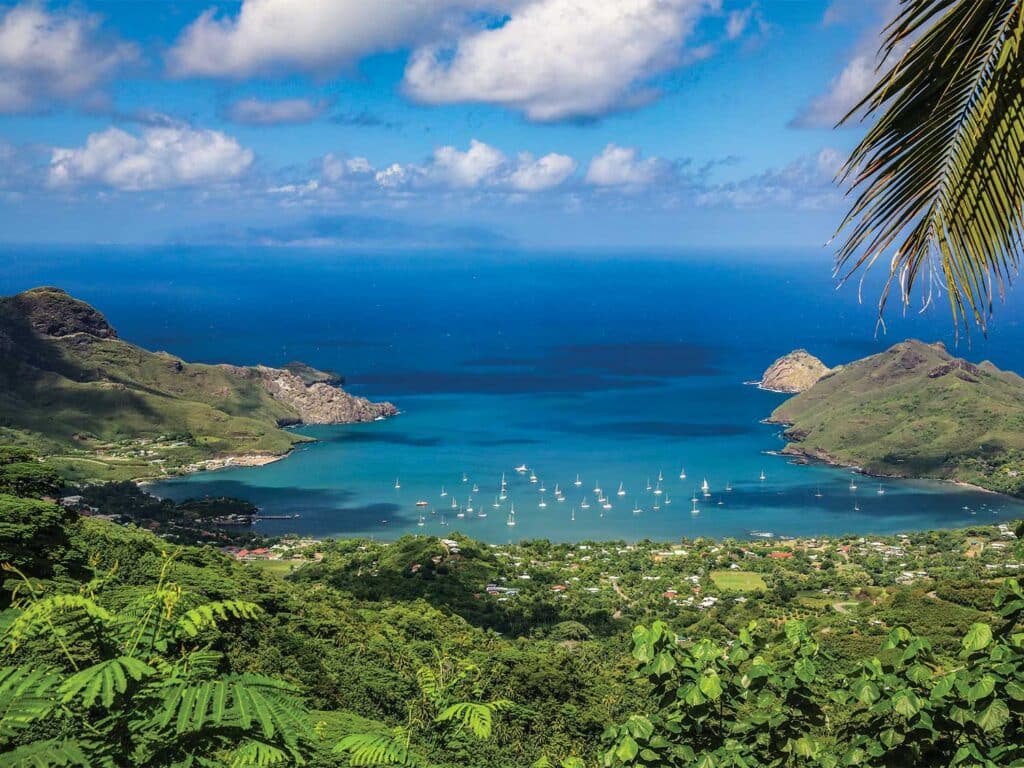
On a chart, Taiohae Bay curves into the southern shore of Nuku Hiva like a place made for rest. Then you notice the opening to the south. Swell can enter there. For us, sailing to the Marquesas begins with that second look: the distinction between a coastline that looks sheltering and an anchorage that will let tired people sleep.
Frequent flyer miles solve a different problem, and often solve it well. They can make a long flight more comfortable, preserve a useful day, bring someone home sooner. There is no reason to diminish that. Flying to an island does not make the encounter with it superficial, any more than crossing an ocean automatically makes someone perceptive.
But a flight and a passage make different uses of the distance between departure and arrival. One works to remove that distance from your attention. The other makes it part of your life. As we prepare the Naora Global Expedition, sailing around the world from 2027 to 2031, that distinction matters more than any comparison of cabins. The Marquesas will be a destination, certainly. For those aboard through the approach, they will also be the place where a stretch of ocean finally acquires an edge.
Sailing To The Marquesas Takes Time
The phrase three weeks at sea sounds definite until it becomes a passage plan. A hypothetical crossing of 3,000 Nm would take almost 21 days at an average speed over the ground of 6 knots. That is a useful illustration of scale, not a prediction of Discovery’s performance or the distance of a particular Naora leg. It assumes that the average can be maintained across every hour, including lighter weather, changes of course and the approach to land.
Speed over the ground matters because it measures progress across the chart. Speed through the water describes the yacht moving through water that is itself moving. An adverse current can leave the sails drawing well and the boat feeling purposeful while the arrival estimate slips. A favourable current does the opposite. Neither should be confused with a change in how well the boat is being sailed.
The southeast tradewinds give much of the tropical Pacific its westward sailing logic, but the word trade does not mean uninterrupted. Squalls, lighter intervals and swell arriving from weather far away all affect the passage. The conventional South Pacific cyclone season runs from November to April. The Marquesas sit away from the principal cyclone tracks, but planning an approach requires looking at the whole ocean track, not merely the destination’s relatively reassuring position.
A forecast cannot describe the last day of a long crossing with the confidence it offers for the next few days. We begin with a seasonal framework and a departure window, then keep revising the picture. The practical consequence for anyone joining is simple: leave room around the estimated arrival. A flight connection is not a reason to carry sail that should come down, or to enter an unfamiliar anchorage before the light is useful.
The Work Behind A Habitable Ocean Passage
Sven is Naora’s founder and captain. That continuity matters because the person assessing a departure also lives with the consequences of the decision. It does not remove the need for rest, watchkeeping or clear handovers. Those are what allow judgement to remain dependable as the days accumulate.
A useful watch handover describes what has changed: the wind trend, nearby traffic, a developing squall, the current sail configuration, anything that needs watching before it becomes a problem. The incoming watch needs a working picture, not simply a position. Sleep depends on that transfer being complete enough for the person going below to stop mentally standing beside the instruments.
Discovery is a Lagoon Eighty2 sailing catamaran, with space that makes living together over distance more manageable. Yet a catamaran’s relatively level stance must not be mistaken for an absence of load. It does not necessarily give the same heeling warning as a monohull. Sail area has to suit the wind and sea state, with reduction made in good time rather than after discomfort has become persuasive. Comfort is partly a design quality. Much of it is also a succession of decisions made before anyone asks.
On an ocean night, instrument lighting needs to be low enough to preserve night vision. Beyond its glow, the horizon can disappear under cloud and return beneath a clearer patch of sky. There is warmth from a mug against the palms, cool air on the forearms, water passing continuously along the hulls. Nothing in that scene requires drama to hold the attention.
The less visible work is equally important. A meal must be possible to prepare safely in the motion actually present, not the motion hoped for when the menu was imagined. Loose objects need securing before the sea builds. Someone feeling unwell needs early attention and permission to rest. Guest participation should follow ability and interest; responsibility remains with the professional crew. A passage is no better for making people prove that they can endure it.
Landfall Begins Before Land Is Visible
The romantic account of a Marquesas arrival often begins with the smell of vegetation, followed by mountains rising from the sea. Either may happen first. A high island can become visible from a considerable distance in clear weather; low cloud can conceal it until much later. A scent carried offshore depends on the wind. Neither belongs in a promised sequence, and neither replaces knowing where the yacht is.
The depth sounder also needs a less theatrical role than it is sometimes given. These are steep volcanic islands, not a coastline approached across a broad, gently shelving sea floor. In deep water, the bottom may remain beyond the instrument’s range. We do not wait for a comforting progression of depth readings to announce that land is near. Charted depths, position, visual observations and the instrument’s actual limitations have to agree.
Before the final approach, the work becomes more concentrated. The entrance needs reviewing in the light of the latest weather. The anchoring arrangement needs preparing. Anyone who will be involved needs to know their role. The expected wind inside the bay may differ from the wind offshore because high terrain shelters some areas and accelerates air through others. An island can interrupt a familiar pattern very quickly.
Fatigue makes this transition important. Offshore, room is abundant even when the weather is demanding. Near land, there are more decisions in less space. The first sight of a mountain is therefore a poor moment to relax the working standard. If the approach would be safer in daylight, the plan has to make room for daylight, with any waiting done in suitable sea room and under an active watch.
One useful habit is to prepare the arrival while still well offshore. The person who has already read the approach carefully is more likely to notice the thing that does not match it.
Sailing To The Marquesas Means Reading The Bay
Taiohae is a deep indentation in a high volcanic coast, not a reef-enclosed lagoon. Its southern opening matters because a southerly swell can enter even when the local wind feels modest. Shelter from wind and shelter from swell are separate questions. A bay can answer one satisfactorily and leave the other unresolved.
In the commonly used anchoring area, depths are often around 10 to 15 metres, over sand and mud. Those figures are useful orientation, not a prescription for where to drop the anchor. Actual depth, seabed, neighbouring boats and room to swing decide the position. More depth means more equipment deployed and a larger area to consider around the yacht. The apparently empty gap between two boats may not remain empty when the wind shifts.
Scope calculations also begin with more than the number on the sounder. We need to know whether that display refers to the transducer, the waterline or clearance beneath the hull. The vertical distance from the seabed to the bow roller, together with the expected rise in water level, governs the geometry of the rode. More chain can improve that geometry, but it also increases the space the yacht may occupy. Neither depth nor chain length is meaningful without the other conditions.
Once the anchor is laid, its holding has to be checked under controlled load, with position monitored against fixed references and instruments. An anchor alarm is useful after that work; it is not evidence that the anchor has set. The crew also needs a sensible plan for getting ashore. A tolerable night aboard and a safe tender landing are different assessments, especially with swell at a quay.
When the engines stop, the bay does not become completely still. Water continues against the hulls; a swell may lift the boat almost imperceptibly before setting it down again. The change is in the absence of forward effort. After the checks, people can begin to hear the place around them rather than listen for what the yacht needs next.
Taiohae Is A Place Before It Is A Landfall
For an arriving sailor, Taiohae can feel like the answer to weeks of anticipation. For the people living there, it is also an administrative centre, a working waterfront and home. Their day has not been organised around our crossing. That is a useful correction to the language of an earned arrival: the passage may change our relationship with the island, but it gives us no special claim on it.
Entry requirements and clearance arrangements need checking before arrival, including what can be brought ashore. Then comes the ordinary courtesy of finding out how things work. French is useful for practical exchanges, while Marquesan languages are distinct from Tahitian. Polynesia is not one interchangeable culture. Asking how to greet someone locally is more attentive than assuming a word learned elsewhere will serve everywhere.
The same attention belongs in a market or a conversation about craft. Marquesan wood and stone carving are living practices with particular forms and meanings, not simply decoration for a visitor’s account of the Pacific. Permission matters before photographing people at work. Interest does not entitle us to their time.
Provisioning can make the encounter wonderfully practical. If breadfruit is available, asking how it is prepared locally is more useful than treating it as an unfamiliar dessert fruit. Mature breadfruit is starchy and needs cooking; roasting or boiling brings it into the role that potatoes might occupy in another kitchen. We buy with storage, ripening and the next passage in mind. Sourcing locally should mean paying attention to what a place can reasonably supply, not expecting a small island to reproduce the galley inventory of a large port.
Choosing How Much Ocean To Live Through
None of this means that a long crossing is the correct choice for everyone. Time away from children, interrupted work, motion, sleep and medical needs are substantive considerations. They deserve a plain conversation before a passage, not a reassuring sentence after the decision has been made. Someone who prefers to fly to the region and spend their time among the islands has not chosen a lesser experience.
Naora’s private circle allows members to choose when they join, where along the worldwide route they step aboard and how long they stay. One week and a much longer stretch belong to the same continuous expedition. The yacht keeps sailing as different lives intersect with it. Those choices are worked through suitable joining points, access arrangements and the realities of weather, rather than treated as a promise that every shore is a practical place to arrive or leave.
For someone considering an ocean leg, the useful question is not how much distance they can collect. It is how much passage life they want to inhabit. That includes quiet afternoons and shared meals, but also a night of awkward motion or a day when reading is less appealing than lying down. Connectivity should not be assumed to sustain an immovable work schedule. The sea can take precedence without becoming an emergency.
Frequent flyer miles remain useful in this arrangement. They help connect life ashore with the point at which someone joins it afloat. There is no contradiction in using the quickest way across one distance to make room for taking another slowly.
What An Arrival Can Hold
A sailing passage can be arranged, paid for and made comfortable. What cannot be supplied in advance is the meaning someone will find in it. Some people may remember the first clear outline of Nuku Hiva. Others may remember a meal on an otherwise indistinguishable day, or the relief of sleeping without needing to know what comes next.
Nor does the passage guarantee that the island will fulfil the image carried towards it. There may be rain across the hills, swell in the bay, practical work before anyone goes ashore. Arrival remains an encounter with a real place, not the delivery of a promised feeling. Allowing it to be ordinary in some respects makes room for the details that are genuinely extraordinary to the person noticing them.
After enough days in motion, even sitting ashore can be unfamiliar. The body may continue making small adjustments that the ground no longer requires. A glass stands on a table without needing to be held. Behind it, the bay moves. For a while, there is nothing to improve about that.