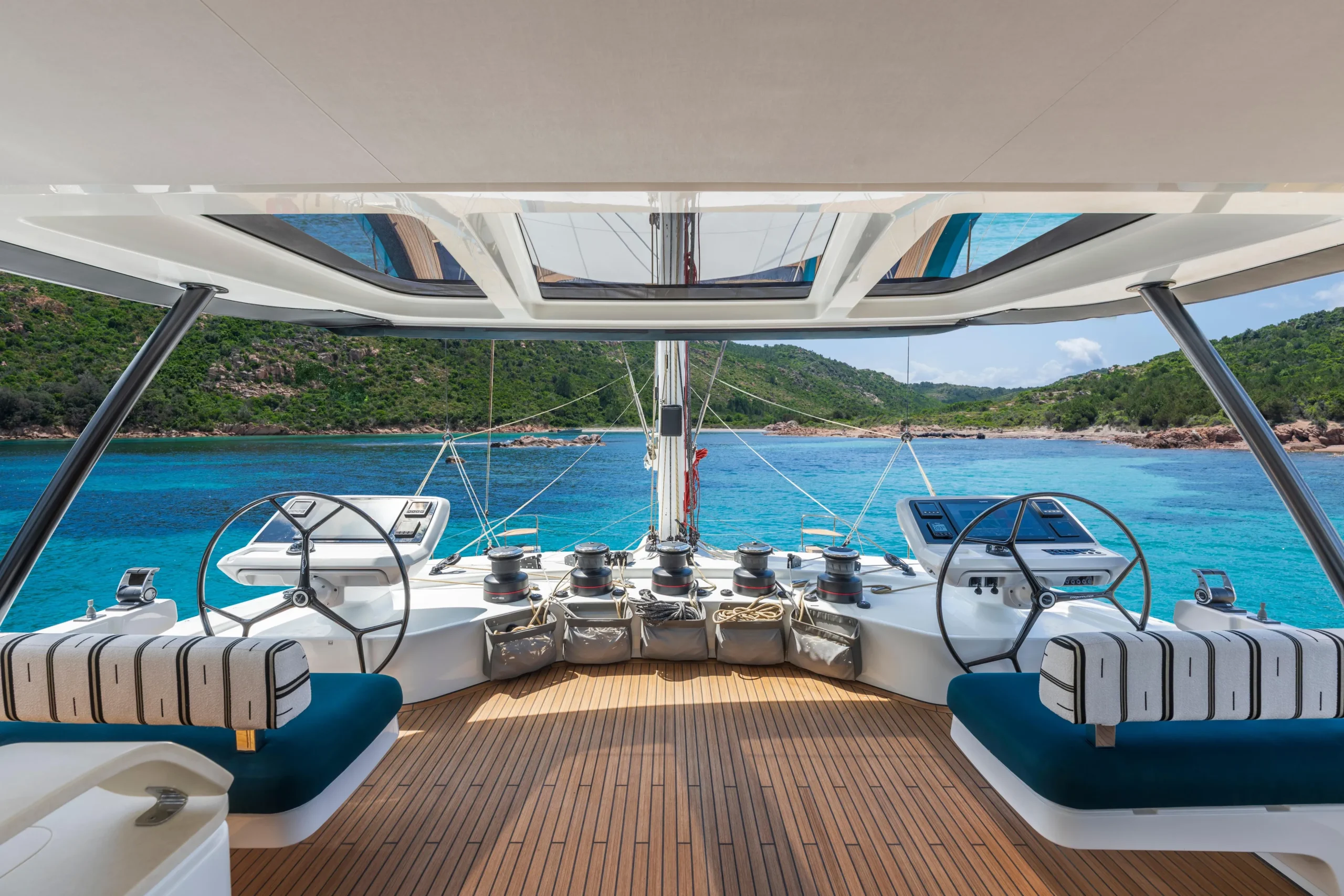
A bay can be bright, quiet and uncomfortable at the same time. Swell arriving from outside bends around a headland and sets the yacht moving, making a spoon chatter against a cup while there is scarcely enough wind to lift a napkin. For someone new to Mediterranean sailing, that small contradiction is worth noticing. The view does not tell you everything about the anchorage.
Much of learning to live aboard happens through distinctions like this. Shelter from wind is different from shelter from swell. A short distance can make a demanding passage. A day spent in the same place can be the result of careful judgement rather than a lack of ambition. These are useful things to discover while land remains close and the plan still offers choices.
That is the honest reason to consider the Mediterranean for a first leg with Naora. It offers circumstances in which the unfamiliar can become ordinary without an ocean crossing being the first commitment. What it cannot do is reproduce the experience of remaining at sea after the option of stopping has disappeared. There is no hierarchy of beautiful water here. There are different kinds of time.
What Mediterranean Sailing Lets You Learn
The Bodrum loops, the Dodecanese and the Cyclades belong to the Naora route, but they do not offer interchangeable introductions. A coastal loop and an exposed passage between islands may occupy similar spaces in a calendar while asking quite different things of the people aboard. For a first stay, the useful questions concern hours under way, exposure to the prevailing wind, the likelihood of sailing into the sea rather than with it, and the places where a sound alternative exists.
A simple planning calculation makes the distinction clear. An illustrative passage of 30 Nm at an average of 6 knots takes five hours under way. That is arithmetic, not an Discovery schedule. Manoeuvring, a changed course, reduced speed in a head sea and the time needed to anchor all sit outside it. A modest line on the chart can therefore occupy most of the useful day, particularly for someone still adjusting to motion.
The Mediterranean often allows these experiences to be separated by genuine rest. There may be a sheltered night between passages, an opportunity to walk ashore, or time to discover that a lighter lunch suits a sailing day better. Nearby land gives the captain options to assess before departure. It does not promise an immediate place to stop whenever someone wishes.
Sven, Naora’s founder and captain, plans every weather window and sails every leg himself. The important continuity is in the judgement: reading the proposed passage against the conditions and the people aboard, rather than assuming that a route suitable for an experienced sailor will feel the same to a family finding its balance for the first time.
The Summer Wind Is Not A Sea Breeze
The Aegean makes a poor classroom if it is introduced as a reliably gentle sea. Its summer northerly, the meltemi, is often most persistent in July and August. It belongs to a regional pressure pattern, not merely to the daily warming of the land, and it can continue through the night and across several days. Leaving early may avoid some local afternoon strengthening. It does not make an established meltemi vanish.
Beaufort Force 6 means winds of 22 to 27 knots. In human terms, an exposed passage into that wind can mean repeated movement through short, steep waves, spray and a day in which carrying a drink requires attention. The same wind from a more favourable direction may produce a very different experience. Wind strength alone is not a description of comfort.
Islands complicate the picture. Air can accelerate through gaps and descend in gusts from high ground. Water immediately behind an island may look flatter while the wind remains forceful. Farther out, waves retain the history of the weather that built them. A forecast easing does not instantly flatten the sea.
This is why we consider wind direction, gusts, fetch and the expected sea state together. On a catamaran, relatively little heel should never be mistaken for little load in the rig. Sail reduction follows the conditions and the yacht’s operating guidance, not a wait for dramatic movement to announce that something needs changing.
The practical lesson for a first leg is to leave room in the plan. A fixed departure can turn a manageable forecast into an argument with the weather. A flexible day can remain a good day ashore, with the boat secure and nobody obliged to demonstrate endurance.
An Anchorage Has To Work After Dark
Choosing an anchorage begins with what may happen later. The attractive bay in the afternoon photograph is only one version of that place. A wind shift can remove its shelter. Swell can enter from a different direction. A crowded anchorage may leave too little room for the boat to swing when the breeze changes.
We look beyond the colour of the water. Suitable sand, where anchoring is permitted, is preferable to laying an anchor into living seagrass, both for holding and for the habitat beneath the boat. Even sand needs interpretation: a thin covering over rock is not the same as a substantial bed. Depth, slope, obstructions and room to recover the anchor all matter. Clear water is helpful, but it is not a substitute for the chart or a correctly understood depth reading.
Scope is another small word with a large practical consequence. A scope of 5:1 describes five lengths of rode, the chain or rope connecting the anchor to the yacht, for the vertical distance between seabed and bow roller. It does not mean five times whatever number happens to appear on the sounder. The instrument’s reference point and the height of the bow matter, as does the water level expected during the stay. That ratio describes geometry, not a universal prescription; weather, holding ground and swinging room still determine the plan.
Mediterranean tides are often modest, but that is no reason to ignore changes in water level, local current or surge. Once the anchor is laid, the set needs to be checked under controlled load and the yacht’s position monitored. An anchor alarm supports that work. It does not establish that the anchor is holding.
For the guest, the result is pleasantly uneventful: dinner without a hurried move, a settled night, confidence that somebody has considered the hours when everyone else hopes to be asleep. Much of comfort aboard is work completed before it becomes visible.
The Body Learns Before The Vocabulary
On a moving deck, the body learns a sequence before the mind learns its name. Find the handhold, transfer the weight, then move the foot. A knee softens as the boat lifts. The glass goes farther from the edge of the table. None of this needs to feel like a lesson, but it makes the difference between inhabiting the yacht and continually being surprised by it.
Discovery, the Lagoon Eighty2 sailing the Naora world route, offers generous living space. Space does not abolish motion. A catamaran can pitch and accelerate abruptly in a short sea, and a person who feels entirely comfortable at anchor may need time to adjust once under way. We would rather hear about discomfort early than discover that someone has spent hours trying not to inconvenience anybody.
There is a particular deception in a warm sailing day. Moving air cools the skin while sunlight reflected from the water reaches beneath the brim of a hat. Below, the breeze falls away and the heat becomes more apparent. Shade, drinking regularly, eating something manageable and resting before exhaustion arrives are ordinary provisions for a good day. They matter more than appearing hardy.
A first coastal stay also gives someone time to discover how they actually like being on the water. Swimming may be the pleasure; sailing between places may take adjustment. Before entering the sea, visibility is only one consideration. Current, wind, passing boats and a clear way back aboard matter too. The ability to see the bottom says nothing about how easily a swimmer can return against a breeze.
These small discoveries deserve room. Someone travelling with children or several generations should not have to judge the whole idea of life aboard from a single tiring afternoon. Nor should enjoying a sheltered week be treated as proof that everyone will enjoy a prolonged passage equally.
What Mediterranean Sailing Cannot Rehearse
A coastal night passage can introduce darkness without reproducing the demands of an ocean crossing. Navigation lights replace the daytime outlines of vessels. Shore lights make targets harder to distinguish. Fishing activity and approaching traffic require attention, and the comforting presence of land creates its own workload. Coastal sailing is not automatically the simpler navigational task.
What it often lacks is duration. The next anchorage may offer an uninterrupted sleep. Offshore, the yacht keeps moving, the watch system continues, and rest must be protected within that movement. A comfortable first night does not tell us how somebody will feel after successive nights of unfamiliar sleep, or how readily they can recover while the sea remains active.
Guests can be interested in watchkeeping without becoming responsible for it. Looking out beside an experienced watchkeeper can reveal how much is being assessed: changes in bearing, the relationship between a light and an electronic target, the movement of weather across the horizon. Enthusiasm is not a watchkeeping qualification, and the safe operation of the yacht must not depend on a guest remaining enthusiastic.
The same distinction applies to self-reliance. Near shore, a missing provision or a developing fault may have a relatively accessible remedy. Before an ocean departure, stores, maintenance, medical planning and reserve capacity need to be considered against a longer interval without outside help. The useful habit learned in the Mediterranean is attention. The additional demand offshore is sustaining it.
A first leg can reveal preferences and difficulties. It cannot certify an appetite for every kind of sea. Recognising that limit is part of preparing someone well.
The Atlantic And Pacific Change The Scale
The Atlantic changes the relationship with the destination. Between islands, arrival can remain the organising event of the day. On an ocean crossing, most days must make sense without it. Meals, maintenance, weather assessment and rest become the structure of life rather than things fitted between departure and arrival.
Following the tradewinds can put wind and sea in a more favourable relationship to the yacht, but it does not produce an unchanging conveyor belt. Squalls, shifts and awkward swell still require judgement. Downwind motion is still motion. The meaningful difference is that a suitable offshore rhythm can continue long enough to become familiar, rather than ending just as the body begins to understand it.
For some people, that continuity is the reason to return after the Mediterranean. For others, it is precisely what they do not want. There is no sound basis for predicting that every happy coastal guest will inevitably want an Atlantic crossing.
The Pacific adds another kind of distance. In the Polynesian atolls on Naora’s route, reaching land does not necessarily mean reaching easy access, immediate supplies or an uncomplicated entrance. A reef pass can carry substantial current, and slack water need not coincide with high or low water outside the lagoon. Waves breaking across the reef can add water that must leave through the pass. A predicted tide alone cannot settle the entry decision.
Light for reading the water, observed conditions, local knowledge and a safe alternative belong in that decision. This is where a Mediterranean habit becomes something larger. Learning to reject a beautiful anchorage that does not work is related to being willing to wait outside a distant reef. The surroundings change. The obligation to arrive well does not.
The Route Leaves The Choice Open
The Naora Global Expedition is planned across roughly 49,000 Nm from 2027 to 2031. Those figures describe a continuing voyage, not a commitment any guest has to match. Members choose when they join, where along the route they step aboard and how long they remain. The yacht continues around the world as people step into and out of its life.
That continuity removes the need to make the Mediterranean carry every expectation. A first stay can be an introduction rather than a declaration. Someone may return for an Atlantic passage after finding that motion, sleep and time away from shore suit them. Someone else may rejoin among Pacific islands without wanting to cross an ocean at all. The decision still has to fit the actual leg and its conditions, rather than the appeal of a regional name.
A family arranging the private hire of Discovery may place the greatest value on time together within the Mediterranean. That is a complete reason to sail. It would be a mistake to call their voyage insufficient because the yacht has farther to go.
The Mediterranean becomes the wrong only leg when it is asked to stand as evidence for an entire life at sea. It can teach the first habits, reveal preferences and make the unfamiliar approachable. Beyond it are experiences that require longer separation from land, and whose character cannot be compressed into a coastal week.
There is no need to diminish the first anchorage to make room for that possibility. A sheltered night, a meal eaten comfortably and the familiar outline of land are things an ocean sailor can still value deeply.