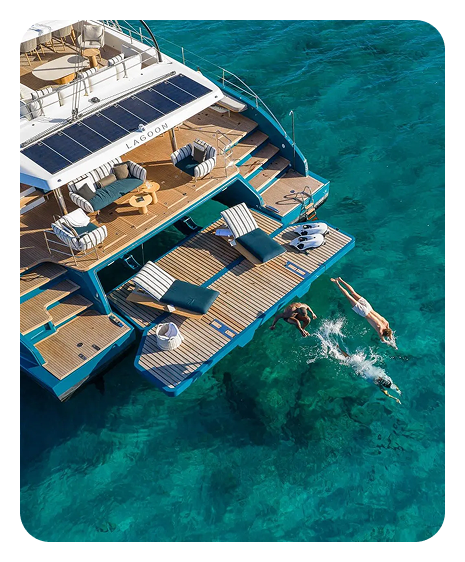
In the tropics, the sun is present for six to eight hours a day at high intensity and the Eighty2 is in the tropics for most of its five years. The Mediterranean in summer. The Caribbean from December to April. The Pacific trade wind belt. The Indonesian archipelago. The Indian Ocean.
These are the regions with the highest solar energy availability on the planet, and the solar array on the Eighty2 is the primary reason the boat can operate largely independently of diesel generation for the majority of the circumnavigation. The sun does most of the work. The diesel does the rest.
The solar panel converts light into electricity through the photovoltaic effect. Inside the panel, a layer of silicon, the same material that computer chips are made from, is treated with specific impurities that create a junction between two types of silicon with different electrical properties. When a photon from the sun strikes this junction, it knocks an electron loose from the silicon lattice.
The junction’s built-in electric field pushes the free electron in a specific direction, and the accumulation of electrons moving in the same direction is an electric current. More light means more photons, more displaced electrons, more current. The panel generates direct current whose voltage and current are determined by the panel’s construction and the intensity of the light hitting it.

What MPPT Does
The panel does not produce a fixed voltage and current. Its output varies with the light intensity, the temperature, and the load connected to it. For every combination of light conditions and temperature, there is a specific operating point, a specific voltage and current combination, at which the panel produces the maximum power it can given those conditions. This is the maximum power point, and it changes continuously as the light changes throughout the day.
The MPPT charge controller finds this operating point continuously and keeps the panel working there. It samples the panel’s voltage and current many times per second, calculates the power being produced, makes a tiny adjustment to the operating point, samples again, and adjusts again. It is constantly hunting for the peak of the power curve the way a person adjusting a radio dial hunts for the clearest signal, small movement, check, small movement, check and it finds the peak far faster and more accurately than any human could.
By operating the panel at its maximum power point rather than simply connecting it directly to the battery, the MPPT controller extracts ten to thirty percent more energy from the same panel area. Over a five-year circumnavigation with solar panels generating energy every day, this is a significant amount of energy that without the MPPT controller would simply be wasted as heat in the circuitry.
The five minutes when the cloud passes over the panel and the generation drops is visible on the battery monitor as the charge rate decreasing. The crew on the afterdeck does not feel it, the instruments do not dim, the refrigerator does not notice: the battery bank absorbs the drop and continues supplying the loads from stored energy while the panels wait for the cloud to pass.
When the sun returns, the MPPT controller finds the maximum power point again within seconds and the charge rate rises back. The ocean provides the sunlight in the quantities it provides. The system uses every photon it can.