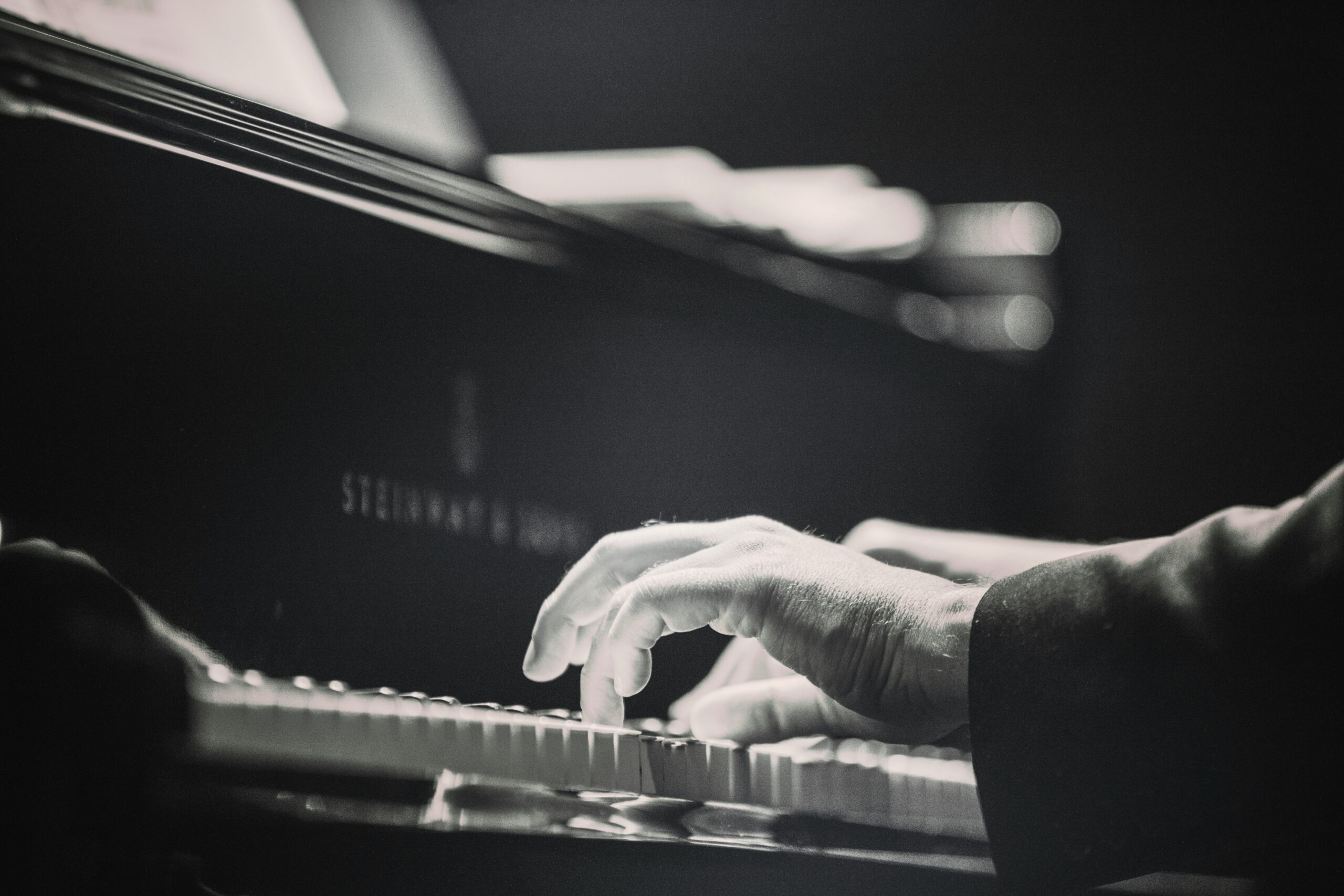
When a pianist lifts both hands from the keys, the last chord can still hang in the room while the bass carries on underneath it. The texture thins. Something previously difficult to hear becomes clear. In jazz improvisation, this withdrawal can be as deliberate as anything played: a decision to leave space because another musician has begun something worth following.
This is the territory of the digital Circle session led by Antony, Naora’s co-founder, in conversation with a jazz musician. What interests us is the work behind that apparently effortless decision. A player has to recognise what is happening, know several possible responses and resist the temptation to use all of them. There is a close connection with offshore sailing here, although it becomes useful only when we are precise about where the resemblance begins and where it ends.
What Jazz Improvisation Keeps In Place
Improvisation is often described as freedom from a script. In much small-group jazz, the more useful description is freedom within an understood structure. The musicians may share a melody, a sequence of harmonies and a form that repeats, even when none of those things is being stated plainly. What sounds open to the listener can be held together by a remarkably exact sense of where everyone is.
A common blues form lasts 12 bars. A common song form lasts 32 bars, arranged as AABA: an eight-bar section, its repetition, a contrasting eight-bar bridge, then a return. These are examples, not rules for all jazz. Their importance is practical. A player can leave a phrase unfinished because the others still know where the harmony is going. The group does not have to negotiate its position from the beginning at every change.
One complete passage through the form is called a chorus, which here does not mean the repeated refrain of a song. At 120 quarter-note beats a minute, a 12-bar blues in 4/4 takes 24 seconds to complete. That is a short time in which to propose an idea, hear a response and decide what deserves to happen next. It also explains why counting rests matters. A musician who stops sounding does not stop travelling through the form.
This is something anyone can hear with a little attention. Follow the return of a familiar melody or harmonic shape rather than trying to identify every note. Gradually, the music becomes less like a stream of surprising events and more like a conversation in a room whose proportions you understand. The surprise remains. You can begin to hear what makes it possible.
What Practice Makes Available
The preparation is more than learning which notes belong to which chord. Fingers need to find a sound without a separate instruction for every movement. The ear needs to recognise tension and release. Time has to remain steady while the surface rhythm becomes complicated. None of this removes thought from playing. It makes room for thought that would otherwise be crowded out by the mechanics.
A useful distinction is between practising a phrase and practising what a phrase can do. The first can produce a polished fragment ready to be inserted whenever the right harmony appears. The second involves changing its rhythm, shortening it, moving it to another key or beginning it at a different point in the bar. A small idea becomes flexible rather than merely impressive. It can answer something instead of arriving regardless of what preceded it.
There is a simple way to feel the difference at an instrument. Sing a short phrase before trying to play it. Notice where the breath begins and ends, which note feels settled and which seems to ask for another. Then find those sounds. The hesitation between hearing and finding is useful information. It shows where familiarity with a fingering has run ahead of familiarity with the music. Speed would only conceal that gap.
For us, this is the most valuable meaning of preparation: making alternatives genuinely available. A second anchorage is not yet an alternative because its name appears in a notebook. It becomes one when its approach, shelter, depth, holding ground and limitations have been considered. Likewise, a musician cannot reliably choose a sound that exists only as an attractive idea. Some of the work must already be in the hands.
Listening In Jazz Improvisation
Once playing begins, preparation has to leave enough attention free for listening. That is harder than it sounds. A musician can be so occupied with the next phrase that the bass player’s change of emphasis passes unnoticed. The result may be technically accomplished and still feel oddly disconnected. Everyone is contributing, but the contributions do not seem to affect one another.
Accompaniment makes this particularly clear. A pianist does not need to put every note of a chord beneath a soloist. The third and seventh often carry much of its harmonic identity; the bass may already be supplying the root. A lighter voicing can make the harmony clearer while leaving more space around the melody. Restraint here has an audible function. It reduces duplication and allows another person’s detail to survive.
The physical experience is worth noticing. Near an acoustic group, the brush moving across a drumhead can be almost a grain against the steadier body of the bass. A piano chord briefly occupies much more of the room, then decays. When it is not immediately replaced, the quieter sounds come forward. Silence in this setting is rarely absolute. It is a change in what the ear is allowed to attend to.
Nor does listening require an answer to every event. If every player echoes every accent, the music can become crowded with agreement. Sometimes the useful response is to maintain a steady foundation while someone else takes a risk. Sometimes it is to leave a thought alone. Good interaction includes knowing which changes matter and which can pass without being turned into a new direction for everyone.
A Weather Window Is A Whole Passage
At sea, the equivalent begins well before departure. A weather window is not simply a favourable wind at the moment the lines come off. It is a period in which the expected conditions suit the passage, including the approach and arrival, with room for the uncertainty in both the forecast and the yacht’s progress. Leaving in comfortable weather tells us little if the destination becomes difficult before we can reach it.
Even elementary passage arithmetic makes this visible. On a hypothetical 60 Nm passage, an average speed over the ground of 6 knots gives ten hours under way. At 5 knots, it gives twelve. That modest difference costs two hours, enough to turn a daylight approach into an arrival after dark. These are planning figures, not performance claims for Discovery. They explain why an arrival estimate needs a range and why a change in speed can require a change in destination.
The Cyclades, part of the Naora route, give this judgement a particular shape. In summer, the northerly meltemi can persist for days. Wind can accelerate between islands, and shelter behind high ground may come with strong gusts descending from the slopes. A bay that looks protected from the prevailing direction on a small chart still needs closer examination. Its opening, the surrounding terrain and any swell reaching around the headland all matter.
A forecast also does not describe the sea as though it were starting from rest. Wind can ease while an uncomfortable sea remains. Locally generated waves and an older swell may arrive from different directions. That is why the decision uses weather, pilotage and observation together. None is improved by being treated as sufficient on its own.
An opening that arrives earlier than expected is therefore something to assess, not an instruction to hurry. Readiness, the people aboard, the passage and the arrival still have to make sense. Missing a usable window can be frustrating. Treating the fear of missing it as evidence that we should leave is worse.
The Boundary Between Freedom And Safety
The musical analogy has a limit, and it matters. A band can turn an unexpected note into the beginning of something interesting. A yacht cannot make an unsafe depth acceptable by responding imaginatively. Charts, collision regulations, equipment limits and the captain’s responsibility remain in force when the plan changes. The freedom is in choosing a sound course of action within those constraints.
On a cool night watch, that distinction becomes physical. Instrument light can make the surrounding darkness feel deeper. The air reaches the face before the rest of the body registers a change, and the sound of water along the hulls may sharpen as conditions alter. Such impressions deserve attention, but they are prompts to check the wind, heading and sea state, not replacements for doing so. A quiet cockpit must never become a reason to keep a concern quiet.
This is also where experience needs a little humility. Recognising a pattern quickly is useful; deciding too quickly that it is the familiar pattern is not. An observation from someone less experienced may be incomplete and still be important. A member does not need to diagnose a change before mentioning it. Interpreting that information and deciding what follows belong with the captain and crew.
A changed plan also has to be communicated. People need to know what has changed, why it matters and what they should expect next. This is less romantic than the image of a captain sensing the right moment, but it is how judgement becomes dependable for everyone aboard. Nobody should have to infer an operational decision from another person’s confidence.
Discovery, the 2025 Lagoon Eighty2 sailing the Naora Global Expedition, gives this distinction a continuing context. Across the five years from 2027 to 2031, members choose when they join, where along the world route they step aboard and how long they stay. The yacht keeps sailing. That freedom depends on careful coordination with real passage conditions. A personal calendar matters, but it cannot make an exposed arrival safe.
A Conversation Without A Recording
The Circle session brings the musical and maritime versions of this attention into the same conversation. Antony leads, the musician contributes the knowledge of musical practice, and members can bring what they recognise from a watch, a shared table or their own work. There is no need to have played an instrument or crossed an ocean to understand the difficulty of listening while already preparing a reply.
The most revealing detail will be in the decisions rather than the general principle. A phrase was possible, but another was chosen. A pause was left long enough for someone else to enter. An expected response did not arrive, and the player had to reconsider. Those are the mechanics worth exploring with a musician. Saying that improvisation requires preparation is only the beginning; understanding what preparation frees the player to notice is the more interesting work.
The session sits under Circle Sessions in the Circle app and is not recorded. A recording has its uses, particularly when someone wants to return to a technical explanation. Here, the choice is to give the conversation its own boundary rather than shape it into something for a later audience. That does not guarantee openness, and it does not remove the ordinary responsibility to treat another person’s contribution with care.
A digital conversation has its own timing, too. A slight delay can make two people begin together, or make a thoughtful pause seem like a failed connection. The medium rewards a little patience. Leaving a beat before speaking is a small courtesy with a practical effect: it gives the person at the other end a better chance to finish the thought they actually meant to offer.
Leaving Space For The Answer
At a Long Table, the same discipline can be almost invisible. Someone takes time to find a word. Another person knows a relevant story and chooses not to introduce it yet. The conversation becomes warmer because nobody is required to compete with the speed of the quickest speaker. There is still direction and energy, but less effort spent defending a place in it.
This should not become a romantic argument for silence in every circumstance. An unclear instruction aboard needs clarification. A concern needs to be spoken. A pause in conversation is not evidence of agreement. The useful skill is discrimination: recognising when space helps another person contribute and when plain words are needed to keep everyone working from the same understanding.
What we value in the musician’s craft is that readiness can remain present without constantly announcing itself. The form is still being counted. The ear is still following the bass. The hands know where they might go next, yet they can wait because something worth hearing is already happening. The next note is available. For a moment, it can remain unplayed.