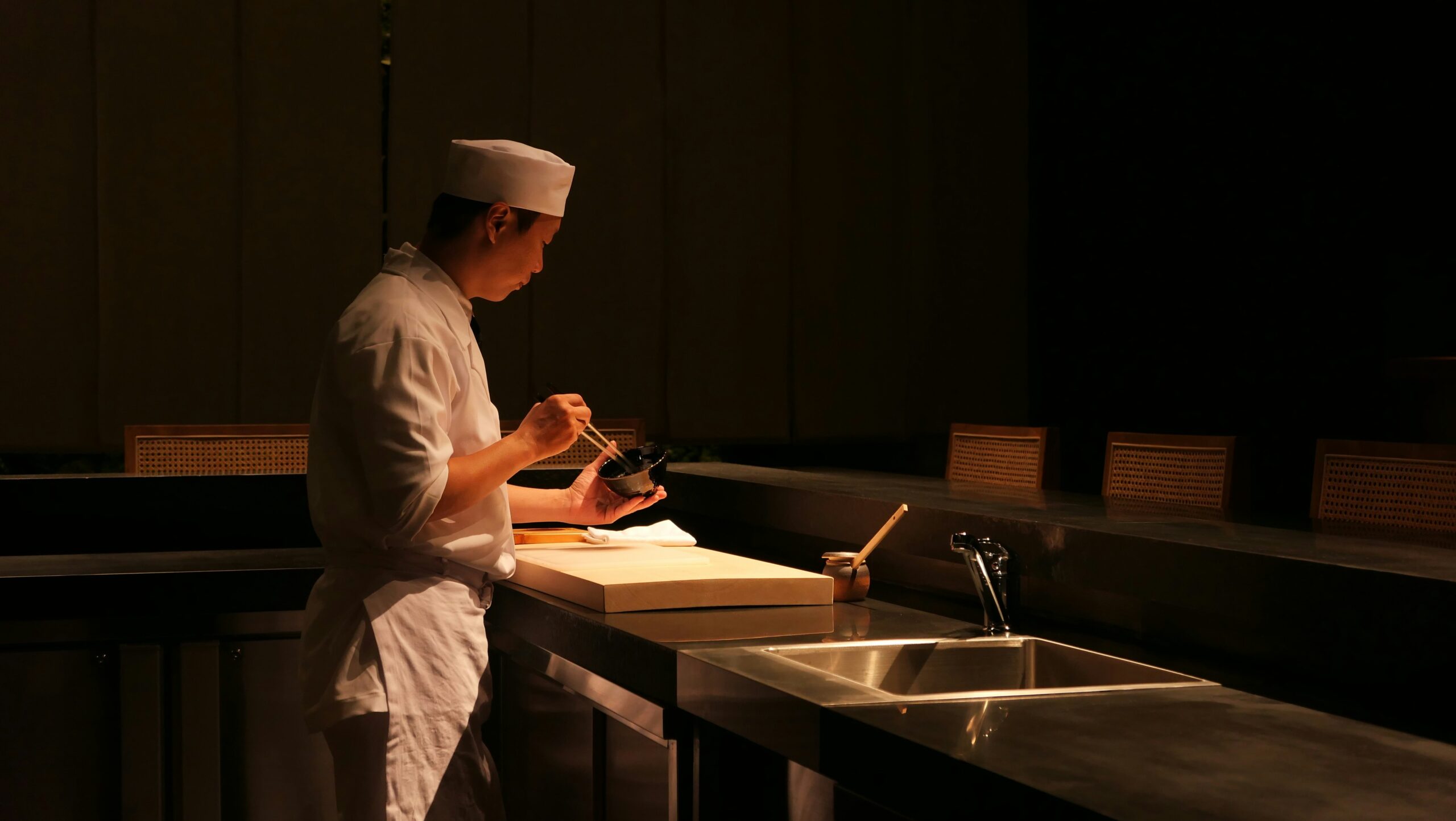
A cold fish fillet takes heat from a pan the moment it touches the metal. Add too many fillets and the sound changes, the sharp sizzle softening as moisture collects faster than it can evaporate. The cook now has a different problem from the one the recipe described. Restaurant systems begin in decisions this small: how much a pan can hold, when another should be ready, and who notices before an avoidable compromise reaches the table.
This is the territory of the Naora Circle conversation with a three-star chef. The distinction matters, though we should be precise about it. Stars belong to the restaurant, rather than being a permanent personal qualification. They recognise the cooking; they do not explain how the kitchen organises its work, how someone learns to recognise an error, or what happens when an ingredient is refused at the delivery door. Those are the things we want to understand.
Our point of connection is the galley. Cooking for twelve aboard a moving yacht makes the relationship between preparation and judgement unusually visible. It would be romantic, and inaccurate, to say that a yacht has no supply chain. The market, the producer, the refrigerated transport and the dry stores are all part of one. What changes offshore is the opportunity to repair an omission. Once the coast falls away, purchasing has become inventory.
Restaurant Systems Begin Before Service
The dining room sees the final assembly. Much of the work that makes it possible has already happened: produce checked, stock reduced, equipment tested, dietary requirements understood, tasks placed in an order that allows each person to finish without obstructing someone else. Good preparation removes decisions that do not deserve to be made under pressure, leaving attention available for those that do.
This does not mean turning cooking into an inflexible sequence. A recipe can specify a quantity of lemon juice, but lemons vary in acidity and fragrance. A sauce reduced to a marked level may still need tasting because the original stock was stronger than yesterday’s. The useful system records the method and the intended result. It leaves the cook responsible for recognising the difference between the instruction and the food.
There is a practical lesson here for anyone cooking dinner at home. Work backwards from the moment of serving, rather than forwards from the first line of each recipe. Identify what needs the oven, what occupies the hob, what can wait, and what deteriorates immediately. Several manageable dishes can become an unmanageable meal if they all require the same pair of hands at the last moment.
The cost of preparation is time spent before anyone is hungry. Some components may have to be abandoned when the evening changes. That can look inefficient from a distance, but a kitchen with no spare time, no alternative and no room on the work surface has already committed itself to perfect conditions. The pressure merely reveals the commitment.
What The Market Can And Cannot Decide
We want the place to influence what we eat. That begins with looking properly at what is available, rather than carrying a finished menu ashore and asking a market to reproduce it. Ripeness, condition and provenance matter more than the pleasure of finding an ingredient whose name suits the destination. Buying locally also requires restraint. A small supply should not be treated as though it exists solely to fill our refrigerator.
But allowing the market to shape dinner is different from allowing chance to determine whether dinner exists. A trolling line cannot be part of the minimum provisioning calculation. Weather may make fishing impractical, nothing suitable may be caught, or the catch may be a species we cannot confidently identify and use. A fish brought aboard is a possibility to assess, never an obligation to serve.
Cold storage is where this becomes less picturesque and more important. For chilled perishable food, 5°C or below is a practical upper limit, not a promise of unlimited shelf life. Fresh fish benefits from temperatures close to 0°C, protected from contamination and kept out of standing meltwater. A refrigerator’s setting is not proof of the temperature throughout a crowded compartment. Air needs to circulate, and actual temperatures need checking.
Nor does freshness at the moment of capture settle every safety question. Some fish can develop histamine when poorly chilled, and cooking does not reliably remove it. Smell alone cannot establish safety. The handling history matters. Likewise, citrus changes the texture of raw fish but does not make it equivalent to fish made safe by appropriate cooking or parasite controls.
These limits do not diminish the pleasure of a catch reaching the table that evening. They make the pleasure honest. The most consequential culinary decision may be the one that keeps an ingredient off the menu.
Preparation That Leaves Room For Judgement
Mise en place is often translated into an arrangement of small containers. Its deeper value is readiness. The knife is sharp, the board is secure, the garnish is usable, and the cook knows which components can tolerate waiting. Chopping everything early is not automatically good preparation. Cut herbs lose fragrance; dressed leaves soften; some vegetables release water after salting. Readiness means choosing the right moment as well as completing the task.
Take the fish in the opening pan. Drying the surface removes moisture that would otherwise have to evaporate before browning could begin. Leaving space between portions helps the pan recover its heat. Skin intended to become crisp needs contact with the cooking surface, not constant anxious movement. The decision about when to turn the fish comes from its thickness, the heat and its behaviour in the pan, rather than a timer alone.
Elsewhere on the stove, a sauce can offer flexibility. Its base may be prepared ahead, then adjusted and finished near service. Fresh herbs added late retain a different character from herbs cooked into the base. Butter worked into a warm sauce changes texture, but excessive heat can separate the emulsion. Knowing which part of the preparation is stable, and which part is fragile, is what allows the final minutes to remain manageable.
Dietary requirements belong in this early work too. An allergy cannot be handled by lifting a garnish off a finished plate. Ingredients, labels, utensils and shared preparation surfaces need consideration before cooking starts. Where safe separation cannot be assured, the honest response is to say so and choose another dish. Hospitality becomes unreliable the moment reassurance runs ahead of what the kitchen can actually control.
Restaurant Systems Depend On Bad News Arriving Early
A cook who notices that a sauce is catching has useful information. The value of that information declines while they decide whether it is safe to speak. By the time the smell reaches someone else, the kitchen has fewer choices. The leadership question is therefore very concrete: what happens to the person who reports a problem while it is still small?
There is a difference between exacting correction and humiliation. Correction makes the required change clear. Humiliation makes the person think about the consequences of being seen to need help. In a busy kitchen, where heat, knives and intersecting movements already demand attention, that additional private calculation is expensive. We should be wary of confusing a frightening room with a disciplined one.
Clear communication can be almost plain enough to escape notice. A timing call is acknowledged. A change in an allergy order reaches the person preparing the food, rather than remaining with the person who first heard it. If a task changes hands, the new owner knows its condition and what remains to be done. Assumptions are particularly dangerous when everybody believes somebody else has checked.
The restaurant and the yacht share this need, but their pressures are not identical. A delayed course and a navigational error do not carry the same consequences. The useful comparison is narrower: both depend on people making an accurate picture available to one another before acting. Offshore, there is little value in a brave account of how things are going. We need the true one.
Afterwards, a correction should survive beyond the person who remembers the evening. If a container was mislabelled, the answer may involve changing the labelling practice, not merely asking everyone to concentrate harder. Attention is necessary. It is also finite.
The Galley Has Its Own Clock
On Discovery, the Lagoon Eighty2 that will sail the Naora Global Expedition, the meal plan has to belong to the passage plan. Sven, Naora’s founder and captain, plans every weather window and sails every leg himself. Expected motion, departure time and the demands of the watch affect what is sensible to prepare. The galley cannot be planned as a separate little restaurant whose floor happens to move.
A meal requiring several open pans and delicate last-minute work makes a different demand from a dish that can be prepared earlier and served with fewer movements. If the forecast suggests a more uncomfortable period, the sensible response may be to complete demanding preparation before it arrives. This is a judgement about exposure to hot liquids, sharp tools and fatigue, not an admission that the food no longer matters.
At a moving stove, the body is part of the calculation. One hand wants to steady a pot while the other needs somewhere secure to rest. Steam briefly clouds the space above the hob. A lid that can be set down casually ashore must have a place where it will stay. The task includes carrying the finished food safely to the table, a detail easily forgotten when a menu is imagined on land.
Provisioning has its own arithmetic. A table of twelve is not the whole calculation if crew meals are counted separately. Nor is a passage allowance complete without food for a delay. There is no responsible universal percentage for that reserve: it depends on the route, the realistic opportunities to resupply, storage capacity and the people aboard. The reserve needs to be food someone can willingly eat and prepare under the conditions that made it necessary.
A large pot cooked ahead also brings a cooling problem. Dense food left in a deep container can remain warm at its centre long after the outside feels cool. Dividing it into shallow portions helps it cool more effectively before refrigerated storage. Preparing early only creates useful margin if the food remains safe afterwards.
The Standard Can Survive A Changed Menu
Creativity is often described as the arrival of a new idea. In working kitchens it can be the ability to remove an idea without damaging the meal. The planned fish is unsuitable. The greens are tired. A departure has moved. The chef must recognise what the dish was meant to provide, then decide which parts of that intention can survive.
If its appeal depended on richness balanced by acidity, replacing the main ingredient may still leave that relationship available. If it depended entirely on the texture of a particular fish, substitution may be the wrong answer. Better to cook another dish honestly than preserve the name while losing everything that made it worthwhile. The guest does not need to be served the history of the plan.
At sea, the person eating also changes. Someone who enjoyed a long dinner at anchor may want a warm bowl and very little conversation on a passage evening. Nausea, heat, tiredness and an approaching watch all alter appetite. A kitchen that insists on displaying its range regardless of those conditions has misunderstood whom the meal is for.
Members choose when they join Naora, where along the world route they step aboard and how long they stay. Some will arrive for a short stretch; others will live with the galley through a succession of passages and landfalls. That makes quiet knowledge of preferences useful, while leaving room for people to change their minds. A preference should help the cook pay attention, not become a permanent description of the guest.
There is warmth in repetition too. A familiar breakfast can give shape to a morning when everything outside is moving. Returning to something someone enjoys is not necessarily a failure of imagination. Sometimes the more thoughtful choice is to stop asking them to be surprised.
What We Want From The Conversation
The digital Circle session is sixty minutes. That is enough time to follow a difficult decision properly, but not to extract an entire working culture from a chef. I would rather understand how a kitchen responds to a missing ingredient, from the first report through to the revised service, than collect polished statements about creativity. The sequence reveals where responsibility sits and how much discretion the team genuinely has.
Another useful subject is what the chef has chosen to stop doing. Removing a preparation, shortening a menu or changing a handover can require more judgement than adding another impressive component. What looked beautiful on a quiet afternoon may have made the busiest evening unnecessarily fragile. The interesting part is how that became visible, and whether someone close to the work could say it.
We should leave room for differences that resist translation. A restaurant has its own economics, repetition and relationship with returning diners. A yacht has distance, finite stores and the obligation to feed people well beyond a single evening. Neither becomes more understandable by pretending it is the other. The overlap is in the care taken before the visible moment.
On a passage night, a bowl can be held close enough to warm the palms. There may be little to see beyond the light falling across the table, and less appetite for explanation than there was ashore. The cook’s work remains present in the seasoning, the temperature and the ease with which the food can be eaten. For a while, that is all anyone needs from the kitchen.