From the hillside cemetery above Atuona, the view opens towards the sea. On Hiva Oa, that stretch of blue has become part of the story people bring with them: Gauguin, Brel, an island far from Europe, a last refuge. The view is real. The story needs a little more care.
Paul Gauguin died on Hiva Oa. Jacques Brel did not. He died in a hospital near Paris and was brought back to be buried here. Their graves share a cemetery, not a single explanation of why someone leaves home, and the island surrounding them has a history much larger than either life.
For us, the useful beginning is to give the place time before giving it meaning. A visit can include the paintings, the aircraft and the climb to Calvary without turning Atuona into scenery for European departures. Arriving under sail makes that distinction particularly worth remembering. We are visitors too.
Hiva Oa Before The Famous Names
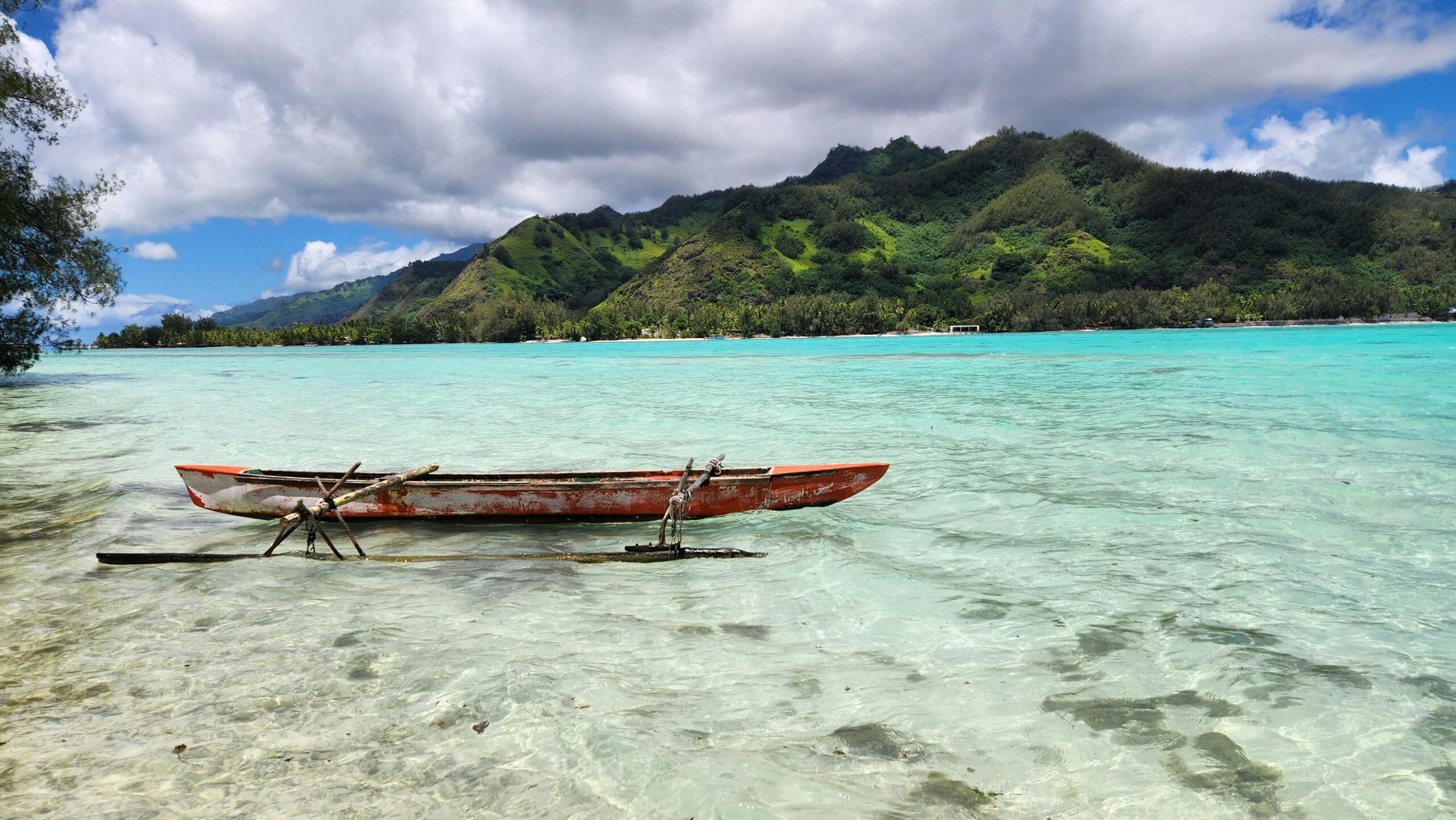
Hiva Oa lies in the southern Marquesas, a high volcanic island whose steep land continues to govern movement, settlement and the approach from the sea. It is not enclosed by the protective barrier reef that many people imagine when they hear French Polynesia. There is no broad lagoon separating every coastal encounter from the ocean. The mountains are close, and so is the swell.
This physical character matters to the visit. Roads have to negotiate the terrain. Rain falling on the slopes finds its way rapidly towards the coast. Cloud can obscure the heights while the shore remains bright. A distant photograph makes the island look like a single green mass; approaching it reveals folds, shoulders and valleys, each changing what can be seen and how the wind reaches the water.
The human history needs the same adjustment of scale. Marquesan society was established long before either artist arrived. European contact brought disease, population loss, missionary intervention and colonial rule. The island Gauguin encountered was already living through profound disruption. Calling it an untouched refuge obscures the very history that helps explain his time here.
Nor did that history end with him. Marquesan language, carving, tattooing and the transmission of family knowledge belong to living communities. Their importance does not depend on their appearance in a European painting. We can come because a song or a canvas first made us curious, then allow the place to become larger than the reason we came.
The Anchorage Before The Shore
For a yacht arriving after a Pacific crossing, the first work is more prosaic than the first view. The approach, the anchorage and the landing have to make sense before anyone starts thinking about the museum. Relief at reaching land is a feeling, not evidence that the boat is secure.
The broad bay at Atuona is Taaoa Bay, also known as Traitors Bay. The harbour occupies a more enclosed part of that coastal setting, but the names should not be treated as interchangeable promises of shelter. Wind protection and swell protection are different things. The easterly trade winds may favour the passage while a southerly swell makes the anchorage uncomfortable. A breakwater reduces exposure; it does not remove the need to assess the movement inside.
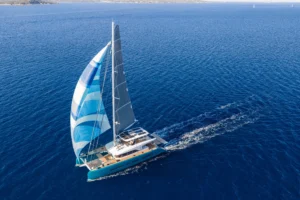
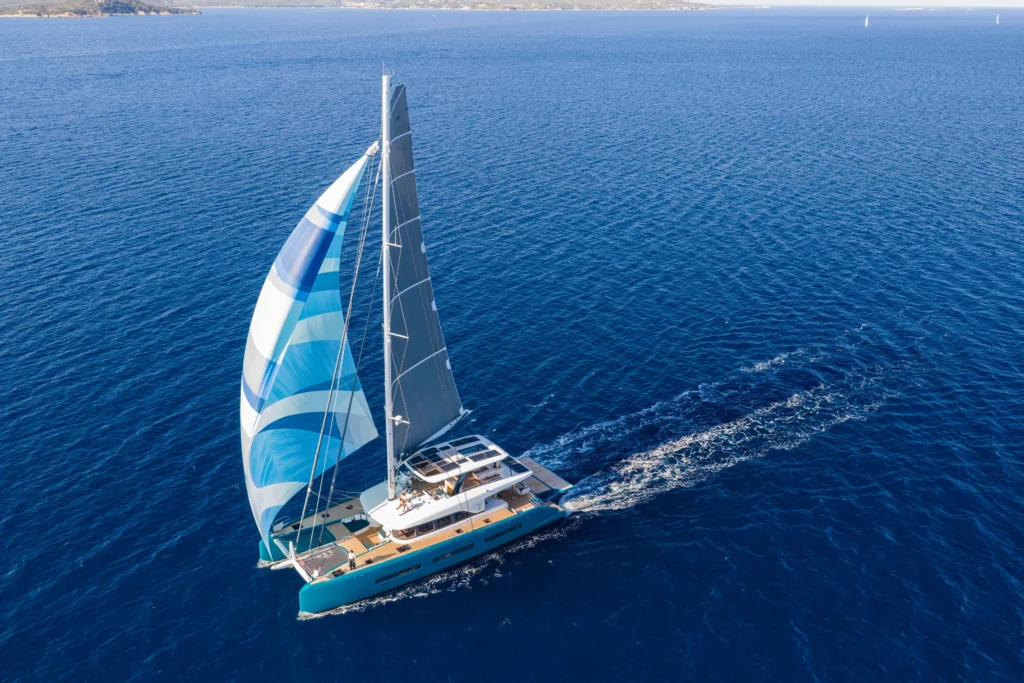
For Discovery, our Lagoon Eighty2, room matters as much as shelter. Sven, Naora’s founder and captain, plans every weather window and sails every leg himself. Here, the judgement includes usable depth, bottom character, swinging room, harbour traffic and the arrangements of boats already present. A vessel restrained by a stern anchor will not swing like one lying to a single bow anchor. Apparently empty water may belong to somebody else’s movement.
Enough water beneath the hulls at low tide and enough chain for the depth at high tide are separate checks. Holding also has to be established, not inferred from a quiet engine or a pleasing position on the chart. If the available space does not suit the yacht, the shore plan changes. The cemetery will remain where it is.
After days offshore, the smell of wet vegetation can reach the deck before anyone sets foot on land. The eyes, accustomed to distance, suddenly have slopes and roofs to settle on. Yet the boat may still move beneath a hand resting on the rail, and that movement follows us into the next decision: where to land, how to step ashore safely, and what conditions the return will involve. The passage ends in stages.
Gauguin’s Final Years In Atuona
Gauguin reached Hiva Oa in 1901 after his years in Tahiti and died here in 1903. His association with the island rests on less than two years of residence. That short interval matters because the familiar story can make it seem as though he spent a long, settled final chapter painting in uncomplicated contentment.
He arrived with poor health, financial concerns and an established appetite for conflict. His life in Atuona included writing and disputes with colonial officials and missionaries, as well as painting. Distance from Europe did not mean an absence of European institutions, correspondence or concern about how his work would be received. He had moved far away without becoming detached from the world he criticised.
There is also no honest account of his Polynesian years that leaves out his sexual relationships with adolescent girls. The inequalities of age, gender and colonial power belong beside the discussion of his artistic achievement. His opposition to particular colonial practices did not place him outside colonial privilege.
We do not need to settle his entire reputation during a morning ashore. We do need to avoid using the beauty of the island as an alibi. The paintings can remain compelling while the life remains troubling. Holding those facts together allows more serious attention to the work than either unquestioning admiration or a hurried dismissal.
It also returns some independence to the people he painted. A face on a canvas is not evidence that the person represented shared the artist’s interpretation of the encounter. That distinction is worth carrying into the cultural centre, particularly when the landscape outside makes it tempting to treat every painted scene as a faithful account of what happened here.
Looking At The Reproductions
The Gauguin cultural centre in Atuona presents reproductions rather than a collection of original canvases. Knowing this before arriving changes the quality of the visit. There is no disappointment to manage if we understand what the place can offer: an account of his life and work, set within the town where his final period unfolded.
A reproduction is useful for looking at composition. We can follow the placement of figures, the balance between occupied and empty space, the flattening of a landscape into areas of colour. It is less reliable for judging the surface of paint, the exact relationships between pigments or the physical presence of an original. Those are different kinds of looking, and confusing them gives a printed image more authority than it can carry.
The reconstructed Maison du Jouir, usually translated as House of Pleasure, requires a similar distinction. It is a reconstruction of Gauguin’s house, not an untouched interior preserved from the day he died. Its value lies in helping us consider the building, its imagery and the way he chose to present himself. It cannot recover the full atmosphere of a household or tell us what everyone who entered it experienced.
The island outside does not simply explain the pictures either. Gauguin worked through memory, invention and symbolic association. Recognising a kind of vegetation or a quality of light may deepen our attention, but it does not turn the paintings into documentary records. The most useful visit leaves room between the place and the artist’s version of it.
Brel And The Practical Life
Jacques Brel arrived by yacht in 1975, already seriously ill. For those of us planning a world voyage, his arrival under sail is an immediate point of recognition, but it should not become a claim of kinship. His circumstances were his own. He settled on Hiva Oa, returned to Europe for medical care and died near Paris in 1978. Burial here expressed a connection to the island; it does not mean his final days were spent here.
The most revealing object associated with him in Atuona is not a stage costume or a record sleeve. It is his aircraft, Jojo, preserved in the town. Brel was a pilot, and his flying helped carry mail and supplies and assisted with medical transport. This was a practical contribution to life in an archipelago, where the distance between islands has consequences that a map cannot show by itself.
A letter, a needed item of food, a person requiring care: these are ordinary things made less ordinary by the sea between departure and arrival. An aircraft does not abolish that geography. Weather, fuel, maintenance and the conditions at each end still have to be considered. The machine makes visible a part of Brel’s island life that the image of the solitary singer tends to leave out.
There is warmth in that practical story. It places him among other people’s needs rather than alone against an ocean view. We should not turn it into another tidy legend, or assume that every islander experienced him in the same way. It is enough to recognise work that had a use beyond the person doing it.
His song Les Marquises is worth hearing before the visit, provided we hear it as the work of someone who lived here, not as the island speaking with a single voice. A song can make us attentive to a place. It should not decide in advance what we are allowed to notice.
The Walk To Calvary
The cultural centre is in Atuona. The cemetery is uphill from the village, while the harbour landing is outside the village centre. Those distinctions disappear in the phrase ‘walkable from the boat’, which is why we separate the landing, the transfer into town and the climb when planning time ashore.
Half a day can accommodate the cultural centre and cemetery if landing conditions, transport and opening arrangements cooperate. That is a planning allowance, not a promise or a measure of how long the island deserves. Heat, recent rain, mobility and the pace of the people walking can all change it. We would rather leave room for a slower return than make a hillside visit depend on everyone maintaining the same stride.
In humid heat, the climb can bring a shirt against the back and make a small patch of shade worth stopping for. A water bottle becomes more useful than a camera. After the uphill effort, the open view offers a different sensation: the sea spread below, the land dropping away, breathing gradually settling. This is part of the visit that a photograph cannot preserve. It belongs to the body that has walked there.
Calvary is a community cemetery, not simply a memorial site for two famous visitors. The other graves deserve the same space and care. We keep to the paths, avoid stepping across graves for a better angle and put the camera away if a family is visiting or a burial is taking place. Permission to visit a cemetery is not permission to make everyone within it part of our account.
At Gauguin’s grave, the figure is a cast of his sculpture Oviri. It belongs to his artistic vocabulary and should not be mistaken for a straightforward example of local funerary tradition. Brel’s grave invites its own associations, especially for someone who knows his voice well. Neither encounter needs to be hurried into a photograph. Sometimes recognition is enough.
Hiva Oa Beyond The Graves
The useful continuation is back down in Atuona, where the visit can turn towards people making things now. Marquesan carving and barkcloth deserve attention on their own terms. Tapa is made by beating prepared inner bark into cloth, not by weaving yarn. Knowing that changes what the surface tells us: the material records repeated work, joining and thinning rather than the crossing of threads.
If we consider buying a carving, we ask who made it, what wood was used and what the maker wishes to explain about the design. A motif should not acquire an invented meaning merely because a visitor would like a good story to take home. Sometimes the better exchange concerns a tool, the time a material needs or a decision the maker changed. There is pleasure in learning something small accurately.
Hiva Oa belongs to the Marquesas chapter of the Naora Global Expedition, part of a five-year voyage rather than an isolated cultural excursion. Members choose when and where along the route they join, and how long they sail. Some will reach this region after a long passage; others will encounter it nearer the beginning of their time aboard. One person may need sleep before a morning ashore. Another may be eager to walk. Discovery does not need everyone to have the same day.
That freedom is most useful when it creates attention rather than more activity. There is room to look at the reproductions without pretending they are originals, to admire Brel without borrowing his reasons for being here, and to spend time in a Marquesan town without requiring it to resemble a painting.
Above Atuona, two famous names are held in stone. Below them is a town with its own afternoon.