The stone stays warm after the street beside it has gone into shade. In Cartagena de Indias, the breeze can reach your face while the pavement is still giving back the afternoon through the soles of your shoes. A doorway, a chair and something cool to drink become more immediately interesting than the next monument. There is useful knowledge in that small surrender. This is a city to understand at the speed its climate allows.
On the Naora Global Expedition, Cartagena belongs to the Caribbean chapter on the way towards Panama. In planning this call, we want to leave room for more than the familiar circuit of walls, castle and dinner. Those things deserve attention, but their meaning begins offshore, in the relationship between a defensible harbour and the wealth that moved through it. Arriving aboard Discovery gives us a way into that relationship. It also gives us responsibilities that a photograph of the old city leaves out.
Cartagena De Indias Begins With The Bay
Cartagena is a working commercial port. The yacht enters a place organised around shipping, channels, cargo and people going about their employment, rather than a harbour arranged around our arrival. Large vessels following a dredged fairway have limited room to improvise. Their movements belong in the arrival plan before anyone begins discussing where to eat.
The bay’s apparent openings are not interchangeable. Shoal water and historic submerged defensive works make the opening nearest the old city something to examine on a current chart, not a visual shortcut. For an unfamiliar approach, our preference is daylight, with enough time left to settle the yacht and complete the necessary formalities without turning an evening ashore into a deadline. Sven, Naora’s founder and captain, plans the weather windows and sails every leg himself. Here, that work includes the less romantic business of checking port instructions, traffic and the intended arrival arrangement.
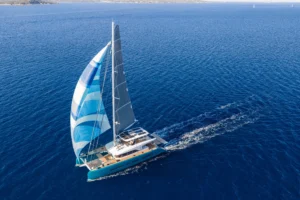
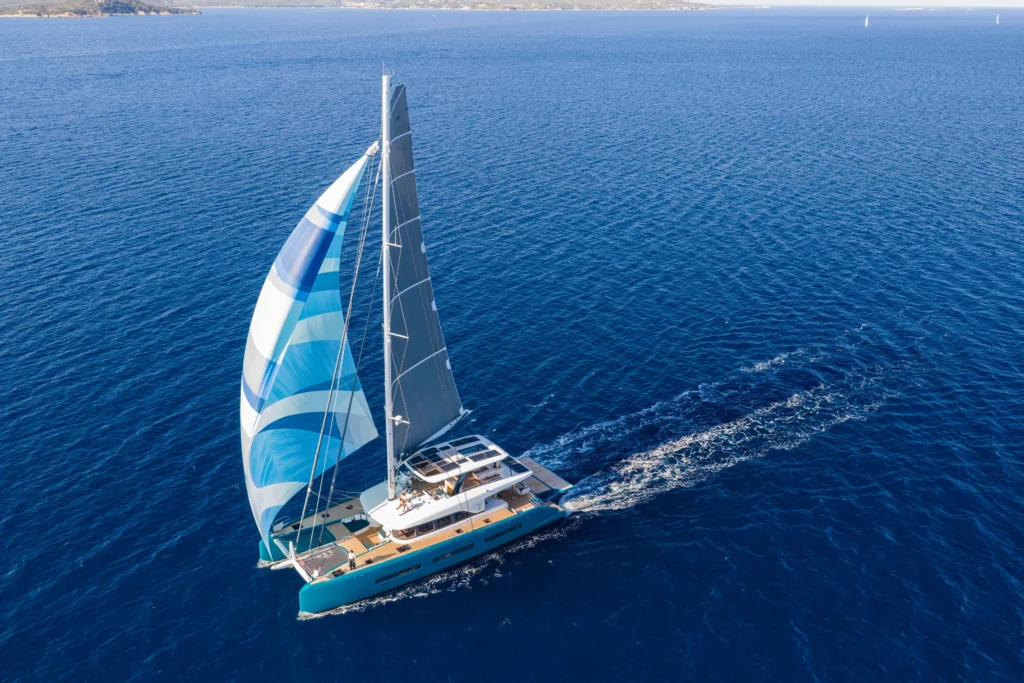
For Discovery, our Lagoon Eighty2 sailing catamaran, a marina name alone is not an arrangement. Club Náutico is part of the local yachting picture, but any proposed berth needs its approach depth, width and manoeuvring room checked against the yacht. Anchoring requires a different set of decisions: permission, clearance from traffic, room to swing and a bottom in which the anchor can actually establish a hold. Much of the bay has muddy ground. Mud can hold well, but its consistency matters, and the word on a chart does not replace setting the anchor under load and checking that the boat stays put.
Cartagena’s tidal rise and fall is generally measured in tens of centimetres rather than metres. That reduces one part of the depth calculation; it does not remove wind-driven changes in water level, wash or the need for a margin beneath the keels. When judging anchor scope, we count the height of the bow roller above the water as well as the water depth. The chain begins at the boat, not at the surface.
Only then does the shore transfer become a sensible conversation. Its duration depends on where we are secured, the permitted landing and conditions in the bay. A fixed promise of fifteen minutes would conceal more than it explained.
The Wealth The Walls Were Built To Protect
The familiar description of Cartagena as a city built to keep the gold in gets the direction of travel slightly wrong. Gold and silver were moving out through the imperial trading system, ultimately towards Spain. The harbour, warehouses, institutions and people involved in that movement needed protection. Cartagena was an important defended junction in a much larger network, not the only port through which the wealth of the Americas passed.
That distinction changes the way the walls look. They were infrastructure as much as architecture. A protected port allowed cargo to gather, ships to provision and trade to be controlled. The stone represented an investment in keeping those operations functioning under threat. Its beauty now comes partly from the distance between its original purpose and what we are free to do beside it: walk slowly, lean into a breeze, look out without searching for an approaching enemy.
Francis Drake captured and ransomed Cartagena in 1586. Much of the substantial defensive system visible today developed afterwards, so it is misleading to imagine that he simply defeated the completed walls we now visit. Fortification was a long response to experience, revised as threats, weapons and military engineering changed. The city was not finished and then tested once. It kept learning, at considerable human and financial cost.
There is another history that cannot be left outside this account. Cartagena was a major port in the trafficking of enslaved Africans. People were brought here under coercion, sold, made to work in the city or sent elsewhere. Enslaved and free people of African descent helped build and sustain the place whose façades visitors admire. Their lives belong in the explanation of its prosperity, alongside the cargoes and the crown.
We can appreciate the workmanship without treating the society that commissioned it as something to recover. Restoration preserves buildings. It does not make the colonial order an ideal.
Reading The Defences Of Cartagena De Indias
A useful way to look at the walls is to follow their angles rather than their length. A projecting bastion allowed defenders to direct fire along an adjoining face, covering ground that a straight wall could leave sheltered. The shape makes sense when you imagine someone trying to reach its base. What appears decorative from a café table was intended to remove a refuge.
The Castillo de San Felipe de Barajas makes that logic more legible. Construction began in 1657, with major enlargement later. Its hill position helped command the approaches to the city, and its mass is less important than the relationship between its defensive positions. Different levels and lines of fire supported one another. The fortress was designed to make an attacker solve several problems at once.
The failed British attack in 1741 belongs to this history, although stone and cannon alone do not explain the outcome. Disease, supply and command decisions also shaped the campaign. That is worth remembering from the elevated view: military history, like a sea passage, is often decided by what people can sustain rather than what they intended at the start.
We would give the castle a cooler part of its opening hours rather than automatically saving it for sunset. Exposed slopes store heat, and the interior passages can be confined and uneven. Someone who is uncomfortable underground loses nothing by remaining outside and reading the structure from the surface. For a family walking together, choosing where to pause is more useful than insisting everyone completes the same circuit. The point is to see clearly, not to finish tired.
Planning A Day Around Heat And Wind
The generally drier period from December through April often brings more persistent northeasterly trade winds. That is a broad seasonal pattern, not a forecast for our arrival. A sunny day ashore can coincide with a demanding sea outside the bay, and shelter at the berth tells us little about the conditions on the next passage. Before departure, we need to look beyond the harbour to the strength and duration of the wind and the sea it has had time to build.
Afternoon air temperatures commonly sit around 30°C. The practical consequence is larger than that number sounds because humidity slows the evaporation of sweat, while sunlit paving and masonry add radiant heat. Shade changes the load on the body even when the air temperature barely changes. Water, light clothing and an unhurried pace are part of planning the visit, particularly for children and anyone still recovering sleep after a passage.
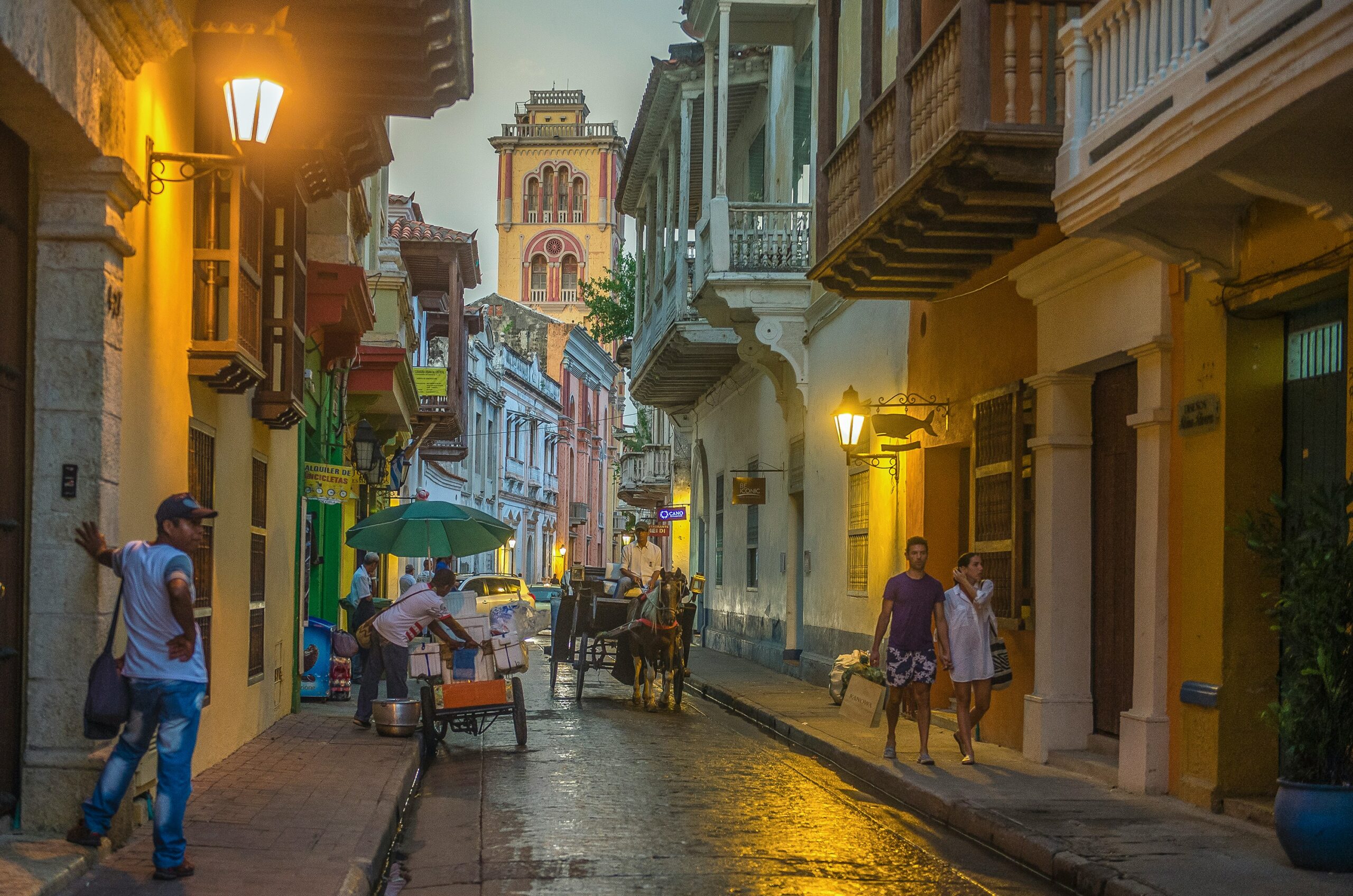
There is a physical relief in moving from a bright plaza into a deep doorway. Your eyes need a moment to adjust. The glare releases its grip, the heat from the paving falls away, and the sounds of voices and footsteps become easier to separate. We want enough space in the day to notice that change rather than use the doorway only to check where we should hurry next.
A sensible shore plan has somewhere to sit before anyone urgently needs it. It also has a way back to the yacht that does not depend on everybody having the same energy at the same hour. The castle, the old streets and Getsemaní do not have to be consumed in one continuous walk.
During wetter periods, heavy showers can alter the comfort of a landing or tender ride quickly. Shoes with grip and a protected phone are modest preparations. So is checking the return arrangement before leaving the waterfront, rather than trying to reconstruct it in rain after dinner.
Getsemaní Is A Neighbourhood Before It Is An Evening
Getsemaní is often described simply as the neighbourhood outside the walls. Historically, it belonged to the wider fortified city, with defences of its own. Its identity is bound up with artisans, workers and Afro-Caribbean life, not merely with its position beyond the central enclosure. That matters because the usual visitor’s shorthand turns a living neighbourhood into the colourful alternative to somewhere else.
It is also no longer sensible to divide Cartagena into an expensive, visitor-facing centre and an untouched Getsemaní where everything is local. Tourism has changed both. A mural is not evidence that a street exists for photography, and a busy restaurant outside the central walls is not automatically a better expression of the city than a quiet kitchen within them. We need to pay attention to the particular place rather than its reputation.
Respect here is ordinary and specific. Leave doorways clear. Ask before making a person the subject of a photograph. Keep voices down beside homes, especially when a lively evening has made it easy to forget that someone nearby has work in the morning. In churches, a pause at the entrance usually tells us more about appropriate behaviour than walking straight in with a camera raised.
Some of the pleasure of being ashore comes from allowing people to remain occupied with their own lives. We do not need every interaction to become a story brought back aboard. A greeting, a purchase and a little patience can be enough.
What The Caribbean Coast Puts On The Table
The table offers a more intimate way into Cartagena than another façade. Corn, coconut, plantain and fish connect its cooking to the Caribbean coast, while the methods carry Indigenous, African and European histories without separating them neatly on the plate. We would rather begin with something cooked well and eaten at the right moment than work through a list of supposedly essential dishes.
An arepa de huevo is a good example of why timing matters. A corn dough disc is first fried until it forms a pocket, then opened carefully so an egg can be slipped inside before a second frying cooks the filling. The method asks the cook to manage two textures: a crisp shell and an egg enclosed without destroying it. Fresh from the oil, the surface gives a small brittle crack beneath the teeth, followed by the softer corn and the richness inside. Left waiting, it becomes a different thing.
Arroz con coco is worth understanding beyond the translation of coconut rice. In a common coastal preparation, coconut milk is reduced until its water evaporates, oil separates and the solids brown into titoté. Rice and liquid are then added to that concentrated base. The toasted flavour comes from this patient stage, not simply from pouring coconut milk over rice. Versions vary in sweetness and may include raisins, but the browned coconut explains the depth that makes it work beside savoury food.
Patacones depend on another deliberate sequence. Green plantain is fried, flattened and fried again, giving it a firm, crisp surface rather than the softness of ripe plantain. Beside fish and coconut rice, that texture has a purpose. A good plate is a set of contrasts, not an accumulation of garnishes.
For fish, we ask what species is being offered and how it has been handled rather than assuming that a waterfront address guarantees the catch. The same discipline applies to provisioning Discovery. Local sourcing still requires judgement about condition, storage and how soon we can use something. Fish needs prompt chilling and separation from ready-to-eat food. Fruit needs room to ripen without a whole purchase becoming ready on the same hot afternoon. A smaller purchase, used properly, is often the more respectful one.
The Yacht Keeps Its Own Time
A city call changes the work aboard. There are provisions to receive, rubbish to land through appropriate facilities, machinery to check and a departure forecast that will not wait because we have found a good table. Those tasks need to be planned into the call, not hurried through at its end. The ease of coming back aboard rests on work that was done while the evening still felt open.
We also keep the distinction between harbour life and time in the water. A working port anchorage is not automatically a swimming place. Traffic, visibility and water quality have to be considered, and we would not treat the presence of a bathing platform as a reason to ignore them. Cartagena’s value to the expedition is on its own terms. It does not need to provide every kind of pleasure available along the world route.
Members choose when they join Naora, where along the route they step aboard and how long they stay. Someone may share this Caribbean chapter; someone else may remain aboard as Discovery continues towards Panama. Their time with us can differ without turning the yacht’s continuous voyage into a succession of isolated holidays. The expedition keeps sailing, subject to the weather and the care the boat requires.
That continuity should make us more attentive ashore, not less. Cartagena is not scenery between ocean passages. It is a port where work continues behind the view, where a fortified past remains tangled with an inhabited present. We will leave with another weather window. The city has its own morning to get on with.