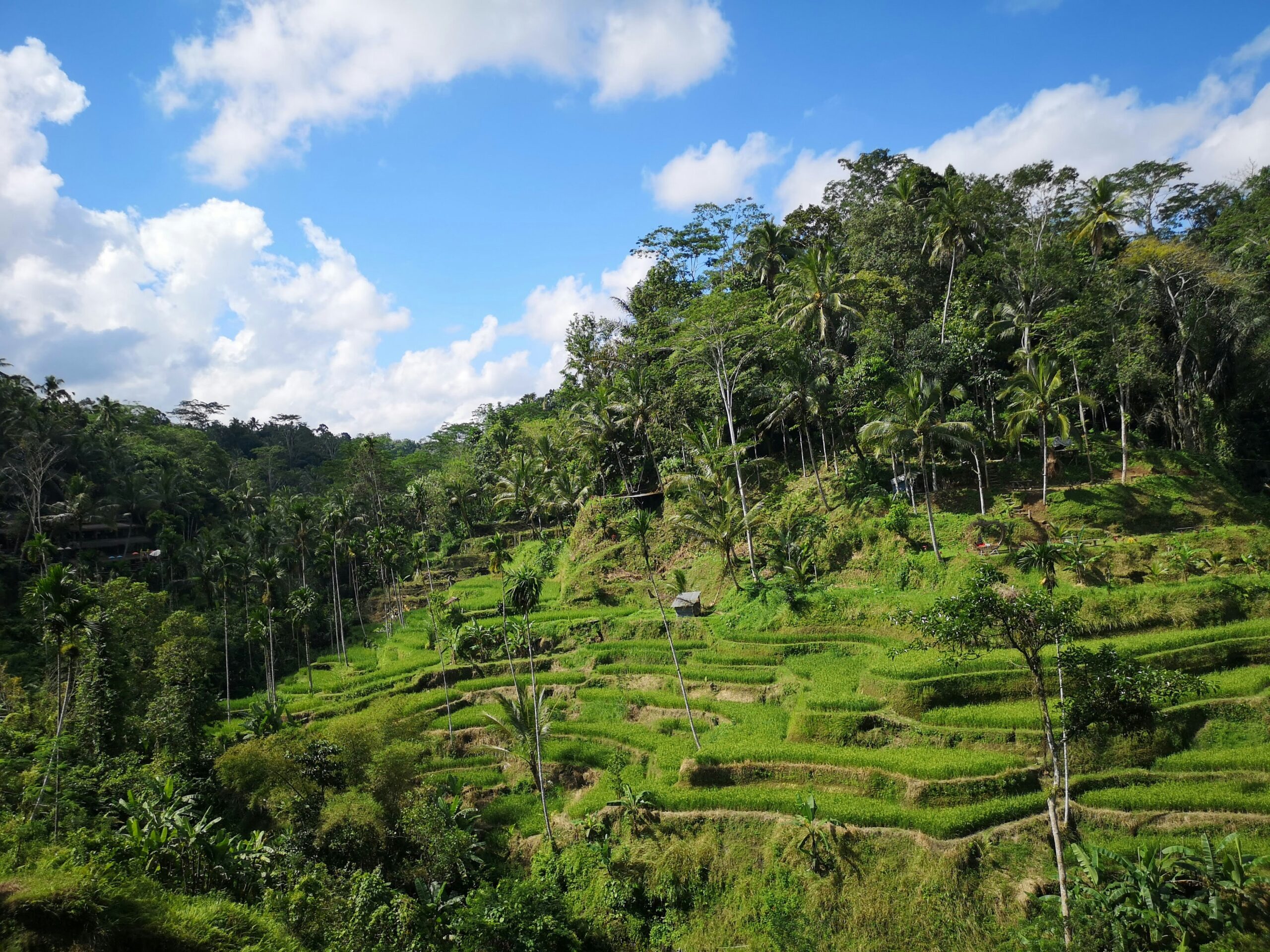
At the Tegallalang Rice Terraces, a flooded field can catch the morning before the rice does. The water holds a pale reflection of the sky while the planted slopes remain dark, and the narrow earth banks become visible as lines between one surface and another. Where an irrigation channel runs close to the path, its sound gives away something the photograph leaves out. This apparently still landscape is moving water.
That is a better reason to arrive early than the possibility of having a familiar viewpoint to ourselves. There may be fewer visitors, less heat and more room to stop without obstructing anyone, but dawn does not remove Tegallalang from the contemporary life of Bali. The cafés and swings belong to its economy too. What the early hour offers is a little space in which to notice the agricultural work beneath the image, before we decide that recognising the view is the same as understanding it.
Reaching The Tegallalang Rice Terraces Before Dawn
A morning inland begins with a decision at the coast. Arriving off northern Bali and arriving through Benoa in the south create quite different journeys ashore. Neither should be treated as a convenient place to leave a yacht solely because someone wants an early photograph. For Discovery, our Lagoon Eighty2, shelter, port requirements, suitable access and the arrangements for the yacht while people are away must come before the road itinerary.
That distinction matters particularly at anchor. A departure before daylight requires a suitable tender landing, a safe transfer and a return plan that still works if conditions change. A berth in the Benoa area would require confirmation that it can accommodate the yacht, rather than an assumption based on the presence of a marina. Sven, Naora’s founder and captain, plans the weather windows and sails every leg himself. A shore visit has to fit that responsibility, not compete with it.
Tegallalang lies north of Ubud. It is not reliably forty-five minutes from Kuta, and a short driving estimate should not become the foundation of a dawn departure. From the Benoa area, a working allowance of roughly one and a half to two hours by road is more prudent, subject to the precise pickup point and current conditions. That is a planning estimate, not a promised transfer time. From the north coast, the route across the island needs a separate assessment.
We would work backwards from the light, after confirming access with someone local who knows the entrance being used. A driver needs an agreed meeting point and return arrangement, not simply an instruction to arrive early. If the coastal position makes the outing exhausting, the sensible answer may be a later visit. An unhurried morning is worth more than a dawn reached through haste.
Light And Weather In The Valley
Bali’s sunrise varies through the year, roughly between 05:50 and 06:40 local time. The practical difference is considerable when a car journey and a transfer ashore precede it. More importantly, sunrise on a weather application is not the moment direct sunlight reaches the bottom of a terraced valley. The ridge, the slope and cloud cover decide that. There can be ample light to see the fields while the lower terraces remain in shade.
This is why a fixed instruction to be there at six is less useful than it sounds. On one morning the water may reflect an open sky. On another, low cloud may flatten the contrast and leave the greens soft and evenly lit. Mist is possible, not part of an appointment. The terraces were shaped to hold water and make cultivation possible on a slope, rather than to deliver a particular arrangement of sunlight for a camera.
Bali’s generally wetter period, roughly November to March, brings a greater likelihood of rain affecting paths and visibility, although rain occurs outside those months too. Recent weather matters more to the footing than the label attached to the season. A shower can leave clay slick beneath an apparently dry surface, and prolonged rain can make a steep descent a poor choice even after the sky clears.
We would rather wait for enough light to place a foot properly than hurry down a dark path for a viewpoint. Cloud does not spoil the visit. Losing the hard sunlight can make the irrigation channels and the changing stages of the crop easier to read.
The Shared Work Of Subak
The first useful distinction is that subak is not merely a name for the channels. It is an organisation of farmers who share irrigation, with responsibilities for distributing water, maintaining the system and making collective decisions. Its religious life is connected with temples and ceremonies. The channels are the visible engineering of a much larger arrangement between people.
Gravity does much of the physical work, but gravity alone does not distribute water fairly. A terrace needs a sufficiently level bed to hold water across its surface. Its banks contain that water, while inlets and outlets regulate movement into and out of the plot. Small changes matter. A damaged bank can lose water; an obstructed channel can interrupt supply; an alteration upstream can become someone else’s shortage below. These are working structures, not ornamental borders.
Following a channel with the eye is a useful way to begin understanding the hillside. Notice where water enters, where its level is controlled and where it leaves. What looks like a separate field may depend on decisions made beyond the visible slope. That dependence explains why maintenance and allocation cannot be left entirely to individual preference. A farmer can work a particular plot, but cannot make the shared water system function alone.
The Balinese idea of Tri Hita Karana brings together relationships with the divine, with other people and with the natural world. In the subak tradition, those relationships have practical expression. Water sustains the crop, its use requires agreement, and religious observance gives that work a place within a wider understanding of life. Reducing the system to either ingenious plumbing or picturesque spirituality misses the connection between them.
Nor should we mistake a long history for an unchanged landscape. Banks are repaired, channels cleared and decisions renegotiated. Subak has developed over centuries, but that does not date every terrace at Tegallalang to a single ancient beginning. The continuity lies partly in repeated work. The hillside survives because people keep attending to it.
Reading The Crop At The Tegallalang Rice Terraces
The greenest photograph is not a reliable forecast of what will be growing when we arrive. Many rice crops take roughly three to five months from sowing to harvest, depending on the variety and growing conditions. During that time, the same field can move from reflective water and young plants to dense green growth, then towards ripening grain and the cut remains of harvest. The agricultural calendar changes the view as much as the weather does.
Young rice leaves space for the water to show between plants. A more established crop conceals much of the field surface. As grain fills, the seed heads become heavier and begin to bend. A recently harvested plot may look bare beside the next one, but bare does not mean abandoned. It may be between crops, being prepared, or managed differently from its neighbour. The useful response is to ask, rather than supply a story from appearance alone.
Timing also has consequences beyond the individual field. Coordinating planting and fallow periods can help interrupt the continuous supply of food and habitat available to crop pests. Yet planting together can concentrate demand for irrigation. This is one reason water management involves negotiation across an area, rather than a simple instruction that everyone should follow the same date.
We would ask a local guide what stage the visible fields are in and where their water comes from. Those questions usually reveal more than asking where to stand for the best picture. They also leave room for an honest answer: the person accompanying us may know the paths well without knowing the planting decisions of every farmer.
Walking A Working Landscape
The banks between paddies are easy to misread as footpaths. Some carry established walking routes; others exist primarily to retain water or allow farmers access to their crop. Their narrowness is not an invitation to balance along them. A misplaced step can crush seedlings, damage a soft edge or start a leak that someone else must repair after the visitor has gone.
We would stay on the permitted route, ask before entering a field and accept that a path shown in an old photograph may no longer be open. Access arrangements differ between entrances and can change. Arriving before a ticket point is staffed does not make the land freely accessible. Early access needs to be agreed, and any legitimate entrance arrangements respected.
On a damp descent, the body notices what the wide view conceals. A shoe sole can collect clay until its tread stops gripping. Grass brushes moisture onto the ankles. The air may feel cooler than at the coast, yet the climb back up soon brings heat into the shoulders and back. The small sound of falling water becomes clearer beside an outlet, then disappears behind the next bank. There is plenty to attend to without walking far.
Shoes with dependable grip are more useful than footwear chosen for a photograph. Drinking water, sun protection and a light rain layer belong in the plan even for an early visit. Children need close supervision near drops and channels, and anyone uncomfortable with steep, uneven ground should be able to enjoy the upper views without feeling that the lower path is the real experience.
The same restraint applies to touching the system. An inlet is not something to adjust for a clearer reflection. A channel is not a convenient place to rinse muddy shoes. Offerings should be left undisturbed, and a temple entrance should never be assumed to be part of the walking route. Appropriate dress and permission matter wherever religious space is involved.
Time With The People Who Live Here
A farmer at work does not owe the visitor a conversation, or a photograph. Asking before making a close portrait is a small courtesy with a large effect: it recognises that the person belongs to their own morning. If someone is carrying tools along a narrow path, the useful gesture is to step aside where it is safe, rather than ask them to wait while the composition improves.
A local guide can make the visit richer when the arrangement is clear. We would explain that we want to understand farming, water and daily life, not merely move between viewpoints. It is reasonable to ask how the guide knows the area and which paths are appropriate. It is not reasonable to expect every local person to act as an interpreter of Balinese religion or speak for the farming community as a whole.
The businesses around the terraces deserve the same proportionate attention. Tourism brings income as well as pressure, and an early visitor is still a visitor. A café opening later in the morning does not make the landscape less real. Nor does arriving before other travellers give us a stronger claim to it. Paying for local knowledge, respecting access and making ordinary purchases can be more useful than congratulating ourselves for having avoided the busiest hour.
This changes the purpose of staying a little longer. Time allows us to distinguish what we can actually see from what we have assumed. A field can be beautiful, productive, commercially visited and difficult to maintain at once.
Breakfast Before Returning To The Sea
Breakfast in Ubud can give the return journey a natural pause, provided the opening hours and road route make sense. There is no need to force another destination into the morning. After damp paths and an early departure, somewhere to sit, drink water and eat is enough. The meal should restore attention rather than become another appointment.
If bubur ayam is on the menu, its rice porridge offers a different encounter with the crop we have just been looking at. The grains are cooked with sufficient liquid to soften and release starch, making a warm, spoonable base for chicken and the accompaniments a kitchen chooses. It is an Indonesian breakfast rather than a dish unique to Bali. With porridge or any cooked food, we would favour a busy kitchen serving it properly hot, rather than something left lukewarm while the morning passes.
This kind of shore time belongs naturally within the Naora Global Expedition, our private sailing expedition around the world from 2027 to 2031. Guests joining through Naora’s private circle choose when they come aboard, where along the route they join and how long they stay. Discovery continues sailing. That freedom allows different rhythms aboard, but it does not make weather, access or the working lives ashore infinitely adjustable.
There is something worth keeping from Tegallalang that does not require a photograph. Once we begin to recognise the inlets and outlets, the terraces stop looking like separate green steps. The eye follows a connection it previously missed. A field that looks still may be feeding the next one.