From the road above Itea, the olive trees begin to merge into a single surface, and the Corinthian Gulf becomes a band of water beyond them. The approach to Delphi from Itea makes the relationship between sanctuary and sea visible before you reach a single ancient stone. You have left the boat, but not the landscape through which people approached this place. The road climbs. The water stays in view, then disappears behind a bend.
This is what interests us about Delphi within the Mediterranean part of the Naora Global Expedition. A day ashore can deepen the passage rather than interrupt it. The gulf becomes more than water to cross, and the mountain more than a shape used to recognise the coast. But the day needs room. Delphi is close enough to reach comfortably from Itea, not small enough to understand between breakfast and a hurried return for lunch.
Planning Delphi From Itea
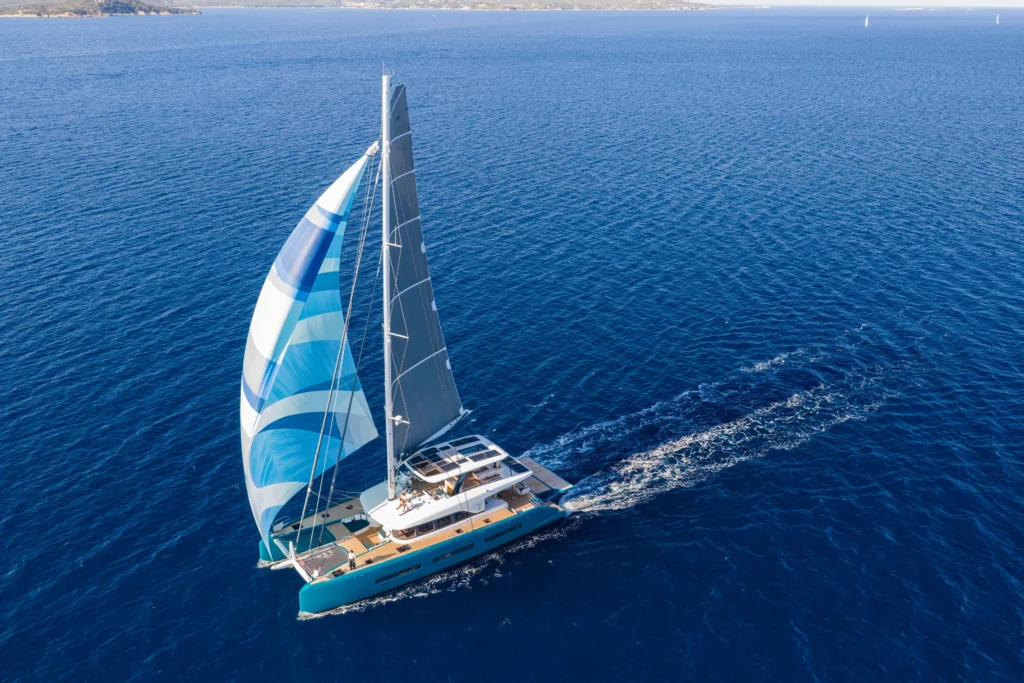
For Sven, our founder and captain, the visit begins with the weather window and the way Discovery will lie while people are ashore. Our 2025 Lagoon Eighty2 is the yacht sailing the world route, and her security does not become less important because the destination happens to be inland. An anchorage that is comfortable for a short stop with everyone aboard may be unsuitable for a long absence.
Itea lies on the northern shore of the Corinthian Gulf. Wind and swell with a southerly component therefore deserve particular attention when assessing an anchoring position. Being inside a gulf does not mean being sheltered from every direction. The surrounding mountains can channel the wind and produce local gusts, while thermal winds in settled summer weather can strengthen during the afternoon. Flat water at breakfast is an observation, not a forecast for the return.
We need current chart information, an assessment of the seabed and sufficient room to swing before deciding where to stay. The vertical distance relevant to anchor scope runs from the bow roller to the seabed, not simply from the sounder’s transducer to the bottom. More chain cannot repair poor holding or create space between boats. The anchor must be set and its holding checked, rather than assumed because the yacht has stopped moving.
The shore plan also needs a watch aboard, a working means of contact and a suitable tender landing. The town quay is useful only if local rules, access and conditions allow it. None of this needs to occupy the guests’ morning. It does need to be settled before they leave.
Allowing Time For Delphi From Itea
The road transfer from Itea to Delphi is roughly half an hour each way in ordinary conditions. That is a useful planning estimate, not a promise measured from the moment someone steps into the tender. Landing, meeting the driver and reaching the entrance all belong to the journey. So does agreeing how the return will work before the car leaves.
Our generous planning allowance would be around two hours for the archaeological site and another two for the museum. Add the road transfers, the tender journeys and a pause to eat, and this becomes a substantial shore day. A shorter visit is possible, but it involves choices. Returning to Discovery for lunch should be the consequence of choosing a shorter visit, not a deadline that quietly removes the museum.
In hot weather, an early start gives the exposed paths the cooler part of the day. The museum can follow as the sun becomes stronger. That order is a judgement call rather than a rule: cooler weather, opening arrangements or temporary restrictions may make the reverse sensible. Opening hours, heat-related closures and access to the upper parts of the site need checking close to the visit, not remembered from another season.
Footwear matters more than the apparent brevity of the excursion. The sanctuary climbs, its surfaces are uneven, and worn stone can be slippery. Water, a hat and a bag light enough to carry comfortably are practical necessities. Anyone with limited mobility should understand the gradient and current access arrangements before leaving the boat. A view of a hillside on a screen does not explain how it feels underfoot.
The Olive Groves Below The Sanctuary
The olive groves are worth looking at as more than the foreground to Delphi. Their leaves show dark and pale faces as the wind turns them, giving the cultivated plain a movement different from the water beyond it. From above, the trees can seem like a continuous natural covering. They are a working landscape, maintained through pruning, harvesting and decisions made over generations.
That distinction changes how we enter the place. A grove is neither empty land nor an extension of the archaeological site. Keeping to public routes and respecting access is a small expression of the same care we owe a working quay. Local food also becomes more interesting when it is connected to labour rather than scenery. An olive straight from the tree is generally intensely bitter. Curing is what makes it table food, and the method shapes its texture and flavour.
The ancient sanctuary was connected to the coast through this landscape, although arriving at modern Itea is not an exact reconstruction of an ancient pilgrim’s landing. We should not pretend otherwise. What remains legible is the relationship between sea access, cultivated ground and the steep ascent to sacred space. On a clear day, looking back towards the gulf makes that relationship almost physical. In haze, some of it has to be held in the mind.
The Questions Brought To Apollo
Delphi was understood as the omphalos, the navel of the world. In the myth, Zeus sent eagles from opposite ends of the earth, and their meeting identified its centre. That is a sacred explanation of the place, not a geographical claim we need to defend. It tells us something more useful: people arrived believing that this particular ground connected their uncertain lives to a larger order.
Apollo’s oracle spoke through the Pythia, the priestess consulted by communities and individuals. Questions concerned public decisions as well as private lives. Establishing a settlement, going to war or seeking relief from misfortune could all require more than practical calculation. Divine sanction carried weight in a world where religion and public authority were not neatly separated.
The exact mechanics of consultation are less certain than the familiar image of a woman delivering perfectly preserved riddles. We should be cautious about treating every famous oracle story as a verbatim record, or reducing the Pythia to an explanation involving fumes and trance. The physical setting, ritual preparation, people involved and later retelling all complicate that simple picture. What can be said plainly is that Delphi possessed an authority whose consequences extended far beyond the sanctuary.
It was not a place outside politics. The cities that sought Apollo’s guidance also displayed their successes here. Gifts could express gratitude and advertise power at the same time. Remembering this makes Delphi warmer and more recognisable. Its visitors brought reverence, ambition, fear and disagreement up the same slope. They did not become less human at the entrance.
Reading The Climb Through The Sanctuary
The Sacred Way is best understood as an approach that revealed buildings and dedications progressively. Walking it slowly allows the arrangement to do some of the explaining. The treasuries were buildings for offerings, but they also made the identity of the dedicating community visible. At the Athenian Treasury, the useful question is not only what the building contained, but what its position and appearance said to everyone passing it.
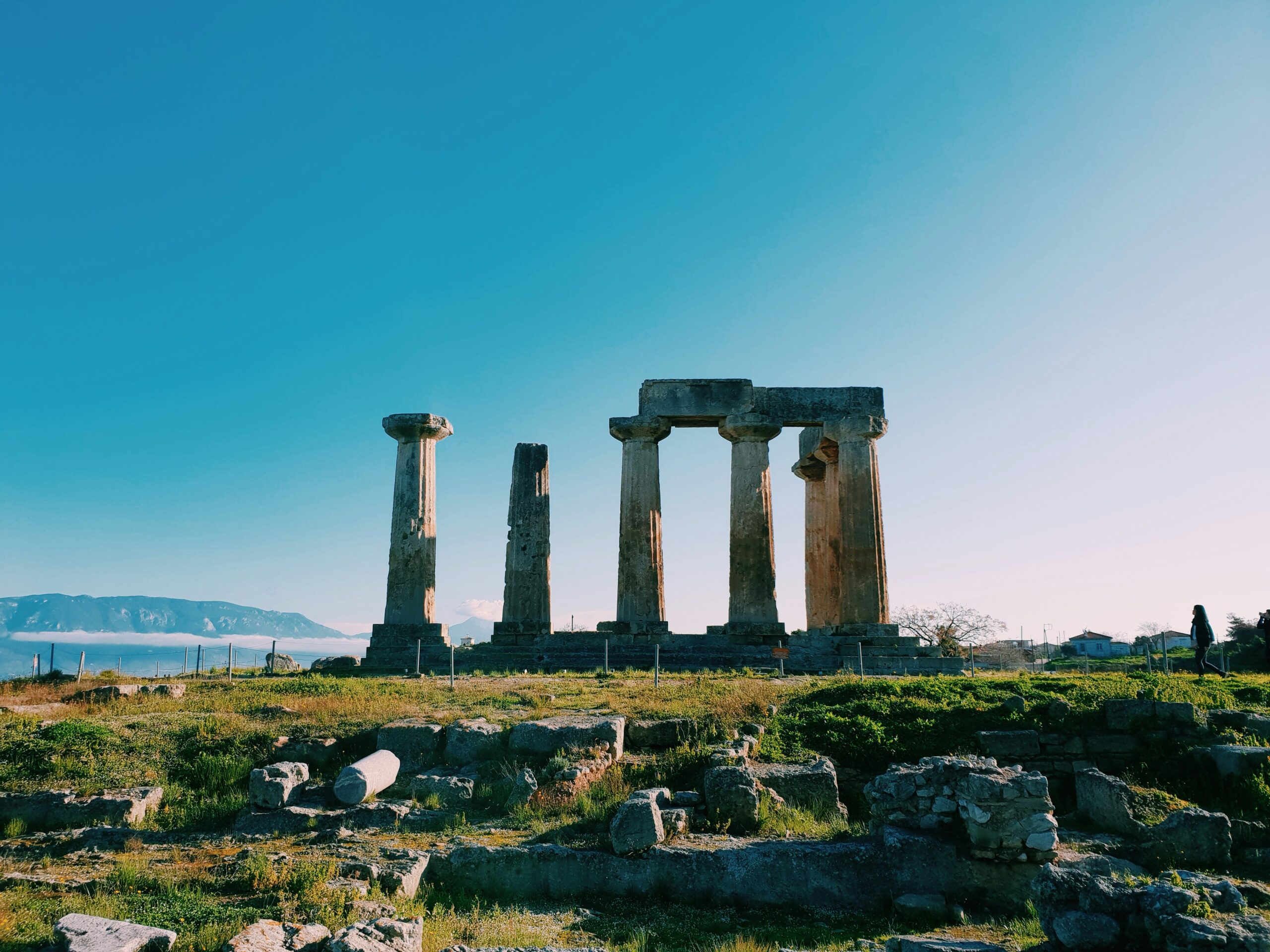
The visible remains of the Temple of Apollo belong principally to the fourth century BCE, after an earlier temple was destroyed. This matters because Delphi was repeatedly built, damaged and rebuilt. There is no single untouched moment waiting here. The six re-erected columns are an aid to imagining the temple’s form, not six survivors left exactly as the ancient worshippers saw them. Much of the building has to be understood from its footprint.
In summer, the climb is felt through the soles of the feet and the heat reflected from the stone. On exposed stretches, light comes from the ground as well as the sky. You shorten your stride on an uneven rise, stop where there is room without blocking the path, and discover that the pause makes the arrangement of the sanctuary easier to read. Heat is a good reason to slow down, but it should not be allowed to make the decision for you too late.
The theatre sits above the temple, and the stadium is farther uphill. Their presence widens the idea of Delphi beyond the oracle. The Pythian festival, held every four years, included musical and athletic competition. Apollo belonged to a world of performance as well as prophecy. A sanctuary could gather people to listen, watch and compete, not only to ask for an answer.
The stadium is worth the extra climb when access, temperature and everyone’s energy make it sensible. It is not a test of whether someone has properly visited Delphi. For a family or a group with different walking speeds, agreeing a comfortable extent of the visit is kinder than discovering halfway up that one person has been keeping quiet about tired legs. Seeing less attentively is better than reaching everything exhausted.
The Museum Gives The Stones Their People
The museum is not the indoor remainder of the visit. Outside, the missing objects leave spaces that the imagination can fill too easily with a vague idea of antiquity. Inside, the craftsmanship becomes specific. Stone was carved, bronze was worked, faces were given expressions and offerings were made to be seen. The sanctuary begins to recover something of its material density.
The Charioteer, a bronze figure from the early fifth century BCE, repays standing still. He belonged to a larger dedication that included a chariot and horses. Seen alone now, he can appear almost self-contained, but that was not his original setting. His composure belonged to the public celebration of an athletic victory, with patrons, competitors and spectators behind it.
After the glare outside, give your eyes time to adjust before moving closer. Look at the inlaid eyes, the folds of the long garment and then the bare feet. The detail of the toes and tendons brings the figure out of the category of ancient masterpiece and back towards a body. This is an especially useful way to look with children: choose something precise enough to notice together, rather than trying to explain an entire civilisation in front of a label.
The bronze also corrects the habit of imagining Greek sanctuaries as arrangements of pale, unadorned stone. Sculpture and architecture could carry colour, and metal dedications contributed a different surface and light. What survives outdoors is a reduced version of a much fuller visual world. The carved marble omphalos offers another connection between object and belief: the idea of a centre could be given a tangible form. Allowing time for these encounters is why we resist making the museum an optional final room before departure.
Returning To The Water
The return deserves the same care as the arrival. Afternoon conditions may differ from those at the morning landing, and tired legs are less reliable when stepping into a moving tender. Passing bags separately and keeping a hand available are small habits with real value. The boat is familiar by then, which is precisely when it is easy to stop paying attention to the short piece of water between quay and deck.
There is also no need to fill the rest of the day. After the climb, shade, drinking water and time to sit can be more welcome than another activity. Someone may want to describe the Charioteer. Someone else may prefer to look back at the mountain without talking. Shared time aboard does not require everyone to make the same use of it.
This is part of the freedom Naora is built around. Members choose when they join, where along the world route they step aboard and how long they stay, while Discovery continues sailing. Within that larger movement, a place can be given the attention it deserves. Freedom does not remove weather, opening hours or the need for a sound anchorage. It gives us room to respond to those things without pretending that every day must deliver the same amount.
Delphi asks for that room. We can understand something of its buildings and rituals without claiming to recover exactly what an ancient visitor felt. We can take its importance seriously without demanding a revelation of our own. Above the olive groves, the sanctuary remains on its slope. It does not need an answer from us.