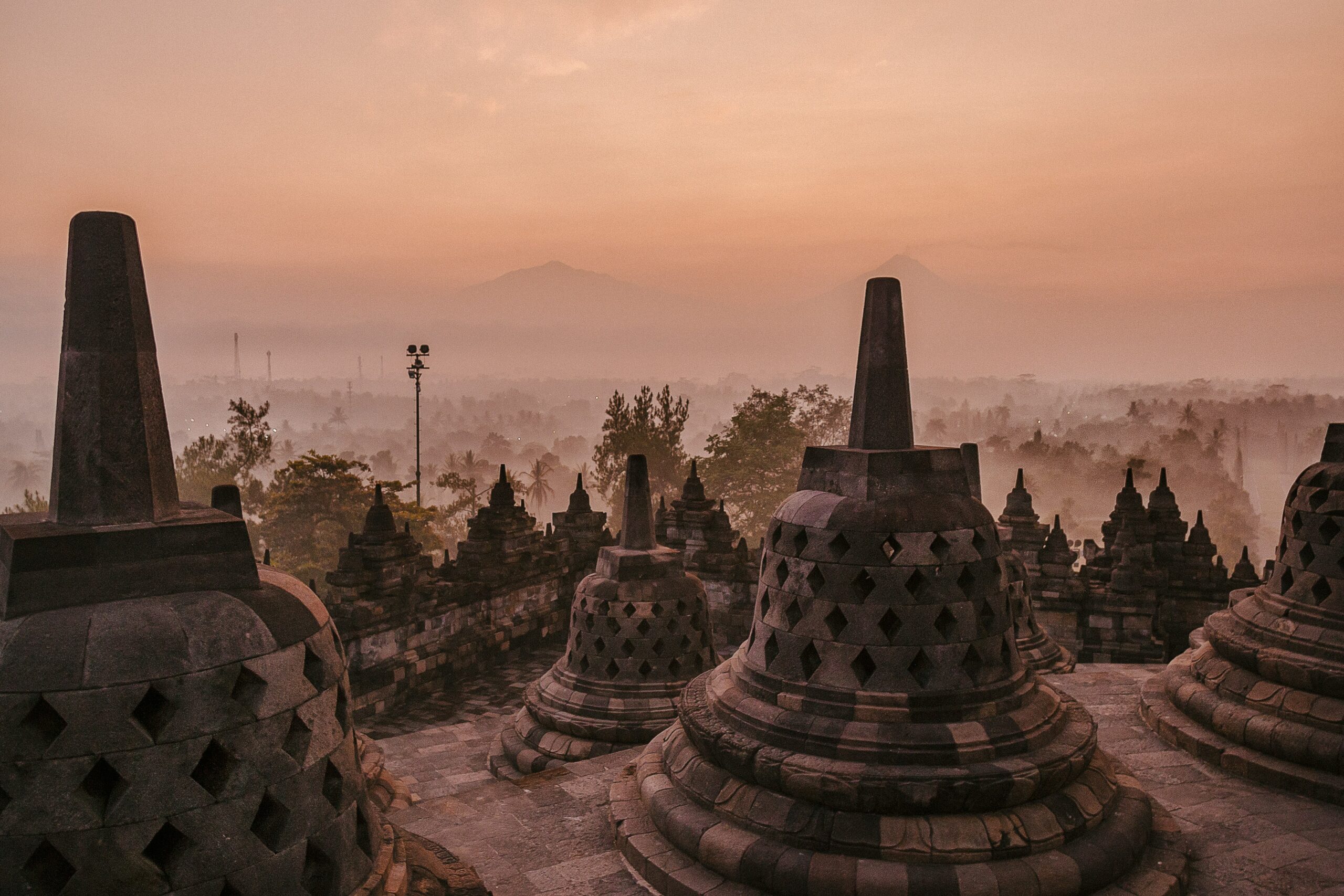
When low light falls across Borobudur’s carved walls, a cheek or a fold of cloth throws a small shadow, and what seemed a patterned surface resolves into people. The appeal of Borobudur at sunrise begins here, in the way light gives depth back to the stone. The distant outline matters, but so does the detail close enough to examine without lifting your head.
It is easy to plan the whole visit around the outline. There is the photograph of the bell-shaped stupas, the pale sky beyond them, the promise of arriving before the day gathers heat. Yet the photograph leaves out almost everything that determines the morning: where the boat lies, what access is permitted, how the weather develops and whether we have allowed enough time to understand what we came to see.
For us, that is the more interesting visit. Sunrise can be its beginning, without becoming the condition on which its value depends.
Planning Borobudur At Sunrise From The Coast
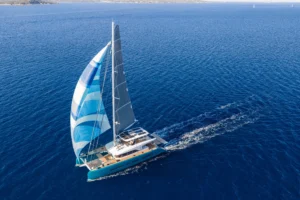
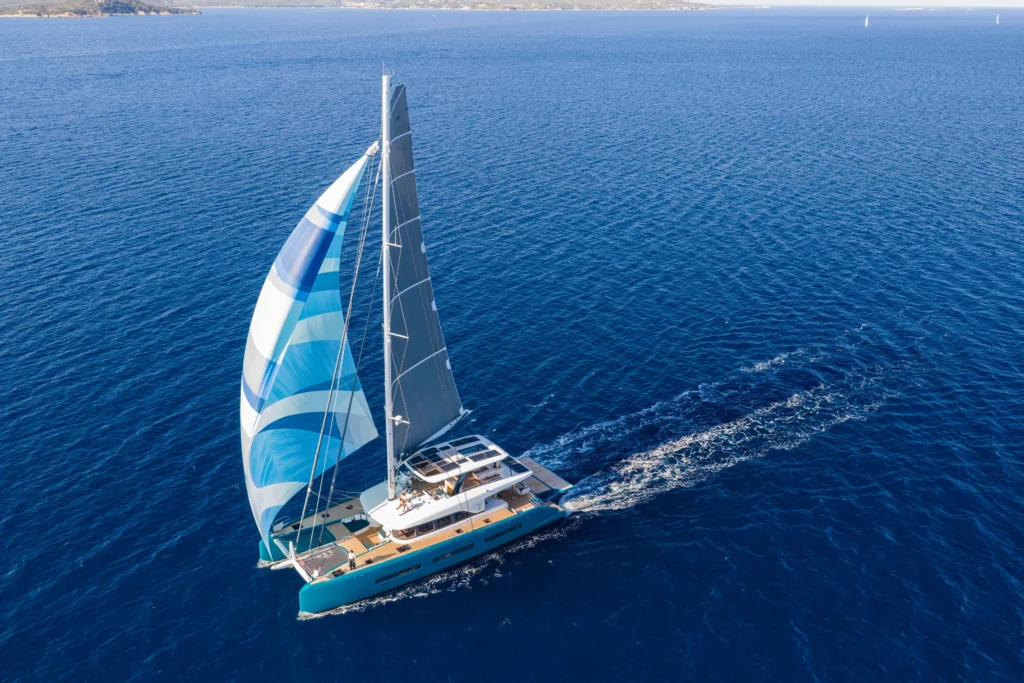
In the Indonesian chapter of the Naora Global Expedition, Borobudur belongs to an inland day from Java’s north coast. Discovery, our Lagoon Eighty2 sailing catamaran, remains on the coast while the road carries us towards the Kedu Plain. This separation matters. A yacht gives us a way of reaching Java, but it does not make the interior conveniently close to every possible landing.
The road time has to be calculated from the actual departure point, not from the phrase north Java. We need to account for getting ashore, meeting the vehicle, the road itself and the entrance procedure at the other end. A driving estimate is only one part of that sequence. An early alarm does not repair a plan that omitted the tender journey.
Before an inland visit belongs in our day, the boat must be secure for the whole absence. At anchor, that means considering the forecast beyond the quiet conditions at departure, the holding and swinging room, and the return landing if wind or swell develops. In a harbour, the questions change, but responsibility does not disappear. The arrangements for the yacht and the people remaining aboard need to be clear.
Sven, Naora’s founder and captain, plans the weather windows and sails every leg himself. A morning ashore has to fit that larger responsibility. We would rather change the land plan than make the boat’s afternoon depend on an optimistic return time.
The same judgement applies to the people going inland. A dark departure after insufficient sleep can turn an absorbing place into an endurance exercise. If the confirmed access and road journey make the morning unnecessarily punishing, an overnight stay inland may be the better decision. That is a planning choice, not a failure to keep the yacht at the centre of everything.
Access For Borobudur At Sunrise
The essential distinction is between entering the temple grounds and climbing the monument. Permission for one should never be assumed to include the other. Nor should the word sunrise be taken to mean standing among the upper stupas when the sun appears. It can describe a view of the temple rather than access onto its stone terraces.
These arrangements can change. Before fixing a departure, we need to establish what the visit actually permits on the intended date, including the entrance time and whether access onto the structure is included. If climbing is available through an assigned time and guide, the road plan has to work backwards from that appointment. An old account of a dawn visit is not an operating instruction.
The guide’s role deserves more thought than simply getting us through an entrance. Borobudur contains intersecting sequences of stories, and the shortest route upwards is not necessarily the most revealing. We would want time with someone who can explain a particular panel, place it within its sequence and distinguish what is known from what remains an interpretation.
Clothing and footwear also belong in the preparation, rather than becoming negotiations at the gate. Covered shoulders and knees are a respectful starting point. Any protective footwear required on the monument is part of conserving the surface. Familiar shoes that work well on deck do not automatically satisfy the rules for ancient stone.
Borobudur remains a Buddhist place of worship. Waisak, the observance of the Buddha’s birth, awakening and passing, is an especially important occasion here. During religious activity, the visitor’s preferred photograph is a minor consideration. Space for prayer comes first, and ceremonies may affect how people move through the site.
Weather And The Shape Of The Morning
Java’s wetter months generally fall from November to March, with drier conditions more likely in the middle of the year. That is useful seasonal context, not a promise about a particular dawn. The Kedu Plain and its surrounding volcanic uplands can hold cloud and moisture when a visitor would prefer a clear horizon.
The conditions that produce atmospheric mist can also conceal the view. A forecast showing no substantial rain does not guarantee visible sunrise, and a dry-season morning is not guaranteed to be cloudless. We would look at cloud and rainfall expectations as well as the broad seasonal pattern, then keep the plan generous enough to accept what arrives.
There is a bodily reason for preferring an early visit even without a dramatic sky. The ascent asks work of the legs; humid air makes that work more noticeable. On the open terraces, shade becomes scarce. Water, sun protection and a pace that suits the slowest person matter more than reaching a particular level before someone else does.
Imagine the change as the morning advances: the shaded side of a passage still feels cool against the warmth gathering on your shoulders, footsteps become more distinct as more people arrive, and the stair ahead suddenly seems steeper than it looked from below. That is the point to pause before fatigue makes the decision for you. Wet stone requires still more attention, particularly on the way down.
Cloud has its own visual advantage. Softer light can make the reliefs easier to study without deep shadow cutting across them. A morning without the expected sunrise can still be an excellent morning for looking closely.
The History Beneath The View
Borobudur was built during the late eighth and ninth centuries, under the Sailendra rulers of central Java. Its scale makes it widely recognised as the world’s largest Buddhist temple, but size alone explains little about the achievement. This was an immense arrangement of stone, imagery and movement, built around a hill so that the visitor’s progress through it could carry meaning.
Its later history is less tidy than the familiar story of a temple buried by a volcano and then discovered. Religious and political life shifted, the monument ceased to receive sustained care, vegetation grew and volcanic material accumulated. The reasons for its abandonment cannot responsibly be reduced to a single event.
In 1814, Raffles ordered an investigation of the overgrown monument. Local people already knew it was there. That distinction is worth retaining: an official investigation brought Borobudur into a different historical record, but did not bring an unknown place into existence.
What we see now also owes much to major restoration work, including campaigns in the twentieth century. Sections were dismantled, recorded and reassembled, and drainage was a central concern. Rainwater entering the structure can carry moisture into places where it is difficult to remove, encouraging deterioration and affecting the stability of the masonry. Keeping water moving away is part of keeping the monument standing.
For anyone responsible for a boat, that is a familiar kind of problem. The visible surface is only part of the condition of a structure. What water does behind it can matter more. Borobudur’s apparent permanence rests on continuing work, which is one reason limits on access deserve to be understood rather than merely tolerated.
A Temple Designed To Be Walked
Borobudur rises through six square platforms and three circular ones, crowned by a central stupa. Those numbers explain a physical change that a photograph from a distance can conceal. Below, the architecture directs attention along galleries and carved walls. Above, the enclosing detail gives way to a more open relationship with the sky.
The ascent expresses Buddhist ideas of movement from desire through form towards formlessness. That is a useful beginning, although it should not be mistaken for a complete explanation of the monument’s religious meaning. The structure makes an abstract progression something the body can experience through walking, turning and climbing.
Traditional circumambulation is clockwise, keeping the sacred centre to the right. Where the permitted visitor route allows that movement, it helps explain why Borobudur should not be treated simply as a staircase to a viewpoint. The galleries ask for movement around the monument as well as upwards. Current circulation rules take precedence over any visitor’s attempt to reconstruct a pilgrimage.
On the circular terraces stand 72 perforated, bell-shaped stupas, originally each enclosing a Buddha figure. Their openings allow partial views rather than presenting every figure immediately and completely. The repeated forms are part of the experience: the eye moves from one to another, while the open landscape beyond gives a different measure of distance.
Up here, the physical sensation changes. There is less wall close beside you, more sky in your peripheral vision, and fewer carved scenes asking you to stop. The climb remains in your breathing. It is possible to appreciate that change without claiming a revelation from it.
The stupas and statues are not handholds. Reaching through an opening, leaning against a figure or stepping onto masonry for a better picture adds pressure without adding understanding. A little distance is often what allows the form to become clear.
The Stories Cut Into The Stone
Borobudur’s often quoted total of 2,672 relief panels includes decorative as well as narrative work. It does not mean a single story told in that many consecutive scenes. Some sequences concern the Buddha’s life; others depict earlier lives and exemplary acts. Knowing that prevents the understandable mistake of trying to read every gallery as one continuous biography.
The most useful request we can make of a guide is to slow down at one panel. Identify the principal figure. Look at the direction of the faces and hands. Ask what action connects this scene to the next. A single explanation followed carefully can teach us how to look at much more of the monument than a rapid procession of names.
There is warmth in the ordinary detail. Alongside religious narratives are representations of buildings, plants, animals, clothing and human exchanges. These are not transparent photographs of everyday life, but they allow the stories to take place in a recognisable world. An offering has to be held by a hand. A listener turns towards someone speaking.
For a child, finding an animal or following a gesture may be a more generous beginning than an explanation of Buddhist cosmology. For an adult, it may be the better beginning too. Recognition gives attention somewhere to settle; interpretation can follow.
As sailors, we are particularly drawn to the vessels represented in the reliefs, including ships with sails and outriggers. An outrigger helps a narrow hull resist heeling by placing supporting buoyancy away from the main hull. The principle is legible even when the craft belongs to a very different sailing world from Discovery.
These carvings are images, not construction drawings, and they should not be asked to prove more about a vessel or a voyage than they can. Still, their presence matters. Here, inland among Buddhist narratives, boats occupy a place in the human world the sculptors understood. The coast has not been left entirely behind.
Time To Return Without Hurrying
We would not make a return to Discovery by noon the measure of a successful visit. The road, the permitted time on the monument, the weather and the people walking it all have a claim on the day. A fixed return promise made too early can begin to govern every decision, including how long we listen and whether someone feels able to rest.
There is room for a meal ashore and for the unremarkable interval after an absorbing visit, when nobody needs another explanation. There is also room for someone to decide that the grounds are enough, or that an early inland departure does not suit them. Shared travel does not require identical appetites for every day.
That fits the wider shape of Naora. Members choose when they join the world route, where they step aboard and how long they stay. Discovery keeps sailing, but the life of the expedition is not measured only in passages completed. Some days deepen a place rather than add another destination to it.
Borobudur deserves that kind of day. The light may arrive as hoped, or the volcanoes may remain behind cloud. Access may lead us onto the terraces or require a different way of seeing the monument. What need not change is the attention we bring.
A carved hand holds its offering in the stone. There is time to look at it.