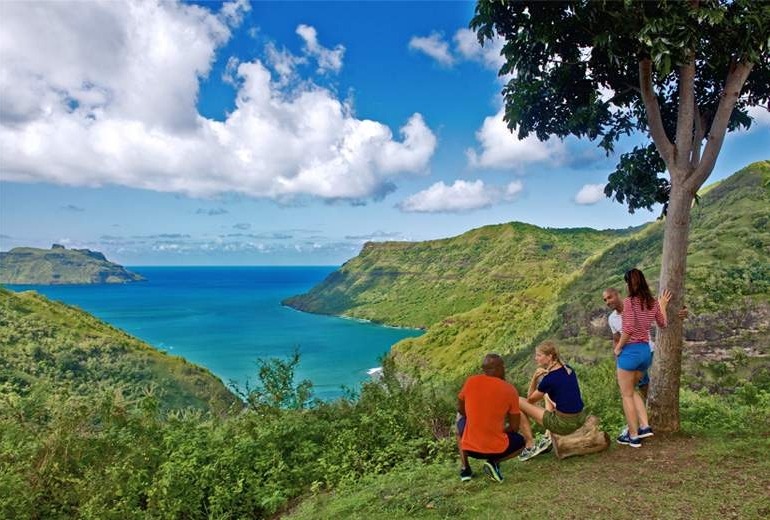
From Taiohae Bay, the ridges conceal more of Nuku Hiva than they reveal. Taipivai Valley lies beyond that first wall of land, out of sight from the anchorage, and the distance between the two is more than something to measure on a map. After open water, there is an almost physical appetite for following a slope inland, for finding out what grows behind the skyline and where the water comes from. A coast becomes a place when we begin to understand what lies behind it.
Herman Melville crossed into that interior after deserting a whaling ship. We come with a different relationship to the boat behind us, and with the advantage of being able to read his account before setting foot ashore. But Typee needs careful handling. It is a remarkable book, written by a young outsider who knew very little of the language and stayed only briefly. It can sharpen our attention. It should not decide in advance what we are going to see.
The Sailor Behind The Story
In July 1842, Melville deserted the whaler Acushnet at Nuku Hiva. He and a companion crossed the mountainous interior and reached the valley inhabited by the Taipi. The physical difficulty matters: leaving a ship did not mean stepping into an easy alternative. It meant moving through unfamiliar country, dependent on people whose intentions he could not always understand and whose language he could scarcely speak.
His stay among the Taipi lasted about four weeks. The book expands it into roughly four months. That difference changes how we read everything around it. A month allows powerful impressions, attachments, misunderstandings and moments of extraordinary dependence. It does not allow a newcomer to understand a society from the inside. Melville made a sustained narrative from a much shorter encounter, giving uncertainty the shape and momentum of an adventure.
He did not write Typee in the valley. He wrote it after leaving the Pacific, and it appeared in 1846. Moby-Dick followed in 1851, five years later. The valley belongs to the beginning of his literary life, when remembered experience was becoming something more deliberate on the page. The title itself is his rendering of Taipi, a people’s name carried into another language and made familiar to readers far away.
There is much to value in his attention to food, hospitality, physical skill and the damage outsiders could bring. There is also fear, romantic invention and the appetite of a foreign readership for an unfamiliar world. France asserted possession of the Marquesas in 1842, the same year he arrived. Whaling, trade, missionary activity and colonial power were already changing island life. He was not witnessing a place outside history. He was passing through one under considerable pressure, without being able to see the whole of that pressure himself.
Taiohae Bay Before Going Ashore
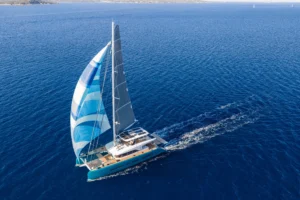
For Discovery, the Lagoon Eighty2 sailing the Naora Global Expedition, the first responsibility at Nuku Hiva is less literary. Taiohae Bay opens south, so swell arriving from that direction can work into the anchorage. High ground provides shelter from some winds while also bending and accelerating airflow. A settled breeze offshore does not guarantee an equally settled breeze between the slopes. The view of green hills is not an anchoring assessment.
We need to understand the bottom, the depth and the room available as separate questions. Mud may offer useful holding, but a soft surface layer does not mean the anchor has reached material that will resist a sustained pull. Once the anchor is down, we allow it to settle and load it progressively under engine, checking movement against fixed references and the instruments. The boat coming to rest is not, by itself, evidence that the anchor is secure.
The depth figure also needs interpretation. A sounder may display depth below the transducer, below the keel or from the surface, depending on its settings. Before calculating how much chain to lay, we need to know which figure we are using, account for the bow’s height above the water and allow for any expected rise in water level. Then we consider the whole swinging area, including neighbouring boats that may move differently. Scope is geometry before it is a rule of thumb.
Sven, Naora’s founder and captain, plans every weather window and sails every leg himself. A day inland sits within that continuing responsibility. The shore plan must leave Discovery properly attended, with a return arrangement that can change if conditions do. The tender landing deserves its own assessment because movement at a quay can be quite different from movement aboard. These decisions are made before anyone is looking for walking shoes. Getting ashore should feel simple because the complications have already received attention.
Reaching Taipivai Valley Today
Taipivai is connected by road to the rest of Nuku Hiva. It is not a roadless valley preserved by isolation, and arriving by vehicle does not diminish the encounter. A drive followed by walking locally may leave more energy for looking, listening and spending time with someone who knows the place than an ambitious crossing of the ridges. Melville’s escape route is part of the story, not an obligation placed on every visitor.
We would not give an unverified trailhead or promise a fixed walking time from Taiohae. Paths change, vegetation closes in, access may cross land where permission is needed, and recent rain can matter more than the apparent length of a route. The useful conversation is with someone who knows the intended path now. A local guide can contribute both practical judgement and an understanding of what we would otherwise pass without recognising. That is skilled work worth paying for.
On a wet morning, shade in a valley does not necessarily bring relief from humidity. A shirt can stay damp beneath the trees even when the direct sun has disappeared. Leaves continue dripping after the shower has moved away, and a root that looks like a convenient step can be slick under a shoe. These are ordinary details, but they determine pace. Secure footwear, drinking water, sun protection for exposed stretches and protection against biting insects belong in the plan before the book goes into the bag.
Rain higher in the catchment can also change a stream while the lower valley remains comparatively dry. Rising or newly discoloured water deserves attention; a swollen crossing is a reason to stop, not a challenge to complete. We leave time to turn back without rushing the return to the boat. For families or people finding their land legs after a passage, the better day may contain less walking and more stopping. There is no particular virtue in arriving at an important place too tired to notice it.
The Work Beneath The Canopy
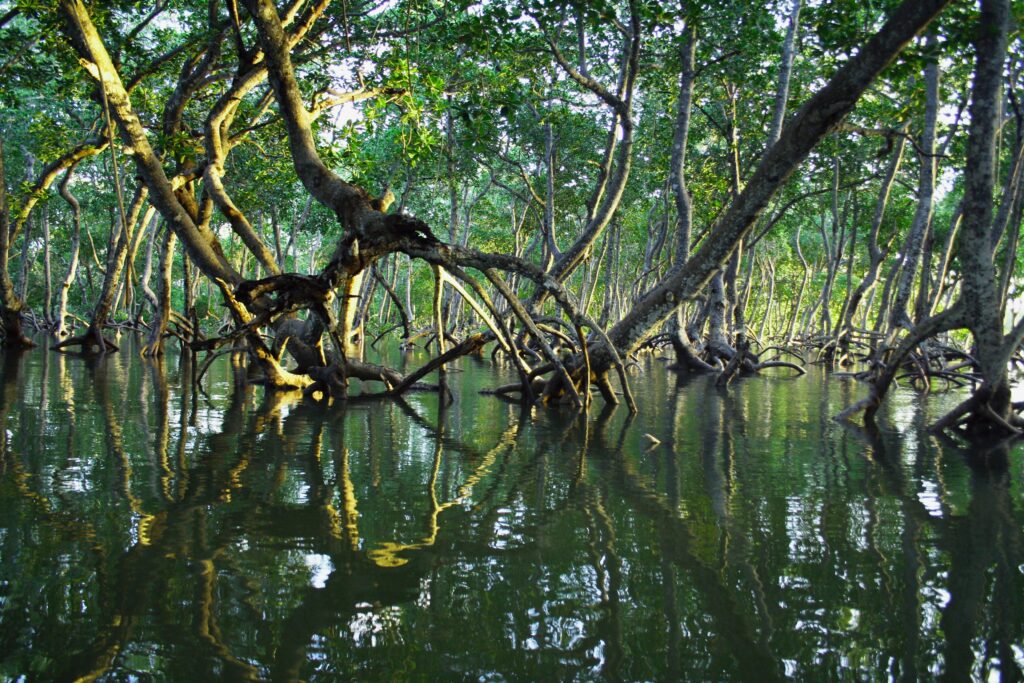
The easy mistake in Taipivai is to call everything green forest and everything forest wild. Breadfruit, coconut and taro belong to histories of cultivation as well as to the present landscape. A tree canopy can conceal generations of work. What appears abundant to a passing visitor may depend on selection, planting, tending, harvesting and the knowledge of how to keep food beyond the moment when it is fresh.
Breadfruit makes that distinction especially clear. Its starchy flesh becomes substantial food when cooked, but maturity and ripeness are not interchangeable. A mature, firm fruit can be treated as a savoury staple; as it ripens, its texture softens and its sweetness increases. If we buy one for the galley, the useful first question is how the person selling it would prepare that particular fruit. An unfamiliar ingredient is easier to understand through its condition than through a recipe chosen before seeing it.
Firm breadfruit can be cooked until tender and then browned, giving the edges a different texture from the soft interior. Roasting develops another character again. Marquesan food knowledge also includes fermentation and pounding, with breadfruit used in preparations such as popoi. Traditionally, breadfruit was fermented in storage pits so that part of a harvest remained available beyond the fresh season. That is an answer to a practical problem familiar aboard any long-distance yacht: abundance today does not remove the need to think about tomorrow.
Taro draws attention to water and labour. Where it is grown in wet cultivation, water must be managed rather than merely endured. Looking at a valley floor with that in mind changes the meaning of a channel or a level patch of ground. The same is true of coconut groves. Their presence does not prove that the landscape is unchanged, and it does not erase the cultivation that came before. Without local knowledge, we should be cautious about assigning an age or a purpose to what we see.
This is where looking slowly becomes useful rather than decorative. Notice the relationship between a planted area and the river, between a fruit tree and a house, between stonework and usable ground. The valley becomes more legible when we stop treating vegetation as a curtain over its history. Much of the history is growing.
Reading Taipivai Valley With Local Company
Stone remains require the same change of attention. In the Marquesas, a paepae is a stone platform associated with a building, often a house. A tohua is a communal gathering ground. Learning the distinction helps prevent every substantial stone structure from becoming a vaguely described sacred site in a visitor’s account. Domestic life, public life and religious life each left material traces, and their meanings cannot be read reliably from appearance alone.
A guide can help establish what a particular place is, what is known about it and what remains uncertain. We should leave room for that uncertainty. An explanation does not become better because it supplies a confident story for every stone. Nor does a platform become somewhere to climb simply because it appears solid and accessible. We follow local guidance, avoid disturbing remains and ask before entering land that is not clearly open to visitors.
The same courtesy applies to living homes and cultivated ground. Fruit within reach is not necessarily available to pick. A person working beside the road is not automatically available for a photograph. Asking permission is a small act, but it changes the relationship from taking to meeting. We value privacy aboard Discovery; it would be a strange inconsistency to forget what privacy means as soon as we step into someone else’s valley.
Marquesan is a living language, not a decorative accompaniment to the landscape. Asking how a name is pronounced, listening carefully and using it again is more valuable than arriving with a memorised phrase we do not understand. Local company may also direct attention away from the things we expected to discuss. Melville might be less important to the conversation than food, family, a damaged path or work that needs doing. We need not pull every subject back towards the visitor who became famous elsewhere.
That is perhaps the most useful reason to carry Typee without allowing it to lead the whole day. The book gives us one person’s intense encounter. Someone who lives here can show us what that encounter leaves out, including the ordinary present. The valley is allowed to have concerns that do not involve us.
The Return To Discovery
After a passage, the transition from boat to land can be surprisingly physical. The body has been making small adjustments so continuously that a firm surface feels almost overdetermined. Inland, those adjustments give way to climbing, heat and the weight of a bag against the shoulders. Returning to the tender brings another change: moving water beneath the feet, the need to time a step, the engine briefly taking over the conversation. A good day ashore leaves enough attention for that last transfer.
Back aboard, wet shoes and muddy soles need dealing with before they carry the valley through the living spaces. Walking gear should be cleaned before the yacht moves on, particularly before another island visit. Soil and seeds travel easily in tread and seams. Keeping them from travelling with us is a small, practical expression of the care a worldwide route requires. Local respect does not end at the waterline.
Within the French Polynesian part of Naora’s world route, a visit like this can hold a different place in each person’s time aboard. Members choose when they join, where along the route they step aboard and how long they stay. Some will have a longer passage in their recent memory; others will be settling into the yacht’s rhythm. There is no need to make their days identical. The expedition continues, but attention need not always be directed towards the next horizon.
An inland day also asks something of the evening. People may want food, a shower and quiet before they want a conversation about what they have seen. We can leave the book within reach without turning dinner into a discussion that everyone must join. Later, a passage in Typee may read differently because we have begun to distinguish the author’s experience from the place itself.
Beyond the ridges, people are at home.