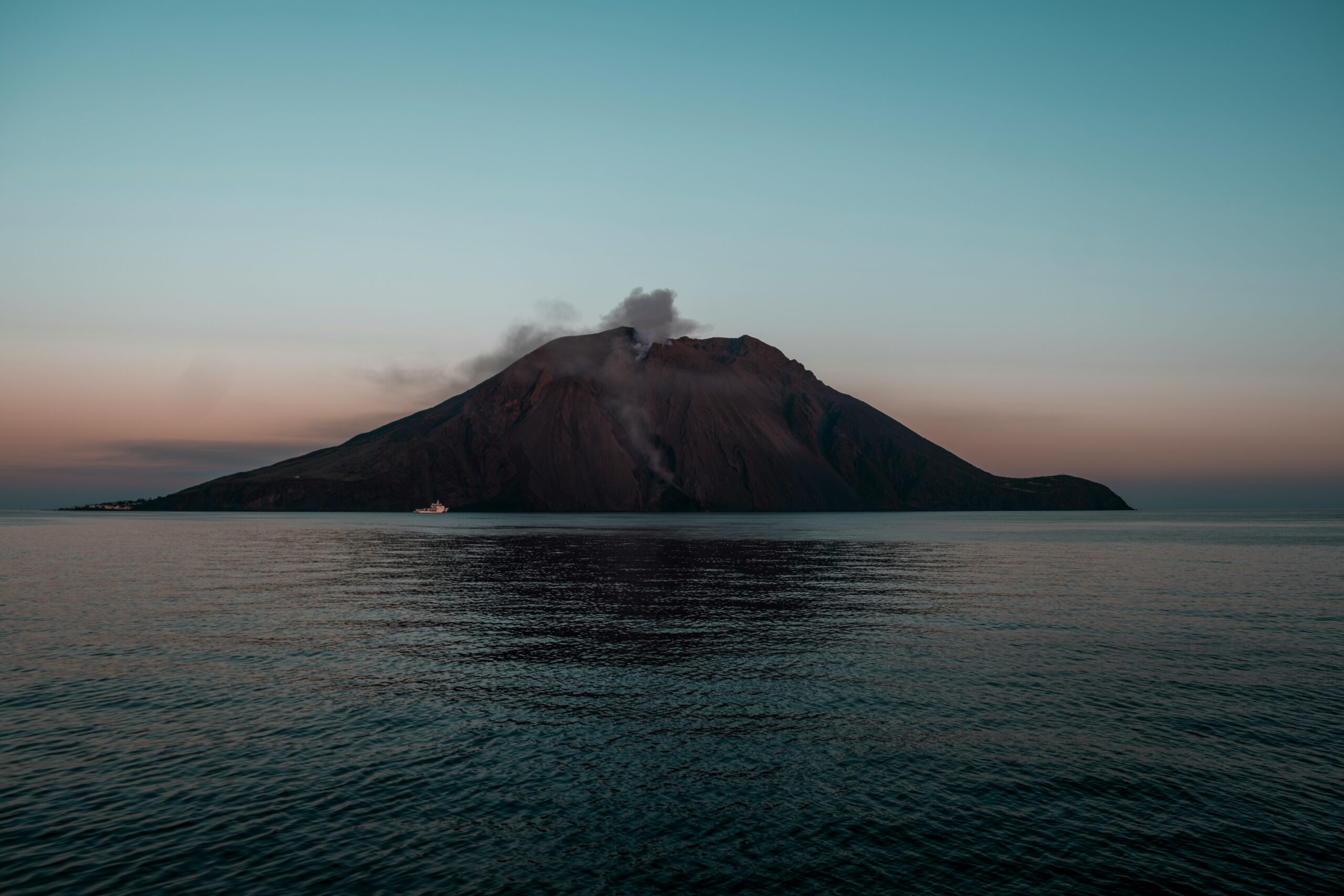
The first orange fragments can be visible while the mountain beneath them is almost lost against the sky. Stromboli at night has this strange scale: a small brightness in the distance belongs to a process large enough to shape an island. The sound, if it reaches you, comes later. Between seeing and hearing, there is time to notice the water against the hull.
Darkness makes the eruption more visible and much of its setting less visible. The slope disappears. Distance becomes difficult to judge. A photograph can bring the glow close while removing almost everything that would explain where the photographer was standing. The experience is extraordinary, but the image is a poor planning document.
For Naora, an evening here begins with less photogenic questions. What access is permitted? Where can Discovery remain safely? What will the wind do while people are ashore, and what happens if the return takes longer than expected? These questions belong to the pleasure of the evening. Answering them properly leaves room to look up.
A Persistent Volcano Is Not A Predictable One
Stromboli belongs to the Aeolian Islands, north of Sicily in the Tyrrhenian Sea. Its reputation rests on roughly 2,000 years of persistent activity, a span that helps explain why sailors have long recognised it as a natural beacon. But persistent does not mean uniform. The phrase describes the volcano over human history, not a dependable performance on a particular evening.
In its characteristic activity, gas rising through the magma expands and bursts near the surface, ejecting incandescent fragments. Separate explosions can occur minutes or tens of minutes apart, with considerable variation in strength and appearance. This is different from a sustained lava flow. An orange spray above a vent does not mean that molten rock is running all the way down to the sea.
The summit reaches about 924 metres above sea level, with the active crater terrace below it. That distinction matters from the water: we are looking towards vents within a complicated landscape, not a fire burning neatly at the highest point of a cone. A ridge may hide an explosion that would be visible from another permitted position. Cloud can obscure the upper mountain altogether.
The familiar bursts also do not represent the full range of Stromboli’s behaviour. Larger explosions and episodes of lava emission occur. A quiet interval is not evidence that conditions have become safer, and a captain’s experience with weather does not confer the ability to forecast volcanic activity. We can make decisions about exposure. We cannot promise what the mountain will do.
Reading Stromboli At Night From The Water
The Sciara del Fuoco occupies the northwestern flank, a broad, steep scar descending from the crater area towards the sea. It is often imagined as a permanent river of lava. More usually, it is a slope across which loose volcanic material falls and accumulates; during effusive activity, lava can descend there too. Knowing the difference changes what we look for and prevents us from expecting a continuous red line.
It also changes how we approach. The foot of the Sciara is not somewhere to edge closer for a better photograph. Material descending the slope can reach the sea, and larger events can affect the water as well as the land. Rapid entry of material into the sea can generate dangerous waves. Being afloat does not remove volcanic exposure, which is why current maritime restrictions matter independently of the weather forecast.
Our planning therefore begins with the permitted sea areas and any temporary restrictions, then considers visibility, wind, swell and a clear route away. We do not choose a distance from an attractive photograph or from where another vessel happens to be waiting. Nor does a clear view oblige us to stay. A viewing position has to remain a sound position for the boat.
Wind direction matters for more than comfort. It influences where gas and ash travel, while the air moving around a steep island may differ from the broader forecast. A plume leaning away from the yacht is information about the present moment, not a guarantee for the next hour. We keep watching the water and the instruments as well as the mountain.
After dark, an eruption can draw every face in the same direction. Someone still has to watch the vessels around us. A boat moving slowly to observe is still navigating, and its lights, lookout and manoeuvring room remain part of the evening.
An Anchorage Has To Work After Sunset
A view of the volcano is not an anchoring criterion. Holding ground, depth, shelter and room to leave come first. Stromboli’s steep form continues below the water, and depth can change quickly close to shore. An anchorage that looks comfortably near the village on a small chart may offer less usable bottom than the view from the deck suggests.
We read the chart alongside the sounder and the actual conditions. For scope, the relevant vertical distance runs from the bow roller to the seabed, not simply from the waterline to the bottom. The depth display also needs to be understood: its reading may be referenced to the transducer, the keel or the surface. An unexplained number is not yet useful information.
On a steeply shelving bottom, we also consider where the yacht would lie after a wind shift, rather than only where the anchor first lands. A promising patch of sand must be large enough for the intended arrangement. Rock, boulders and seagrass are not interchangeable alternatives. We look for suitable bare holding ground and avoid treating vegetation as something the anchor can simply tear through.
The Mediterranean’s generally modest tidal range does not make an open anchorage motionless. Swell can arrive from weather beyond the local horizon, and an offshore wind can make a beach look sheltered while complicating a tender passage farther out. Summer warmth says little about how easily someone will step from a moving tender after a long walk.
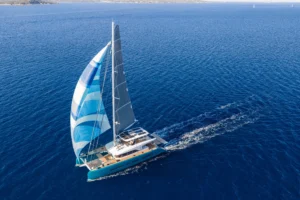
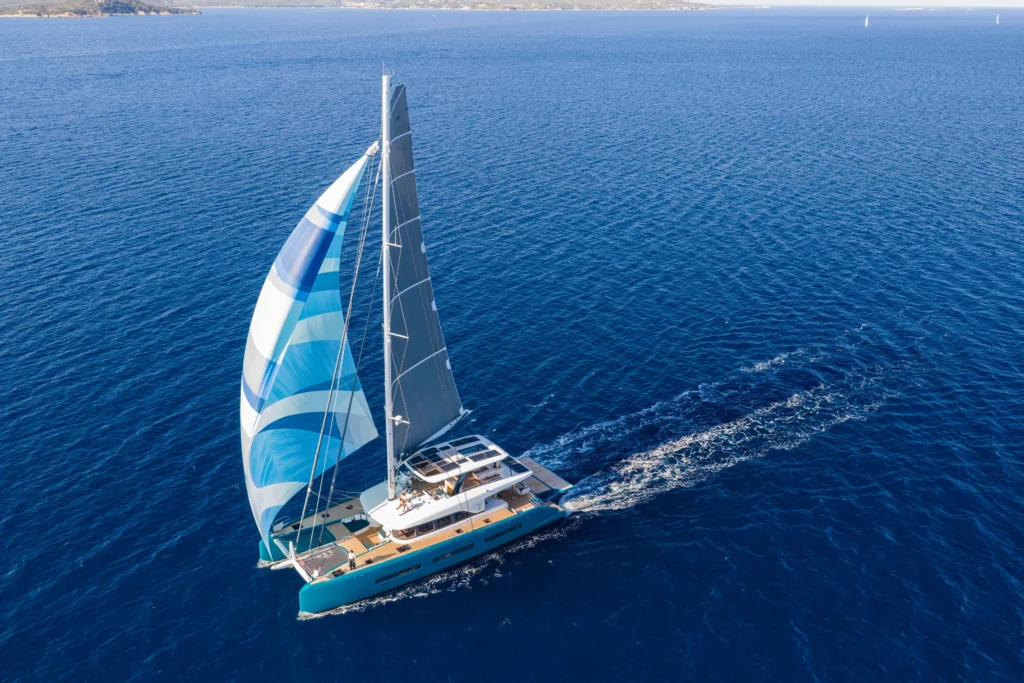
On Discovery, our Lagoon Eighty2 sailing catamaran, the space and steadiness aboard do not change these fundamentals. We need a secure boat, adequate watchkeeping and a workable return from shore. If those conditions cannot be maintained, the shore visit changes or does not happen. Dinner can move. Holding ground cannot.
Walking On The Volcano As It Is Today
The old description of Stromboli as a straightforward sunset climb to the crater rim is not a reliable basis for a visit. Access limits, guiding requirements and closures change with volcanic conditions and the state of the paths. A previous visitor’s permitted altitude may have no relevance to the day we arrive. Summit access must never be assumed.
Before arranging a walk, we establish which routes are open, how high they go, whether a qualified local guide is required and what equipment is necessary. A guide brings knowledge of the terrain, the permitted route and the response expected if conditions change. A guide does not make a closed path open or eliminate volcanic risk.
The departure time follows that actual route, the season’s daylight, the party’s pace and the agreed return arrangements. There is no universally useful instruction to leave in mid-afternoon. A lower permitted walk and a longer ascent are different undertakings. So are a party accustomed to loose ground and a family discovering that volcanic grit moves beneath each step.
Where walking is permitted, footwear needs grip and a secure fit. Water is planned for the duration, heat and exertion, with a reserve rather than an optimistic allowance. Each walker needs a working headtorch, with backup lighting arranged, and a windproof layer for the change from climbing to standing still. Any required protective equipment belongs to the plan from the beginning.
The physical change after sunset can be abrupt even when the weather remains settled. The heat of the climb stays inside a shirt while the breeze cools damp fabric against the back. A headtorch lights a small patch of ground; beyond it, the slope loses definition. Loose grains roll under a boot, and the descent requires attention precisely when tired legs would prefer to finish.
That is why the return is part of the outing rather than an inconvenience after the spectacle. We allow time for it and avoid a boat schedule that encourages anyone to hurry downhill. Choosing a shorter walk, or remaining near the village, can be the better decision without requiring an apology.
Giving Stromboli At Night Your Attention
Eyes need roughly 20 to 30 minutes to adjust substantially to darkness, though adaptation continues beyond that and varies with the light around us. A bright phone screen works against the process. Put it away for a while and the island’s outline becomes easier to distinguish; the sea gains texture, and lights that initially seemed to float without context begin to belong to boats or buildings.
We keep deck lighting appropriate to the task, without compromising safe movement or navigation. The same applies ashore. Preserving night vision is never a reason to cross loose ground without enough light to see it. Looking and walking are best treated as separate activities: stop somewhere permitted and secure, then give the mountain your attention.
Sound provides another useful lesson in distance. It takes about five and a half seconds to travel 1 Nm through air, while light arrives effectively at once. That explains why an explosion may be seen before it is heard. Wind, terrain and the character of the event affect what reaches us, however, so counting seconds is not a dependable way to establish a safe viewing position.
The quiet between events is part of what makes the place compelling. There may be voices nearby, a halyard touching a mast, the small slap of water beneath a hull. Nothing in that interval promises another visible eruption. Once we stop treating the pause as a delay, there is considerably more to notice.
The Island Beyond The Eruption
From offshore, Stromboli can appear to consist entirely of its mountain. Ashore, there are homes, work, deliveries, meals and the ordinary need to get somewhere without being photographed. The volcano draws visitors into a place where people continue to live with it after the last boat has gone. That difference in perspective deserves some room.
We keep clear of working landing areas, avoid blocking narrow routes while gathering a shore party and respect barriers even when there is no one standing beside them. In a place where access may change quickly, a sign is not decorative scenery. Nor should a visitor’s desire for a quiet photograph make someone else’s doorway or garden part of the evening’s entertainment.
Food can bring the attention back to a human scale. Capers are part of Aeolian cooking, offering a sharp, savoury counterpoint to tomatoes, olive oil and fish. If we bring salt-packed capers aboard, we rinse and taste them before adding them to a sauce. Some need soaking as well. Their salt belongs in the seasoning calculation, rather than being followed automatically by another handful.
We ask what was grown or landed locally rather than assuming that everything served on an island came from it. The answer may be mixed, and that is useful to know. Sourcing locally means understanding what a place can provide, not requiring it to fulfil an idea we brought with us.
An unhurried meal ashore or something simple from the galley can sit comfortably beside the volcano without competing with it. There is pleasure in returning to a familiar glass, a dry layer and a plate that needs no explanation. The mountain does not have to occupy every conversation.
A Place Within A Longer Passage
Stromboli belongs within the Mediterranean chapter of a much longer undertaking. The Naora Global Expedition is planned across roughly 49,000 Nm around the world. At that scale, a responsible voyage cannot depend on making every anticipated experience happen exactly as imagined. It needs room for places to be encountered on the terms they actually present.
Sven, Naora’s founder and captain, plans every weather window and sails every leg himself. The evening’s decisions therefore belong to the same person who must consider the following passage. A late return, a deteriorating anchorage or a tired shore party is not separate from tomorrow’s sailing simply because tonight’s view is memorable.
Members choose when they join, where along the world route they step aboard and how long they stay, while Discovery continues sailing. That freedom gives people different relationships with a place like Stromboli. For someone aboard briefly, it may be the evening they most anticipated. For someone staying longer, it sits among many landfalls. Neither expectation changes the access rules or the forecast.
We can prepare carefully, make a sound approach and still see very little. Cloud may hold over the summit. The permitted view may remain dark. There is no need to manufacture a lesser version of the promised spectacle, because no spectacle should have been promised. For a while, the outline of the island is enough.