
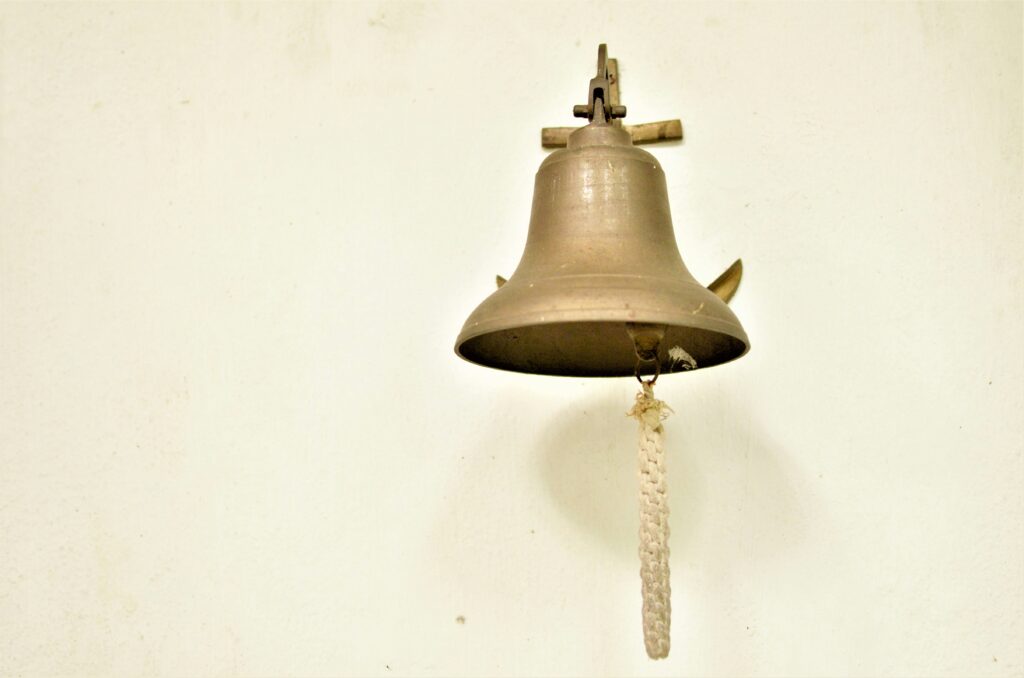
The ship’s bell is the most underestimated instrument on any sailing vessel, and the most misused artefact in maritime-themed interior design, where it most commonly appears as a decorative object on a bar wall with no indication of the six or seven specific and critical functions it served on the vessel it was removed from.
The bell is not decorative. It is the most versatile communication and measurement instrument that the pre-electronic sailing vessel possessed, and every function it served was a function that the vessel’s safety and the crew’s welfare depended on.
The Watch System
The primary function of the ship’s bell was timekeeping for the watch system. In the era before personal timepieces were available to ordinary sailors, the bell was the vessel’s clock: struck once at the end of the first half hour of each watch, twice at the end of the first full hour, building to eight bells at the end of the four-hour watch and then beginning again at one bell for the next watch. The eight-bell system divided the 24-hour day into six watches of four hours each, with the dog watches of two hours each in the late afternoon that prevented the same crew from standing the same watch every day.
The specific significance of eight bells in the maritime culture extends beyond the watch change: the expression eight bells has been used since at least the 18th century as the maritime expression for death, derived from the eight bells that marked the end of the final watch of a sailor’s life. When a sailor died, the bell was struck eight times regardless of what position in the watch cycle the death occurred at: the final watch ending at the moment of death rather than at the end of the four-hour rotation. Eight bells still appear in maritime obituaries as the conventional expression of the death of a sailor, the bell marking the end of a watch that lasted a lifetime.
Fog Signal, Alarm, and Baptismal Font
The bell served as the vessel’s fog signal in restricted visibility: the Rules of the Road for vessels at sea, codified in the Convention on the International Regulations for Preventing Collisions at Sea, still require a vessel at anchor in fog to ring the ship’s bell rapidly for five seconds every minute, a requirement that the electronic fog horn has largely replaced in practice but that the bell was designed for originally. The specific resonance of the bronze bell carried further through fog than most other acoustic signals, and the regularity of the one-minute interval was the acoustic equivalent of the lighthouse’s fixed-period flash: the identifier that told other vessels that a specific anchored vessel was in a specific location.
The bell served as the fire and emergency alarm, rung rapidly and continuously to call all hands on deck in the specific emergency that required the full crew’s response. The bell served as the ceremony instrument for the vessel’s formal occasions: the captain’s arrival on deck, the beginning and ending of significant passages, the ceremonies that the maritime tradition had developed for the thresholds that the offshore life produced.
And the bell served, in one of the most specific and least known of its traditional functions, as a baptismal font: children born aboard ship or carried aboard as infants were baptised in the ship’s bell filled with sea water, and their names were traditionally inscribed on the inner surface of the bell as the permanent record of the vessel’s most intimate connection to the human lives that passed through it.
The ship’s bell on the bar wall is a timekeeping instrument, a fog signal, an emergency alarm, a ceremonial instrument, and a baptismal font. It is also the clock by which every sailor’s death was marked and the record of every child whose life the vessel witnessed at its beginning. The bar wall does not know this. The bell does not forget it.