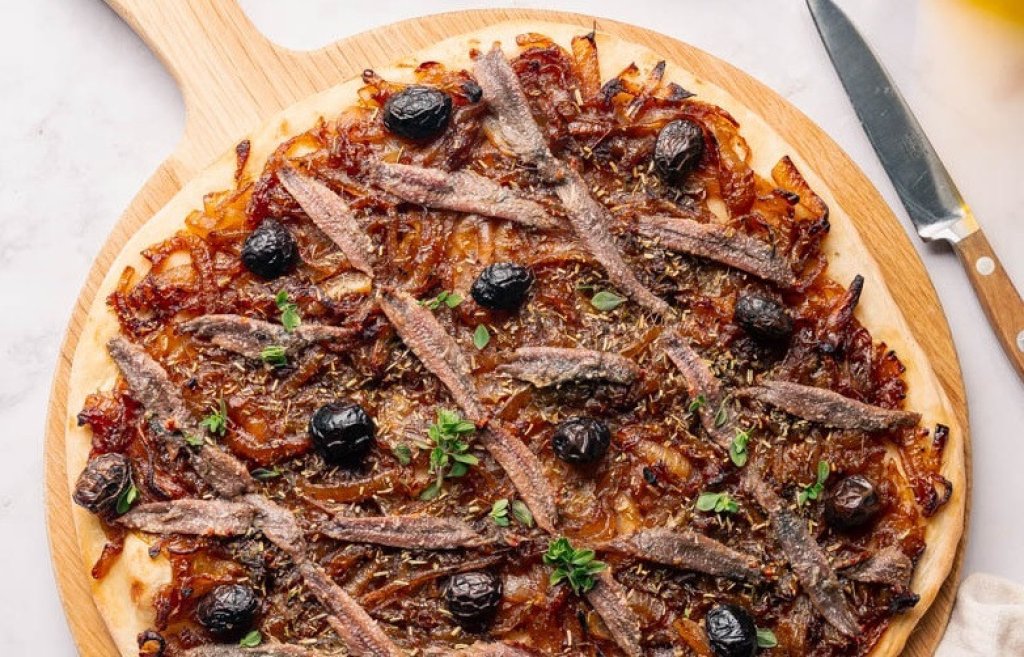
The pissaladière looks, before you taste it, like a pizza that forgot to add the cheese and put anchovies where the tomato should be. This is approximately the correct framework for understanding it except for the implication that something is missing. Nothing is missing.
The pissaladière is complete exactly as it is: the bread dough base, the layer of onions caramelised so slowly and so completely that their sharpness has entirely converted to sweetness, the grid of anchovy fillets whose saltiness is the counterpoint the sweetness requires, and the black olives pressed into the surface at the intersections of the grid. Four ingredients. The combination is not what any of them suggests individually.
The Ligurian Connection
The pissaladière is the dish that most clearly reveals the Ligurian identity of the Côte d’Azur. Nice was Nizza for most of its recorded history: an Italian-speaking city belonging to the House of Savoy until 1860, when it was transferred to France as part of the political arrangements surrounding Italian unification. The cuisine of Nice reflects this history precisely: it is not French cuisine with Italian influence, it is a Ligurian-Provençal cuisine that finds itself west of the current border, and the pissaladière is one of its clearest expressions.
The name derives from pissalat, the anchovy paste that was the original condiment of the Nice fishing community: anchovies dissolved in salt and strained through cloth to produce a thick, intensely flavoured paste that preserved the anchovy harvest for use through the year. The paste was spread on the dough before the caramelised onions, then the whole thing baked until the dough was crisp and the onions had further concentrated in the heat of the oven. The modern version uses anchovy fillets rather than the paste because the paste is no longer commercially produced, but the flavour intent remains identical.
The Onion
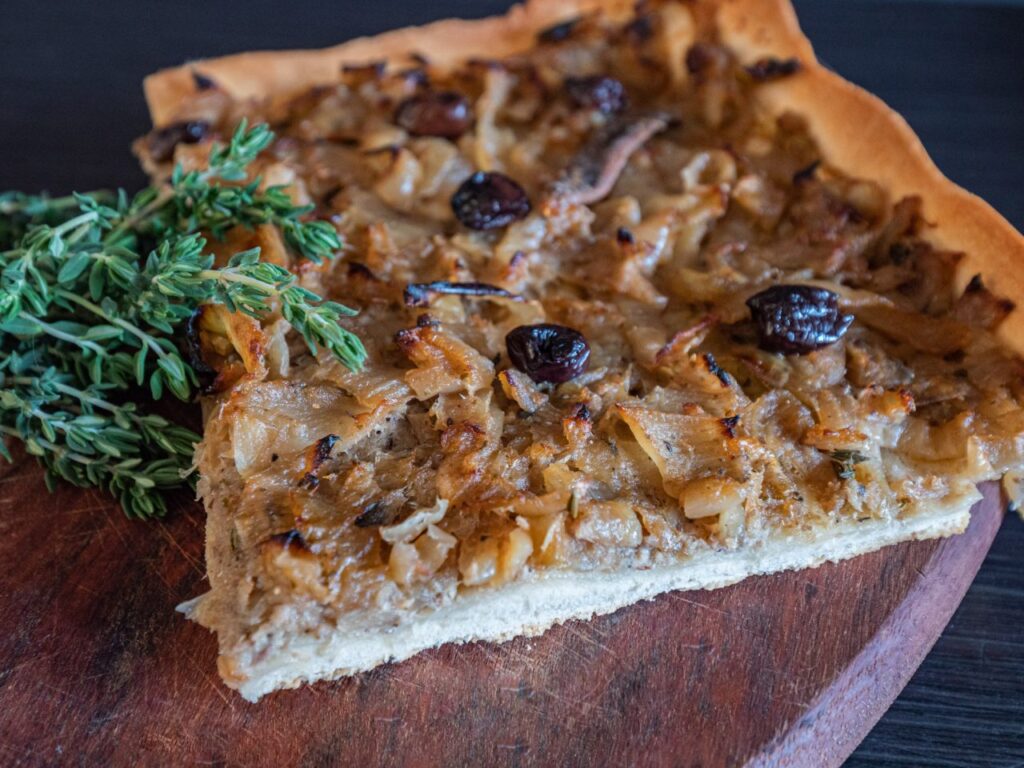
The onion is the dish. This is not hyperbole. The anchovy and the olive provide flavour and the bread provides structure, but the pissaladière is the specific result of what one to one and a half hours of slow cooking in olive oil does to a very large quantity of onions. The Maillard reaction and the caramelisation of the onion’s sugars, proceeding slowly over low heat, convert the sharp, sulphurous, tear-inducing raw onion into something dark and sweet and intensely savoury that bears almost no resemblance in flavour to its starting point.
The quantity of onions required is always more than seems reasonable: a proper pissaladière uses two to three kilograms of raw onion to produce a thin layer of caramelised onion across a standard baking sheet, because the onions lose seventy to eighty percent of their volume during cooking. The time cannot be shortened without losing the depth of caramelisation that the recipe requires. The pissaladière is a dish that teaches patience through its production and rewards the patience completely in the eating.
Why You Will Find It Aboard
The pissaladière is one of the few complex preparations that works aboard a moving boat, because all the labour is in the advance preparation and the baking is passive. On Naora it appears when the route is on the Côte d’Azur or the Ligurian coast, made from the onions from the market in Nice or Menton or San Remo and the anchovies from the Ligurian producers whose salted fillets are among the finest available anywhere in the Mediterranean. It comes out of the oven at the aperitif hour, cut into squares and served warm, and it is one of those dishes that creates a specific silence in the people eating it: the silence of someone concentrating on what is in their mouth rather than on what they were saying.