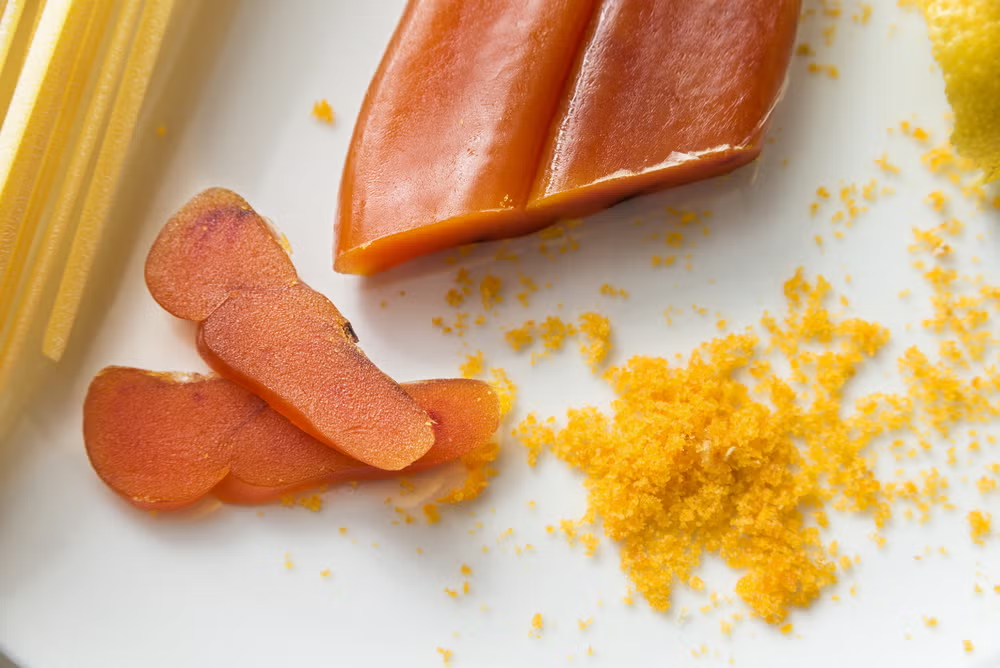
Bottarga is the pressed and dried roe sac of the grey mullet, cured in salt and dried in the air until it reaches the amber, waxy consistency that allows it to be grated over food in the way that a hard cheese is grated: in thin shavings that dissolve into the heat of whatever they land on and release a flavour that is intensely, specifically, irreducibly of the sea.
This description does not convey the experience of bottarga to someone who has not eaten it, which is the specific challenge of writing about ingredients whose character is primarily olfactory and gustatory rather than conceptual. The flavour of bottarga is not the flavour of fish roe as most people understand it: not the bright, fresh, delicate flavour of fresh roe, and not the strong preserved flavour of commercial caviar. It is something else entirely: deep, saline, umami in the specific sense of the word before umami became a marketing term, with an aftertaste that persists for minutes and that deepens rather than diminishes with time.
The Phoenician Origin
The Phoenicians brought the technique of curing fish roe to Sardinia approximately three thousand years ago, as part of the commercial and cultural exchange that accompanied their establishment of trading posts along the western Mediterranean coast. The grey mullet population of the Sardinian lagoons, particularly the lagoons at Cabras and at Santa Giusta near Oristano on the western coast of the island, provided the raw material. The salt from the Sardinian saltpans provided the preservative. The dry Mediterranean air and the wind off the sea provided the drying conditions.
The production has not changed in its essentials across three thousand years. The roe sac is removed from the female grey mullet at the moment of spawning, when the roe is fully developed but the sac has not yet ruptured. It is cleaned, pressed gently to remove air pockets, salted, pressed under weight for approximately a month, and then hung to dry in the air for a further month or more. The result is a product that has been transformed by time and salt and air from something perishable into something that will last for months and that concentrates in each gram the flavour of many kilograms of the raw material.
How to Use It
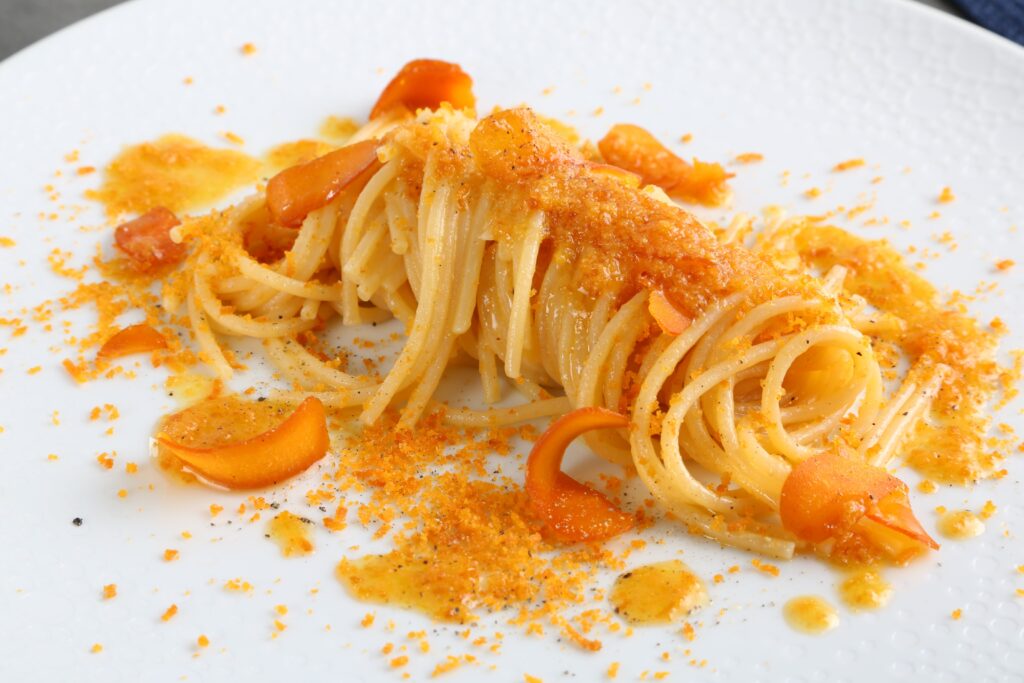
The simplest use of bottarga is also the best use of bottarga. Spaghetti, cooked to precisely al dente, drained and tossed with good olive oil and a generous amount of grated bottarga and a small amount of lemon zest and nothing else. The heat of the pasta dissolves the bottarga shavings and the pasta water emulsifies the olive oil around them and the result is a dish that is ready in fifteen minutes and that tastes like an elaborate production because the bottarga is doing almost all the work and the pasta is providing the vehicle for it.
On Naora, a piece of bottarga from the Cabras producers travels with the boat through the Sardinian chapter and beyond. It grates over the fresh pasta that the chef makes when the passage schedule allows the time. It shaves over scrambled eggs on a slow anchor morning, where it transforms a simple breakfast into something that justifies eating slowly and with attention. It appears on bruschetta with good olive oil and a squeeze of lemon when the aperitif arrives at four o’clock and the bay is the right shade of blue and the conversation has reached the quality that the bottarga deserves to accompany.
Why It Is Expensive and Worth It
A good Sardinian bottarga costs between one hundred and two hundred euros per kilogram, which positions it alongside the finest cheeses and the rarest spices in the category of luxury ingredients. The price reflects the cost of the raw material (the grey mullet at spawning is not abundant), the manual labour of the production (each roe sac is handled individually throughout the process), and the loss of weight during drying (the finished product weighs approximately half what the fresh roe sac weighed). It also reflects scarcity: the genuine Sardinian product from the Cabras lagoon is limited in quantity and the imitations from other countries and other fish species are readily available and uniformly inferior.
A kilogram of bottarga, used with the restraint that its flavour intensity demands, produces many meals. Used correctly, grated sparingly over simple preparations, it elevates each one to something that could not have been achieved with any other ingredient at any price. This is the specific economy of great ingredients: they are expensive per unit and cheap per outcome, because a small amount of the right thing does more than a large amount of anything else.