The sea is not always flat. This is the most important thing to understand about offshore sailing and the thing that most people who have not been offshore do not fully account for when they imagine it. The brochure photographs are flat water. The social media posts are flat water. The reality of a five-year circumnavigation includes conditions from glassy calm to Force 7, and the quality of life aboard the Eighty2 varies with those conditions in specific ways that are worth understanding before you board rather than discovering after.
This article is about what the boat actually feels like in different sea states, what changes and what does not, and why the conditions that most people imagine when they think about rough seas are considerably less frequent and considerably less dramatic than the imagination suggests.
Beaufort 1-3: What Most of the Route Feels Like
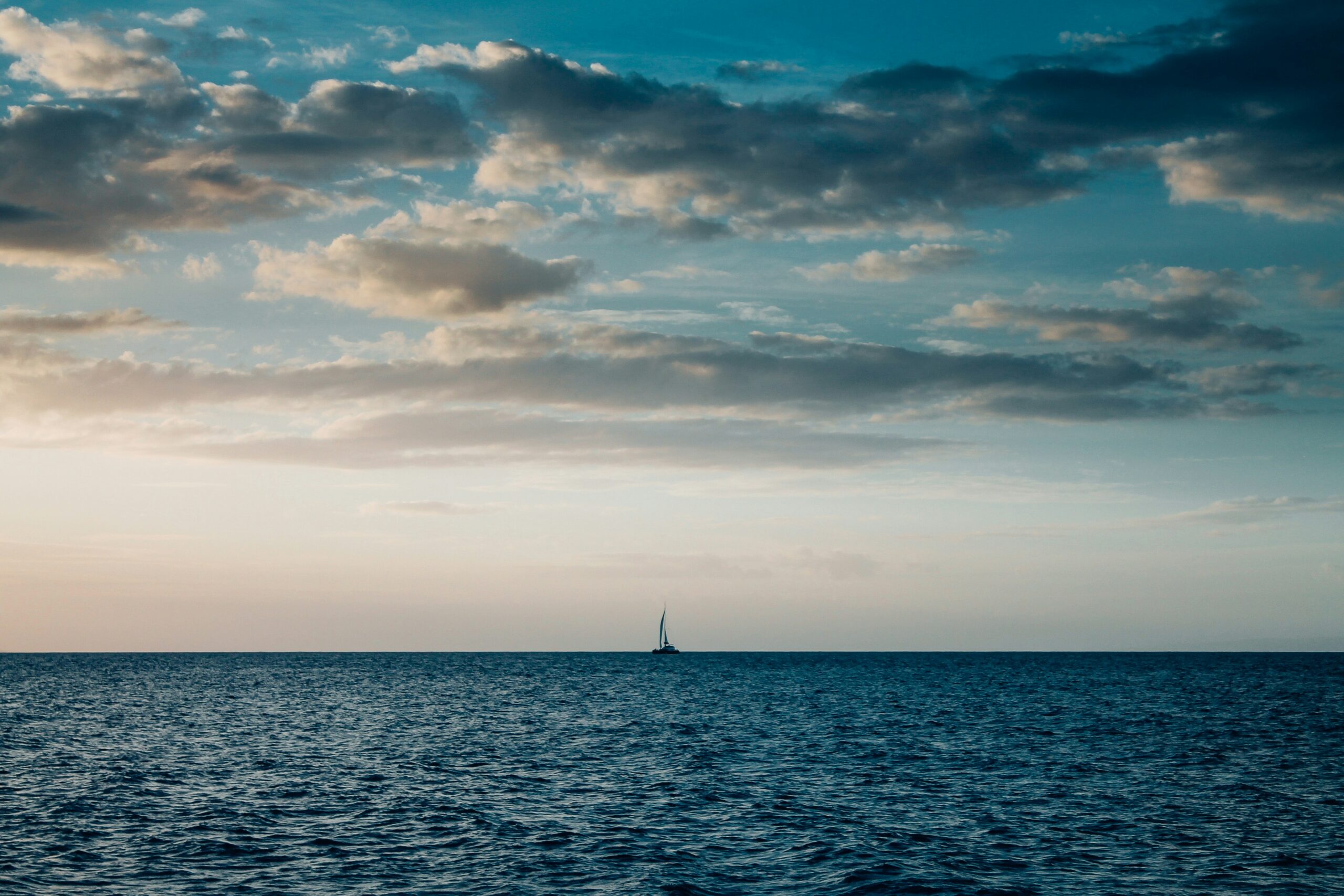
The majority of the Naora route is sailed in conditions between Beaufort 1 and Beaufort 3: light to gentle breezes producing a slight to moderate sea with wave heights of half a metre to a metre. In these conditions the Eighty2 is so stable that the landward comparison is closer to a slow train than to anything most people would call a boat. The surfaces are level. The coffee cup stays where you put it. Walking from the salon to the afterdeck requires no particular attention to balance. Cooking in the galley is a normal activity.
The Mediterranean summer and the trade wind belt of the Atlantic and Pacific, which together account for the majority of sailing time on the route, produce this character of conditions most consistently. The trade winds are steady and moderate, the swell is regular and predictable, and the boat moves through them with a specific and pleasant rhythm that most members find deeply restorative rather than challenging. This is the offshore sailing that the voyage is designed around: consistent, comfortable, and sufficiently engaging to be interesting without being demanding enough to be stressful.
Beaufort 4-5: Proper Sailing Conditions
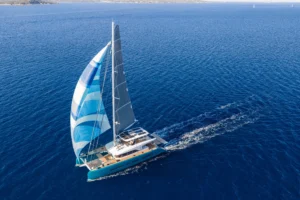
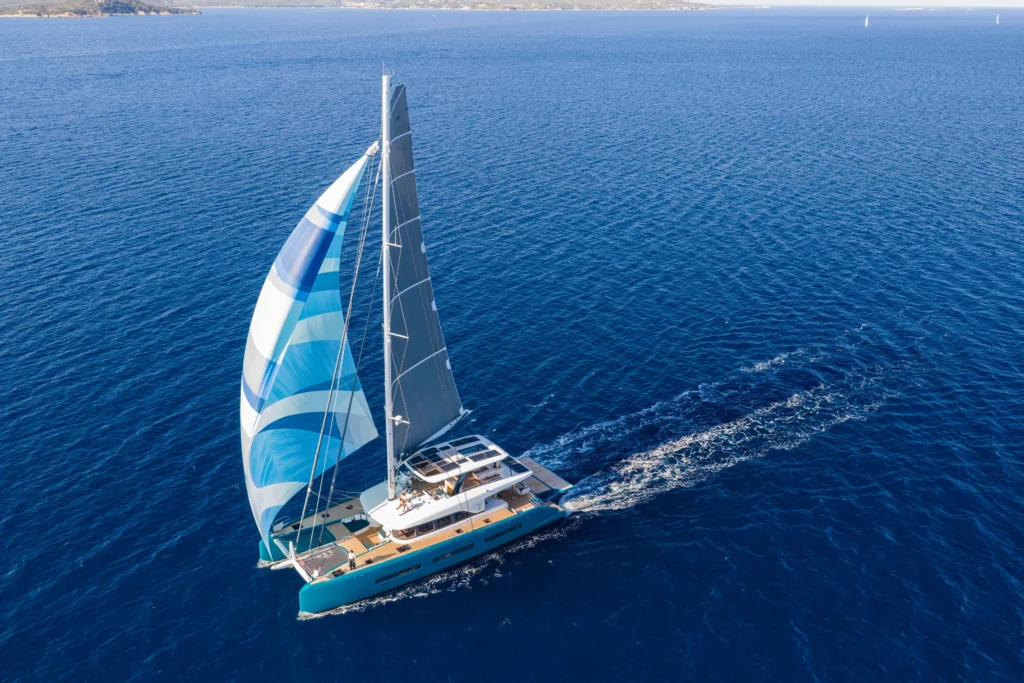
A fresh breeze at Beaufort 4 to 5, 11 to 21 knots, with waves of one to two and a half metres, is what sailors mean when they say proper sailing conditions. The Eighty2 in these conditions is moving well: 8 to 10 knots over ground, the sails full and drawing, the bow wave audible from the afterdeck and visible from the flybridge as a white line extending back from the bows. The motion is present but entirely manageable: a slight lean into the wind on a reach, a rolling following motion if the swell is behind us.
In these conditions, life aboard changes slightly but remains entirely functional. Cooking requires a little more attention to what is on the stove. Walking through the boat is done with a hand on whatever is convenient. The afterdeck table is used for meals only if the conditions and the point of sail allow it comfortably; otherwise the salon serves as the meal location. Sleep is easier than it might appear from the description: the consistent motion of a well-found boat in a steady breeze is one of the most reliable sleep inducers available, and the motion that seems challenging from the outside is, for the person in their berth, simply the rhythm of the sea.
Beaufort 6-7: When the Boat Goes to Work
A strong breeze at Beaufort 6, 22 to 27 knots, with waves of 2.5 to 4 metres, is the upper end of conditions that the Naora route encounters with any regularity. The Mediterranean Meltemi can produce these conditions persistently in the Aegean in summer. The North Atlantic in December can produce them on the approach to the Canaries. The Southern Ocean approaches produce them routinely, which is why the route does not go to the Southern Ocean.
In Force 6 the boat is reefed: the sail area is reduced to manage the increased wind load, the boat is sailed conservatively, and the watch pays close attention to conditions and the instruments. This is not frightening. It is the boat doing what it was built to do in conditions that require it. The Eighty2’s stability means that Force 6 on this vessel is a very different experience to Force 6 on a 35-foot monohull: the motion is larger than in lighter conditions but the boat is not heeled uncomfortably, not crashing through seas, not producing the violent motion that smaller and less stable vessels generate in these conditions.
Life aboard in Force 6 is simplified rather than stopped: meals in the salon rather than on the afterdeck, movement through the boat with both hands available, activities that don’t require fine motor precision. Most members who have been in Force 6 conditions on the Eighty2 describe them as more dramatic from the sound than from the motion: the wind in the rigging is loud, the bow wave is loud, and the conditions feel more intense than they physically are. By the second Force 6 passage, most people have calibrated to the difference between what it sounds like and what it requires of them, which is much less than the sound suggests.
| Beaufort | Wind speed | Wave height | What it feels like aboard | Life aboard |
|---|---|---|---|---|
| 1–3 | 1–10 knots | 0–1 metre | Train-like stability, coffee cup stays where you put it | Entirely normal, all activities available |
| 4–5 | 11–21 knots | 1–2.5 metres | Proper sailing, slight lean or roll, clearly moving | Normal with minor adaptations: hand on rail walking, salon meals if conditions warrant |
| 6–7 | 22–33 knots | 2.5–5 metres | Reefed, focused, loud. More dramatic from sound than from motion | Simplified: salon meals, two-handed movement, calm activities. Not stopped |